As the world transitions toward a decarbonized power grid, the scale of renewable energy infrastructure has reached unprecedented levels. As of March 2026, global solar and wind capacity has surpassed several terawatts, presenting a massive logistical challenge: how do we maintain millions of decentralized assets spread across some of the planet’s harshest environments? The answer lies in Renewable Energy Robotics.
Renewable energy robotics refers to the integration of autonomous or semi-autonomous machines designed to inspect, clean, and repair solar photovoltaic (PV) arrays and wind turbines. These systems leverage Artificial Intelligence (AI), advanced sensors like LiDAR, and specialized mechanical engineering to replace or augment human labor in dangerous, repetitive, or high-precision tasks.
Key Takeaways
- Efficiency: Robotic cleaning can increase solar energy output by up to 30% by eliminating “soiling” (dust/dirt).
- Safety: Drones and crawlers eliminate the need for technicians to climb 100-meter turbines or work in extreme desert heat.
- Cost Reduction: Automated Operations and Maintenance (O&M) can reduce long-term costs by 20–40%.
- Predictive Power: AI-driven robotics catch structural micro-cracks before they lead to catastrophic failure.
Who This Is For
This guide is designed for renewable energy asset managers, O&M technicians, clean-tech investors, and engineering students who need a deep dive into the practical application of robotics in the field. Whether you are managing a 500MW solar farm in the Mojave or an offshore wind cluster in the North Sea, understanding these tools is no longer optional—it is a competitive necessity.
The Critical Need for Automation in Green Energy
The “Green Rush” has created a scale problem. In the early 2000s, a solar farm might have consisted of a few thousand panels. Today, utility-scale sites house millions. Similarly, wind turbines have grown in both height and rotor diameter, with some offshore blades now exceeding 100 meters in length.
Human technicians simply cannot keep up. Manual inspection of a wind turbine blade involves “rope access”—technicians dangling hundreds of feet in the air, often in high-wind conditions. It is slow, dangerous, and expensive. For solar farms, manual cleaning requires millions of gallons of water and thousands of man-hours, often in water-stressed regions.
Robotics solves the “Triple Constraint” of energy maintenance:
- Water Scarcity: Modern solar robots use “dry cleaning” brush technology.
- Labor Shortage: Automation fills the gap in a tightening global labor market.
- Data Fidelity: A robot provides a digital twin of every asset, something a human with a clipboard cannot achieve.
Solar Farm Maintenance: The Robotic Revolution
Solar panels are deceptively low-maintenance, but their efficiency is hyper-sensitive to the environment. The primary enemy is soiling—the accumulation of dust, bird droppings, pollen, and industrial pollutants. In desert regions, soiling can reduce power output by 1% per day if left untreated.
1. Automated Cleaning Systems
There are three primary categories of solar robots used in 2026:
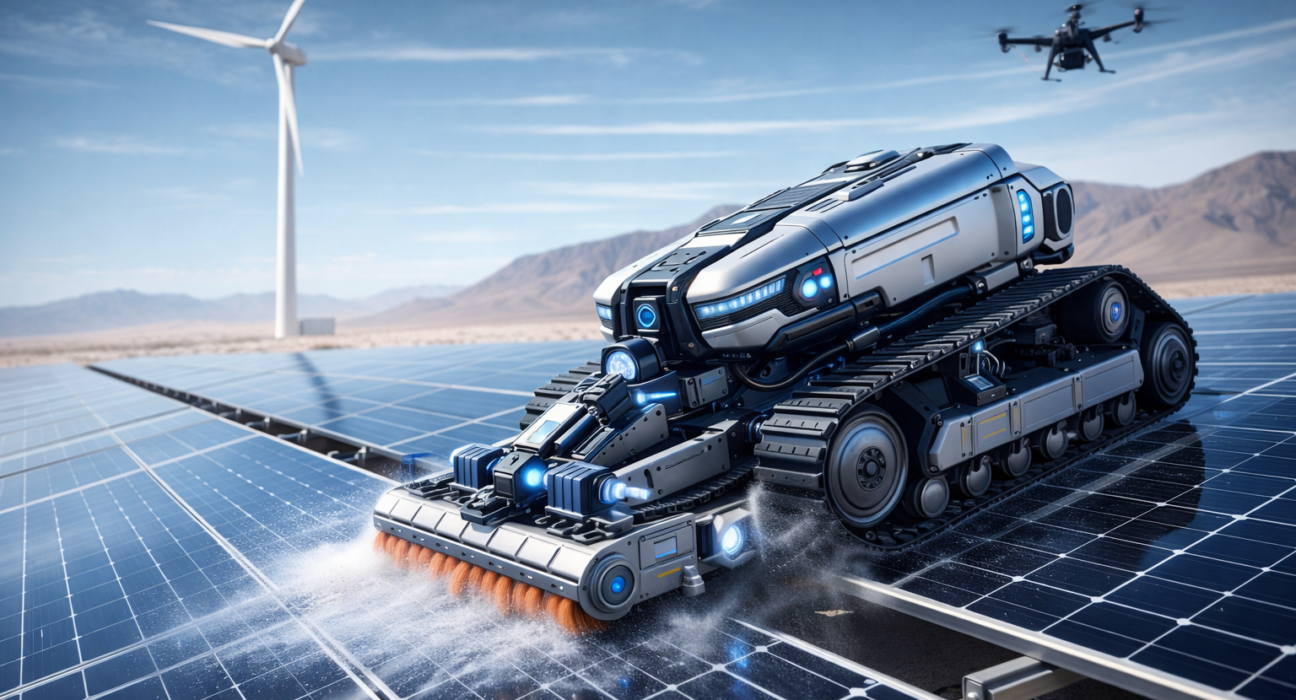
- Row-Integrated Robots: These are permanent fixtures on the solar mounting rails. They travel back and forth daily, usually powered by their own small onboard solar panel.
- Example: Systems like those from Ecoppia use microfiber brushes and airflow to remove 99% of dust without using a drop of water.
- Semi-Autonomous Portable Robots: These are brought to the site by a small crew, placed on a row, and left to clean. They are ideal for older sites not designed with robotic rails in mind.
- Truck-Mounted Robotic Arms: For sites with wide access roads, large robotic brushes mounted on vehicles can clean panels at high speeds using computer vision to adjust the brush pressure.
2. Thermal Inspection and “Health Checks”
A cracked cell or a faulty “bypass diode” doesn’t just reduce power; it creates a “hot spot” that can lead to a fire.
- Drone Thermography: Drones equipped with FLIR (Forward Looking Infrared) cameras fly over miles of panels in minutes. AI algorithms then process the thermal maps to identify “thermal anomalies” that are invisible to the naked eye.
- The Benefit: Identifying a $50 part failure today prevents a $50,000 inverter fire tomorrow.
Common Mistakes in Solar Robotics
- Ignoring Glass Abrasion: Using the wrong brush material can cause micro-scratches on the panel glass, which permanently reduces light transmission.
- Underestimating Topography: Robots designed for flat ground often fail or tip over on “tracker” systems located on rolling hills.
- Data Overload: Collecting 10,000 infrared photos is useless if you don’t have an AI pipeline to turn those photos into a “To-Do” list for technicians.
Wind Farm Maintenance: Scaling New Heights
Wind turbines operate in high-stress environments. Every rotation subjects the blades to centrifugal force, UV radiation, and “leading-edge erosion” from rain and insects.
1. Aerial Inspection Drones
Until recently, wind turbine inspection required stopping the turbine for a full day. Today, autonomous drones can perform a “stop-and-stare” inspection in 15 to 20 minutes.
- Autonomous Path Planning: The drone uses LiDAR to “see” the turbine and automatically calculates a flight path that keeps it exactly 5 meters from the blade, regardless of wind gusts.
- Internal Inspection: Tiny, cage-protected drones (like the Elios series) can fly inside the dark, cramped hollows of the blades to look for internal structural delamination.
2. Blade Repair Robots
Inspection is only half the battle. If a drone finds a crack, someone has to fix it.
- The Crawler Revolution: Robotic crawlers use vacuum suction or magnetic wheels to “climb” the tower and crawl onto the blade. Once positioned, they can grind away damaged fiberglass, apply resin, and cure it with UV light—all controlled remotely by a technician on the ground.
- Leading Edge Protection (LEP): Specialized robots are now being used to apply protective coatings to the edges of blades, extending their lifespan by 5–10 years.
3. Offshore Wind and Subsea Robotics
Offshore wind is the “final boss” of renewable maintenance.
- AUVs and ROVs: Remotely Operated Vehicles (ROVs) and Autonomous Underwater Vehicles (AUVs) are used to inspect the “monopile” (the part of the turbine underwater) for corrosion and “scour” (erosion of the seabed).
- Subsea Cable Crawlers: These robots track the buried high-voltage cables that bring power to shore, ensuring they haven’t been uncovered by currents or snagged by fishing anchors.
The Software Brain: AI and Digital Twins
A robot is merely a “hand.” The “brain” is the software that manages it. In 2026, the industry has moved toward Predictive Maintenance.
Computer Vision (CV)
When a drone takes a photo of a wind turbine, it isn’t just a picture. A CV model compares that image against a database of millions of known defects. It can distinguish between a harmless bird dropping and a structural lightning strike.
Digital Twins
Every time a robot inspects a solar farm or wind turbine, it updates a “Digital Twin”—a virtual 3D model of the physical asset. By comparing the digital twin’s state over time, engineers can predict exactly when a component will fail.
- As of March 2026: Digital twin integration has reduced “unplanned downtime” in offshore wind by 15% globally.
Safety First: A Mandatory Disclaimer
Safety Warning: The maintenance of solar and wind infrastructure involves high-voltage electricity (up to 1,500V DC for solar and 66kV+ for wind), extreme heights, and heavy machinery. While robotics reduce human exposure to these risks, they do not eliminate them. All robotic operations must be conducted by certified professionals in accordance with local regulations (such as OSHA in the US or GWO standards globally). Never attempt to manually intervene with an active robotic system without following “Lockout/Tagout” (LOTO) procedures.
Economic Impact and ROI
Why spend $500,000 on a robotic fleet? The math is surprisingly simple when looking at the Levelized Cost of Energy (LCOE).
| Metric | Manual Method | Robotic Method |
| Inspection Time | 4–6 hours per turbine | 15–30 mins per turbine |
| Solar Cleaning | Requires 1–2 liters water/panel | 0 liters (dry brush) |
| Safety Risk | High (Rope access/Heat) | Low (Ground-based) |
| Data Accuracy | Subjective (Human eye) | Objective (Sensors/AI) |
| Cost per MW | $2,000–$5,000 | $800–$1,500 |
Labor Transition
A common concern is that robots will “steal” jobs. However, the renewable sector is facing a massive labor shortage. Robots allow existing technicians to stop doing the “dirty, dull, and dangerous” work and instead become Robot Fleet Managers. One technician who used to clean 100 panels a day can now oversee a fleet of robots cleaning 10,000.
Implementing Robotics: A Step-by-Step Guide
If you are an asset manager looking to integrate robotics, follow this roadmap:
Phase 1: The Site Audit
Not every site is “robot-ready.”
- For Solar: Measure the gap between rows. Is it consistent? Are there obstacles like junction boxes blocking the path?
- For Wind: Check your connectivity. Many autonomous drones require a local 5G or Starlink connection to upload high-res data for real-time processing.
Phase 2: Pilot Testing
Start with a “POC” (Proof of Concept).
- Deploy one robot on your most “soiled” row of solar panels.
- Compare the energy yield of that row against a control row for 30 days.
Phase 3: Full Integration and Training
Robots are not “set and forget.”
- Training: Your ground crew must be trained in basic robot maintenance (changing brushes, clearing sensor errors).
- Data Silos: Ensure your robotic data integrates with your SCADA (Supervisory Control and Data Acquisition) system.
Future Trends (2027 and Beyond)
The next frontier for renewable energy robotics involves two major shifts:
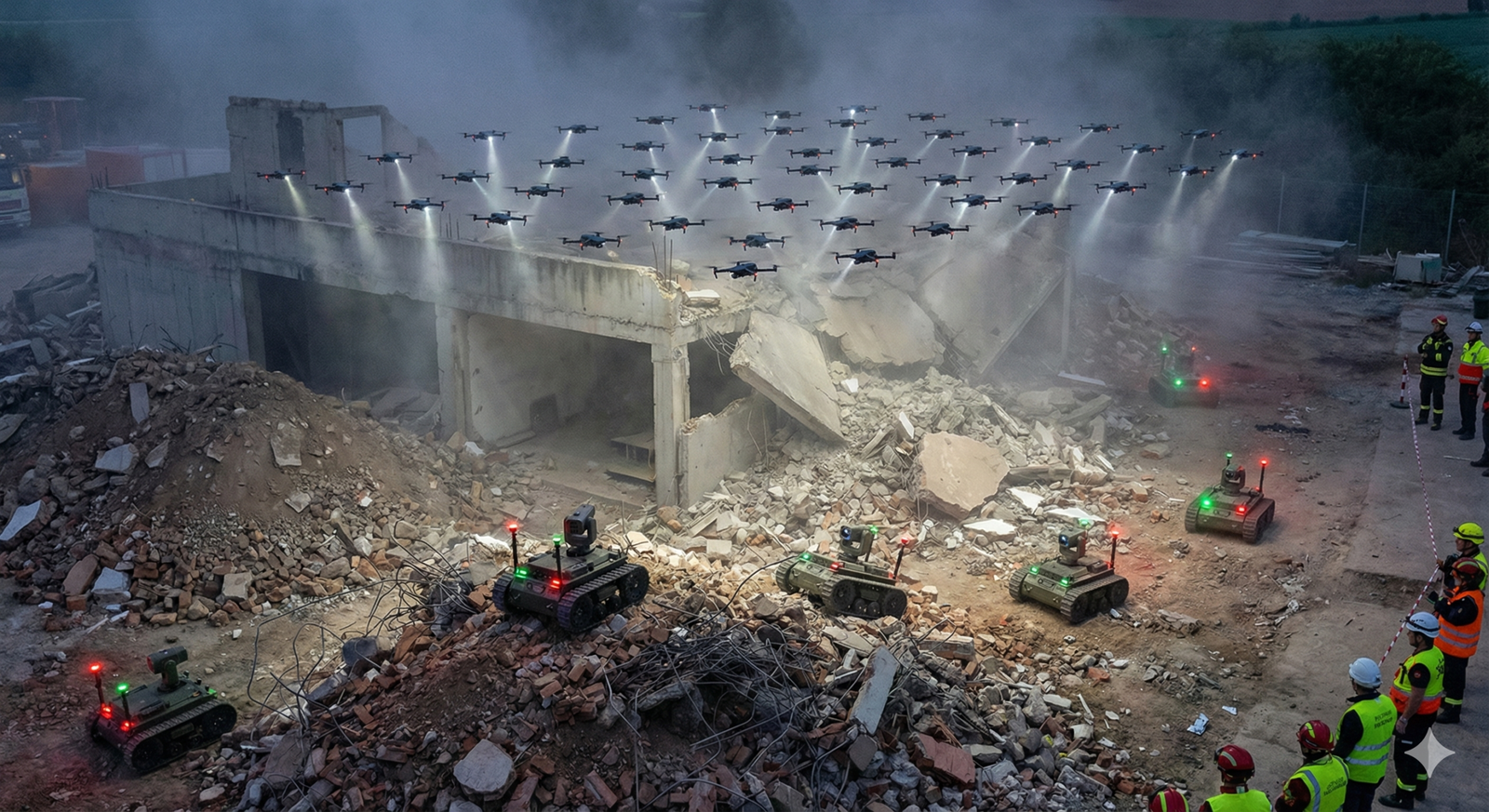
- Swarm Robotics: Instead of one large, expensive robot, a “swarm” of 50 small, low-cost robots will work together to clean a solar farm. If one breaks, the others continue, making the system “fault-tolerant.”
- Self-Healing Materials: Researchers are developing robotic systems that don’t just find cracks but “inject” self-healing polymers into blades during the inspection flight itself.
- In-Situ Hydrogen Maintenance: As wind farms begin to produce green hydrogen directly at the turbine, new classes of “Ex-rated” (explosion-proof) robots will be required to monitor high-pressure hydrogen tanks.
Conclusion
The marriage of robotics and renewable energy is no longer a futuristic concept; it is the backbone of the modern energy transition. As we move through 2026, the scale of our climate goals demands that we abandon manual, inefficient maintenance processes in favor of precision automation.
By adopting these technologies, we do more than just save money. We ensure that our green infrastructure is resilient, that our technicians are safe, and that every ray of sunlight and every gust of wind is converted into electricity with maximum efficiency. The “human-first” approach to this transition isn’t about choosing between people and machines—it’s about using machines to empower people to do more meaningful, safer work.
Next Step: I recommend conducting a “soiling analysis” or a drone-based thermal audit of your current assets. This data will provide the baseline ROI you need to justify a robotic investment.
FAQs
1. Can solar cleaning robots damage the panels?
If designed correctly, no. High-quality robots use specialized soft-bristle brushes or “air-knives” that exert less pressure than a human manual cleaner. However, using uncertified or “DIY” robotic solutions can lead to micro-cracks or scratches on the anti-reflective coating. Always ensure the robot is certified by the panel manufacturer.
2. Do drones work for offshore wind farms in high winds?
Most industrial-grade drones (like the DJI M350 RTK or specialized wind-bots) can operate in winds up to 12–15 meters per second. However, offshore conditions often exceed this. In these cases, “crawlers” that remain attached to the turbine are a more reliable option than free-flying drones.
3. How much water do robotic cleaners save?
Most modern utility-scale solar robots are “waterless.” In a typical 100MW desert solar plant, switching from manual wet-cleaning to robotic dry-cleaning can save upwards of 5 million gallons of water annually.
4. Are these robots fully autonomous?
It varies. Most solar cleaning robots are fully autonomous—they wake up, clean, and return to their docks. Wind turbine drones are currently “semi-autonomous”; they fly the path themselves, but a human pilot must be present to monitor the flight and take over if an emergency occurs (per current FAA/EASA regulations).
5. What is the typical ROI for a robotic maintenance system?
For solar farms in high-soiling areas, the ROI is often achieved in less than 18 months through increased energy yield. For wind turbines, the ROI is usually measured in “risk reduction” and “uptime,” often paying for itself within 2 years by preventing a single major blade failure.
References
- International Energy Agency (IEA): Renewables 2025/2026 Analysis and Forecasts. (Official projections for capacity growth).
- NREL (National Renewable Energy Laboratory): The Impact of Soiling on PV System Performance. (Technical study on energy loss).
- IEEE Robotics & Automation Society: Applications of Robotics in the Power Industry. (Peer-reviewed engineering papers).
- Global Wind Organisation (GWO): Safety Standards for Wind Turbine Maintenance. (Safety protocols).
- IRENA (International Renewable Energy Agency): Innovation Outlook: Smart Grids and AI. (Digital twin and AI integration).
- Solar Power World: 2026 Guide to Robotic O&M. (Industry trends).
- Journal of Wind Engineering and Industrial Aerodynamics: Leading Edge Erosion of Wind Turbine Blades. (Scientific breakdown of blade damage).
- U.S. Department of Energy (DOE): Solar Energy Technologies Office (SETO) Reports. (Government funding and research data).
- DNV: Offshore Wind Service and Maintenance Standards. (Certifications for offshore robotics).
- Scientific American: Why Drones are the Future of Green Energy. (General tech analysis).