
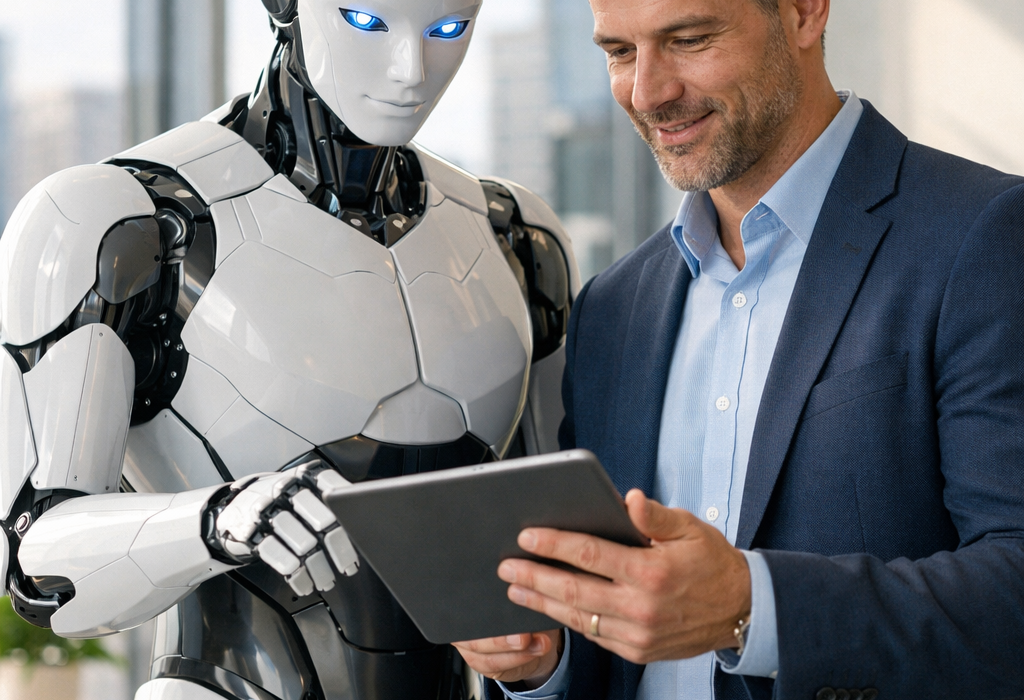
As of March 2026, the office cubicle looks drastically different than it did just two years ago. The “Robotic Coworker” has officially transitioned from a science-fiction trope into a functional, billable member of the modern workforce. While automation has been a part of industrial life for decades, 2026 marks the specific inflection point where Physical AI met general-purpose mobility, allowing robots to step out of their safety cages and into our shared human workspaces.
This shift isn’t just about replacing repetitive tasks; it’s about the emergence of a new category of employee. The robotic coworker of 2026 is a multi-modal, agentic entity capable of understanding natural language, navigating complex human environments, and learning new tasks on the fly through simulation-to-reality (Sim2Real) transfer.
Key Takeaways for 2026
- Mass Deployment: Major players like Tesla and Figure have moved from pilot programs to mass-scale production of humanoid units.
- The RaaS Revolution: Robot-as-a-Service (RaaS) has lowered the entry barrier, allowing small-to-medium enterprises (SMEs) to “hire” robots on a monthly subscription basis.
- VLA Models: The integration of Vision-Language-Action (VLA) models allows robots to reason through tasks like a human would, rather than following rigid pre-set code.
- Safety Compliance: New certifications like UL 3300 and the implementation of the EU AI Act have provided the legal safety net needed for widespread adoption.
Who This Is For
This guide is designed for business leaders looking to integrate automation without destroying company culture, HR professionals navigating the new “hybrid-biological” workforce, and employees who want to understand how to leverage these machines to enhance their own career trajectories.
The Definition of a Robotic Coworker
Before we dive into why 2026 is the year of change, we must define what a robotic coworker actually is. Unlike the “dumb” industrial arms of the 2010s, a robotic coworker (or “cobot” in its evolved form) is defined by three pillars:
- Embodied Intelligence: It possesses a physical form (often humanoid or quadruped) that can navigate human-designed spaces (stairs, narrow hallways, elevators).
- Semantic Understanding: You don’t program it with Python; you talk to it. Thanks to 2026-era Large Behavior Models (LBMs), these units can interpret a command like “Go find the late shipment and bring it to Sarah in Marketing” without further instruction.
- Collaborative Safety: It uses advanced haptic sensors and vision-based “spatial awareness” to slow down or change its gait when a human is nearby, ensuring a zero-harm environment.
1. The Technological Leap: From LLMs to VLAs
The primary reason 2026 has become the “Year of the Robotic Coworker” is the maturation of Vision-Language-Action (VLA) models. In early 2024, AI was largely trapped in a box (your screen). In 2026, the “brain” has finally been successfully fused with the “body.”
The “Nervous System” of 2026 Robotics
Companies like NVIDIA, with their Isaac GR00T N1 architecture, have provided a foundational model that acts as a universal operating system for robotics. This allows a robot produced in a factory in Germany to “know” how to pick up a coffee cup or open a door in an office in New York without specific training for that exact environment.
The Rise of General-Purpose Humanoids
As of March 2026, we have seen the following milestones:
- Tesla Optimus Gen 3: Now in mass production, these units are being used internally at Tesla and sold to Tier-1 logistics partners.
- Figure 02 & 03: Currently deployed in BMW’s Spartanburg plant, these robots handle complex sub-assembly tasks that were previously thought “un-automatable.”
- 1X Technologies: Their “Neo” robot is being deployed in residential and light-office settings, specializing in “soft” tasks like laundry, organization, and basic reception.
2. Industry-Specific Transformations
The robotic coworker is not a one-size-fits-all solution. In 2026, we are seeing specialized “personas” emerge across different sectors.
Healthcare: The “Nurse’s Shadow”
In hospitals, robotic coworkers like those from Moxi by Diligent Robotics have become indispensable. They don’t perform surgery; they handle the “hunting and gathering.” They fetch supplies, deliver lab samples, and manage linen distribution, saving human nurses an average of 3 hours of walking time per shift.
Retail: The “Autonomous Inventory Partner”
Retail giants like Walmart and Carrefour are now using shelf-scanning robots (like Simbe’s Tally) that are fully UL 3300 certified. These robots work alongside shoppers, identifying out-of-stock items in real-time. By March 2026, these units have been upgraded to “fixer” roles, where they not only identify the problem but can autonomously restock lightweight items during night shifts.
The Modern Office: The “Facility Assistant”
In white-collar environments, the robotic coworker acts as a mobile concierge.
- FLAE Robotics has introduced humanoids that act as virtual receptionists with physical presence.
- They manage mailrooms, guide visitors to meeting rooms, and even monitor indoor air quality and temperature, adjusting building systems via IoT integration.
| Industry | Primary Robotic Role | Human Benefit |
| Logistics | Autonomous Sorting & Palletizing | Reduced physical strain/injuries |
| Hospitality | Physical Concierge / Cleaning | Consistent service 24/7 |
| Healthcare | Supply Retrieval / Logistics | More “bedside time” for nurses |
| Construction | Site Security / Heavy Lifting | Enhanced safety in high-risk zones |
3. The Economic Shift: Robot-as-a-Service (RaaS)
One of the biggest hurdles to robotics used to be the price tag. In 2023, a humanoid robot might cost $250,000. By 2026, the business model has flipped.
Moving from CapEx to OpEx
Most businesses now “hire” their robotic coworkers through a subscription model. For approximately $3,000 to $5,000 per month, a company can lease a fully maintained humanoid unit. This includes:
- Regular software updates (improving the robot’s “intelligence” over time).
- On-site maintenance and hardware repairs.
- Liability insurance coverage.
This shift has allowed SMEs to compete with massive corporations. A small warehouse in Ohio can now deploy three “robotic coworkers” to handle the night shift for less than the cost of a full-time human supervisor’s salary, ensuring that the human team can focus on high-value strategy during the day.
4. Psychology and Culture: Sharing the Breakroom
The most significant challenge in 2026 isn’t the technology—it’s the human element. How do people feel about sitting next to a 5-foot-8-inch robot that never blinks?
Human-Robot Interaction (HRI)
Workplace psychologists have found that “Social Robotics” is a critical field in 2026. Companies that treat robots as “tools” see lower employee morale. Companies that treat them as “teammates”—giving them names, explaining their specific duties to the staff, and involving employees in their training—see a 22% increase in productivity.
The “Uncanny Valley” and Design
In 2026, we have moved away from hyper-realistic “creepy” faces. Most robotic coworkers now feature simplified, expressive LED screens or “friendly” visors. This design choice reduces anxiety and helps humans intuitively understand the robot’s “intent” (e.g., a green light when it’s waiting for you to pass, or a downward-tilting head when it’s focused on a task).
Safety Disclaimer: While 2026 robotics are equipped with advanced collision avoidance, they are still heavy machinery. Always follow your organization’s specific “Safe Zone” guidelines and never attempt to manually override a robot’s motion sensors.
5. Navigating the Skills Gap: Upskilling for 2026
The robotic coworker doesn’t just replace jobs; it changes them. If a robot is doing the filing, the human needs to be doing the managing.
New Roles Created by the Robotic Influx
- Robot Operations Manager (ROM): A role focused on scheduling robot shifts, monitoring battery health, and managing software “skill” updates.
- Interaction Designer: Professionals who specialize in how humans and robots communicate within a specific workflow.
- Sim2Real Engineer: Specialized tech roles that help “teach” the company’s specific environment to the robot’s cloud-based brain.
Soft Skills are the New Hard Skills
As robots take over the “quantifiable” tasks, the value of human “unquantifiables” has skyrocketed. Empathy, complex negotiation, creative problem-solving, and ethical judgment are the primary focuses of corporate training in March 2026.
6. The Legal and Regulatory Landscape
As of March 2026, the wild west of robotics is closing. Two major frameworks now govern how your robotic coworker can behave.
The EU AI Act (Full Implementation)
The EU’s landmark legislation now classifies general-purpose robotics as “High-Risk” in certain contexts. This requires:
- Transparency: Employees must be informed when they are interacting with an AI-driven robot.
- Human Oversight: Every robot must have a “kill switch” and a human responsible for its actions (the “Deployer”).
- Data Privacy: Robots cannot record audio or video in private spaces (like restrooms or sensitive boardrooms) without strict encryption and compliance auditing.
US OSHA Updates (2026)
OSHA has officially integrated the ANSI/A3 R15.06-2025 standard into its enforcement. This means that if you deploy a robot that doesn’t meet specific “Collaborative Safety” ratings, you face significant fines. The good news? March 2026 saw the first “Robotic Workplace Safety Certificate” program, which provides tax incentives for companies that meet high safety standards.
7. Common Mistakes in Robotic Integration
Despite the excitement, many companies are failing their “Robot Integration” phase. Here are the pitfalls to avoid as of 2026:
Over-Automation
The “Tesla Mistake” of the late 2010s is being repeated by some. Automating every single movement leads to “brittleness.” If the WiFi goes down or a floor is wet, a fully automated office can grind to a halt. The 2026 Best Practice: Use a 70/30 split—70% robotic assistance, 30% human adaptability.
Ignoring the “Culture Shock”
Dropping a humanoid robot into an office on a Monday morning without prior warning is a recipe for disaster. It breeds resentment and “sabotage by neglect” (where humans won’t help a robot that is stuck).
- The Fix: Hold “Town Halls” where the robot’s capabilities and—more importantly—its limitations are demonstrated.
Underestimating the Data Burden
A robotic coworker generates roughly 2 terabytes of data per day through its sensors. Many companies aren’t prepared for the cloud storage costs or the cybersecurity risks involved.
- The Fix: Invest in “Edge Computing” solutions where the robot processes its vision locally and only sends critical data to the cloud.
How to Implement Your First Robotic Coworker
If you are reading this in 2026 and haven’t started your journey, you are behind—but not out. Follow this step-by-step roadmap:
Step 1: The “Digital Twin” Audit
Before buying a robot, use a platform like NVIDIA Omniverse to create a digital twin of your workspace. Simulate the robot’s paths. Does it get stuck at the kitchen threshold? Does it block the fire exit? Fix these in the virtual world first.
Step 2: Pilot a “Niche” Task
Don’t try to make the robot do everything. Pick one high-frequency, low-complexity task (e.g., “Mail Delivery” or “Floor Sanitization”).
Step 3: Identify Your “Human Champions”
Find the employees who are most excited about tech. Make them the “super-users” who train others. This creates a bottom-up adoption rather than a top-down mandate.
Step 4: Scale via RaaS
Once the pilot is successful, use the RaaS model to scale from 1 robot to 5. This keeps your cash flow healthy and ensures you always have the latest hardware.
Conclusion: The New Partnership
The year 2026 isn’t the beginning of the end for human labor; it’s the beginning of a superior partnership. The “Robotic Coworker” is the ultimate force multiplier. By offloading the dull, dirty, and dangerous to our mechanical counterparts, we are finally free to reclaim the “human” in human resources.
As we move through the remainder of 2026, the distinction between “robot” and “coworker” will continue to blur. We will stop seeing them as machines and start seeing them as the infrastructure of a productive life.
Next Step for You: Audit your weekly task list. Which 20% of your work feels like it could be done by a machine? That is where your robotic coworker will start. Would you like me to generate a “Robotics Readiness Checklist” for your specific industry to help you identify these tasks?
FAQs
Q1: Will my robotic coworker record everything I say?
A: Under 2026 privacy laws (like the EU AI Act and updated CCPA), robots are required to have “Privacy-by-Design.” Most general-purpose robots process voice commands locally and do not store audio logs unless explicitly configured for “Meeting Minutes” mode, which must be clearly signaled to everyone present via a blue light indicator.
Q2: What happens if the robot hits me?
A: 2026-grade cobots are equipped with “Force-Limiting” technology. If the robot detects a contact pressure higher than a few Newtons, it instantly cuts power to its actuators. While it might be startling, it is physically incapable of “punching” or knocking over a human under normal operating parameters.
Q3: How do I “train” a robotic coworker if I don’t know how to code?
A: You use “Kinesthetic Teaching” or “Natural Language Interaction.” You can physically move the robot’s arm to show it a path, or simply say, “Watch me do this,” and the robot uses its cameras and VLA model to mirror your actions.
Q4: Are these robots taking jobs away from humans?
A: As of early 2026, the data shows a “Job Transformation” rather than “Job Loss.” While some entry-level manual roles are declining, we are seeing a 15% increase in “Technical Support” and “Robot Oversight” roles. Most companies are using robots to fill the global labor shortage rather than replacing existing staff.
Q5: Can a robotic coworker work in a home office?
A: Yes. Companies like 1X and Apptronik have released “Home-Edition” models in 2026. These are lighter, slower, and optimized for domestic tasks like tidying and laundry, though they require a stable 6G or high-speed 5G connection for full cognitive capability.
References
- NVIDIA (January 2026). “Project GR00T: A Foundation Model for Humanoid Robots.” Official Technical Whitepaper.
- Tesla Inc. (February 2026). “Optimus Gen 3 Production & Logistics Deployment Report.” Investor Relations.
- European Parliament (2024/2026). “The AI Act: Full Implementation Guidelines for Embodied AI.” Official Journal of the EU.
- OSHA (December 2025). “Directive 29 CFR 1910.147: Safety Standards for Collaborative Robotics in the Workplace.”
- International Federation of Robotics (IFR). “World Robotics Report 2025: The Rise of General Purpose Humanoids.”
- Figure AI (2026). “Commercial Deployment of Figure 02 in Automotive Manufacturing.” Case Study Series.
- IEEE Robotics & Automation Magazine. “The Psychology of Human-Robot Collaboration in Open Office Environments.” (March 2026 Edition).
- UL Solutions (2026). “UL 3300: Standard for Service, Communication, and Information Robots.”
- Gartner (January 2026). “Strategic Technology Trends 2026: The Year of Physical AI.”
- MIT Technology Review (2026). “Why Simulation-to-Reality (Sim2Real) Solved the Robotics Problem.”
- Boston Dynamics (2026). “Atlas Electric: Bringing Humanoid Agility to the Enterprise.”
- 1X Technologies (2026). “Neo: The First Safe Android for Residential and Office Use.”