- ~75%of businesses planning to deploy AI agents by end of 2026 (Deloitte State of AI in the Enterprise)
- ~15%of IT application leaders piloting or deploying agents that require no human oversight at all
- 3typical roles in an emerging supervisor-agent pattern: data gathering, modeling, and report compilation, each handled by a separate connected agent
“Fully autonomous enterprise” is a phrase vendors reach for readily and a state almost nobody has actually built. What is real: agents that reason, plan, and execute complex multi-step workflows across different software systems without a human clicking through each step. What is not real, outside a small number of narrow pilots: an enterprise where no human reviews any consequential decision anywhere in the business. The distance between those two claims is exactly where most of the interesting engineering and governance work is happening right now.
What “fully autonomous” actually covers today
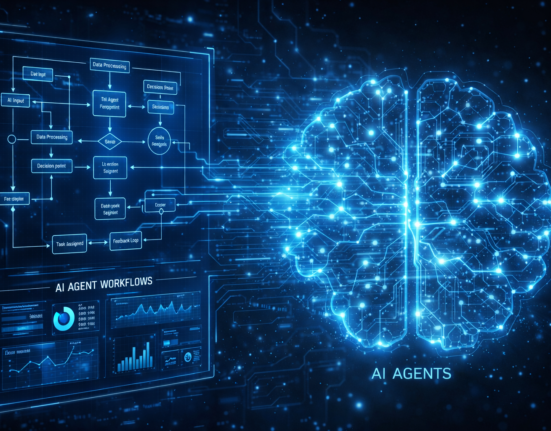
The pattern showing up in the more advanced deployments is a supervisor-agent structure: one agent assigns tasks to several connected agents, each handling a distinct piece of a larger workflow. A commonly cited example has one agent gathering market data, a second modeling it, and a third compiling the results into a final report — a genuine end-to-end pipeline with no human touching any individual step. That is real, it works, and it is expanding into more domains every quarter.
What has not materialized at any real scale is the far more sweeping version of the phrase: agents making financial commitments, legal decisions, or reputationally significant public actions with no review path at all. Every serious enterprise deployment keeps a human-in-the-loop control specifically for decisions where the downside of a wrong call is severe, even as the routine, reversible layer of work becomes fully agent-executed.
| Work category | Autonomy level in 2026 | Why |
|---|---|---|
| Data gathering and synthesis | Largely autonomous | Reversible, low blast radius if wrong, easy to spot-check |
| Multi-step operational workflows | Mostly autonomous with exception routing | Bounded scope, established patterns, clear rollback paths |
| Financial commitments above a threshold | Human approval required | Severe, sometimes irreversible downside if wrong |
| Legal and regulatory decisions | Human approval required | Liability and compliance exposure a model cannot absorb |
| Public-facing reputational actions | Human approval required | Reputational damage is slow to reverse and hard to bound in advance |
Why removing the human creates a specific new kind of risk
The risk of removing a human from a workflow is not that the agent will simply fail more often — well-scoped agents in bounded categories often fail less often than a rushed human would. The risk is that failure becomes a black box: when something does go wrong in a fully autonomous chain, there was no person at any point who could have caught it, which means the organization’s existing business controls — the ones built assuming a human touches every consequential step — have nothing to catch the error either. Removing the human doesn’t just remove a cost center; it removes the control surface those controls were designed around.
That is a different failure mode than the ones agent engineering has mostly focused on solving so far: tool-use reliability, hallucination detection, budget overruns. Those are properties of a single agent or a bounded pipeline. The black-box risk of a fully autonomous chain is an organizational governance property — it shows up only when you ask “who would have caught this, and at what point,” and for a genuinely autonomous chain, the honest answer is often nobody, at no point.
- 1. Supervisor assignsA supervisor agent breaks a goal into sub-tasks and assigns each to a specialized connected agent.
- 2. Parallel executionData-gathering, modeling, and compilation agents each execute their piece independently.
- 3. Handoff without reviewOutputs pass directly between agents with no human checkpoint in the routine path.
- 4. Threshold checkOnly actions crossing a pre-defined financial, legal, or reputational threshold get routed to a human.
- 5. Silent failure riskAnything wrong below that threshold ships without anyone in the loop ever seeing it.
Where the supervisor-agent pattern still keeps — and drops — human review
Step 5 is the honest description of the current risk surface: it is not that agents fail often, it’s that nothing catches the failures that fall under the threshold.
Who is actually piloting zero-oversight agents, and why so few
Only around 15% of IT application leaders report considering, piloting, or deploying agents that require no human oversight whatsoever — a small minority even among organizations that are otherwise moving fast on agentic AI generally. That gap between broad agentic adoption (roughly three-quarters of businesses) and genuine zero-oversight deployment (roughly one in seven IT leaders even piloting it) tells you where the industry’s actual risk tolerance sits: enterprises are comfortable letting agents execute routine, bounded, reversible work end-to-end, and are not comfortable, almost across the board, removing review from anything where a wrong call has real consequences.
Automate the reversible layer fully Working now
Data gathering, internal reporting, routine multi-step workflows with clear rollback paths — this is where genuine end-to-end autonomy is already delivering value.
Automate exception routing, not the exception itself The right target
Let agents detect when a decision crosses a financial, legal, or reputational threshold and route it — but keep the actual decision with a human until you have long-run evidence otherwise.
Remove human review across the board to chase full autonomy Premature
Doing this before your business controls have been redesigned around a no-human-touchpoint reality creates a black-box failure mode your existing governance was never built to catch.
Common mistakes
Common mistake
Treating “fully autonomous” as a single on/off switch for the whole enterprise, rather than a threshold that has to be set, tested, and defended separately for every category of decision the business makes.
Common mistake
Assuming that because an agent chain performs well in a pilot, it is safe to remove the human checkpoint permanently. A pilot period without an incident is not evidence the black-box risk has gone away; it’s evidence you haven’t hit the tail case yet.
Common mistake
Keeping the old business controls unchanged while removing the human they were designed around. A control built assuming a person reviews every invoice over $10,000 does nothing if an agent chain now approves that invoice with no person touching it.
What worked
Organizations that scaled autonomy successfully treated every threshold as a hypothesis to be tested with real incident data over months, not a policy set once at launch — and they explicitly redesigned the underlying business control, not just the agent’s permission, every time a human checkpoint was removed.
Glossary
- Supervisor-agent pattern
- An architecture where one agent assigns and coordinates work across several specialized connected agents, each handling a distinct part of a larger task.
- Zero-oversight agent
- An agent authorized to complete a workflow with no human review at any point, as distinct from an agent that operates with minimal but present human-in-the-loop controls.
- Black-box failure mode
- A failure that occurs in a fully autonomous chain where no human at any point in the process could have caught it, because the organization’s existing controls assumed a human touchpoint that no longer exists.
- Threshold routing
- The practice of letting agents execute routine work autonomously while automatically escalating anything crossing a defined financial, legal, or reputational risk level to a human.
- Business control redesign
- The process of rebuilding an organization’s existing review and audit controls to function correctly once a human checkpoint they were built around has been removed from a workflow.
Key takeaways
- Roughly 75% of businesses plan to deploy AI agents by the end of 2026, but only about 15% of IT leaders are even piloting agents with zero human oversight — the gap is the real state of the industry.
- The supervisor-agent pattern, where one agent coordinates several specialized agents through an entire workflow, is the most advanced form of autonomy actually in production today.
- Removing a human from a workflow doesn’t just remove cost, it removes the control surface most existing business controls were designed around.
- The defining new risk of full autonomy is a black-box failure mode: an error nobody at any point could have caught, not simply a higher error rate.
- Financial commitments, legal decisions, and reputationally significant actions remain almost universally gated behind human approval, even in otherwise aggressive agentic deployments.
- A pilot period without an incident is not evidence that removing a human checkpoint is safe — it may just mean the tail case hasn’t happened yet.
- Successful scaling redesigns the underlying business control itself every time a human checkpoint is removed, rather than leaving the old control in place with nobody left to trigger it.
FAQs
Are any companies actually running a fully autonomous enterprise today?
Not in the sweeping sense the phrase implies. Only around 15% of IT application leaders are even piloting agents that require zero human oversight, and those pilots are concentrated in narrow, reversible categories like data gathering and reporting rather than the whole business.
What is the supervisor-agent pattern?
It’s an architecture where one supervisor agent assigns tasks to several specialized connected agents — for example, one gathering market data, another modeling it, and a third compiling a final report — completing an entire workflow with no human touching any individual step.
What actually breaks when you remove humans from enterprise decisions?
The organization’s existing business controls break, because most were designed assuming a human reviews every consequential step. Removing that human removes the control surface those checks depended on, creating a black-box failure mode where errors go uncaught by anyone.
Why do so few companies allow agents to operate with zero oversight?
Because financial, legal, and reputational risk from a wrong autonomous decision can be severe and sometimes irreversible, and most enterprises’ risk tolerance stops well short of removing review from anything with real consequences, even when they’re aggressively adopting agents elsewhere.
Is a successful pilot enough evidence that full autonomy is safe?
No. A pilot period without an incident doesn’t prove the black-box risk is gone — it may simply mean the rare, consequential failure case hasn’t occurred yet, which is why ongoing monitoring matters more than a one-time pilot result.
What kind of work is actually fully autonomous in enterprises today?
Reversible, bounded work with clear rollback paths — data gathering, internal report compilation, and routine multi-step operational workflows — where wrong outputs are cheap to catch and correct.
How should a business decide which decisions to keep human-gated?
By setting and testing thresholds separately for each decision category based on real incident data over time, rather than applying one blanket autonomy policy across the whole enterprise at once.
What should change in a company’s controls when a human checkpoint is removed?
The underlying business control itself needs to be redesigned, not just the agent’s permission scope — a control built around a person reviewing every large invoice does nothing once an agent approves that invoice with nobody reviewing it.
References
- CIO — “Taming AI agents: The autonomous workforce of 2026”
- Raconteur — “Autonomous AI agents 2026: the new rules for business governance”
- Forbes — “SAP Wants AI Agents To Run Your ‘Autonomous Enterprise'”
- Nautics — “Enterprise AI Agents Are Running Business”
Related reading on The Tech Trends: Agentic ERP, Human-in-the-Loop Checkpoints, Long-Horizon Agents, Agent Observability, and Machine-Speed Business.