| Technology | Best suited for |
|---|---|
| Differential privacy | Aggregate reporting and dashboards where exact individual-level precision is not required |
| k-anonymity | Sharing extracts or exports where each record must blend into a group of similar records |
| Data clean rooms | Cross-company collaboration, such as joint marketing measurement, without exposing raw records |
| Synthetic data | Testing, development, and training environments that need realistic but non-real customer data |
| Secure enclaves | Running third-party or partner queries against sensitive data without ever exposing rows to them |
Why Analytics Teams Need a Different Toolkit Than Model-Training Teams
Privacy-enhancing technologies (PETs) get discussed constantly in the context of AI and machine learning — differential privacy during model training, federated learning across devices, synthetic data replacing sensitive training corpora. That is a real and important conversation, but it is not the same conversation a business analytics or BI team needs to have. An analytics team is not training a model that will make predictions about future individuals; it is answering questions like “what is our customer churn rate by region this quarter” or “which product features correlate with renewal” and building dashboards that executives, partners, and sometimes regulators will look at repeatedly.
That distinction matters because the risk profile is different. A model-training pipeline typically consumes data once (or in periodic batches) and produces a model artifact; the privacy question is largely about what the model itself might memorize or leak. A BI pipeline, by contrast, continuously exposes query interfaces, dashboards, and data exports to a wide range of internal stakeholders, external partners, and sometimes third-party contractors — creating many more opportunities for a specific individual’s record to be isolated, re-identified, or inferred through repeated querying. The AI-training-specific side of this toolkit, covering differential privacy and federated learning applied to model training, is a distinct discipline discussed later in this piece. This article focuses squarely on the analytics and BI use case: customer analytics, reporting, dashboards, and data sharing between business units or partners.
Differential Privacy for Aggregate Reporting
Differential privacy adds carefully calibrated statistical noise to query results or published datasets so that the presence or absence of any single individual’s record has a bounded, mathematically provable effect on the output. For an analytics team, this typically shows up not as a research technique but as a query-layer feature: a BI tool or data warehouse extension that automatically injects noise into aggregate query results (counts, sums, averages) while leaving the underlying data untouched.
The practical benefit for BI teams is that dashboards and reports can be shared more broadly — with other business units, with partners, even published externally in some cases — without each report requiring a full privacy review of the underlying row-level data. The tradeoff is a “privacy budget”: every additional query against the same dataset consumes part of a finite noise budget, and once that budget is exhausted, further precise querying has to stop or accept increasingly noisy results. Analytics teams that adopt differential privacy well design their reporting cadence around this constraint — for example, computing and caching a fixed set of daily aggregate metrics rather than allowing unlimited ad hoc querying against raw customer tables.
k-Anonymity for Data Extracts and Shared Exports
Where differential privacy operates at the query layer, k-anonymity operates at the dataset layer: it requires that every record in an extract be indistinguishable from at least k-1 other records across a defined set of quasi-identifying attributes (region, age bracket, plan tier, and similar fields). For analytics teams producing exports for partners, vendors, or even internal teams outside the immediate data governance perimeter, k-anonymity is often a more practical control than differential privacy because it can be applied as a one-time transformation to a static export rather than requiring query-layer infrastructure.
The tradeoff is well understood in the privacy research community: k-anonymity alone does not protect against attribute disclosure within a group (l-diversity and t-closeness extensions address this), and it degrades in effectiveness as more quasi-identifying columns are added to an extract, since more columns make each individual’s combination of attributes rarer. Analytics teams should treat the choice of quasi-identifying columns in any shared extract as a deliberate privacy decision, not an afterthought — dropping a single high-cardinality column like exact signup date can meaningfully raise the achieved k value across an entire dataset.
How a data clean room changes a partnership analytics workflow
Two companies want to measure the overlap between their customer bases for a joint marketing campaign, without either company handing over its raw customer list to the other. Both parties upload their respective customer data into a data clean room, a neutral, access-controlled environment. Pre-approved queries run inside the clean room and return only aggregated results, such as “how many customers appear in both lists,” subject to a k-anonymity threshold that suppresses any result below a minimum group size. Neither company ever sees the other’s individual records, and the clean room operator enforces query allow-listing so no party can run an unapproved query designed to isolate a specific person.
Data Clean Rooms for Cross-Company Analytics
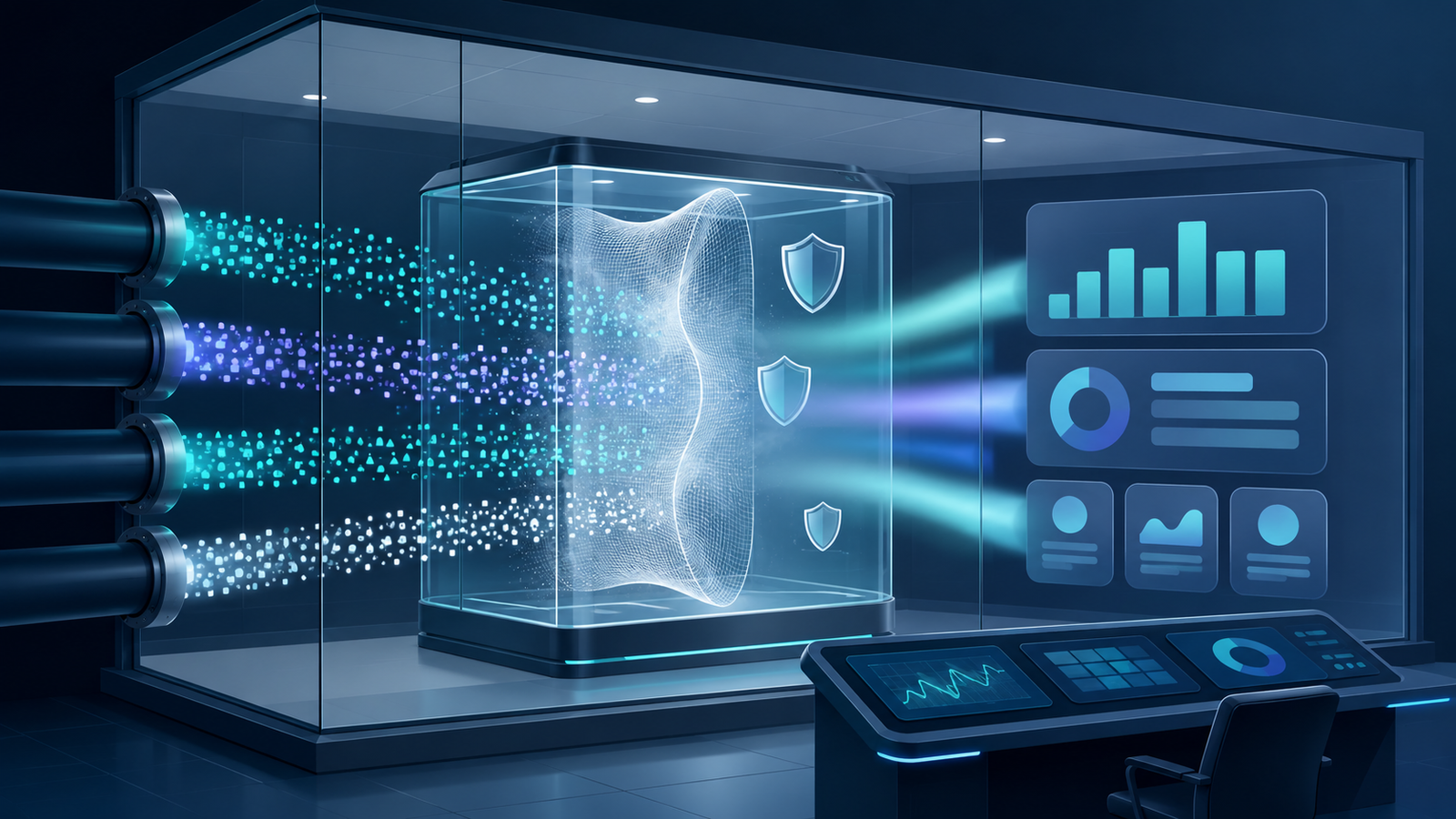
Data clean rooms have become one of the most widely adopted PETs specifically for business analytics collaboration, particularly in advertising, marketing measurement, and partner data-sharing arrangements. A clean room is a secure, access-controlled environment where multiple parties can run pre-approved, jointly-agreed queries against their combined data without either party gaining direct access to the other’s raw records. Strong clean room implementations combine several underlying techniques: k-anonymity thresholds on returned results, differential privacy noise on aggregate outputs, query allow-listing to prevent adversarial queries designed to isolate individuals, and sometimes secure multi-party computation or trusted execution environments for the underlying computation itself.
For an analytics team, the appeal of a clean room is that it turns what would otherwise be a legally fraught data-sharing negotiation (raw customer lists changing hands) into a governed, repeatable workflow. The tradeoff is reduced flexibility: only pre-approved query types are typically available, and ad hoc, exploratory analysis is intentionally restricted, since flexibility is precisely what would let a bad actor extract individual-level information through cleverly chained queries.
| Requirement | Technique that satisfies it | Analytics team impact |
|---|---|---|
| Publish an aggregate metric externally | Differential privacy on the query or report | Requires managing a privacy budget across the reporting calendar |
| Share a customer-level export with a partner | k-anonymity plus l-diversity on the extract | Requires deliberate selection of which columns to include |
| Run joint analysis with another company | Data clean room | Requires pre-agreeing on the specific queries allowed in advance |
| Give QA or offshore contractors realistic test data | Synthetic data generation | Requires validating that synthetic data preserves the statistical properties needed for testing |
| Let a partner query sensitive data without seeing it | Secure enclave / trusted execution environment | Requires additional infrastructure investment and query certification |
Synthetic Data for Testing, Development, and Sandbox Analytics
Synthetic data is statistically generated data designed to mirror the structure, distributions, and correlations of real data without mapping to any actual individual. For analytics teams, its most common and lowest-friction use case is not production reporting but test and development environments: QA teams, offshore contractors, and third-party integration partners frequently need realistic-looking data to validate dashboards, test ETL pipelines, and debug reporting logic, without ever touching real customer records.
Market analysts have projected that a large majority of businesses will lean on generative techniques to produce synthetic customer data for exactly these use cases by the latter half of this decade, driven by both privacy regulation and the simple operational convenience of not having to lock down every test environment to production-grade access controls. The caveat analytics teams should hold onto is that synthetic data quality varies enormously — a synthetic dataset that fails to preserve rare edge cases (a churn spike in a small customer segment, for example) can cause a dashboard or model validated against it to behave differently against real production data, so synthetic test data still needs periodic validation against real data’s statistical properties, even though the two must never be conflated for reporting purposes.
Secure Enclaves for Partner and Vendor Query Access
Secure enclaves, also called trusted execution environments, are hardware- or software-isolated compute environments where code can process sensitive data with strong guarantees that not even the infrastructure operator can inspect the data during processing. For analytics teams, enclaves are most relevant when a partner or vendor needs to run analysis against sensitive data — for example, a fraud-scoring vendor that needs to compute a risk score using a bank’s transaction history — without that data ever leaving the bank’s environment in a form the vendor could copy or retain.
Enclaves are the most infrastructure-intensive of the technologies covered here, generally requiring specialized cloud offerings or dedicated hardware support, and are typically reserved for the highest-sensitivity collaborations rather than routine reporting. Many data clean room products now use enclaves as their underlying computation layer specifically because they offer the strongest technical guarantee that raw data was never exposed to any party, including the clean room operator itself.
Common mistake
Analytics teams frequently borrow PETs terminology and tooling built for AI model training and assume it transfers directly to BI use cases without adjustment. Differential privacy tuned for a model-training pipeline’s privacy budget, for instance, is calibrated around a single training run, not the hundreds of ad hoc dashboard queries a BI team runs daily — applying the same budget assumptions to a live reporting environment either exhausts the privacy budget within days or requires so much noise that dashboards become useless. PETs need to be selected and configured for the actual query pattern of the analytics workload, not copied from an AI training playbook.
What worked
Analytics teams that successfully adopt PETs typically start with a clear map of their actual data-sharing surface: which dashboards go to which internal and external audiences, which exports leave the organization, and which partners need query access. From there, they apply the lightest-weight technique that satisfies each specific surface — k-anonymity for one-time extracts, differential privacy for recurring published dashboards, clean rooms only for genuine cross-company collaboration — rather than deploying a single heavyweight PET (like a full clean room platform) everywhere out of convenience.
Building a Practical PETs Program for a BI Team
A workable rollout usually starts by inventorying the analytics team’s actual outputs: internal dashboards, external partner reports, ad hoc data exports, and any cross-company collaboration workflows. Each output gets matched to the lightest PET that addresses its specific risk — a dashboard viewed only by internal finance staff may need nothing beyond standard access controls, while the same metric published to a public investor report likely needs differential privacy noise calibrated to prevent competitor inference. Extracts leaving the organization for a vendor or partner should default to k-anonymized exports unless there is a specific business reason for row-level detail, and any genuine cross-company joint analysis should move to a data clean room rather than a one-off data-sharing agreement involving raw file transfers.
Governance matters as much as technology selection. A defensible program documents which technique protects which data flow, what parameters were chosen (the k value, the differential privacy epsilon, the specific queries allow-listed in a clean room), and revisits those parameters whenever the underlying data or audience changes — a report that once went only to internal leadership but now gets forwarded to a board deck has a materially different risk profile even though the underlying query never changed.
- Privacy budgetThe finite allowance of noise-consuming queries a differential privacy system can support before results become too imprecise to trust — a constraint BI teams must design their reporting cadence around.
- Quasi-identifying columnsThe specific fields in a shared extract, such as region or plan tier, whose combination determines the achieved k-anonymity level — often the most impactful and overlooked design choice in a data export.
- Query allow-listingRestricting a data clean room or shared analytics environment to a pre-approved set of query types, preventing adversarial queries designed to isolate individual records through repeated probing.
- Statistical fidelityHow closely synthetic data preserves the real dataset’s distributions, correlations, and rare edge cases — the key quality metric for whether synthetic test data is actually useful for validation.
- Trusted execution environmentA hardware- or software-isolated compute environment that processes sensitive data without exposing it even to the infrastructure operator, often the computation layer beneath a data clean room.
- Attribute disclosureThe risk that even a k-anonymized group reveals a sensitive attribute shared by all members of that group, the specific gap that l-diversity and t-closeness are designed to close.
Where This Fits Alongside AI-Focused Privacy Work
Business analytics PETs and AI-training PETs solve related but distinct problems, and most organizations need both. Teams building or fine-tuning machine learning models should look at the AI-training-specific treatment of differential privacy and federated learning in privacy-preserving AI: differential privacy and federated learning, which addresses model memorization and training-data leakage rather than dashboard and reporting risk. Because analytics PETs often operate on data that has already been pseudonymized or anonymized upstream, the technical choices covered here interact closely with the classification decisions explored in anonymisation versus pseudonymisation. Cross-company clean room collaborations frequently involve partners in different jurisdictions, which raises the same transfer-mechanism questions covered in cross-border data transfer mechanisms after Schrems II, and the underlying data residency constraints on where a clean room’s compute can even run are shaped by the regional rules mapped in data sovereignty requirements by region.
- Differential privacy
- A mathematical framework that adds calibrated random noise to query outputs so that any single individual’s record has a bounded, quantifiable effect on the result.
- k-anonymity
- A privacy model requiring that each record in a dataset be indistinguishable from at least k-1 other records across a defined set of quasi-identifying attributes.
- Data clean room
- A secure, access-controlled environment where multiple parties can run pre-approved joint queries against combined data without exposing raw records to each other.
- Synthetic data
- Artificially generated data designed to statistically resemble real data’s structure and distributions without corresponding to any actual individual.
- Secure enclave
- A hardware- or software-isolated compute environment that processes sensitive data with strong guarantees against exposure, even to the infrastructure operator.
Key Takeaways
- Analytics and BI teams need a different PETs toolkit than AI model-training teams, focused on protecting dashboards, exports, and partner data sharing rather than model artifacts.
- Differential privacy suits recurring aggregate reporting but requires managing a finite privacy budget across the reporting calendar, unlike a single model-training run.
- k-anonymity is a practical, one-time control for shared data extracts, and the choice of quasi-identifying columns is the most impactful design decision.
- Data clean rooms have become the standard mechanism for cross-company analytics collaboration, combining k-anonymity, differential privacy, and query allow-listing.
- Synthetic data is most useful for test, development, and sandbox environments, but requires ongoing validation that it preserves rare edge cases relevant to real analysis.
- Secure enclaves offer the strongest technical guarantee against data exposure but are the most infrastructure-intensive option, typically reserved for high-sensitivity partner queries.
- A workable PETs program matches the lightest-weight technique to each specific data-sharing surface rather than deploying one heavyweight tool everywhere.
FAQs
How is differential privacy for analytics different from differential privacy in AI model training?
In analytics, differential privacy is typically applied at the query layer to protect recurring dashboard and report outputs, managed against a privacy budget shared across many daily queries. In AI training, it is applied during the training process itself to prevent the model from memorizing individual training examples.
What is k-anonymity and why do BI teams use it?
k-anonymity requires that every record in a dataset be indistinguishable from at least k-1 others across quasi-identifying attributes. BI teams use it to produce shared extracts and exports for partners or other teams without exposing individually identifiable rows.
What is a data clean room used for in business analytics?
A data clean room lets two or more companies run pre-approved joint queries against their combined data, such as measuring customer overlap for a marketing campaign, without either party gaining direct access to the other’s raw records.
Is synthetic data safe to use for production analytics and reporting?
Synthetic data is best suited for testing, development, and sandbox environments rather than production reporting, since it can fail to preserve rare edge cases present in real data. It should be validated periodically against real data’s statistical properties before being trusted for downstream testing decisions.
What is a secure enclave and when does an analytics team need one?
A secure enclave, or trusted execution environment, is an isolated compute environment that processes sensitive data without exposing it even to the infrastructure operator. Analytics teams typically need one for high-sensitivity partner or vendor query access, such as a fraud-scoring vendor computing a risk score on bank transaction data.
What is a privacy budget in differential privacy?
A privacy budget is the finite allowance of noise-consuming queries a differential privacy system can support before results become too imprecise to be useful. Analytics teams need to design their reporting cadence, such as caching fixed daily aggregates, around this constraint.
Does k-anonymity alone fully protect a shared dataset?
No. k-anonymity alone does not protect against attribute disclosure within an indistinguishable group, meaning all members of a group could still share a sensitive attribute. Extensions like l-diversity and t-closeness address this additional gap.
How should an analytics team choose between these different PETs?
The choice should match the specific data-sharing surface: k-anonymity for one-time extracts, differential privacy for recurring published dashboards, data clean rooms for genuine cross-company collaboration, synthetic data for test environments, and secure enclaves for the highest-sensitivity partner query access.
References
- TechTarget, “Privacy-enhancing technology types and use cases.”
- Decentriq, “What are privacy-enhancing technologies?”
- Decentriq, “What are the best data clean room companies in 2026?”
- AnalyticsWeek, “Synthetic Data: Breaking US Data Privacy Bottleneck in 2026.”
- Trackingplan, “What Is a Data Clean Room? A Guide for Marketers in 2026.”
- StarAgile, “Top 10 Privacy Enhancing Technologies of 2026.”