| Myth | Reality |
|---|---|
| Robotic gait training only benefits pediatric patients. | The largest and most rigorous evidence base for robotic gait training actually comes from adult populations recovering from stroke and spinal cord injury, with dozens of randomized controlled trials. |
| More training sessions always produce better outcomes. | Several stroke trials found the most pronounced gains in gait velocity and balance occurred with fifteen or fewer training sessions, suggesting a defined, not unlimited, dose-response relationship. |
Robotic gait training has moved well beyond its early pilot-study era. A growing body of randomized controlled trials and systematic reviews now gives clinicians and patients real, quantified answers about how much walking speed, endurance, and independence improve when robotic systems are added to conventional rehabilitation for adults recovering from stroke or spinal cord injury. This piece focuses specifically on that adult outcomes data, covering the full range of conditions treated with robotic gait training rather than any single age group.
This article is for general educational and informational purposes only. It does not constitute medical advice and is not a substitute for consultation with a qualified physical therapist, physiatrist, or other licensed healthcare professional regarding any individual’s rehabilitation plan.
What Robotic Gait Training Actually Is
Robot-assisted gait training, often abbreviated RAGT in the clinical literature, uses powered devices to guide a patient’s legs through a walking pattern, either on a treadmill with body-weight support or over ground, allowing for higher-repetition, more consistent practice than a therapist manually assisting a patient’s legs can typically provide. Two broad device categories dominate the adult rehabilitation literature.
- Exoskeleton systems, such as EksoGT, use wearable powered leg braces that support and guide the patient’s own limbs through a gait cycle, often used for overground walking practice.
- End-effector systems, such as the Lokomat, use a treadmill-based robotic orthosis with linear drives at the hip and knee that move the legs along a fixed or adjustable path while supporting a portion of body weight.
Stroke Rehabilitation Outcomes
A systematic review and meta-analysis examining robot-assisted gait training in stroke rehabilitation analyzed twenty-three randomized controlled trials covering more than nine hundred patients. The combined evidence found that robot-assisted gait training paired with conventional therapy produced significant improvements in gait function, gait speed, balance, and activities of daily living performance compared to conventional therapy alone.
| Outcome measure | Finding |
|---|---|
| Gait function and speed | Significant improvement with combined robotic and conventional therapy versus conventional therapy alone |
| Balance | Significant improvement, particularly with end-effector systems |
| Activities of daily living | Significant improvement across the pooled trial population |
| Device type comparison | End-effector systems outperformed exoskeleton systems in several trials, especially in subacute patients |
| Session count sweet spot | Most pronounced gains in gait velocity and dynamic balance observed with fifteen or fewer training sessions |
One especially useful finding from this body of research is that the type of robotic device matters for certain outcomes: end-effector systems, which move the foot along a defined path via a footplate rather than fully bracing the leg, produced superior outcomes compared to exoskeletons in a number of the pooled trials, with the most pronounced benefits concentrated in gait velocity and dynamic balance among patients still in the subacute recovery phase, generally defined as the weeks to a few months following a stroke.
Spinal Cord Injury Outcomes
The spinal cord injury literature shows a similarly consistent pattern of benefit, with some of the most detailed dose-response data available in the field. A systematic review and meta-analysis of randomized controlled trials in individuals with spinal cord injury found that robot-assisted gait training produced beneficial enhancements in activities of daily living, muscular strength, and walking ability, with the improvements more prominent in interventions lasting over two months and among patients in the subacute injury phase.
A notable 2026 study examining training frequency specifically compared twice-weekly and other dosing schedules and found the twice-weekly robotic-assisted gait training group demonstrated the greatest improvements among the groups studied.
| Metric | Reported change |
|---|---|
| Timed Up and Go test | Decreased by 44.8 percent in the twice-weekly training group |
| Six-minute walk test distance | Increased by 43.5 meters in the twice-weekly training group |
| Intervention duration threshold | Benefits more prominent when training extended beyond two months |
| Recovery phase | Subacute patients showed more prominent improvement than chronic-phase patients |
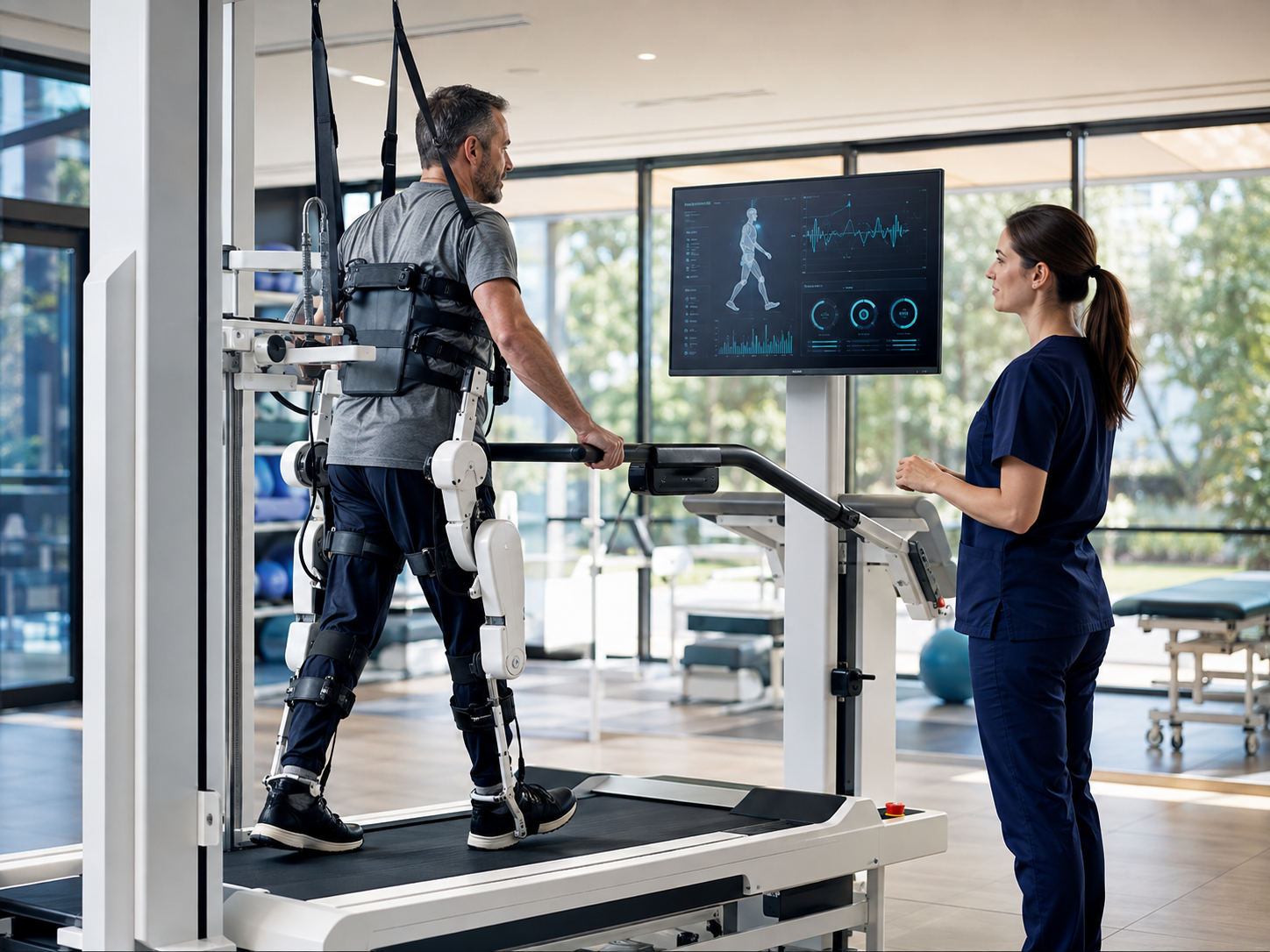
A typical adult robotic gait training session
A patient is secured into a body-weight-supported harness over a treadmill or fitted with an exoskeleton, the device guides the legs through a repeatable gait cycle while a therapist monitors muscle activation and adjusts support levels, and outcome measures such as gait speed and the six-minute walk test are periodically retested to track progress across the training block.
Lokomat: The Most Studied End-Effector and Orthosis System
The Lokomat, a widely used robotic exoskeleton-orthosis system with linear drives at the hip and knee joints, guides a patient’s legs along a predetermined path while walking on a treadmill. It remains the most extensively studied device in the robotic gait training literature. A systematic review and meta-analysis of the Lokomat’s effect on lower extremity rehabilitation in stroke patients found that stationary robot-assisted training could better improve the walking ability of subacute stroke survivors compared to traditional training methods, maximizing motor learning, gait speed, and coordination through high-intensity, tailored training with real-time feedback. Typical study protocols run around three months of treatment, with assessments spanning lower limb joint range of motion, balance, activities of daily living, walking speed, and muscle tone. A separate systematic review and meta-analysis focused specifically on Lokomat’s effect on balance control after stroke similarly found meaningful improvement across the pooled trial population, and another study reported improvements in postural control and functional independence among both subacute and chronic stroke patients.
How Training Dose and Timing Shape Outcomes
A consistent theme across both the stroke and spinal cord injury literature is that more training is not simply better in an unlimited sense; rather, there appears to be a dose-response relationship with a practical ceiling. Several stroke trials found the most pronounced gains concentrated in protocols using fifteen or fewer sessions, while spinal cord injury data favored interventions extending beyond two months for the deepest functional gains, and twice-weekly frequency outperforming both more and less frequent protocols in at least one 2026 dosing study. Interpreting these findings together, timing and phase of recovery, specifically whether a patient is in the subacute or chronic stage, appears to influence how much benefit a given number of sessions will produce, more than simply maximizing total session count.
Common mistake
Assuming robotic gait training outcomes are interchangeable across exoskeleton and end-effector device types, or across recovery phases. Several stroke trials found end-effector systems outperformed exoskeletons for gait velocity and balance, and both stroke and spinal cord injury data show consistently stronger gains in subacute patients than in those in the chronic phase, so device selection and timing both matter to expected outcomes.
Functional Independence and Daily Living Measures
Beyond raw walking speed, the clinical literature consistently tracks activities of daily living performance as a key outcome, since improved gait mechanics only matter clinically if they translate into greater independence in daily tasks. Pooled trial data across both stroke and spinal cord injury populations shows measurable gains in these functional independence measures when robotic gait training is added to a conventional rehabilitation program, reinforcing that the technology’s value extends beyond laboratory gait-speed metrics into meaningful everyday function.
What worked
Rehabilitation programs that matched device type to recovery phase, using end-effector systems for early subacute stroke patients targeting gait velocity and balance gains, and extending spinal cord injury programs beyond the two-month mark with a twice-weekly cadence, reported the strongest functional outcomes in the pooled trial data reviewed for this piece.
Frequently Overlooked Factors in Gait Training Outcomes
- Recovery phaseWhether a patient is subacute or chronic significantly influences the magnitude of benefit from robotic gait training, with subacute patients generally showing stronger gains.
- Device architectureEnd-effector systems and exoskeleton systems produce measurably different outcomes for specific metrics like gait velocity and balance, particularly in stroke rehabilitation.
- Session dosingBoth too few and, in some data sets, excessive session counts underperform a defined middle range, making protocol design a meaningful clinical decision.
- Body-weight support levelThe percentage of body weight offloaded by the harness during treadmill-based training affects both safety and the intensity of motor learning achieved.
- Combined versus standalone therapyNearly all strong outcomes data reflects robotic training paired with conventional therapy, not robotic training used in isolation.
Glossary
- Robot-assisted gait training (RAGT)
- The use of powered robotic devices to guide a patient’s legs through a repeatable walking pattern during rehabilitation.
- End-effector system
- A robotic gait training device, such as the Lokomat, that moves the foot along a defined path via a footplate rather than bracing the entire leg.
- Exoskeleton system
- A wearable powered device, such as EksoGT, that supports and guides a patient’s own limbs through a gait cycle, often used for overground walking practice.
- Subacute phase
- The recovery period spanning roughly the weeks to a few months following a stroke or spinal cord injury, during which rehabilitation gains tend to be most responsive to intervention.
- Six-minute walk test
- A standardized clinical measure of functional walking endurance based on the distance a patient can walk in six minutes.
- Timed Up and Go test
- A clinical mobility test measuring the time it takes a patient to rise from a chair, walk a short distance, turn, and sit back down.
Key Takeaways
- Robotic gait training paired with conventional therapy produces significant improvements in gait speed, balance, and activities of daily living in adult stroke patients across pooled randomized controlled trial data.
- End-effector systems outperformed exoskeleton systems for gait velocity and balance in several stroke trials, particularly among subacute patients.
- The most pronounced stroke rehabilitation gains were observed in protocols using fifteen or fewer training sessions.
- Spinal cord injury data shows the strongest benefits with interventions lasting over two months and twice-weekly training frequency.
- One 2026 spinal cord injury dosing study found Timed Up and Go time decreased by 44.8 percent and six-minute walk test distance increased by 43.5 meters in the twice-weekly training group.
- The Lokomat remains the most extensively studied robotic gait training device, with strong evidence in both stroke and spinal cord injury populations.
- Recovery phase, whether subacute or chronic, meaningfully affects the magnitude of benefit from robotic gait training.
FAQs
Does robotic gait training actually improve walking speed after a stroke?
Yes. A meta-analysis of twenty-three randomized controlled trials covering more than nine hundred stroke patients found that robot-assisted gait training combined with conventional therapy produced significant improvements in gait function, gait speed, balance, and activities of daily living compared to conventional therapy alone.
What is the difference between an end-effector system and an exoskeleton?
An end-effector system, such as the Lokomat, moves the foot along a defined path via a footplate while the patient’s leg moves more freely, while an exoskeleton, such as EksoGT, is a wearable powered brace that directly supports and guides the entire leg through a gait cycle.
How many robotic gait training sessions produce the best results after a stroke?
Several stroke trials found the most pronounced gains in gait velocity and dynamic balance occurred with protocols using fifteen or fewer training sessions, particularly among patients in the subacute recovery phase, suggesting a defined rather than unlimited dose-response relationship.
How does robotic gait training help people with spinal cord injury?
A systematic review and meta-analysis found robot-assisted gait training produced beneficial enhancements in activities of daily living, muscular strength, and walking ability in people with spinal cord injury, with the most prominent improvements seen in interventions lasting over two months and among subacute patients.
How often should robotic gait training sessions occur for spinal cord injury patients?
A 2026 study examining training frequency found that a twice-weekly robotic-assisted gait training schedule produced the greatest improvements among the frequencies studied, with Timed Up and Go time decreasing by 44.8 percent and six-minute walk test distance increasing by 43.5 meters.
Is the Lokomat effective for chronic stroke patients, not just recent stroke survivors?
Some studies report improvements in postural control and functional independence among both subacute and chronic stroke patients using the Lokomat, though the magnitude of benefit is generally more pronounced in patients earlier in the subacute recovery window.
Is robotic gait training used alone or combined with conventional therapy?
Nearly all of the strongest outcomes data reflects robotic gait training used in combination with conventional physical therapy rather than as a standalone replacement, and this combined approach is the standard studied in the majority of randomized controlled trials.
Does robotic gait training improve activities of daily living, not just walking speed in a lab setting?
Yes. Pooled trial data across both stroke and spinal cord injury populations shows measurable gains in activities of daily living performance when robotic gait training is added to conventional rehabilitation, indicating the benefits extend into meaningful everyday functional independence.
Readers interested in the pediatric side of gait rehabilitation should see our companion piece on adaptive gait training for pediatric rehabilitation. For a look at how hospitals are automating other parts of patient care logistics, see our piece on hospital service robots for delivery and disinfection. Readers tracking how autonomous medical devices reach the market may also want our coverage of regulatory pathways for autonomous medical devices, and those evaluating connected rehabilitation equipment should review our piece on the cybersecurity of medical robotics. Administrators building a broader digital health strategy may also find our piece on home diagnostic robots and longevity stations useful context.
- PMC, “Effectiveness of Robot-Assisted Gait Training in Stroke Rehabilitation: A Systematic Review and Meta-Analysis”
- PMC, “Robot-Assisted Gait Training in Individuals With Spinal Cord Injury: A Systematic Review and Meta-Analysis of Randomized Controlled Trials”
- Springer Nature, Journal of NeuroEngineering and Rehabilitation, “The impact of robot-assisted training on gait, balance, and endurance in patients with partial spinal cord injuries: insights from rehabilitation”
- Frontiers in Neurology, “Can robot-assisted gait training improve walking and activity abilities in persons with spinal cord injury? A systematic review and meta-analysis of randomized controlled trials”
- PMC, “The effect of the Lokomat robotic-orthosis system on lower extremity rehabilitation in patients with stroke: a systematic review and meta-analysis”
- PMC, “The Effect of Robotic Assisted Gait Training With Lokomat on Balance Control After Stroke: Systematic Review and Meta-Analysis”
- PMC, “Effect of Lokomat Robotic Rehabilitation on Balance, Postural Control, and Functional Independence in Subacute and Chronic Stroke Patients: A Quasi-Experimental Study”