| Myth | Reality |
|---|---|
| Hospital service robots are mostly a marketing gimmick. | Deployment data from real hospital systems shows measurable reductions in staff walking time and documented infection-control benefits from UV-C disinfection cycles. |
| These robots replace nurses and environmental services staff. | Current systems are designed to offload repetitive transport and cleaning tasks so clinical staff can spend more time on direct patient care, not to replace roles entirely. |
Walk down a corridor in a growing number of hospitals today and you may share the hallway with a robot quietly delivering medications to a nursing station, or pass a machine bathing an empty patient room in ultraviolet light after a discharge. These are not experimental novelties. Hospital logistics and disinfection robots have moved from pilot programs to standard infrastructure at hundreds of facilities, and the technology behind them has matured considerably. This deep dive covers how these systems actually work, what deployment data says about their impact, and where the category is headed.
This article is for general educational and informational purposes only. It does not constitute medical advice and should not be used as a substitute for consultation with a qualified healthcare professional or infection-control specialist regarding any specific facility’s protocols.
Three Categories of Hospital-Floor Robots
Hospital service robotics generally falls into three functional categories, each solving a distinct operational problem.
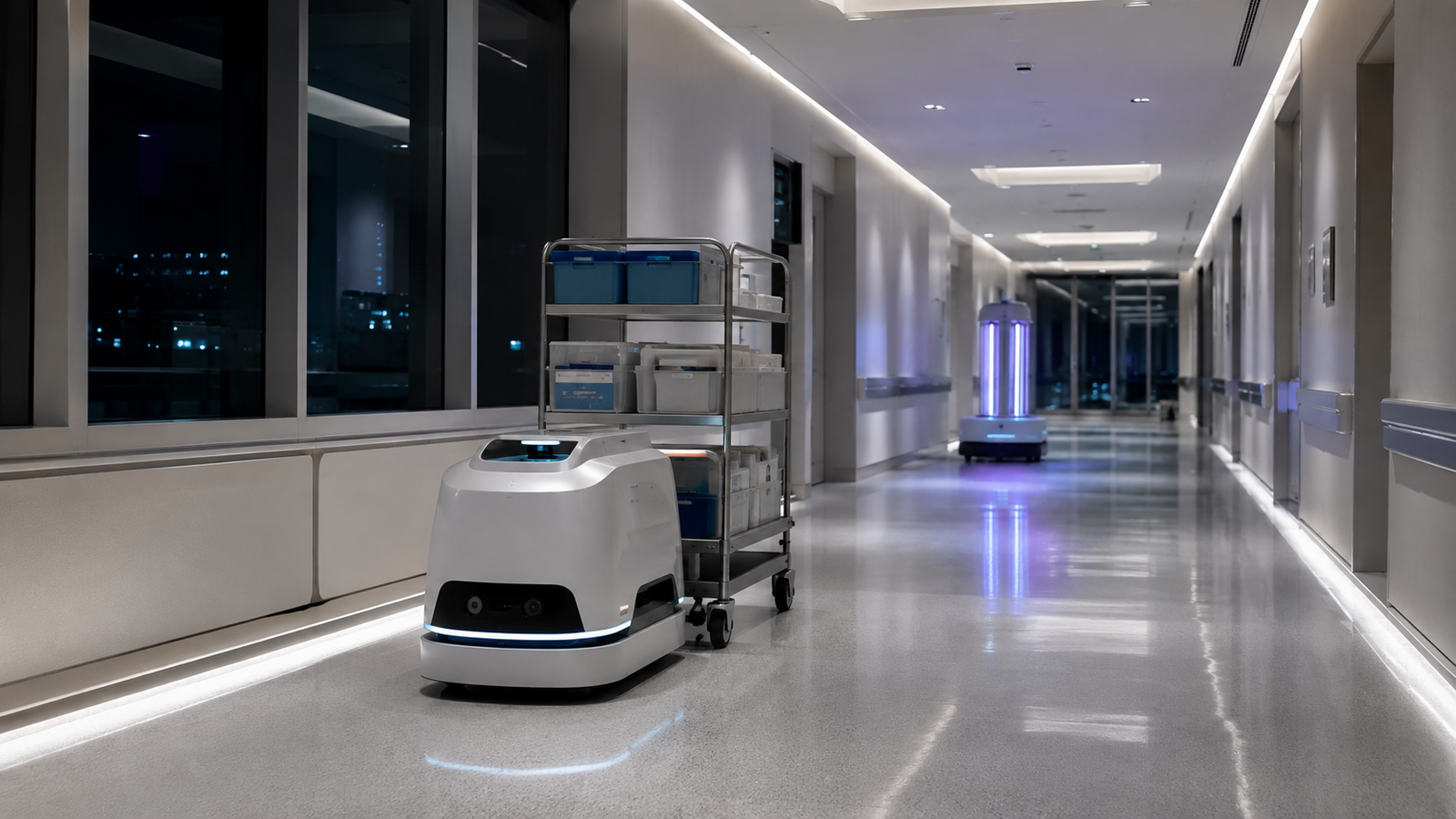
- Delivery and transport robots move medications, supplies, lab specimens, linens, and meal trays between departments, freeing clinical staff from repetitive walking and waiting.
- Disinfection robots use ultraviolet-C light, chemical fogging, or robotic wiping arms to perform terminal cleaning of patient rooms and high-touch surfaces after discharge or between procedures.
- Autonomous floor-care robots handle routine scrubbing and vacuuming of long corridors and lobbies, a task that is repetitive, time-consuming, and well suited to autonomous navigation.
Delivery Robots: Moxi and TUG
Two names dominate the hospital delivery robot conversation. Aethon’s TUG system, one of the earliest commercially deployed hospital robots, uses a wheeled cart-carrying base that autonomously navigates hospital corridors, calls elevators, and delivers items such as medications and linens to nursing stations. An early academic medical center study found that TUG deployment reduced the time from medication order to label printing, order preparation time, and the interval between medication checking and delivery.
Diligent Robotics’ Moxi robot takes a different approach, using a mobile base with an articulated arm capable of picking up and delivering individual items such as supply totes, lab specimens, and personal protective equipment restocks. Moxi is typically offered as a subscription service with usage-based pricing, which lowers the upfront barrier to entry compared to an outright equipment purchase. Deployment has scaled quickly: Diligent reports its robots have completed over one million deliveries across more than two dozen hospitals, giving hundreds of thousands of hours back to clinical staff who would otherwise be walking supplies and specimens across a facility. In one reported year, the number of hospitals using Moxi grew from two to fourteen, with the robots logging roughly 160,000 deliveries across those sites in a single year.
| System | Maker | Primary task | Business model |
|---|---|---|---|
| TUG | Aethon | Cart-based delivery of medications, linens, supplies | Direct hospital purchase |
| Moxi | Diligent Robotics | Item-level delivery with articulated arm | Subscription, usage-based |
| Autonomous scrubbers | Various vendors | Corridor and lobby floor cleaning | Purchase or lease |
| UV-C disinfection units | Various vendors including TMiRob-class systems | Terminal room disinfection | Purchase, typically 15,000 to 50,000+ USD |
UV-C and Robotic Wiping Disinfection
Disinfection robots address a persistent infection-control challenge: manual terminal cleaning quality varies by staff fatigue, time pressure, and training, while pathogens such as Clostridioides difficile, MRSA, and various viruses can survive on surfaces for extended periods. Ultraviolet-C light disinfection robots address this by delivering a standardized, repeatable dose of germicidal light to a room after manual cleaning is complete.
Hospital-grade UV-C systems have demonstrated pathogen kill rates as high as 99.99 percent against bacteria and viruses, including methicillin-resistant Staphylococcus aureus, Clostridioides difficile spores, and SARS-CoV-2, when used according to manufacturer dwell-time protocols. A field study conducted in an academic hospital examined the use of a UV-C disinfection robot within the routine cleaning process and found it could be integrated into standard workflows as a supplement to, rather than a replacement for, manual cleaning.
The Dual-Disinfection Approach
A newer category of “intelligent autonomous wiping and UV-C disinfection robot” combines two disinfection mechanisms in a single unit. First, a robotic manipulator arm physically wipes down surfaces to remove visible contaminants and organic material, which UV-C light alone cannot reliably penetrate. Second, the same unit follows with UV-C irradiation to reach corners, undersides, and narrow spaces that are difficult for either human staff or a wiping arm alone to disinfect thoroughly. This combination approach is designed to address one of the most consistent criticisms of UV-C-only systems: that organic residue and shadowed surfaces can block ultraviolet light from reaching contaminated areas.
A typical terminal disinfection cycle
After a patient room is vacated, environmental services staff perform manual cleaning of visible surfaces, then a UV-C or dual wipe-and-UV robot is wheeled in, sensors confirm the room is empty, and a timed irradiation cycle runs across multiple positions in the room before the space is cleared for the next patient.
Autonomous Floor Cleaning
Long hospital corridors and large lobby areas represent a significant recurring labor cost for environmental services departments. Autonomous scrubbing and vacuuming robots, similar in navigation approach to commercial floor-care robots used in retail and airports, are increasingly deployed overnight in hospital common areas, corridors, and cafeterias where continuous human supervision is least practical. These systems free environmental services staff to focus on patient rooms, isolation units, and other higher-priority disinfection tasks that still require human judgment.
| Robot type | Typical deployment window | Primary benefit | Typical cost range |
|---|---|---|---|
| Delivery robot | 24/7, continuous | Reduced staff walking and wait time | Subscription or purchase, roughly 15,000 USD and up |
| UV-C disinfection robot | Between patients, terminal cleans | Standardized, repeatable pathogen reduction | 50,000 USD and up |
| Autonomous floor scrubber | Overnight, low-traffic hours | Consistent cleaning without added labor hours | Purchase or lease, moderate range |
Return on Investment: What Hospitals Report
The clearest, most consistently reported return-on-investment signal from hospital service robot deployments is time returned to clinical and support staff rather than direct headcount reduction. Facilities running Moxi robots describe the value proposition as nursing time freed for direct patient care, a benefit that is harder to quantify in a spreadsheet than raw labor cost but is consistently cited by administrators as the primary justification for continued investment. Delivery robots also reduce the variability of internal logistics, since a robot does not get pulled into an unrelated task mid-delivery the way a human staff member might when flagged down in a hallway.
For disinfection robots, the return-on-investment case rests more heavily on infection-control metrics, such as reductions in hospital-acquired infection rates tied to more consistent terminal cleaning, alongside the labor efficiency of automating a task that previously required dedicated staff time per room.
Common mistake
Treating disinfection robots as a full replacement for manual cleaning rather than a supplement to it. UV-C light cannot penetrate dust, organic residue, or shadowed surfaces, so skipping the manual wipe-down step before running a UV-C cycle can leave contaminated areas under-treated even though the robot completed its programmed cycle.
What worked
Hospitals that paired delivery robot rollouts with a clear internal communication plan, explaining to staff and patients what the robots do and do not do, reported smoother adoption and fewer workflow disruptions than facilities that deployed robots without preparing frontline staff for the change in hallway traffic and task handoffs.
Integration Challenges
Deploying fleets of autonomous robots inside an active hospital is operationally more complex than deploying the same technology in a warehouse or office building, for several reasons.
- Elevator and door integration: robots must interface with building systems to call elevators and open secured doors without human assistance, which requires facility-specific engineering work.
- Infection control zoning: robots moving between general wards and isolation units must follow strict protocols to avoid cross-contamination risk.
- Staff workflow adaptation: nursing and environmental services staff need training on how to hand off tasks to a robot and what to do if a delivery or disinfection cycle is interrupted.
- Network and connectivity reliability: robots depend on consistent facility Wi-Fi and positioning systems, and dead zones in older hospital buildings can disrupt navigation.
- Cybersecurity: connected hospital robots represent another endpoint on the hospital network that must be secured against unauthorized access, a topic covered in more depth in our companion piece on the cybersecurity of medical robotics.
Frequently Overlooked Operational Details
- Dwell timeThe programmed duration a UV-C robot must irradiate a given position in a room to achieve the manufacturer’s claimed pathogen kill rate; shortening it undermines effectiveness.
- Fleet orchestration softwareThe backend system that assigns tasks to multiple robots, manages charging cycles, and reroutes around blocked corridors in real time.
- Chain of custodyThe documented handoff process ensuring medications or specimens transported by a robot are verified at pickup and delivery, preserving accountability.
- Elevator brokeringSoftware integration that allows a robot to summon and ride a building elevator autonomously, often the single hardest integration point in a deployment.
- Isolation protocol overridesSpecial routing rules that keep robots away from or apply extra disinfection procedures around rooms under infection isolation precautions.
Glossary
- UV-C light
- Ultraviolet light in the germicidal wavelength range used to damage the genetic material of bacteria, viruses, and spores on surfaces.
- Terminal cleaning
- The thorough disinfection process performed in a patient room after discharge and before the next patient is admitted.
- Autonomous mobile robot
- A robot capable of navigating a facility independently using onboard sensors and mapping software, without following a fixed physical track.
- Fleet orchestration
- Software that coordinates multiple robots operating in the same facility, assigning tasks and managing traffic and charging schedules.
- Dual disinfection system
- A robot design combining physical surface wiping with UV-C irradiation to address both organic residue and hard-to-reach contaminated areas.
Key Takeaways
- Hospital service robots fall into three broad categories: delivery and transport, disinfection, and autonomous floor cleaning.
- Aethon’s TUG and Diligent Robotics’ Moxi are the two most established names in hospital delivery robotics, with Moxi reporting over one million completed deliveries across more than two dozen hospitals.
- Hospital-grade UV-C disinfection robots can achieve pathogen kill rates of up to 99.99 percent for organisms including MRSA, Clostridioides difficile, and SARS-CoV-2 when protocols are followed correctly.
- Newer dual-disinfection robots combine physical wiping with UV-C irradiation to address organic residue that UV-C light alone cannot penetrate.
- The clearest reported return on investment is time returned to clinical staff for direct patient care, not direct headcount reduction.
- Integration challenges include elevator and door access, infection control zoning, staff workflow adaptation, and network reliability.
- Disinfection robots should be treated as a supplement to manual cleaning, not a replacement for it.
FAQs
What tasks do hospital delivery robots actually perform?
Hospital delivery robots such as TUG and Moxi transport medications, lab specimens, linens, supply totes, and meal trays between departments and nursing stations, autonomously navigating corridors and operating elevators to reduce the walking and waiting time required of clinical staff.
How effective are UV-C disinfection robots at killing pathogens?
Hospital-grade UV-C disinfection robots have demonstrated pathogen kill rates as high as 99.99 percent against organisms including MRSA, Clostridioides difficile spores, and SARS-CoV-2, provided the programmed dwell time and positioning protocols are followed as specified by the manufacturer.
Do disinfection robots replace manual cleaning staff?
No. UV-C light cannot reliably penetrate dust or organic residue, so manual wiping of visible surfaces remains a necessary first step. Disinfection robots are designed to supplement manual cleaning by providing a standardized final disinfection pass, not to replace human environmental services staff.
How much do hospital service robots cost?
Costs vary widely by function: basic delivery robots can start around 15,000 dollars or be offered on a subscription basis, while dedicated UV-C disinfection units frequently cost 50,000 dollars or more depending on features and coverage capability.
What is the biggest integration challenge when deploying hospital robots?
Elevator and secured-door integration is consistently cited as one of the hardest technical challenges, since robots must interface with existing building systems to move between floors and through access-controlled areas without human assistance.
What return on investment do hospitals report from delivery robots?
Hospitals most commonly report time returned to clinical staff for direct patient care rather than direct headcount reductions, with providers such as Diligent Robotics citing hundreds of thousands of hours given back to clinicians across their hospital deployments.
Can hospital robots be hacked or pose a cybersecurity risk?
Any networked hospital robot represents an additional connected endpoint that must be secured against unauthorized access, making cybersecurity a standard part of deployment planning alongside clinical and infection-control considerations.
What is a dual disinfection robot?
A dual disinfection robot combines a robotic wiping arm that physically removes surface contaminants with UV-C irradiation that reaches corners and shadowed areas, addressing the limitation that ultraviolet light alone cannot penetrate organic residue or block light from reaching hidden surfaces.
Readers interested in how connected medical devices are secured against unauthorized access should see our companion piece on the cybersecurity of medical robotics. For a look at how autonomous decision-making is being introduced inside the operating room itself, see our deep dive on autonomous surgical robotics and machine-assisted procedures. Hospitals building a broader automation strategy may also want to review our piece on home diagnostic robots and longevity stations, and administrators tracking new device clearances should follow our coverage of regulatory pathways for autonomous medical devices. Facilities comparing capital equipment purchases across departments may also find our surgical robot platform comparison useful context for budgeting conversations.
- Techxplore, “Transforming hospital sanitation: Autonomous robots for wiping and UV-C disinfection”
- EurekAlert, “Transforming hospital sanitation: autonomous robots for wiping and UV-C disinfection”
- PMC, “The use of a UV-C disinfection robot in the routine cleaning process: a field study in an Academic hospital”
- RobotLAB, “Healthcare Robots: Delivery, Cleaning, and Patient Support”
- AWS, “Deploying physical AI to aid clinicians using AWS with Diligent Robotics”
- Diligent Robotics, “Meet Moxi: Why We Invested in Diligent Robotics”