| Myth | Reality |
|---|---|
| Autonomous weeding robots are basically just self-driving sprayers | The hardware varies enormously by mechanism: laser weeders burn weed meristems, mechanical weeders use blades or tines, and micro-spray systems fire a targeted droplet at a single plant, each with different chassis, power, and control requirements |
| Precision spraying just means a smaller spray radius | Precision spraying is a closed-loop system: a vision model identifies and classifies each plant in real time, a control system calculates nozzle timing and trajectory, and the nozzle fires a dose sized to that specific plant, all within milliseconds at field speed |
| These systems replace herbicide entirely | Laser and mechanical weeders can eliminate herbicide for many weeds, but targeted micro-spray still uses chemical herbicide, just at a small fraction of the volume of blanket spraying |
Weeding and spraying get lumped together constantly in agricultural robotics coverage, and that is understandable since both solve the same underlying problem: applying an intervention, mechanical or chemical, to an individual plant rather than an entire field. But the hardware underneath these two categories is genuinely different, and growers evaluating a purchase need to understand the distinct engineering tradeoffs. Our companion piece on AI for agriculture covering predictive yields, precision irrigation, and pest management, linked in the resources section below, touches on weed detection as one benefit within a broader data and irrigation story. This article goes the other direction: it is specifically about the robotic hardware and control systems, the weeding mechanisms, the nozzle targeting precision, and the field robot chassis design, that make targeted weeding and spraying physically possible.
Three Weeding Mechanisms, Three Different Machines
Laser weeding
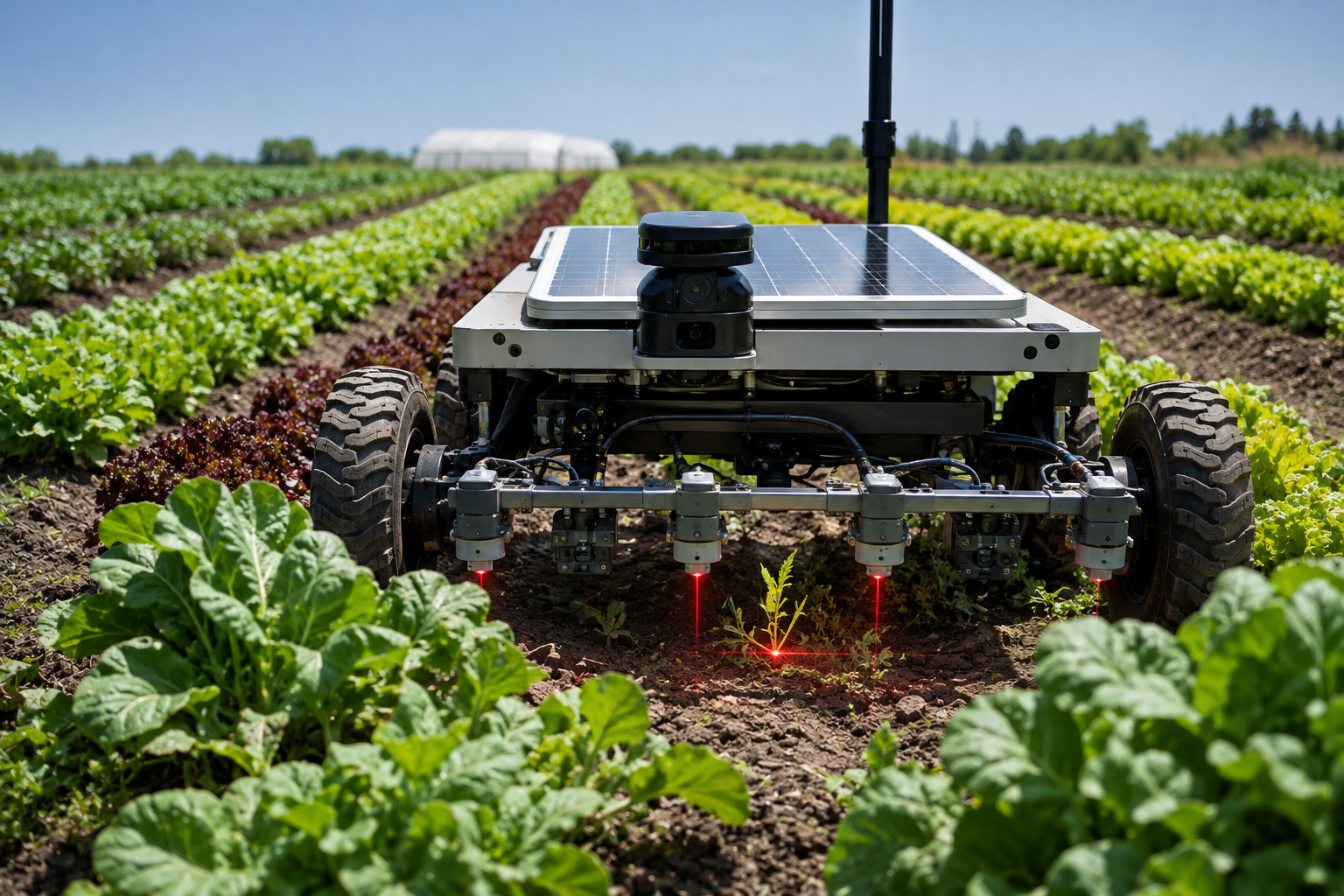
Laser weeding systems mount an array of high-powered laser modules on a downward-facing boom beneath the robot chassis. A vision system identifies each weed’s growing point, or meristem, and directs a laser pulse to destroy it, killing the plant without any physical contact or chemical application. Because there is no mechanical tool touching the soil, laser weeding avoids soil disturbance and works close to crop stems without the collision risk of a blade or tine. The tradeoff is power demand: laser arrays require substantial onboard power generation, and throughput is bound by how quickly the laser can cycle through detected weed targets, which becomes a bottleneck in fields with very high weed density.
Mechanical cultivation
Mechanical weeders use robotically actuated blades, tines, or rotating cultivator elements that physically till or cut weeds from the soil. A vision-guided mechanical weeder positions its tool with sub-inch precision to work close to the crop row without damaging the crop itself, then withdraws or lifts the tool as it passes a crop plant. This approach requires no chemical input at all and can be effective against a wide range of weed sizes, but it is mechanically more complex to actuate at field speed and can disturb soil structure in ways that laser weeding avoids.
Precision micro-spraying
Precision spraying systems keep the chemical herbicide model but replace blanket application with individually targeted micro-doses. A vision and control system identifies each weed, calculates its exact position relative to the moving boom, and fires a small, precisely timed burst from a dedicated nozzle only onto that weed, rather than saturating the entire row. This is mechanically the simplest of the three approaches to retrofit onto existing sprayer booms, which is part of why it has seen the fastest adoption at scale on row crops.
| Mechanism | Herbicide use | Soil disturbance | Best-fit crop type |
|---|---|---|---|
| Laser weeding | None | None | High-value row crops, vegetables |
| Mechanical cultivation | None | Moderate to high | Row crops, vineyards, orchards |
| Precision micro-spraying | Reduced 40 to 95 percent vs. blanket spray | None | Row crops, especially corn and soybeans |
The Vision and Control Stack Behind Real-Time Targeting
Every one of these mechanisms depends on the same underlying pipeline: a camera or camera array captures the field ahead of or beneath the robot, a neural network classifies each detected plant as crop or weed (and often by species) in real time, a control system converts that classification into a physical coordinate relative to the moving chassis, and an actuator, laser, blade, or nozzle, executes the intervention within a narrow timing window before the robot has moved past the target. At typical field speeds, this entire pipeline has to execute in a few tens of milliseconds per detected plant, which is why onboard compute and camera frame rate are as important a spec as the weeding mechanism itself when evaluating a system.
Figure: The real-time targeting pipeline on a laser weeding robot
A schematic showing the sequence from camera capture beneath the chassis, through a neural network classification stage that labels each detected plant as crop or weed, to a coordinate transform that accounts for chassis speed and vibration, ending in the laser module firing at the calculated meristem location, the entire loop completing in under 100 milliseconds at typical field travel speed.
Field Robot Chassis Design
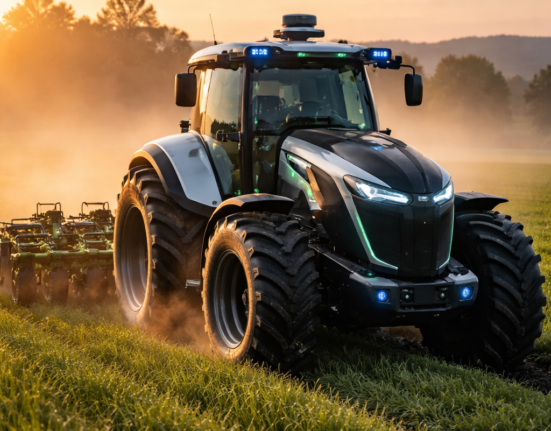
The chassis carrying these systems is not an afterthought; it directly shapes what the vision and actuation systems can achieve. Narrow, high-clearance chassis designs are common on row crop weeding robots specifically to straddle a crop row without touching plants on either side, while lower, wider chassis are more common on systems built for open-field vegetable operations with wider row spacing. Power architecture matters enormously for laser systems in particular, since laser arrays draw significant current, pushing many laser weeding platforms toward diesel-electric hybrid power systems or large onboard battery packs rather than pure battery-electric designs, which is a meaningfully different engineering approach from the lighter electric platforms common on mechanical and spray-based weeders.
Autonomous navigation on these platforms typically combines GPS-based row following for coarse guidance with a secondary vision-based row-centering system that keeps the chassis precisely aligned within a crop row despite GPS drift, since even a few centimeters of lateral error can mean the difference between a laser or blade correctly targeting a weed and instead damaging the adjacent crop.
Herbicide Reduction: The Numbers Behind the Claims
Precision spraying and weeding vendors make aggressive herbicide reduction claims, and 2026 research and field data broadly support them, within limits. Research on robotic weeders using selective micro-dose spraying has shown herbicide volume reductions in the range of 20 times less than conventional blanket spraying in controlled trials, and some field deployments report herbicide use reductions of up to 95 percent versus conventional practice. Separately, camera-guided spot spraying deployed at scale on row crops has been credited with reducing non-residual herbicide use by close to 50 percent in real-world commercial use, a somewhat lower figure than the lab-trial numbers, reflecting the gap between controlled research conditions and full-field variability.
| Source of data | Reported herbicide reduction | Context |
|---|---|---|
| Controlled research trials, selective micro-dose spraying | Up to 20x reduction (95 percent) | Lab and controlled field trial conditions |
| Commercial camera-guided spot spraying, row crops | Approximately 50 percent reduction | Real-world commercial deployment at scale |
| Laser weeding, high-value crops | Up to 80 percent reduction in total weed-control cost | Combines herbicide and hand-labor cost elimination |
Common Mistakes When Evaluating Weeding and Spraying Hardware
Common mistake
Buyers frequently evaluate these systems purely on herbicide reduction percentage without considering the mechanism-specific tradeoffs that determine whether a system will actually work on their farm’s soil type, row spacing, and weed pressure. A laser weeder’s throughput can be overwhelmed by extremely high weed density, and a mechanical cultivator’s soil disturbance may be unacceptable on farms practicing strict no-till or reduced-till soil conservation programs. The right mechanism depends on farm-specific conditions, not just a headline reduction percentage.
What worked
Growers who matched the weeding mechanism to their specific weed pressure and crop value, choosing laser weeding for high-value crops with moderate weed density, mechanical cultivation for operations already comfortable with tillage, and precision micro-spray for large-acreage row crops where retrofit compatibility with existing sprayer booms mattered most, reported more consistent results than growers who selected a system based on vendor marketing alone.
Frequently Overlooked Factors in Weeding and Spraying Hardware
- Power architectureLaser weeding systems draw substantial current and often require hybrid or large battery power systems, a meaningfully different infrastructure commitment than lighter electric mechanical or spray platforms.
- Weed density throughput limitsEvery mechanism has a maximum throughput of weeds it can process per pass at a given field speed; extremely high weed pressure can force a slower travel speed or multiple passes, changing the effective economics.
- Row-centering precisionCentimeter-level lateral positioning accuracy, not just GPS row following, is what actually prevents a laser or blade from damaging the crop instead of the weed.
- Soil conservation compatibilityMechanical cultivation may conflict with a farm’s no-till or reduced-till soil health program, a consideration that herbicide reduction statistics alone will not surface.
- Species-specific vision trainingVision models need to be trained or retrained for the specific crop and regional weed species mix on a given farm, and performance can degrade on weed species the model has not seen before.
- Nozzle and laser maintenanceLaser modules and precision nozzles both require periodic cleaning and calibration to maintain targeting accuracy, an ongoing maintenance cost that differs meaningfully between the two mechanisms.
Glossary
- Meristem
- The growing point of a plant, the specific target that laser weeding systems aim to destroy in order to kill a weed without physical contact.
- Micro-dose spraying
- A precision spraying technique that applies a small, individually targeted burst of herbicide to a single detected weed rather than blanket-spraying an entire field.
- Row-centering
- A vision-based navigation technique that keeps a field robot’s chassis precisely aligned within a crop row, correcting for GPS drift at centimeter-level precision.
- Onboard compute
- The processing hardware carried on a field robot responsible for running real-time vision classification and control calculations at field travel speed.
- No-till / reduced-till
- Soil conservation farming practices that minimize mechanical soil disturbance, a factor that can conflict with mechanical weed cultivation approaches.
Key Takeaways
- Autonomous weeding uses three distinct hardware mechanisms: laser, mechanical cultivation, and precision micro-spraying, each with different tradeoffs.
- Laser weeding eliminates herbicide entirely but requires substantial onboard power and can be throughput-limited under high weed density.
- Mechanical cultivation eliminates chemical input but disturbs soil, which can conflict with no-till farming practices.
- Precision micro-spraying is the easiest to retrofit onto existing sprayer equipment and has seen the fastest adoption at row-crop scale.
- Real-world commercial herbicide reductions run around 50 percent, lower than the up to 95 percent figures seen in controlled research trials.
- Centimeter-level row-centering precision, not just GPS guidance, is what prevents these systems from damaging the crop instead of the weed.
- The right mechanism depends on farm-specific weed density, crop value, and soil conservation practices, not headline reduction percentages alone.
FAQs
What is the difference between laser weeding and precision spraying?
Laser weeding uses a high-powered laser to destroy a weed’s growing point with no chemical input at all, while precision spraying still uses chemical herbicide but applies it in small, individually targeted doses to each detected weed rather than blanket-spraying the entire field.
How much can these systems actually reduce herbicide use?
Controlled research trials on selective micro-dose spraying report reductions of up to 20 times, or about 95 percent, versus conventional blanket spraying. Real-world commercial deployments at scale on row crops typically report a somewhat lower figure, around 50 percent reduction in non-residual herbicide use.
Why do laser weeding robots need so much power?
High-powered laser modules capable of destroying a plant’s growing point at field speed draw substantial current, which is why many laser weeding platforms use hybrid diesel-electric power systems or large onboard battery packs rather than lighter battery-electric designs used on mechanical or spray-based weeders.
Does mechanical weeding disturb the soil more than other methods?
Yes. Mechanical cultivation physically tills or cuts weeds using blades or tines, which disturbs soil structure to a degree that laser weeding and precision spraying, both of which avoid physical soil contact, do not.
How precise does the navigation need to be for these systems to work?
Centimeter-level precision is required. GPS-based row following alone is not accurate enough; most systems add a vision-based row-centering system that corrects for GPS drift in real time, since even small lateral errors can cause a laser or blade to hit the crop instead of the weed.
Can one system be trained to recognize any weed species?
Not automatically. Vision models need to be trained or retrained on the specific crop and regional weed species mix present on a given farm, and detection accuracy can degrade meaningfully on weed species the model has not previously seen.
Which mechanism is best for a large row-crop operation?
Precision micro-spraying tends to be the easiest and most cost-effective option for large-acreage row crops like corn and soybeans, largely because it can be retrofitted onto existing sprayer booms rather than requiring an entirely new dedicated machine.
Is soil conservation a real concern with these technologies?
Yes. Mechanical cultivation can conflict with a farm’s no-till or reduced-till soil health program, since it inherently disturbs the soil surface, a factor that growers focused on soil conservation should weigh against the appeal of a fully chemical-free weeding mechanism.
References
- Carbon Robotics, LaserWeeder product and cost-savings disclosures
- AgFunderNews, “Brief: NVIDIA’s venture arm invests in autonomous weeding startup Carbon Robotics”
- ScienceDirect, “Smart spraying technologies for precision weed management: A review”
- NC State Extension Publications, “Artificial Intelligence (AI)-enabled Robotic Weeders in Precision Agriculture”
- CropLife, “More Farmers Are Adopting John Deere’s See and Spray. Here’s Why”
- Farm Progress, “Here come the crop robots”
- Intel Market Research, “Robotic Weeding Machines Market Outlook 2026-2034”
Related reading on this site: for the broader AI-and-data context around weed detection and precision agriculture, see AI for agriculture covering predictive yields, precision irrigation, and pest management. For the financial case behind adopting weeding and spraying hardware, see agricultural robotics ROI for mid-size farms. For a crop-by-crop assessment of a related but distinct field robotics category, see which crops robotic harvesting has actually solved. For how drone-based scouting complements ground-based weeding systems, see AI drones for precision agriculture. For a look at swarm-based approaches to autonomous land management, see swarm robotics for reforestation and restoration.