| Approach | Update Speed | Safety Case Impact | Typical Use |
|---|---|---|---|
| Manual on-site reflash | Slow, weeks per fleet | Low risk, but rarely re-validated formally | Legacy industrial arms |
| Unmanaged blanket OTA push | Fast, hours | High risk of silent safety case invalidation | Consumer-grade robotics, avoid for safety-rated units |
| Staged, ring-based OTA with rollback | Moderate, days | Low risk when paired with regression evidence | Recommended for safety-rated fleets |
| Feature-flagged incremental rollout | Fast per-flag, slow overall | Very low risk, granular control | Mixed-criticality fleets with varied duty cycles |
Why OTA Updates Threaten Safety Cases
A safety case is not a one-time certificate that a robot earns and keeps forever. It is a structured argument, backed by evidence, that a specific configuration of hardware and software behaves within defined risk bounds for a defined operating envelope. The moment any element of that configuration changes, the argument underneath the certification changes with it, whether anyone intended that or not. Over-the-air updates are, by design, a mechanism for changing exactly the software configuration that safety cases describe, which is why fleet operators who treat OTA as a routine IT operation rather than a safety-relevant activity tend to discover problems only after an incident review asks why a robot was running code that nobody had re-validated against its original hazard analysis.
The tension is structural. Robotics companies want the commercial benefits of continuous deployment: faster bug fixes, new perception models, improved path planning, and the ability to patch security vulnerabilities across thousands of deployed units without a truck roll. Regulators and certification bodies want assurance that the robot behaving in a warehouse or hospital today is the same robot, in every safety-relevant respect, that passed its original type approval. Reconciling those two pressures is the central engineering problem of fleet-scale OTA for robotics, and it is a problem distinct from consumer software updates precisely because a bad rollout does not just crash an app, it can change how a multi-kilogram machine moves near people.
Search interest and vendor documentation both point to this becoming a mainstream concern rather than a niche one. Cloud-connected update subscriptions are now a standard commercial offering from major cobot and industrial arm vendors, which means the safety-case question is no longer hypothetical for a small number of research fleets; it applies to a large and growing installed base of commercially deployed machines.
What a Safety Case Actually Certifies
Before designing an OTA process, it helps to be precise about what is actually being protected. A safety case for a robot typically bundles together several distinct claims: the hazard identification and risk assessment performed against a defined use case, the verification evidence that control software enforces the required safety functions (such as speed and separation monitoring or force limiting), the validation evidence that the system behaves correctly in representative scenarios, and the configuration baseline that ties all of that evidence to a specific, identifiable version of hardware and software.
That last element is the one OTA updates disturb most directly. Standards bodies and functional safety frameworks generally require that any change to the certified configuration baseline trigger an impact assessment: does the change affect a safety function, does it affect a component that a safety function depends on, and does it require re-verification or re-validation. In practice, many software changes pushed through OTA channels are cosmetic or affect only non-safety-rated subsystems, but some absolutely do touch perception thresholds, motion limits, or fault-handling logic, and those are exactly the updates that require the most rigor.
Readers who want the deeper regulatory and legal framing behind why this matters as a compliance obligation, not just an engineering nicety, can see the broader argument for governance as compliance in our overview of robotics governance as a legal requirement.
Staged Rollout Architecture for Fleet Updates
The single most effective control against an OTA update silently breaking a safety case is refusing to ship any update to the entire fleet at once. A ring-based or cohort-based rollout structure limits the blast radius of any regression and creates natural checkpoints where safety-relevant telemetry can be reviewed before the update proceeds further.
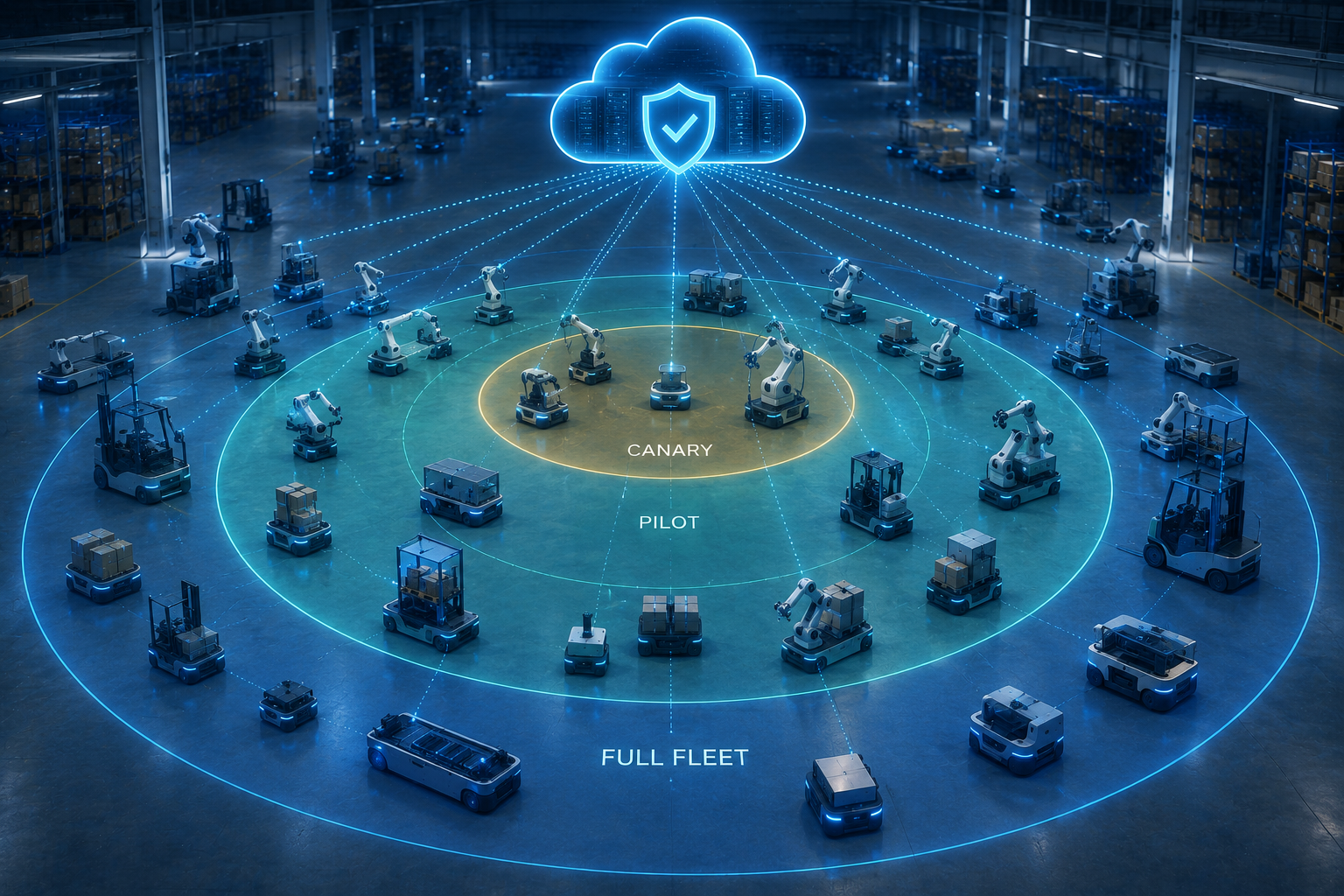
A mature staged rollout for a safety-rated robot fleet generally moves through four population tiers. First, a small internal canary set of robots operating in a controlled test cell, where engineers can directly observe behavior and where a fault causes no real-world harm. Second, a pilot cohort of production robots at a small number of sites that have opted into early updates and where operators have been briefed to watch for anomalies. Third, a broader regional rollout to a meaningful percentage of the fleet, gated by automated monitoring of safety-relevant metrics. Fourth, the full fleet rollout, which only proceeds once the prior tiers have run long enough to catch issues that only appear under real operating conditions, such as unusual lighting, novel obstacles, or edge-case network conditions.
| Rollout Tier | Population Share | Minimum Soak Time | Gate to Advance |
|---|---|---|---|
| Canary (internal test cell) | Under 1 percent | 48 to 72 hours | Zero safety-function regressions in scripted scenarios |
| Pilot cohort | 2 to 5 percent | 1 to 2 weeks | No anomalous e-stop or fault-log spikes |
| Regional rollout | 20 to 40 percent | 2 to 4 weeks | Telemetry parity with pre-update baseline |
| Full fleet | 100 percent | Ongoing monitoring | Formal sign-off from safety engineering |
Each gate should be tied to objective, pre-defined criteria rather than a subjective judgment call made under commercial pressure to ship. Robotics teams that skip this discipline, usually because a customer is pushing for a fast fix to an unrelated bug, are the ones most likely to end up rolling an update back across an entire fleet after the fact.
Regression Testing Against Safety Requirements
Staged rollout limits exposure, but it does not by itself tell you whether an update is safe; it only limits how many robots are affected while you find out. The evidence that actually answers the safety question comes from regression testing that is explicitly mapped to the original safety requirements, not just general functional testing.
This means maintaining a living traceability matrix that links each safety requirement in the original case (for example, “the robot shall stop within X milliseconds of an object entering the reduced-speed zone”) to one or more automated test scenarios that exercise that exact requirement. Every candidate OTA update runs against the full safety-requirement test suite in simulation first, then against a subset of physical test rigs that represent different hardware revisions in the fleet, since a fleet accumulated over several years rarely has fully uniform hardware.
Three categories of regression are worth testing for explicitly: functional regressions, where the update changes an output such as stopping distance or force threshold; timing regressions, where the update slows down a safety-critical control loop even without changing its logical output, which matters enormously for anything running on a real-time control cycle; and interaction regressions, where the update behaves correctly in isolation but interacts badly with another subsystem, a common failure mode when perception model updates change confidence thresholds that downstream planning logic silently depends on.
- Map every safety requirement to at least one automated regression test before the update ships.
- Run the full safety-requirement suite in simulation prior to any physical rollout tier.
- Test against every hardware revision present in the live fleet, not just the newest one.
- Treat timing and latency regressions as seriously as output-value regressions on real-time control loops.
Rollback and Kill-Switch Mechanisms
No regression suite catches everything, which is why the second pillar of safe OTA is the ability to reverse a bad update quickly and reliably, ideally without requiring a technician to physically visit the robot. Rollback design deserves as much engineering attention as the forward update path, because a rollback mechanism that itself fails during an incident turns a software problem into a fleet-wide outage or, worse, leaves robots running in an undefined intermediate state.
Effective designs use an A/B partition scheme, where the robot always has a known-good previous image available and boots into it automatically if a post-update health check fails, combined with a remote kill-switch that can force a subset of the fleet into a safe, stationary state independent of the update mechanism itself. Cryptographic signing of every update image, verified before installation, prevents a compromised or corrupted update package from being accepted in the first place, which matters both for safety and for security, since the two increasingly overlap in fleet robotics.
| Mechanism | What It Protects Against | Recovery Time |
|---|---|---|
| Dual-partition A/B boot | Failed or corrupted update installation | Seconds, automatic |
| Signed image verification | Tampered or unauthorized update packages | Instant rejection before install |
| Remote fleet-wide kill switch | Widespread behavioral regression post-update | Minutes across a full fleet |
| Automatic health-check rollback | Update passes install but fails runtime self-test | Under one minute per unit |
Anatomy of a Safety-Gated OTA Pipeline
A candidate update moves from simulation regression testing, through a signed build and canary deployment, into a pilot cohort with live telemetry gating, and finally to full fleet rollout, with an automatic rollback path available at every stage and a change-control record generated at each gate.
Regulatory Documentation and Change Control
Engineering controls only satisfy a regulator or an internal safety board if they are documented in a way that creates an auditable trail. This is the part of OTA governance that engineering teams most often under-invest in, because it produces no visible product feature, yet it is frequently the deciding factor in how quickly a company can respond to a post-incident inquiry or a certification body’s periodic audit.
A defensible documentation practice records, for every OTA release: the specific safety requirements affected, the regression test results mapped to those requirements, the rollout tier schedule and the telemetry thresholds used as advance gates, the identity and role of the engineer who approved production rollout, and a version-locked record of exactly which robots received which build and when. This last point matters more than it sounds: during an incident investigation, being able to state with certainty which software version a specific robot was running at a specific timestamp is often the single most important piece of evidence.
Digital provenance records, the kind of cryptographically verifiable build and deployment history increasingly expected across robotics supply chains, make this documentation far less burdensome to maintain. Teams building this kind of audit trail benefit from the broader practices described in our piece on digital provenance in robotics, which covers how provenance certificates are constructed and verified across a robot’s software supply chain.
Common mistake
Treating an OTA update as purely an IT deployment problem and routing it through a release pipeline that has no visibility into which safety requirements the change touches. The result is that a perception model tweak or a firmware patch ships with normal software QA sign-off but without anyone in the safety engineering function ever reviewing it, and the safety case quietly becomes stale without a single person deciding that it should.
What worked
Fleets that assign every OTA release a mandatory safety-impact classification step before it can enter the build pipeline, performed jointly by a release engineer and a safety engineer, consistently catch requirement-relevant changes earlier and spend far less time on emergency rollbacks than fleets that classify impact only after a field incident.
Building an OTA Governance Program
Pulling these pieces together into an operating program, rather than a collection of good ideas, requires clear ownership. Most mature robotics operators now designate a specific role, often called a release safety officer or fleet change-control lead, whose sole job is to approve or block progression through rollout tiers based on the regression and telemetry evidence, independent of the commercial pressure to ship. This separation of duties mirrors long-established practice in aviation and automotive software, both of which learned the same lesson decades earlier: the person who wants the update to ship on schedule should not be the same person who decides whether it is safe to ship.
Fleets operating across multiple regulatory jurisdictions add another layer of complexity, since an update that is a minor configuration change under one region’s framework might be classified as a significant modification requiring re-certification under another. Teams building or auditing this kind of software stack often also need visibility into the underlying middleware; readers working with ROS-based fleets can find complementary operational guidance in our coverage of running ROS 2 in production environments, and teams whose robots operate at higher functional-safety integrity levels should also consult our dedicated look at functional safety engineering for robots.
Frequently Overlooked Details
- Configuration driftFleets accumulate hardware revisions over years, so an update validated on new units may behave differently on older sensor or actuator batches.
- Network partition behaviorRobots that lose connectivity mid-update need a defined, tested fallback state rather than an assumption that connectivity will simply return.
- Third-party dependency updatesOperating system and middleware patches pulled in automatically can alter timing behavior even when the robot’s own application code has not changed.
- Human factors retrainingAn update that changes robot behavior in ways operators can perceive, such as different pause patterns, should trigger a briefing so staff do not misread the change as a malfunction.
- Audit trail continuityVersion records must survive fleet-management platform migrations, vendor changes, and personnel turnover, or the documentation trail that regulators expect quietly disappears.
- Safety case
- A structured, evidence-backed argument that a specific robot configuration operates within an accepted level of risk for a defined use case and environment.
- Canary rollout
- Deploying a software update to a small, closely monitored subset of a fleet before wider release, so problems surface with minimal exposure.
- Regression testing
- Re-running a defined set of test scenarios after a software change to confirm that previously verified behavior, including safety-relevant behavior, has not degraded.
- A/B partition boot
- A device architecture that keeps a known-good previous software image available so it can boot back into it automatically if a new update fails.
- Change control
- The formal process of documenting, reviewing, and approving modifications to a certified system so that every change is traceable and accountable.
Key Takeaways
- A safety case is tied to a specific software and hardware configuration, so any OTA update is potentially a safety-relevant change, not just an IT deployment.
- Staged, ring-based rollouts limit the blast radius of a bad update and create checkpoints for reviewing safety-relevant telemetry before wider release.
- Regression tests must be explicitly mapped to the original safety requirements, not just general functionality, and should run in simulation before any physical rollout.
- Rollback mechanisms, including A/B partition boots and remote kill switches, need to be engineered and tested as rigorously as the forward update path.
- Documentation that ties every release to specific safety requirements, test results, and deployed robot versions is what makes an OTA program defensible during an audit or incident review.
- Separating the role that approves rollout progression from the role under commercial pressure to ship reduces the chance that safety review gets skipped.
- Fleets operating across regulatory jurisdictions need to classify updates according to each region’s own definition of a significant modification.
FAQs
Does every OTA update require full safety re-certification?
No. Most updates affect non-safety-rated features and only need standard software quality assurance. The key is a documented impact assessment for every release that decides, with evidence, whether a given change touches a safety function and therefore needs regression testing against the original safety requirements.
What is a staged or ring-based rollout in robotics fleets?
It is a deployment strategy that pushes an update first to a small internal test group, then a small pilot cohort of production robots, then a larger regional group, and finally the full fleet, with monitoring gates between each stage so problems are caught before they affect every deployed robot.
How do rollback mechanisms work for robot software updates?
Most fleets use a dual-partition design where the robot keeps its previous known-good software image available and automatically boots back into it if a post-update health check fails, combined with a remote kill switch operators can trigger to halt a wider group of robots if a regression appears after deployment.
Why can a firmware patch invalidate a safety case even if it fixes a bug?
Because a safety case certifies a specific configuration, and a patch changes that configuration even when its intent is unrelated to safety. Timing changes, altered fault-handling paths, or shifted sensor thresholds can affect certified behavior in ways the patch author never intended or tested for.
Who should approve an OTA release for a safety-rated robot fleet?
Mature programs assign approval to a dedicated safety or change-control role that is separate from the team under pressure to ship quickly. This separation of duties mirrors long-standing practice in aviation and automotive software and reduces the risk that safety review gets skipped under deadline pressure.
How is regression testing different from normal software testing for OTA updates?
Regression testing for safety-rated fleets is explicitly mapped to the original certified safety requirements through a traceability matrix, rather than testing general functionality. Every requirement needs at least one automated test scenario, run in simulation first and then on representative physical hardware revisions in the fleet.
What documentation do regulators expect for fleet software updates?
Expect to document the safety requirements a release affects, the regression evidence gathered, the rollout schedule and telemetry gates used, who approved production release, and a version-locked record of exactly which robots ran which software build at any given time, since this evidence is central during incident investigations.
Can OTA updates be paused or reversed after they start reaching a fleet?
Yes, well-designed pipelines include automatic halt conditions tied to telemetry thresholds, plus a manual remote kill switch operators can trigger at any rollout tier. Combined with automatic rollback on failed health checks, this lets teams stop or reverse a problematic release before it reaches the full fleet.
Do older robots in a fleet need separate testing from newer units?
Yes. Fleets accumulate different hardware revisions over years of deployment, and an update validated only on the newest hardware batch can behave differently on older sensor or actuator components, so representative testing across hardware revisions already in the field is an essential part of the regression process.
For readers building out the broader governance stack around fleet software, our companion pieces on the robotics standards landscape by region and how insurers are pricing risk for autonomous machines cover adjacent parts of the same governance picture.
- Robot OTA Update Platforms Market Research Report, Dataintelo
- OTA Update Standards: Ensuring IoT Devices Stay Current in 2026, NGTECO
- Robot Fleet Management Software Guide 2026, CobotFinder
- Reliable Real-Time Deployment of Robot Safety Updates, EP4198714A1, European Patent Office