The digital landscape is currently defined by a tug-of-war between two distinct modes of consumption: the rapid-fire, dopamine-driven scroll of short-form content and the immersive, time-intensive engagement of long-form media. For years, pundits predicted the death of the attention span, arguing that the rise of TikTok, Instagram Reels, and YouTube Shorts would render long-form articles, podcasts, and video essays obsolete. Yet, as we move through 2026, the reality has proven far more complex.
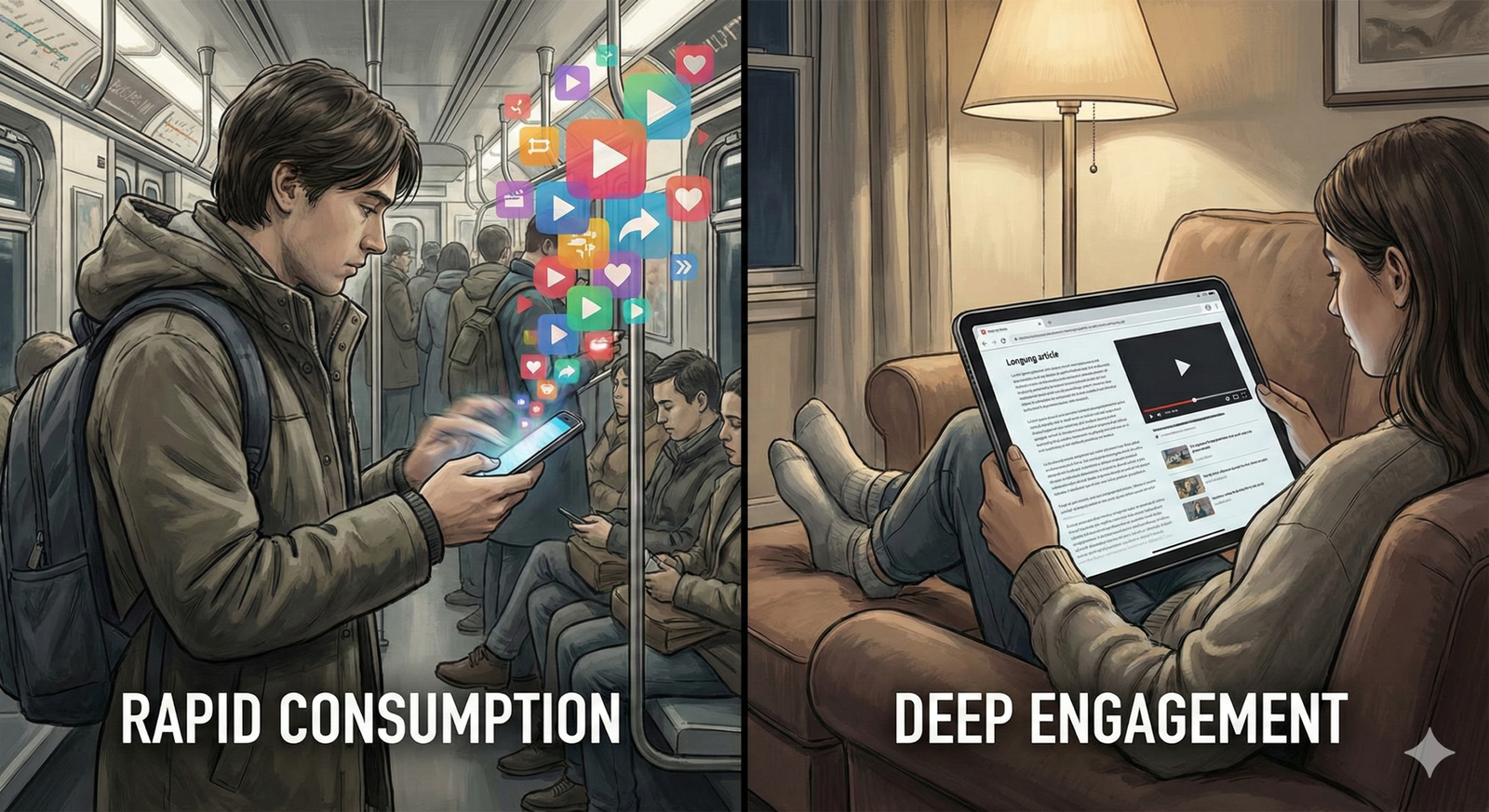
We are not witnessing the extinction of depth; rather, we are seeing a bifurcation of user behavior. Audiences are becoming increasingly “bimodal” consumers—snacking on micro-content throughout the day while reserving specific blocks of time for deep-dive “feasting” on substantial material. Understanding this dichotomy is no longer just an academic exercise in media psychology; it is a survival requirement for creators, brands, and platforms alike.
In this guide, “short-form content” refers to media designed for immediate consumption (typically videos under 60 seconds, social posts under 280 characters, or images), while “long-form content” refers to material requiring sustained attention (videos over 10 minutes, podcasts, newsletters, and articles over 1,000 words).
Key Takeaways
- The Bimodal Consumer: Modern users oscillate between “lean-forward” rapid scrolling and “lean-back” immersive consumption depending on context, device, and time of day.
- The Trust Gap: Short-form drives immense reach and awareness (breadth), while long-form builds authority, loyalty, and parasocial connection (depth).
- Search vs. Discovery: Short-form is largely algorithmically pushed (discovery), whereas long-form is often sought out via search intent or subscription (destination).
- Platform Hybridization: Major platforms (YouTube, TikTok, X) are prioritizing features that bridge the gap, encouraging creators to use short clips as funnels into longer experiences.
- Cognitive Load: Short content minimizes cognitive effort but increases context-switching fatigue; long content requires high initial effort but offers cognitive closure and satisfaction.
- Monetization Physics: Short-form relies on volume and brand deals; long-form supports higher CPMs, direct consumer support, and subscription models.
The Psychology of Consumption: Snacking vs. Dining
To understand how people consume content, we must first understand why they choose a specific format at a specific moment. The choice between watching a 15-second skit or a 30-minute documentary is rarely accidental; it is driven by neurochemistry and environmental context.
The Dopamine Loop (Short-Form)
Short-form consumption is predicated on the “variable reward schedule,” a concept borrowed from behavioral psychology (and slot machines). When a user opens a feed of short videos:
- Uncertainty: They do not know if the next swipe will yield something funny, shocking, educational, or boring.
- Instant Gratification: If the content hits the mark, the brain releases a quick hit of dopamine.
- Low Barrier to Entry: The “cognitive cost” of watching a 15-second clip is near zero. If it’s bad, the user has only lost seconds of their life.
- The Flow State: The seamless transition between clips creates a “flow state” where time perception distorts, leading to the phenomenon of losing hours to an app while feeling like only minutes have passed.
The Oxytocin and Connection Loop (Short-Form vs Long-Form Content)
Long-form content operates on a different psychological mechanism. It requires an upfront investment of time and mental energy from the user.
- Narrative Transportation: Long-form allows for storytelling that transports the viewer/reader into the narrative. This state is associated with higher retention and emotional impact.
- Para-social Bonding: Spending 45 minutes listening to a podcaster creates a sense of intimacy and friendship (oxytocin) that a 30-second clip rarely achieves. This is why podcast listeners are often the most loyal customer base.
- Intellectual Satisfaction: Long-form content provides “closure.” Unlike the endless open loops of a short-form feed, a long essay or video essay explores a topic, provides nuance, and concludes, giving the consumer a sense of completion and accomplishment.
Contextual Usage
The device and the environment dictate the format.
- The “In-Between” Moments: Short-form dominates the “transition times”—commuting, waiting in line, or the five minutes before a meeting starts. Mobile devices are the primary vehicle here.
- The “Destination” Moments: Long-form dominates the “dedicated times”—evenings, weekends, or during tasks that allow for background listening (driving, cooking). Connected TVs (CTVs) and desktops play a larger role here.
Defining the Formats in 2026
As of early 2026, the lines have blurred slightly, but distinct categories remain based on user expectation and platform constraints.
Short-Form Content Ecosystem
- Vertical Video: TikTok, Instagram Reels, YouTube Shorts. Usually under 90 seconds. Highly visual, fast-paced editing, captions for sound-off viewing.
- Micro-Blogging: X (formerly Twitter), Threads, Bluesky. Character-limited thoughts, memes, and real-time reactions.
- Stories: Ephemeral content (Instagram/Snapchat) that disappears after 24 hours. Used for behind-the-scenes updates and casual interaction.
Long-Form Content Ecosystem
- Horizontal Video: YouTube, Vimeo, Streaming Services. Ranging from 10 minutes to several hours. Includes video essays, tutorials, documentaries, and vlogs.
- Audio/Podcasts: Spotify, Apple Podcasts. Episodic content often running 30–90 minutes.
- Written Content: Newsletters (Substack, Ghost), SEO Articles, Whitepapers, eBooks. Content that takes 5+ minutes to read.
- Live Streams: Twitch, YouTube Live. Unedited, real-time engagement often lasting hours.
The Attention Span Myth
A pervasive myth in marketing circles is that “human attention spans have dropped to less than that of a goldfish” (often cited as 8 seconds). This is a misunderstanding of the data.
Humans do not have shorter attention spans; we have higher filters.
Because the volume of content has exploded, our tolerance for irrelevant or boring content has plummeted. We evaluate content faster (within the first 2–3 seconds), but once our interest is piqued, we are capable of binge-watching a 10-hour docuseries or listening to a 3-hour podcast interview without breaking focus.
The “Contextual Attention” Model
This model suggests that attention is not a fixed resource but a variable one dependent on value.
- High-Filter Mode: When scrolling a feed, the user is in high-filter mode. They are looking for a reason to skip.
- High-Focus Mode: When a user clicks a specific YouTube thumbnail or opens a newsletter they subscribe to, they enter high-focus mode. They have already “bought in” and are willing to lend their attention.
Implication: The challenge for creators is not just making things short; it is mastering the “hook” to pass the high-filter test, regardless of the format’s eventual length.
Platform Dynamics: The Battle for Time
The major platforms have recognized that dominating only one format is a vulnerability. Consequently, we are seeing a massive convergence in platform functionality.
YouTube: The Hybrid King
YouTube remains the dominant force in long-form video, but its integration of Shorts has changed consumption habits.
- The Funnel: Successful channels now use Shorts as a discovery engine. A viral Short introduces a new viewer to the creator’s personality. The algorithm then serves that viewer a long-form video from the same creator.
- TV Screens: As of 2026, a significant percentage of YouTube watch time occurs on television screens. This shift favors longer, higher-production value content that resembles traditional TV programming.
TikTok: Stretching the Limits
TikTok, originally the king of the 15-second dance craze, has aggressively pushed into longer formats.
- Search Engine Behavior: Gen Z and Gen Alpha increasingly use TikTok as a search engine. To satisfy search intent (e.g., “how to fix a leaky faucet” or “history of the Roman Empire”), creators are making multi-minute videos.
- Series and Paywalls: To compete with YouTube, TikTok has incentivized longer uploads (up to 10–30 minutes in some regions) to keep users on the app rather than bouncing to a video hosting site.
Text Platforms: The Newsletter Renaissance
While short-text platforms (X/Threads) rely on outrage and breaking news, the newsletter economy (Substack/Beehiiv) has proven that people will read 3,000 words if the voice is unique.
- Email as a Sanctuary: The inbox is seen as a calmer, more controlled environment compared to the chaotic social feed. Long-form text thrives here because it feels like a personal letter rather than a public shout.
Strategic Implications: Reach vs. Resonance
For businesses and creators, the choice between short-form vs long-form content is not binary; it is strategic. It depends on the specific KPI (Key Performance Indicator) being targeted.
Short-Form for Reach (Top of Funnel)
Short-form is the most efficient vehicle for brand awareness.
- Virality: The algorithms for Reels and Shorts are designed to push content to “non-followers.” You can have zero followers and get 1 million views if the content is engaging.
- Trend Jacking: It is easier to hop on trending audio or visual formats to gain quick visibility.
- Low Production Cost: It is cheaper and faster to produce, allowing for higher frequency testing.
The Downside: Reach does not equal influence. A user might watch 50 Shorts in a row and not remember a single creator’s name. Conversion rates from viral shorts are notoriously low because the user is in a “passive consumption” mode.
Long-Form for Resonance (Middle/Bottom of Funnel)
Long-form is the engine of trust and conversion.
- Authority Building: You cannot demonstrate deep expertise in 60 seconds. Long-form allows creators to show their work, explain complex nuances, and prove their value.
- Community Building: Comment sections on long-form videos or newsletters are often more substantive. The audience feels a shared journey.
- SEO Longevity: Long-form blogs and YouTube videos are evergreen. They continue to accrue views via search traffic for years, whereas a Tweet or TikTok usually “dies” within 48 hours.
The Downside: Growth is slow. The algorithms rarely push long content to “cold” audiences as aggressively as short content. It requires patience and consistency.
The Unified Strategy: The Content Pyramid
The most effective strategy in the current landscape is the “Content Pyramid” or “Waterfall” method:
- Core Content (Long-Form): Create one substantial piece of content (e.g., a video interview or a comprehensive guide).
- Repurposing (Short-Form): Slice that core content into 5–10 short clips, quotes, or tweets.
- Distribution: Post the shorts on TikTok/Reels/Shorts with a “Link in Bio” or “Watch Full Video” Call-to-Action (CTA).
- Feedback Loop: Use the comments on the Shorts to see what questions people have, which informs the next piece of Long-Form content.
Generational Consumption Habits
While we must avoid monolithic stereotypes, distinct patterns have emerged across generations regarding short-form vs long-form content.
Gen Alpha and Gen Z
- Multimodal: They are the most fluid, switching instantly between a 15-second meme and a 3-hour video essay on a niche topic (e.g., video game lore or sociological analysis).
- Audio/Video Preference: They prefer video and audio over text for learning. “How to” queries go to YouTube/TikTok, not Google Search text results.
- Authenticity over Polish: They tolerate lo-fi production in long-form if the speaker is authentic, but demand high-stimulation editing in short-form.
Millennials
- The Podcast Generation: Millennials are the primary drivers of the podcast boom. They value “passive learning” via audio while multitasking (parenting, working, commuting).
- Nostalgia and Deep Dives: They consume long-form content that deconstructs cultural phenomena or revisits media from their youth.
- Utility: They use short-form largely for entertainment or quick life hacks (cooking, DIY).
Gen X and Boomers
- Text Loyalists: Still the demographic most likely to read full news articles and long-form blog posts.
- Facebook/YouTube Heavy: Their short-form consumption largely happens on Facebook Reels or YouTube Shorts rather than TikTok.
- TV-Centric: They are driving the shift of YouTube from the desktop to the living room TV, consuming it like traditional broadcast television.
The Role of Algorithms in Shaping Habits
We cannot discuss consumption habits without acknowledging the invisible hand of the algorithm. Algorithms do not just reflect our preferences; they shape them.
The “Completion Rate” Bias
Algorithms prioritize “watch time” and “completion rate.”
- In Short-Form, the algorithm optimizes for loops. If a video is watched twice, it goes viral. This encourages fast pacing, quick cuts, and looping audio.
- In Long-Form, the algorithm optimizes for “session time.” It wants to keep the user on the platform. If a 20-minute video keeps a user on YouTube for 20 minutes, it is valued highly, even if it has fewer raw clicks than a 30-second video.
The Echo Chamber Effect
Because short-form algorithms react so quickly to micro-signals (stopping to hover on a video for 1 second), they can rapidly pigeonhole users into niche content bubbles. Long-form consumption, being more intentional (often driven by search or subscription), allows users slightly more agency in breaking out of these algorithmic loops.
Common Pitfalls for Creators and Brands
When navigating the short-form vs long-form content landscape, many entities make critical errors.
1. The “Cut-Down” Trap
Simply taking a random 60-second slice of a long video and posting it as a Short often fails. Short-form requires its own native structure (Hook → Value → Twist/CTA). A clip that works in the context of a 20-minute discussion may be confusing or boring in isolation.
2. Neglecting the “Bridge”
Creators often get viral success on Shorts but fail to convert those viewers to their long-form channel. This happens when the content styles are too different. If your Shorts are high-energy comedy but your long-form is slow, dry analysis, the audience will not bridge the gap.
3. Over-Indexing on Vanity Metrics
It is easy to get addicted to the view counts of short-form video. A million views on a Short might feel like success, but if it drives zero sales or subscriptions, it is a “vanity metric.” Conversely, a long-form video with 5,000 views might generate significant revenue through high-intent leads.
The Rise of “Mid-Form” Content
An emerging trend is the resurgence of “mid-form” content—videos roughly 5 to 15 minutes long.
- The “Goldilocks” Zone: This length is short enough to watch during a lunch break but long enough to tell a complete story with nuance.
- Vlog Resurgence: The “day in the life” vlog format, which lost popularity to 15-second clips, is returning as audiences crave the deeper connection of mid-form storytelling without the commitment of a movie-length video.
Future Trends: What Lies Ahead?
Looking forward, the distinction between short and long may become even more fluid due to technological advancements.
AI Summarization and Expansion
Artificial Intelligence tools are increasingly allowing users to toggle between formats. A user might see a long article and ask an AI agent to “summarize this in 3 bullets” (turning long into short). Conversely, a user might see a short news clip and ask an AI to “find the full context and history of this event” (turning short into long). This puts the power of format explicitly in the hands of the consumer.
The Slow Content Movement
As a reaction to digital burnout and “doomscrolling,” there is a growing counter-culture movement toward “Slow Content.” This involves deliberate consumption of very long, unedited, or slow-paced media (e.g., slow TV, ambient livestreams, long-read journalism) as a form of digital detox and mental health preservation.
Interactive and Shoppable Media
Both formats are becoming more transactional. Short-form is integrating direct shopping features (TikTok Shop), turning consumption into immediate commerce. Long-form is integrating interactive elements (polls, branching narratives) to maintain engagement over longer durations.
Conclusion
The debate of short-form vs. long-form content consumption habits is not a zero-sum game where one format wins and the other dies. Instead, the digital ecosystem has evolved into a diverse landscape where both formats serve essential, complementary functions.
Short-form content is the scout; it explores, captures attention, and provides immediate entertainment or utility. Long-form content is the settler; it builds infrastructure, deepens relationships, and provides intellectual nourishment.
For the modern consumer, the “skill” of digital literacy involves knowing when to snack and when to feast—managing one’s own attention to ensure that the ease of the scroll doesn’t atrophy the capacity for deep thought. For creators and businesses, success lies not in choosing a side, but in mastering the ecosystem: using the spark of short-form to ignite the fire of long-form loyalty.
Next Steps for Readers: If you are a creator, audit your content strategy. Are you over-indexed on reach (Shorts) with no depth? Or are you creating great depth (Long-Form) that no one discovers? Balance the scale. If you are a consumer, audit your screen time. Are you spending hours snacking without ever feeling full? Consider intentionally scheduling “deep dive” sessions to reclaim your attention span.
FAQs
Q: Does short-form content actually ruin attention spans? A: It creates a habit of rapid context switching and a desire for immediate dopamine, which can make “slow” tasks feel harder. However, it doesn’t permanently damage the brain’s capacity for focus, provided the individual practices deep focus activities (reading, long-form watching) regularly to maintain that “muscle.”
Q: Which format is better for making money? A: Long-form generally offers better monetization stability. Advertisers pay more for mid-roll slots in long videos (higher CPMs), and loyal audiences are more likely to buy merchandise or join Patreon. Short-form requires massive volume to generate significant ad revenue, though it can be lucrative for brand sponsorship deals.
Q: How long should a “long-form” video be in 2026? A: There is no magic number, but the trend is leaning longer. While 10 minutes used to be the benchmark, videos in the 20–40 minute range are performing exceptionally well on YouTube, as they are increasingly consumed on TV screens like episodes of a show.
Q: Can I grow a brand using only short-form content? A: Yes, you can grow a large following (brand awareness), but it is difficult to build deep brand loyalty or “superfans” using only short-form. Most “short-only” stars eventually pivot to long-form or merchandise to secure their business longevity.
Q: Is blogging dead in the face of video dominance? A: No. While video is dominant for entertainment, text remains the primary format for technical information, professional documentation, and B2B research. Furthermore, AI search integration (like Google’s AI Overviews) still relies heavily on indexing high-quality text content.
Q: What is the best way to convert short-form viewers to long-form? A: Do not just say “link in bio.” Use a “cliffhanger” strategy or a “knowledge gap” strategy. For example, present a fascinating problem in the Short, and mention that the comprehensive solution or the “part 2” detailed analysis is available on your main channel. Give them a specific reason to switch platforms.
Q: Why do some people prefer reading over watching video? A: Reading allows for faster scanning and information retrieval. A user can read a transcript faster than a speaker can talk. Reading also allows the consumer to control the pace, pause to reflect, and easily re-read complex sections, which gives a sense of control that video sometimes lacks.
Q: Will virtual reality (VR) change these habits? A: VR and AR (Spatial Computing) are introducing “immersive form” content. This isn’t necessarily defined by length but by presence. As of 2026, this is still a growing niche, but it tends to favor longer session times due to the setup required, similar to gaming or watching a movie.
References
- Google/YouTube Official Blog. (2025). The Living Room Shift: How Connected TV is Changing Watch Time. YouTube Official Blog. https://blog.youtube
- TikTok Newsroom. (2024). The Evolution of Creativity: Introducing Longer Video Formats. TikTok Newsroom. https://newsroom.tiktok.com
- Pew Research Center. (2024). Teens, Social Media and Technology 2024. Pew Research Center. https://www.pewresearch.org
- Ofcom. (2025). Media Nations: 2025 Report on UK Viewing Habits. Office of Communications. https://www.ofcom.org.uk
- American Psychological Association (APA). (2023). The Science of Attention: How Digital Media Impacts Focus. APA Monitor on Psychology. https://www.apa.org
- HubSpot. (2025). The State of Content Marketing 2025: Video Trends and Consumer Preferences. HubSpot Research. https://www.hubspot.com
- Nielsen. (2025). The Gauge: Streaming vs. Linear TV Usage Report. Nielsen Insights. https://www.nielsen.com
- Substack. (2024). The Rise of the Subscription Economy for Writers. Substack Blog. https://on.substack.com
- Journal of Experimental Psychology. (2022). The effects of short-form video application usage on cognitive abilities. APA PsycNet. https://psycnet.apa.org
- Netflix Media Center. (2025). Binge Watching Trends and Viewer Retention Statistics. Netflix Investors. https://ir.netflix.net