| Dimension | AWS | Azure | Google Cloud |
|---|---|---|---|
| Custom accelerator | Trainium2 (training), Inferentia2 (inference) | Maia AI accelerator (early stage); primarily Nvidia-based | TPU v6 (Trillium), the most mature custom AI chip lineage |
| Nvidia GPU depth | P5/P5e (H100/H200), strong but second to Azure’s scale | ND/NC-series, widely regarded as the deepest Nvidia fleet, including exclusive early access to newest chips | A3/A4 Nvidia instances alongside TPUs, broad but TPU-first strategy |
| Flagship managed AI service | Amazon Bedrock | Azure AI Foundry | Vertex AI |
| Model catalog breadth | 100+ models, curated toward production-ready choices | 1,700+ models, broadest catalog, exclusive first-party GPT access | 200+ models, deepest Gemini/Imagen/Veo integration |
Why This Comparison Is Different From a Storage or General Cloud Comparison
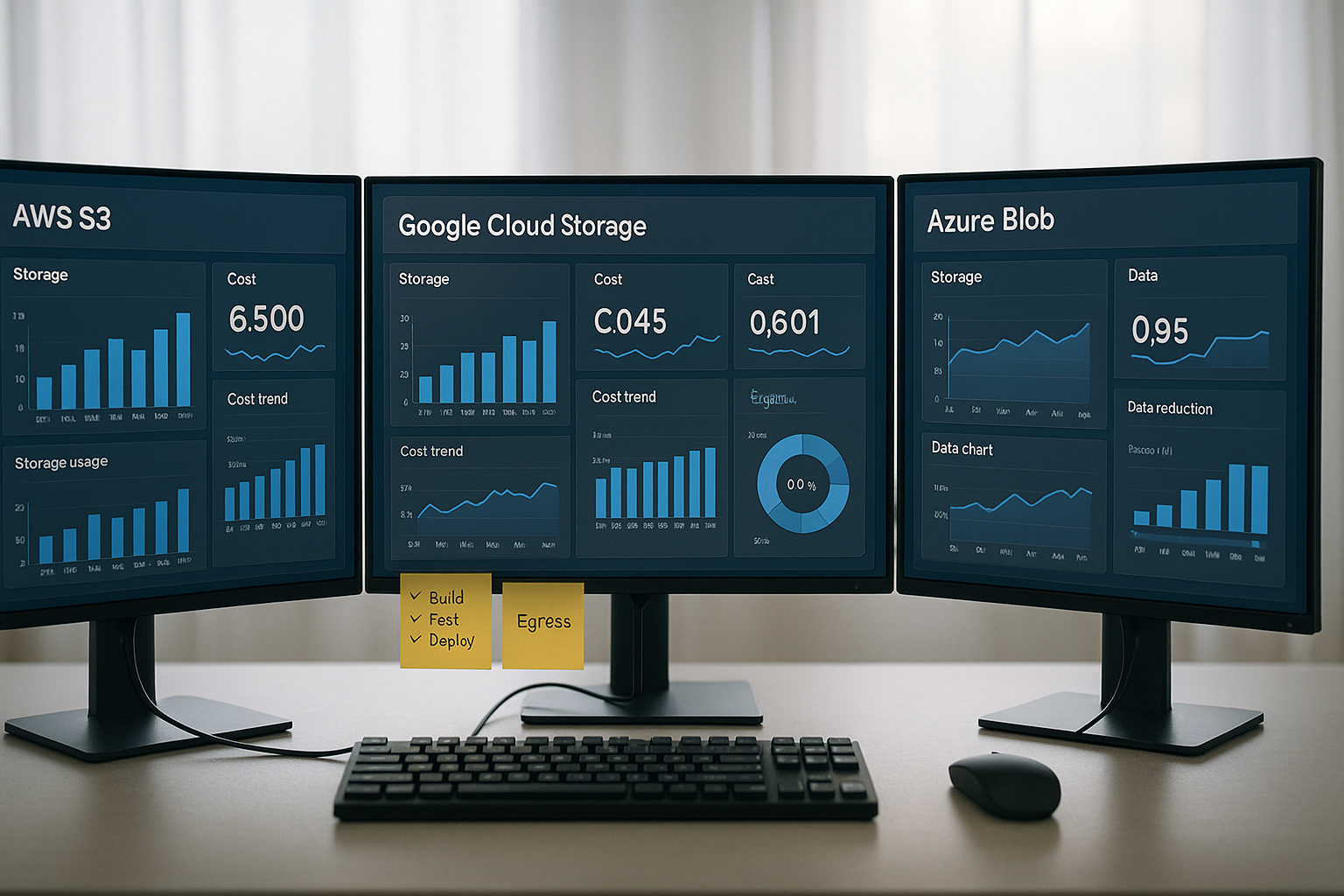
Comparing AWS, Azure, and Google Cloud for storage or general compute is a relatively stable exercise — durability numbers, egress fees, and regional footprints don’t change dramatically year to year. AI workloads are a different animal entirely. Accelerator pricing shifts with chip generations that ship every 12-18 months, managed AI service catalogs expand by hundreds of models in a single year, and the actual bottleneck for most teams — GPU or TPU availability — can matter more than any published price. This guide focuses specifically on the infrastructure layer that matters for training and running AI models at scale in 2027: accelerator hardware, managed AI platforms, and total cost of ownership. For readers coming from our broader storage-focused comparison of AWS S3 vs. Google Cloud Storage vs. Azure Blob, it’s worth noting that comparison covers object storage durability and pricing, not the compute-and-model-serving stack this article addresses — storage is one input to AI cost, not the deciding factor.
The Accelerator Landscape: Custom Silicon vs. Nvidia
Every major cloud now runs a two-track accelerator strategy: a deep bench of Nvidia GPUs for maximum compatibility and customer choice, plus a custom silicon program aimed at undercutting Nvidia on price-per-token for workloads that can be ported to it.
AWS Trainium and Inferentia
AWS has arguably pushed custom silicon the hardest of the three. Trainium2 is built for large-scale training, with AWS positioning its Trn2 UltraServer configurations to deliver tens of petaflops of aggregate training throughput and pricing roughly half of comparable Nvidia H100-based instances on a per-hour basis. Inferentia2 targets inference specifically, with AWS and independent cost analyses reporting inference costs in the range of $0.20-$0.50 per 1,000 inferences for Inferentia2-backed instances — a substantial discount versus general-purpose GPU inference for models that support the Neuron SDK’s compilation path. The tradeoff is real: Trainium and Inferentia require compiling models through AWS’s Neuron SDK, which has improved substantially but still lags Nvidia’s CUDA ecosystem in day-one framework and library compatibility for cutting-edge research code.
Google Cloud TPUs
Google’s TPU program is the most mature custom AI chip lineage of the three clouds, dating back the furthest and now on its sixth generation (Trillium/TPU v6). Google has published price-performance claims of roughly 4.7x better performance-per-chip over the prior generation and up to 67% lower inference power consumption compared to high-end Nvidia GPU alternatives for comparable workloads. In practical terms, running inference across a pod of TPU v5e-class chips has been benchmarked at a fraction of the hourly cost of an equivalent throughput of high-end Nvidia GPUs, though realizing that advantage requires workloads built on JAX or TensorFlow (PyTorch/XLA support has improved but is not universally at parity). TPUs remain deeply tied to Vertex AI and Google’s own training stack, which is precisely where Google wants enterprise AI workloads to land.
Azure and Nvidia
Microsoft has taken a different bet: rather than leading with custom silicon, Azure has built the deepest and broadest Nvidia GPU fleet of the three hyperscalers, including ND-series and NC-series virtual machines spanning H100, H200, and newer Nvidia generations, often with earlier availability than competitors due to Microsoft’s close partnership with Nvidia and its position as OpenAI’s primary infrastructure provider. Microsoft’s own Maia AI accelerator program exists but remains earlier-stage and far less central to Azure’s AI positioning than Trainium is to AWS or TPUs are to Google. For teams whose models and tooling assume CUDA compatibility out of the box — which is still the majority of open-source AI research code — Azure’s Nvidia-first approach minimizes porting friction at the cost of paying closer to Nvidia’s own pricing rather than a custom-silicon discount.
Figure 1: Accelerator Strategy by Cloud
AWS: broad Nvidia GPU catalog (P5/P5e) as the default, with Trainium2/Inferentia2 offered as a lower-cost, higher-effort alternative requiring Neuron SDK compilation. Azure: Nvidia GPUs (ND/NC-series) as the primary and most complete offering, with Maia as an early-stage, lower-profile custom accelerator. Google Cloud: TPUs as the flagship, most heavily marketed accelerator, with Nvidia A3/A4 instances offered in parallel for workloads that need CUDA compatibility.
The throughline: AWS and Google both offer meaningful custom-silicon cost advantages for compatible workloads, while Azure competes primarily on Nvidia GPU depth, availability, and its OpenAI relationship rather than a mature custom-chip discount.
Managed AI Services: Bedrock vs. Azure AI Foundry vs. Vertex AI
Beneath the infrastructure layer, each cloud offers a managed platform for building and deploying AI applications without directly managing accelerator clusters — this is where most enterprise teams actually interact with AI infrastructure day to day.
| Platform | Model catalog | Standout capability | Best fit |
|---|---|---|---|
| Amazon Bedrock | 100+ models: Claude, Llama, Mistral, Cohere, Amazon Titan/Nova | Serverless, model-agnostic API with strong latency for Claude/Llama workloads | Teams wanting one contract, broad model choice, and AWS-native integration |
| Azure AI Foundry | 1,700+ models including exclusive first-party OpenAI GPT access | Deepest enterprise/Microsoft ecosystem integration (Microsoft 365, Entra ID) | Enterprises standardized on Microsoft tooling, or needing frontier OpenAI models |
| Google Vertex AI | 200+ models, curated, Gemini/Imagen/Veo-anchored | Native TPU acceleration and strongest AutoML/MLOps tooling for custom training | Teams building and training custom models, multimodal use cases |
Amazon Bedrock’s core pitch is model-agnostic flexibility under a single AWS contract: rather than betting on one model family, Bedrock exposes a common API surface across Anthropic’s Claude, Meta’s Llama, Mistral, Cohere, and Amazon’s own Titan and Nova models, and current benchmarks show it delivering the lowest latency of the three platforms for Claude and Llama workloads specifically — useful for latency-sensitive production applications. Azure AI Foundry’s defining advantage is exclusivity: as the primary commercial channel for OpenAI’s frontier models, it offers access other clouds structurally cannot match, layered on top of Microsoft’s enterprise identity, compliance, and Microsoft 365 integration story. Vertex AI’s strength is at the other end of the pipeline — it is the strongest platform of the three for teams that want to fine-tune or fully train custom models rather than only calling a hosted API, with AutoML and native TPU access cutting training iteration time significantly for teams whose workloads fit Google’s tooling.
Total Cost of Ownership: Beyond the Sticker Price
The single most common mistake in AI infrastructure budgeting is pricing a project off the advertised per-GPU-hour rate alone. Industry cost analyses consistently show that GPU or TPU compute represents only 55-70% of total cost for training-heavy programs and 35-50% for inference-heavy programs — meaning budgets built purely on hourly accelerator rates understate real total cost of ownership by roughly 30-50% once data transfer, storage, orchestration, and utilization inefficiency are included.
The training-versus-inference split has also flipped. Inference now consumes roughly 80% of AI infrastructure budgets industry-wide, a dramatic shift from the training-dominated spending pattern of just two to three years ago, driven by the fact that a model is trained once but served for as long as it’s in production. At the same time, per-token inference costs have fallen sharply — commonly cited industry figures put the drop at roughly three orders of magnitude over three years, from around $20 to well under $1 per million tokens for comparable model classes — which means the same feature that was cost-prohibitive to ship in 2024 is often routine by 2027, but only if the serving infrastructure is chosen to match the workload’s actual shape.
| Stage | Typical monthly spend | Primary cost driver |
|---|---|---|
| Prototype / early development | $2,000 – $8,000 | On-demand GPU/TPU hours, small-scale experimentation |
| Production with real users | $10,000 – $30,000 | Inference serving volume, autoscaling overhead |
| Research-intensive training programs | $15,000 – $50,000+ | Large-scale training runs, data pipeline and storage costs |
Reserved or committed-use pricing materially changes these numbers — multi-year savings plans and reservations have been reported to bring effective GPU-hour costs down substantially versus on-demand rates, sometimes by 40-50%, which is why any serious TCO comparison across AWS, Azure, and Google Cloud has to model commitment terms rather than comparing on-demand list prices alone.
Figure 2: Where AI Infrastructure Budgets Actually Go
A stacked breakdown for a typical production AI workload in 2027 would show roughly 40-50% of spend on inference serving compute, 15-25% on training and fine-tuning compute, 15-20% on data storage and transfer (including the object storage layer discussed in our AWS S3/GCS/Azure Blob comparison), and the remainder split across orchestration, monitoring, and managed-service premiums layered on top of raw compute.
Choosing a Cloud for Training vs. Inference Workloads
Training and inference have different cost and infrastructure profiles, and the “best” cloud genuinely differs between them. For large-scale pretraining or fine-tuning runs where the workload can be ported to custom silicon, Google’s TPU pods and AWS’s Trainium2 UltraServers typically post the best price-performance, provided the model architecture and framework (JAX/TensorFlow for TPU, or a Neuron SDK-compatible framework for Trainium) align with the vendor’s tooling. For inference at scale, particularly for well-known model families, Inferentia2 and TPU-backed serving both offer meaningful discounts versus general-purpose GPU inference, while Bedrock’s Claude/Llama serving and Azure’s OpenAI-backed serving remain the most turnkey options when the priority is minimizing engineering effort rather than squeezing out the lowest possible unit cost. Teams building agentic, multi-model systems on top of any of these platforms should also weigh how the underlying orchestration layer scales, a topic covered in our analysis of scaling inference through hybrid compute strategies.
- Step 1Classify your workload as training-heavy, inference-heavy, or a mix, since the cost profile and the “best” cloud differ sharply between the two.
- Step 2Check framework compatibility with custom silicon before assuming a discount applies — Neuron SDK for Trainium/Inferentia and JAX/TensorFlow (or XLA-compatible PyTorch) for TPUs both require validation against your actual model code.
- Step 3Model total cost including data transfer, storage, and orchestration overhead — not just the advertised per-hour accelerator rate.
- Step 4Evaluate managed AI platforms (Bedrock, Azure AI Foundry, Vertex AI) against your actual model requirements — exclusive access to frontier models may outweigh a marginal infrastructure cost difference.
- Step 5Price out committed-use or reservation discounts before comparing clouds on-demand, since multi-year commitments can shift the cheapest option meaningfully.
- Step 6Pilot the highest-volume workload on your top two candidate clouds before signing a long-term commitment, since real-world utilization efficiency drives TCO more than any published benchmark.
Enterprise Integration and Ecosystem Considerations
Infrastructure and pricing rarely decide enterprise AI cloud selection on their own — existing organizational investment usually tips the scale. Enterprises already standardized on Microsoft 365, Entra ID, and Azure DevOps tend to gravitate toward Azure AI Foundry because it plugs directly into identity, compliance, and data governance tooling the organization already operates, independent of whether Azure’s raw compute pricing is the cheapest option available. Organizations with deep existing AWS footprints similarly favor Bedrock for the same reason — one contract, one IAM model, one set of existing compliance certifications extending naturally to AI workloads. Google Vertex AI tends to win specifically among teams doing heavier custom model development and training, or those already invested in Google’s data and analytics stack (BigQuery, Dataflow), where Vertex AI’s MLOps tooling and TPU access compound an existing platform advantage. None of this is unique to AI workloads — it echoes the same multi-cloud and vendor-lock-in tradeoffs organizations navigate broadly, a theme explored further in our piece on the rise of the AI orchestrator and the CIO’s changing role.
Common Mistakes
- Budgeting a training or inference project off the advertised per-GPU-hour price without accounting for data transfer, storage, and orchestration overhead that typically adds 30-50% to true cost.
- Assuming Trainium, Inferentia, or TPU discounts apply automatically without validating that your model and framework actually compile cleanly to that vendor’s custom silicon toolchain.
- Choosing a cloud purely on custom-silicon price-performance headlines while ignoring that inference now accounts for roughly 80% of AI infrastructure spend, making serving efficiency more important than training discounts for most production workloads.
- Comparing on-demand list prices across clouds while ignoring that reserved or committed-use pricing can shift the cheapest option by 40-50% or more.
- Overlooking that Azure’s core AI advantage is Nvidia GPU depth and exclusive OpenAI access rather than a mature custom-silicon cost discount, and evaluating it on the wrong axis as a result.
- Treating a narrow storage-cost comparison as a proxy for full AI infrastructure TCO, when storage is a modest fraction of total AI workload spend.
In Practice
Enterprises that get this decision right in 2027 typically run a deliberate multi-cloud AI strategy rather than a single-vendor bet, matching workload to accelerator rather than committing every workload to one cloud. A common pattern: production inference for well-supported open or partner models routes to whichever cloud offers the best custom-silicon price-performance match for that specific model family — often AWS Inferentia2 or Google TPU-backed serving — while frontier-model access for the highest-value use cases routes through Azure AI Foundry specifically for its exclusive OpenAI relationship, and custom model training and fine-tuning work concentrates on Google Vertex AI where the MLOps tooling and TPU access compound fastest. The discipline underlying this pattern is treating “which cloud is best for AI” as a workload-by-workload question rather than a single company-wide answer, and revisiting the allocation as accelerator generations and pricing shift roughly every 12-18 months.
Glossary
- Trainium
- AWS’s custom AI accelerator chip line purpose-built for large-scale model training, offered as a lower-cost alternative to Nvidia GPU-based training instances.
- Inferentia
- AWS’s custom AI accelerator chip line purpose-built for inference workloads, aimed at reducing per-inference cost compared to general-purpose GPU serving.
- TPU (Tensor Processing Unit)
- Google’s custom AI accelerator chip, now in its sixth generation (Trillium/TPU v6), tightly integrated with Google’s JAX and TensorFlow ecosystems and Vertex AI.
- Neuron SDK
- AWS’s software toolchain for compiling machine learning models to run on Trainium and Inferentia chips, required to access their cost advantages.
- Total Cost of Ownership (TCO)
- The full cost of running an AI workload, including compute, storage, data transfer, orchestration, and utilization inefficiency, rather than just the advertised hourly accelerator rate.
- Managed AI platform
- A hosted service (Amazon Bedrock, Azure AI Foundry, Google Vertex AI) that provides API access to foundation models and tooling for building AI applications without directly managing accelerator infrastructure.
- Committed-use discount
- A pricing arrangement where a customer commits to a set usage level over one to three years in exchange for a substantially reduced hourly rate versus on-demand pricing.
Key Takeaways
- AWS and Google Cloud both offer mature custom-silicon alternatives to Nvidia GPUs (Trainium/Inferentia and TPUs respectively) that can meaningfully undercut GPU pricing for compatible workloads.
- Azure competes primarily on Nvidia GPU depth and exclusive first-party OpenAI access rather than a mature custom-silicon cost advantage.
- Amazon Bedrock, Azure AI Foundry, and Google Vertex AI differ most in model catalog breadth, exclusivity, and MLOps depth rather than raw pricing alone.
- Inference now consumes roughly 80% of AI infrastructure budgets industry-wide, a reversal from the training-dominated spending pattern of just a few years ago.
- Published accelerator hourly rates typically understate true total cost of ownership by 30-50% once data transfer, storage, and orchestration overhead are included.
- Committed-use or reservation pricing can shift the cheapest cloud option by 40-50% or more, making on-demand price comparisons misleading on their own.
- Most sophisticated 2027 enterprise strategies allocate workloads across clouds by accelerator fit rather than committing every AI workload to a single vendor.
FAQs
Which cloud has the cheapest AI training in 2027?
For workloads compatible with custom silicon, Google TPUs and AWS Trainium2 typically offer the best price-performance for training, with Trainium2 pricing reported at roughly half of comparable Nvidia H100-based instances. The actual cheapest option depends heavily on whether your model framework ports cleanly to that vendor’s compilation toolchain.
Is Azure a worse choice for AI workloads since it lacks a mature custom AI chip?
Not necessarily. Azure’s strength is the deepest Nvidia GPU fleet of the three clouds plus exclusive first-party access to OpenAI’s frontier models, which matters more than a custom-silicon discount for teams whose priority is model quality and Nvidia/CUDA compatibility over raw price-per-token.
What is the real difference between Amazon Bedrock, Azure AI Foundry, and Vertex AI?
Bedrock offers a curated, model-agnostic catalog under one AWS contract with strong latency for Claude and Llama; Azure AI Foundry offers the broadest catalog (1,700+ models) plus exclusive OpenAI access; Vertex AI offers the deepest custom-training and MLOps tooling, anchored by Gemini and native TPU access.
Why has inference become more expensive to budget for than training?
Because a model is trained once but served continuously in production, inference now accounts for roughly 80% of AI infrastructure spend industry-wide, even though per-token inference costs have fallen sharply. Serving volume, not training cost, is now the dominant long-term budget driver for most production AI applications.
Do Trainium and Inferentia work with any machine learning model?
No. They require compiling models through AWS’s Neuron SDK, which supports a growing but still incomplete subset of popular frameworks and model architectures. Teams should validate compatibility before assuming the published cost advantages apply to their specific workload.
How much does reserved or committed-use pricing actually save on AI infrastructure?
Multi-year savings plans and reservations have been reported to reduce effective GPU-hour costs by 40-50% or more compared to on-demand rates, which is why any serious cross-cloud cost comparison needs to account for commitment terms rather than comparing on-demand list prices alone.
Should a startup pick one cloud for all its AI workloads?
Not necessarily. Many organizations now deliberately split workloads by accelerator fit — routing inference to whichever cloud has the best price-performance for that model family, and routing frontier-model or custom-training work to whichever platform has the exclusive access or tooling depth that workload needs.
Does object storage choice significantly affect AI workload total cost of ownership?
Only modestly. Storage and data transfer typically represent 15-20% of total AI infrastructure spend, well behind compute for training and inference, so storage-layer decisions like those covered in comparisons of AWS S3, Google Cloud Storage, and Azure Blob matter less to overall AI TCO than accelerator and managed-service choices.
References
- AWS. “AWS Trainium.” aws.amazon.com/machine-learning/trainium
- AWS. “AWS Inferentia.” aws.amazon.com/machine-learning/inferentia
- Google Cloud. “Cloud TPU.” cloud.google.com/tpu
- Microsoft Learn. “ND-Series Virtual Machines.” learn.microsoft.com/azure/virtual-machines/sizes/gpu-accelerated/nd-family
- AWS. “Amazon Bedrock.” aws.amazon.com/bedrock
- Microsoft. “Azure AI Foundry.” azure.microsoft.com/products/ai-foundry
- Google Cloud. “Vertex AI.” cloud.google.com/vertex-ai