| Myth | Reality |
|---|---|
| AI dubbing is just automated voiceover with subtitles read aloud. | Production-grade AI dubbing pipelines combine speech-to-speech voice conversion, timing alignment, and a separate visual re-animation pass that reshapes the speaker’s mouth and jaw movements to match the new language track. |
| Lip-sync re-animation replaces the actor’s face entirely. | Most deployed systems modify only the lower-face region frame by frame, keeping the rest of the original performance, lighting, and framing untouched. |
| AI dubbing is only used by small creators, not major studios. | Streaming platforms and dubbing vendors serving premium scripted catalogs now run AI-assisted stages inside otherwise human-supervised localization workflows. |
| One AI dubbing tool fits every use case. | Creator-facing tools optimize for speed and volume, while enterprise vendors optimize for performance fidelity, human review, and rights compliance, and the two categories are not interchangeable. |
What AI Dubbing and Lip-Sync Localisation Actually Involve
Traditional dubbing has always been a two-layer problem: translate the words, then find a voice actor whose performance can carry the emotional beats of the original scene. AI dubbing at scale adds a third layer that did not exist in the analog dubbing booth: visual re-animation of the speaker’s mouth so that the on-screen performance appears to match the new-language audio, even when the phoneme count and mouth shapes of the source and target languages are completely different. This is the piece that separates AI dubbing localization from ordinary machine translation or text-to-speech narration, and it is the piece most general audiences have never seen explained.
A full production pipeline generally runs through five stages: source transcription and diarization (splitting the audio by speaker), machine-assisted translation adapted for lip-flap timing rather than literal accuracy, voice conversion or voice cloning that preserves the original performer’s timbre and prosody, visual lip-sync re-animation applied to the video frames, and a human review and quality-control pass before the dubbed track ships. Vendors differ sharply in how much of that pipeline is automated versus supervised by human localization editors, dialogue directors, and voice actors, and that difference in supervision is the single biggest predictor of how a dubbed track actually sounds and looks in the finished product.
Voice Conversion Versus Full Voice Cloning
Two distinct approaches dominate the voice layer. Speech-to-speech conversion takes a human dub actor’s performance in the target language and converts the timbre toward the original performer’s voice, keeping a real actor’s comedic timing and breath work intact while making the result sound like the original star. Full voice cloning instead synthesizes the target-language line from text, using a voice model trained on the original performer, with no human dub actor in the loop at all. Enterprise dubbing vendors serving scripted film and television lean toward the first approach because it preserves a human performance underneath the synthetic timbre, while faster creator-tier tools lean toward the second because it is cheaper and requires no local-language voice talent.
Emotion-aware synthesis is the fastest-moving part of the voice layer right now. Instead of generating a flat reading of translated text, current systems condition the output on the original performance’s pitch contour, pacing, and emphasis, so a scream, a whisper, or a nervous laugh in the source language produces the equivalent emotional shape in the dubbed line rather than a monotone reading of the translated words.
How Visual Lip-Sync Re-Animation Works
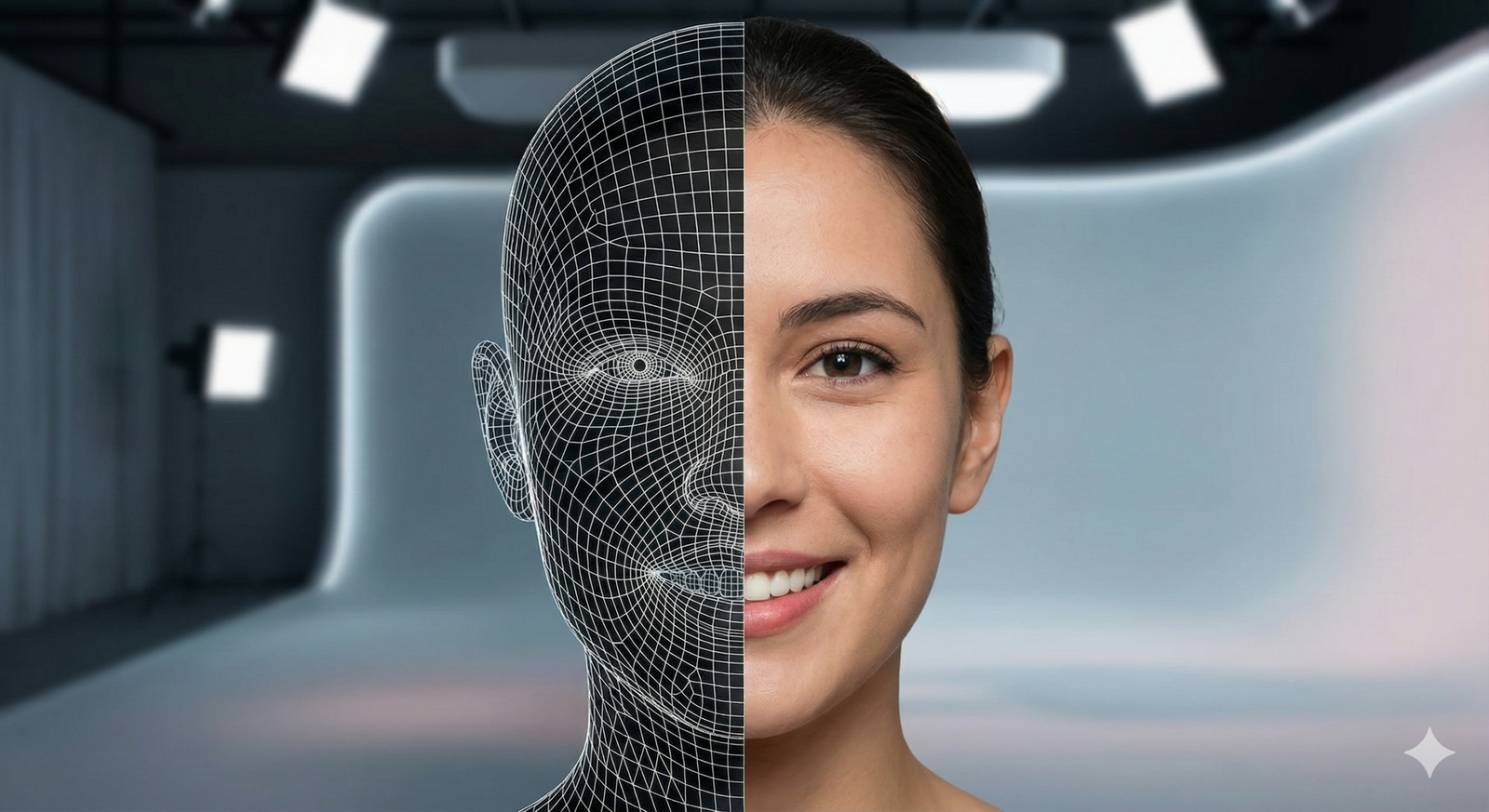
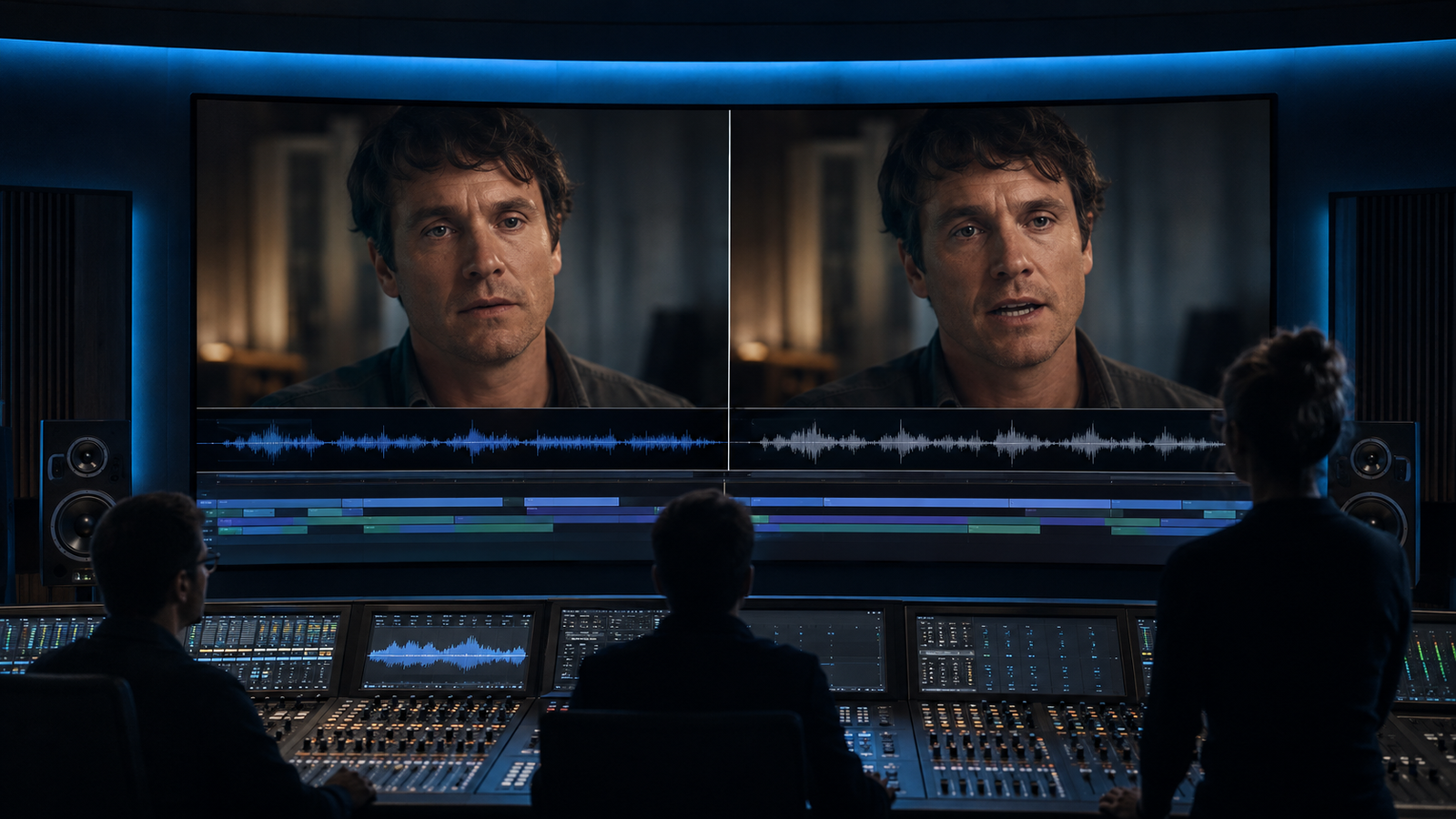
Visual re-animation models typically isolate the mouth and jaw region of a speaking face, predict a sequence of mouth shapes (visemes) that correspond to the phonemes in the new audio track, and then render those shapes back onto the original footage frame by frame, blending the edges so the change is not visible as a seam. The hard technical problem is not generating a plausible mouth shape for a single frame, it is maintaining temporal consistency across thousands of frames so the mouth movement looks like continuous speech rather than a flicker of separate images, while also preserving lighting, skin texture, camera motion, and any partial occlusion such as a hand or hair crossing the face.
This is fundamentally different from a full deepfake face swap. Re-animation pipelines built for dubbing intentionally constrain themselves to the lower-face region and avoid altering identity, expression above the mouth, or the rest of the frame, both because that scope is technically more tractable and because studios want the result to remain unambiguously a modified performance rather than a manufactured one.
| Pipeline Stage | What It Does | Primary Technical Challenge |
|---|---|---|
| Transcription and diarization | Splits source audio into per-speaker, per-line segments with timestamps | Overlapping dialogue and background noise reduce accuracy |
| Localization-aware translation | Adapts wording to match target-language syllable count and mouth-shape timing | Literal translation rarely fits the original lip-flap duration |
| Voice conversion or cloning | Produces target-language audio in the original performer’s timbre | Preserving emotional performance, not just voice texture |
| Visual lip-sync re-animation | Reshapes mouth and jaw movement frame by frame to match new audio | Temporal consistency and lighting continuity across the shot |
| Human review and QC | Dialogue director and editor approve or correct the automated output | Catching uncanny-valley artifacts before release |
Who Is Actually Deploying This, and Where
Reporting on Netflix’s 2026 localization program indicates the platform is running a growing share of new dubbed-language tracks through AI-assisted stages, primarily for quality-control transcription, timing adjustment, and voice-matching on incidental and background characters rather than lead performances, with a program described in industry coverage as using automated voice-and-face matching to keep dubbed audio aligned with on-screen performance. That is a meaningfully more conservative deployment pattern than the marketing language around “AI dubbing” often implies: the highest-profile, highest-budget dialogue is still human-directed, while the automation is concentrated on the long tail of secondary lines that would otherwise be expensive to dub at all.
Not every rollout has gone smoothly. Amazon Prime Video quietly pulled AI-dubbed Korean drama tracks in 2024 after Spanish-speaking viewers criticized the results as flat and robotic, a reminder that lip-sync and voice-matching technology can be technically functional while still failing the basic test of sounding like a real performance. That single incident became a reference point across the localization industry for why enterprise vendors keep human dialogue directors in the loop rather than shipping fully automated tracks straight to a global audience.
On the vendor side, enterprise-focused companies position themselves specifically around performance fidelity for premium scripted content, explicitly contrasting their approach with faster, cheaper creator tools by keeping a human review layer and by building tooling meant to preserve the emotional texture of the original performance rather than just translating the words. Creator-oriented platforms, by contrast, compete on turnaround speed, language count, and self-serve pricing, and are aimed at YouTube creators, corporate training video producers, and marketing teams rather than scripted film and television.
Where AI Assistance Concentrates in a Streaming Dub Pipeline
Illustrative distribution of AI-assisted stages across a hypothetical 22-episode series localization: roughly three-quarters of AI involvement sits in transcription, timing QC, and secondary-character voice matching, while lead-performance dialogue remains predominantly human-directed with AI used only for scheduling and draft-timing support.
Cost and Speed: Why Studios Are Interested
The economic case for AI-assisted dubbing is the reason this technology moved from research demo to production pipeline so quickly. Traditional professional dubbing, including studio time, voice-actor fees, and a full ADR (automated dialogue replacement) session, runs on the order of hundreds to low thousands of dollars per finished minute depending on market and language. AI-assisted translation and voice generation pipelines can bring that down to single or low-double-digit dollars per finished minute for the automated portion of the work, though enterprise-grade output with full human review and visual re-animation costs meaningfully more than the cheapest self-serve tools and should not be compared to them directly.
That cost gap is what makes long-tail localization economically viable for the first time. A streaming platform with a catalog of thousands of hours of content historically had to make a business decision about which titles were popular enough to justify dubbing into a given language. AI-assisted pipelines lower that threshold enough that titles which would never have been dubbed under the old cost structure can now reach new-language audiences, which is the actual driver of adoption inside the platforms, more than any ambition to replace top-tier voice performance on flagship titles.
| Approach | Typical Cost Range per Finished Minute | Human Involvement | Best Fit |
|---|---|---|---|
| Traditional studio dubbing with ADR | Roughly $500 to $2,000+ | Full cast of local voice actors, director, mixing engineer | Flagship scripted film and prestige television |
| Enterprise AI-assisted dubbing with human review | Roughly $20 to $100 | Human dialogue director and QC editor over an automated first pass | Wide-catalog streaming localization, secondary characters |
| Self-serve creator dubbing tools | Roughly $2 to $20 | Minimal to none, automated end to end | Creator content, marketing video, corporate training |
Regulatory and Labeling Pressure
Transparency obligations are catching up with the technology faster than most production teams expected. The EU AI Act includes disclosure requirements for AI-generated and AI-manipulated audiovisual content that are being phased in through 2026, and several national regulators, including in China, have introduced labeling rules for synthetically altered audio and video that apply directly to AI-dubbed content distributed in those markets. For a global streaming catalog, that means the same dubbed episode may need different disclosure treatment depending on which country’s version a viewer is watching, which is quietly becoming its own compliance workload inside localization teams.
Performer unions have also weighed in specifically on the dubbing use case, distinct from their broader concerns about synthetic performers discussed elsewhere in the industry. Voice-actor representation in dubbing markets has pushed for consent and compensation terms specifically covering voice-matching technology applied to their recorded performances, since a dub actor’s recorded line can now be used as training or conversion material for a voice model in ways that were not previously anticipated in older contracts.
Common Failure Modes in Deployed Systems
Four failure patterns show up repeatedly in production post-mortems and reviewer feedback on AI-dubbed content. First, timing mismatch: a translated line that is technically accurate but runs noticeably longer or shorter than the original mouth movement, producing a dub that feels rushed or padded even when the visual re-animation layer is doing its job correctly. Second, emotional flattening: voice conversion that preserves timbre but loses the pacing and emphasis of a performance, which reviewers consistently describe as sounding robotic even when the words are correct. Third, uncanny mouth artifacts at extreme camera angles or during fast head movement, where the re-animation model has less reliable training data and the seam between original and re-animated pixels becomes visible. Fourth, inconsistent voice identity across episodes, where a model drifts slightly in how it renders a performer’s voice over a long series run, something human ADR productions rarely have to worry about because the same voice actor is booked throughout.
Common mistake
Treating AI dubbing as a single undifferentiated technology and comparing a creator-tier self-serve tool’s output quality directly against an enterprise vendor’s human-reviewed pipeline. The two serve different budgets and different quality bars, and judging one by the other’s marketing claims leads to either unrealistic expectations or an unfair dismissal of what enterprise-grade dubbing can actually deliver.
What worked
Productions that treated AI dubbing as a first-pass draft rather than a finished deliverable, routing every automated track through a human dialogue director before release, consistently avoided the “flat, robotic” criticism that hit fully automated rollouts. Keeping a human decision point at the review stage, rather than removing humans from the pipeline entirely, was the difference between a well-received localized track and a public backlash.
Evaluating a Dubbing Vendor or Tool
Production teams assessing an AI dubbing localization vendor for a real project are generally weighing the same handful of variables, regardless of budget tier.
- Whether the pipeline includes visual lip-sync re-animation or only audio replacement with the original mouth movement left unchanged.
- Whether voice conversion preserves a human dub actor’s performance underneath the timbre change, or generates the line from text with no human vocal performance involved.
- How many languages and dialects the vendor actually supports at production quality versus how many are listed on a marketing page.
- Whether a human review and correction pass is built into the standard workflow or offered only as a paid add-on.
- How the vendor handles consent and compensation for the original performer whose voice and likeness are being used as source material.
- What labeling or disclosure the finished output carries for regulatory compliance in each target market.
A Practical Rollout Sequence
- Pilot the pipeline on a small batch of secondary-character or long-tail catalog content before applying it to flagship titles.
- Run the automated output past a human dialogue director fluent in both the source and target language.
- Collect audience feedback specifically on emotional tone and timing, not just translation accuracy.
- Confirm the rights and compensation terms with performers or their representatives before the voice model is trained or the visual re-animation model is applied to their performance.
- Document disclosure and labeling requirements per target market before wide release.
- Viseme mappingThe process of converting phonemes in the new-language audio into corresponding mouth-shape targets for the re-animation model.
- Lip-flap timingHow closely a translated line’s duration and rhythm match the original speaker’s visible mouth movement.
- Voice driftGradual, unintended change in a cloned or converted voice’s characteristics across a long production run.
- Long-tail localizationDubbing catalog titles that would not have justified traditional dubbing costs, made viable by lower AI-assisted production costs.
- Disclosure labelingRegulatory or platform requirements to flag content that has been synthetically dubbed or visually re-animated.
Glossary
- Speech-to-speech voice conversion
- A technique that transforms one speaker’s recorded voice performance into the timbre of another (typically the original performer) while retaining the underlying performance’s pacing and emotion.
- Visual lip-sync re-animation
- Frame-by-frame video editing, typically AI-driven, that reshapes a speaker’s mouth and jaw movements so they visually match a new audio track in a different language.
- ADR (automated dialogue replacement)
- The traditional studio process of re-recording dialogue in a controlled environment, historically performed entirely by human voice actors and sound engineers.
- Emotion-aware synthesis
- Voice generation that conditions its output on the pitch, pacing, and emphasis of an original performance rather than producing a flat reading of translated text.
- Diarization
- The process of automatically identifying and separating which speaker is talking at each point in an audio track, a required first step before translation and voice conversion.
Key Takeaways
- AI dubbing localization combines translation, voice conversion, and separate visual lip-sync re-animation, not just automated voiceover.
- Enterprise vendors serving scripted film and television keep human dialogue directors and dub actors in the loop, unlike faster self-serve creator tools.
- Streaming platforms currently concentrate AI-assisted dubbing on secondary characters and long-tail catalog titles, not flagship lead performances.
- Cost reductions of roughly 80 to 98 percent versus traditional dubbing are what actually drives adoption, by making long-tail localization economically viable.
- Public backlash against flat, robotic AI-dubbed tracks has already forced at least one major platform to pull content, showing quality risk is real, not theoretical.
- Regulatory disclosure requirements for AI-dubbed content are expanding across the EU AI Act and other national labeling rules through 2026.
- Evaluating a dubbing vendor requires checking for visual re-animation, human review, consent terms, and per-market disclosure compliance, not just language count.
FAQs
What is the difference between AI dubbing and traditional voice-over translation?
Traditional voice-over translation replaces audio without changing the video, leaving the original mouth movements visibly mismatched with the new language. AI dubbing localization adds a visual lip-sync re-animation layer that reshapes the speaker’s mouth on screen to match the new audio, alongside voice conversion that preserves the original performer’s timbre.
Does AI dubbing replace human voice actors?
Not in enterprise-grade pipelines serving scripted film and television, where human dub actors typically still perform the lines and AI converts their voice toward the original performer’s timbre. Lower-cost, self-serve tools are more likely to generate voice entirely from text without a human performer involved.
How does visual lip-sync re-animation actually work?
Models isolate the mouth and jaw region, predict a sequence of mouth shapes matching the phonemes in the new audio, and render those shapes back onto the original footage frame by frame, keeping the rest of the face, lighting, and framing unchanged for temporal and visual consistency.
Is Netflix using AI dubbing on all its content?
No. Reporting on Netflix’s 2026 localization program indicates AI assistance is concentrated on transcription, timing quality control, and voice-matching for secondary or incidental characters, while lead-performance dialogue on flagship titles remains predominantly human-directed.
Why did Amazon Prime Video pull AI-dubbed content in 2024?
Amazon removed AI-dubbed Korean drama tracks after Spanish-speaking viewers criticized the voices as flat and robotic, illustrating that technically functional lip-sync and voice-matching can still fail to meet audience expectations for an emotionally convincing performance.
How much cheaper is AI-assisted dubbing than traditional dubbing?
Traditional professional dubbing typically costs several hundred to a few thousand dollars per finished minute, while AI-assisted approaches range from roughly two to one hundred dollars per finished minute depending on the level of human review and visual re-animation involved, an 80 to 98 percent reduction.
What regulations apply to AI-dubbed content?
The EU AI Act includes phased disclosure requirements for AI-generated or AI-manipulated audiovisual content through 2026, and several countries have introduced their own labeling rules for synthetic audio and video, meaning the same dubbed title can face different disclosure obligations by market.
What should a production team check before choosing an AI dubbing vendor?
Confirm whether the pipeline includes visual re-animation or audio only, whether a human dub actor’s performance underlies the voice conversion, whether human review is standard or a paid add-on, and how the vendor handles performer consent, compensation, and per-market disclosure labeling.
Can AI dubbing preserve the emotional performance of the original actor?
Increasingly, yes, through emotion-aware synthesis that conditions the generated voice on the original performance’s pitch, pacing, and emphasis rather than producing a flat reading of the translated script, though quality still varies significantly between enterprise and self-serve tools.
References
- HeyGen, “Best AI Dubbing Tools of 2026: Top 10 Tested and Compared”
- RWS, “AI Dubbing in 2026: The Complete Guide for Global Business and Content Leaders”
- Localization Institute, “Case Study: Netflix’s AI-Powered Multilingual Content Localization”
- PoliLingua, “Deepfake Dubbing and the Impact of a One Billion Dollar Market”
- Increditors, “AI Video Dubbing in 2026: What Is Actually Ready for Production Use”
- Dupple, “The Best AI Dubbing Tools in 2026, Tested and Ranked”
For related coverage on the underlying voice technology, see how AI voice cloning models are trained and deployed, how these techniques fit into broader AI in film production workflows, and the compliance groundwork covered in AI content provenance and AI transparency reporting. Performer consent questions raised by voice conversion connect directly to synthetic actors and digital likeness rights, while the visual re-animation layer shares technical ground with wider AI video generation developments.