| Attribute | AGV (Automated Guided Vehicle) | AMR (Autonomous Mobile Robot) |
|---|---|---|
| Navigation | Fixed path: magnetic strip, buried wire, or painted line | Dynamic: LiDAR, cameras, and SLAM mapping |
| Infrastructure | Requires physical guides installed in the floor | None required beyond a one-time facility map |
| Typical deployment time | 8 to 16 weeks | 1 to 4 weeks |
| Reaction to obstacles | Stops and waits | Reroutes around the obstruction |
| Best fit | Stable, repetitive, high-volume routes | Variable layouts, mixed SKUs, human-shared aisles |
Why This Comparison Still Confuses Buyers in 2026
Every year a new wave of warehouse operators starts shopping for mobile robots and runs into the same wall of jargon. Vendors use “AGV” and “AMR” almost interchangeably in marketing copy, sales decks blur the line further, and procurement teams end up comparing quotes for two fundamentally different classes of equipment as though they were the same product. They are not. An Automated Guided Vehicle and an Autonomous Mobile Robot solve overlapping problems — moving goods from point A to point B without a human driver — but they do it with different navigation philosophies, different cost structures, and different failure modes on the warehouse floor.
Getting this distinction right matters because the wrong choice is expensive twice: once in the purchase price and installation cost, and again in the operational friction that shows up months later when a facility’s layout changes, a new SKU mix arrives, or a peak-season surge demands more throughput than the original design assumed. This article breaks the comparison into eleven practical differences that actually affect day-to-day operations, not just spec sheets.
1. Navigation Method
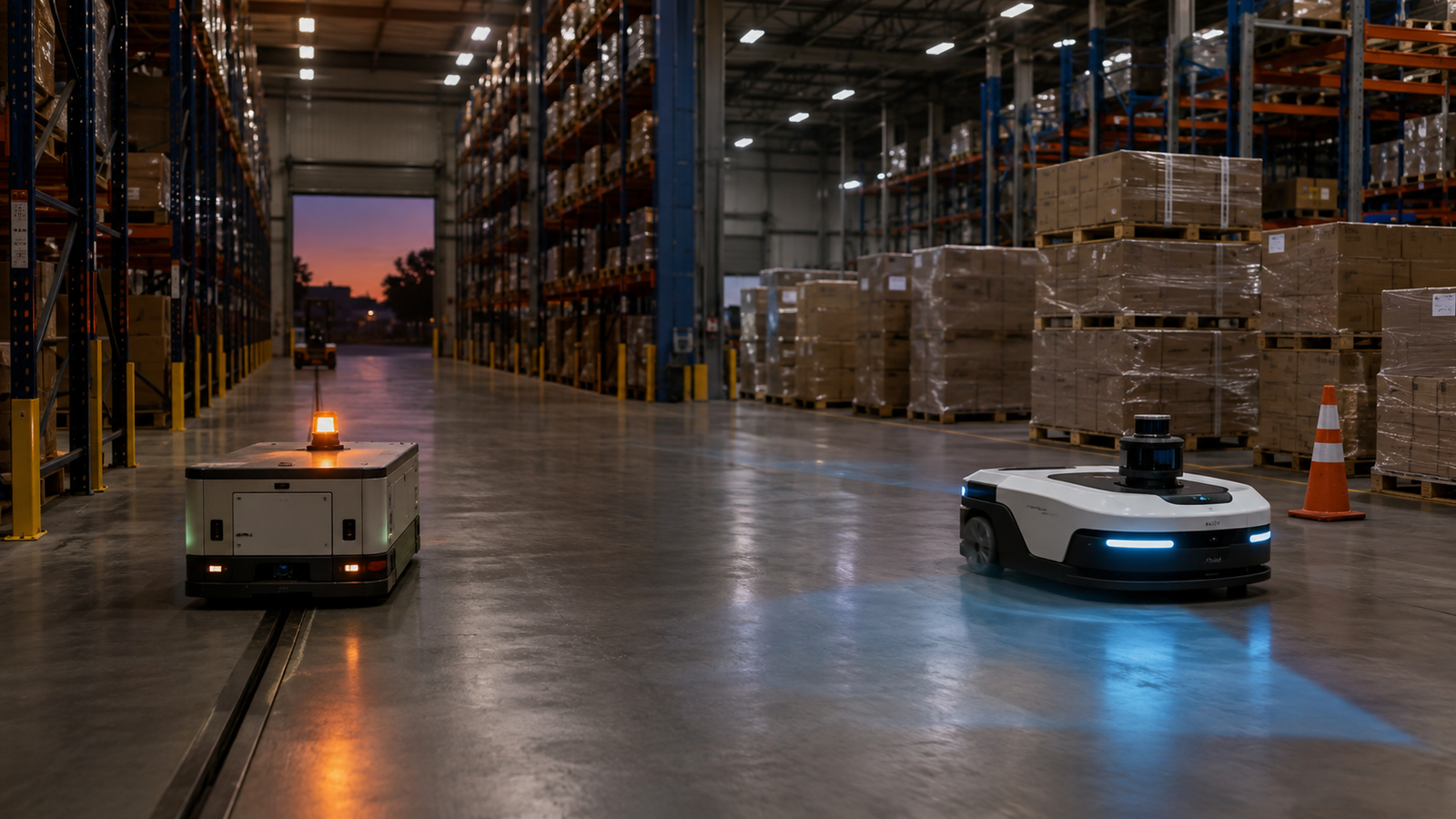
The most fundamental difference is how each vehicle knows where it is and where to go. AGVs follow a fixed, predetermined path defined by a physical or embedded guide: a magnetic strip stuck to the floor, a wire buried in a slot cut into the concrete, a painted or taped line, or in some cases reflective tape read by an onboard laser. The vehicle’s control system does not “decide” a route in real time; it follows the guide it is given, the same way a train follows a rail.
AMRs navigate autonomously. They build and continuously update a digital map of the facility using LiDAR sensors, depth cameras, and Simultaneous Localization and Mapping (SLAM) algorithms. Rather than being locked to a guide, an AMR calculates the most efficient route between its current position and its destination, and it recalculates that route on the fly if the environment changes. This is the root difference from which almost every other item on this list flows.
2. Infrastructure Requirements
Because AGVs depend on a physical guide, deploying them means modifying the facility itself. Magnetic tape installation runs roughly one to three dollars per linear foot, which sounds cheap until a facility needs several thousand feet of guide path across multiple zones. Buried inductive wire is worse: it typically costs ten to twenty dollars per linear foot because it requires cutting slots into the concrete floor, and once it is in place, moving it means tearing up the floor again.
AMRs require no physical guide infrastructure. Deployment consists of driving or wheeling the robot through the facility once (or scanning it with a mapping tool) to build the initial map, then configuring software zones, charging stations, and traffic rules. This is the single biggest reason AMR deployment timelines run in weeks rather than months.
Common mistake
Facilities managers frequently budget only for the robot purchase price and forget to price out the guide-path installation, floor cutting, and the downtime required to lay it — all of which apply only to AGVs but can add 15 to 30 percent to total project cost if they are discovered late in the process.
3. Deployment Speed
An AGV rollout typically takes eight to sixteen weeks from contract signing to live operation, because it involves surveying the facility, engineering the guide path, scheduling floor work (often overnight or during a planned shutdown), installing the guides, and then calibrating the vehicles to follow them precisely. Any change to the route after installation triggers a smaller version of that same process.
An AMR rollout commonly runs one to four weeks. The main variables are how large the facility is, how many robots are being deployed, and how much integration work is needed with the warehouse management system (WMS). Because there is no physical path to engineer, most of the deployment time is software configuration and staff training rather than construction.
4. Flexibility to Layout Changes
This is where the two technologies diverge most sharply in practice. If a warehouse reconfigures its racking, adds a new pick zone, or shifts a conveyor line, an AGV’s guide path has to be physically redone in the affected area — new tape, new wire, new painted lines — before the vehicle can operate there again. For operations that rarely change their layout, this is a non-issue. For e-commerce and omnichannel operations that reslot inventory seasonally or add new zones as SKU counts grow, it is a recurring cost.
An AMR adapts to a layout change by updating its map, a process that can often be done in-house without vendor engineers on site. This is a major reason AMRs have become the default recommendation for high-SKU, high-change environments even though the per-unit price is higher.
| Scenario | AGV Response | AMR Response |
|---|---|---|
| New pick zone added | Guide path engineered and installed on site | Map updated in software |
| Temporary seasonal layout | Rarely attempted, cost-prohibitive | Common; map reverted after peak season |
| Pallet left blocking the route | Vehicle stops until path is cleared | Vehicle reroutes around the obstruction |
| New building or expansion | Full guide-path project required | Re-map the new area, existing fleet extends coverage |
5. Cost Structure: Upfront vs Total Cost of Ownership
AGVs tend to have a lower per-unit acquisition cost and simpler onboard electronics, but the total project cost includes the guide-path installation and any future re-engineering. AMRs cost more per unit — they carry more sensors, more onboard compute, and more sophisticated software — and they typically require a fleet management platform license as an ongoing operating expense. However, because there is no guide-path installation or re-installation cost, the total cost of ownership over a multi-year horizon often favors AMRs in facilities that expect any meaningful change in layout or volume.
Robotics-as-a-Service (RaaS) subscription models have narrowed this gap further by converting the AMR capital cost into a monthly operating expense, which is one reason AMR adoption has accelerated among mid-size operators who previously found the upfront cost prohibitive. Readers evaluating financing structures should also review how Robotics-as-a-Service changes the automation purchase decision before comparing vendor quotes.
6. Obstacle Handling and Failure Modes
When an AGV’s path is blocked — by a stray pallet, a spill, or a person standing on the guide line — its default behavior is to stop and wait, sometimes triggering an alarm for a human to clear the obstruction. This is a safe but throughput-killing failure mode in busy aisles, because a single blockage can back up an entire guide-path loop.
An AMR detects the obstruction with its sensors and calculates an alternate route around it, continuing its task with minimal delay. This is a meaningful throughput advantage in facilities with variable foot traffic, forklifts, or other mobile equipment sharing the same aisles. The tradeoff is that AMR routing software is more complex, and in very dense fleets, rerouting logic itself can create new bottlenecks if not tuned correctly — a topic covered in depth in coordination architecture for large mixed fleets.
7. Safety and Human Interaction
AGVs are traditionally deployed in zones with limited human traffic, or with physical barriers and safety mats separating people from the guide path, because the vehicle’s ability to detect and respond to a person in its path is comparatively simple (stop-on-contact bumpers, basic proximity sensors). AMRs are generally designed from the outset to operate in mixed human-robot environments, with 360-degree obstacle detection and dynamic speed adjustment as people approach. This makes AMRs the more common choice for facilities that cannot fully segregate robot and human traffic. Both categories, however, must comply with the same underlying safety standards, and any deployment should be checked against current human-machine collaboration safety requirements before go-live.
8. Fleet Scalability
Scaling an AGV fleet means extending or duplicating guide paths, which runs into the same infrastructure cost and lead time discussed above. Scaling an AMR fleet is largely a software and traffic-management exercise: add robots, let the fleet manager allocate tasks and routes, and monitor congestion at pinch points. This does not mean AMR fleets scale for free — coordination complexity rises sharply as fleet size grows, and dense deployments need real intersection management, not just more robots.
9. Maintenance and Downtime
AGV maintenance includes the guide infrastructure itself: magnetic tape wears, gets covered in debris, or gets damaged by forklift traffic and needs periodic replacement; buried wire is more durable but far more disruptive to repair. AMR maintenance is concentrated on the vehicle itself — sensors, batteries, wheels, and onboard software updates — with no floor infrastructure to maintain, though sensor calibration drift can degrade navigation accuracy over time if not checked.
Figure: Decision Path for AGV vs AMR Selection
A simplified decision flow: if the facility layout changes less than once a year and routes are high-volume and repetitive, AGVs typically deliver a lower total cost. If the layout changes seasonally, SKU mix is variable, or robots must share aisles with people and forklifts, AMRs typically deliver faster payback despite the higher unit price.
10. Software and Fleet Management Complexity
AGV fleet controllers are comparatively simple: they manage traffic along a known, fixed set of paths, which reduces the number of variables the software has to reason about. AMR fleet management software is considerably more complex because it must handle dynamic path planning, real-time traffic negotiation between robots, task allocation, charging schedules, and integration with the WMS or order management system. This complexity is also where most of the ongoing software licensing cost sits for AMR deployments.
11. Best-Fit Use Cases
Neither technology is universally “better.” AGVs remain the more cost-effective choice for high-volume, repetitive, stable routes such as moving the same pallet type between a fixed receiving dock and a fixed staging area thousands of times a day, where the layout essentially never changes. AMRs are the better fit for e-commerce fulfillment, high-SKU operations, facilities with variable order profiles, and any environment where the layout is expected to change within the equipment’s useful life.
What worked
Operators who ran a phased pilot — deploying a small AMR fleet of three to five units in a single zone for 60 to 90 days before committing to a facility-wide rollout — consistently reported fewer integration surprises than those who committed to a full fleet purchase based on vendor demos alone.
Frequently Overlooked Factors in the AMR vs AGV Decision
- Ceiling height and lightingLiDAR-based AMRs can be affected by reflective surfaces, glass, or highly variable lighting; these conditions rarely affect wire-guided AGVs.
- Network reliabilityAMR fleets depend on consistent Wi-Fi coverage for fleet coordination; dead zones in a facility can cause routing delays that would not affect a simple AGV.
- Floor conditionCracked or uneven concrete can damage magnetic tape and disrupt AGV guide-following, while AMRs are comparatively tolerant of minor floor imperfections.
- Staff training curveAGV operators need to understand a fixed set of routes; AMR operators need basic familiarity with fleet-management dashboards and exception handling.
- Vendor lock-inAGV guide infrastructure is often proprietary to the installing vendor, making a future vendor switch costlier than swapping an AMR fleet, which is more standardized.
- Battery and charging strategyAMRs commonly use opportunity charging at multiple stations throughout a shift; AGVs are more often designed around a fixed charging dock at the end of the guide loop.
Data Snapshot: Cost and Timeline Comparison
| Metric | AGV | AMR |
|---|---|---|
| Per-unit price range | Lower | Higher |
| Guide infrastructure cost per linear foot (tape) | $1 to $3 | Not applicable |
| Guide infrastructure cost per linear foot (wire) | $10 to $20 | Not applicable |
| Typical deployment time | 8 to 16 weeks | 1 to 4 weeks |
| Route change cost | High (physical rework) | Low (software update) |
Glossary
- AGV
- Automated Guided Vehicle; a mobile robot that follows a fixed physical or embedded path such as magnetic tape or buried wire.
- AMR
- Autonomous Mobile Robot; a mobile robot that navigates dynamically using onboard sensors and mapping software rather than a fixed path.
- SLAM
- Simultaneous Localization and Mapping; the algorithmic technique that lets an AMR build a map of its environment while tracking its own position within it.
- Fleet management software
- The control layer that assigns tasks, plans routes, and manages traffic and charging across a group of mobile robots operating in the same facility.
- Opportunity charging
- A charging strategy where robots top up their batteries in short bursts at multiple stations during idle moments, rather than fully recharging at a single dock.
Key Takeaways
- The core difference between AMRs and AGVs is navigation method: dynamic sensor-based routing versus a fixed physical guide path.
- AGVs cost less per unit but require guide-path infrastructure that is expensive to install and even more expensive to change later.
- AMRs deploy in one to four weeks on average, compared to eight to sixteen weeks for a typical AGV project.
- AGVs stop and wait when blocked; AMRs reroute around obstacles, which matters more in high-traffic, mixed-use aisles.
- Total cost of ownership often favors AMRs in facilities that expect layout or SKU changes within the equipment’s lifespan.
- AGVs remain the more economical choice for stable, high-volume, repetitive routes that rarely change.
- A phased pilot deployment reduces integration risk far more effectively than committing to a full fleet from vendor demos alone.
FAQs
What is the main difference between an AMR and an AGV?
The main difference is navigation. An AGV follows a fixed physical path such as magnetic tape or buried wire, while an AMR navigates dynamically using LiDAR, cameras, and SLAM software, allowing it to plan and adjust its own route in real time without any physical guide infrastructure.
Which is cheaper, an AMR or an AGV?
AGVs typically have a lower per-unit purchase price, but they require guide-path infrastructure that adds significant installation cost. AMRs cost more upfront but avoid infrastructure costs entirely, so total cost of ownership often favors AMRs in facilities expecting future layout changes.
How long does it take to deploy an AMR compared to an AGV?
AMR deployments typically take one to four weeks since they require only software mapping and configuration. AGV deployments typically take eight to sixteen weeks because they involve engineering, installing, and calibrating a physical guide path across the facility.
Can AGVs and AMRs work in the same warehouse together?
Yes, many facilities run mixed fleets, using AGVs for stable, high-volume routes and AMRs for variable zones or areas shared with human workers. This requires a fleet management layer capable of coordinating both vehicle types without conflicting traffic rules.
Do AMRs require Wi-Fi to operate?
Most AMR fleets depend on reliable wireless network coverage for fleet coordination, task assignment, and map updates. Facilities with unreliable Wi-Fi coverage may experience routing delays or degraded performance, so network infrastructure should be assessed before deployment.
What happens when an AGV encounters an obstacle in its path?
An AGV typically stops and waits until the obstruction is cleared, often triggering an alert for a human operator to intervene. This is a safe behavior but can create throughput bottlenecks in busy aisles compared to an AMR, which reroutes around the obstacle automatically.
Are AMRs safer than AGVs around human workers?
AMRs are generally designed with more sophisticated obstacle detection and dynamic speed adjustment for mixed human-robot environments, while AGVs are more often deployed with physical barriers separating them from foot traffic. Both must meet applicable safety standards regardless of navigation type.
Which is better for e-commerce fulfillment, AMRs or AGVs?
AMRs are generally the better fit for e-commerce fulfillment because these operations tend to have high SKU counts, variable order profiles, and layouts that change seasonally, all of which favor the flexibility of software-based navigation over a fixed physical guide path.
References
- Jungheinrich, “AGV vs. AMR: Which Mobile Robot is right for your Warehouse?”
- Prime Robotics, “AMR vs. AGV: What’s the Difference?”
- movu Robotics, “Mobile robots comparison: AGV vs AMR”
- GrabaRobot, “AMR vs AGV — Autonomous Mobile Robot vs Automated Guided Vehicle Comparison (2026)”
- Robotomated, “AMR vs AGV: Which Warehouse Robot Is Better for My Operation?”
- DGM News, “AMRs vs. AGVs: How to Pick the Right Warehouse Robots Without Overpaying for Automation You Won’t Use”
For further reading on related automation topics, see how autonomous logistics is reshaping last-mile delivery, how robotic micro-fulfilment is changing urban retail, and how facilities are retrofitting legacy factories for robotics. For a data-driven look at when the investment pays off, see our companion piece on warehouse automation ROI by facility size.