| Protection Mechanism | Who It Covers | Core Requirement |
|---|---|---|
| SAG-AFTRA 2023 TV/Theatrical Agreement | Union background and principal performers | Informed consent and bargained compensation before a digital replica is created or used |
| Tennessee ELVIS Act (2024) | Any individual’s voice as a property right | Civil liability for unauthorized AI voice cloning or simulation |
| California AB 1836 (2024) | Deceased performers’ voice and likeness | Estate consent required for 70 years post-mortem before commercial digital replica use |
| California AB 2602 (2024) | Living performers’ contract terms | Digital replica clauses must be reasonably specific and reviewed by counsel or a union |
Why Digital Likeness Rights Became an Entertainment-Labor Issue
The 2023 SAG-AFTRA strike put one issue ahead of almost every other bargaining point: whether a studio could scan a performer once, generate a synthetic digital replica of them, and then reuse that replica indefinitely without further consent or pay. That fight was not an abstract debate about deepfakes in general. It was a specific, material dispute over how film and television production actually works when a performer’s face, voice, and movement can be captured, stored, and regenerated by a machine learning model long after the performer has gone home, aged out of a role, or died.
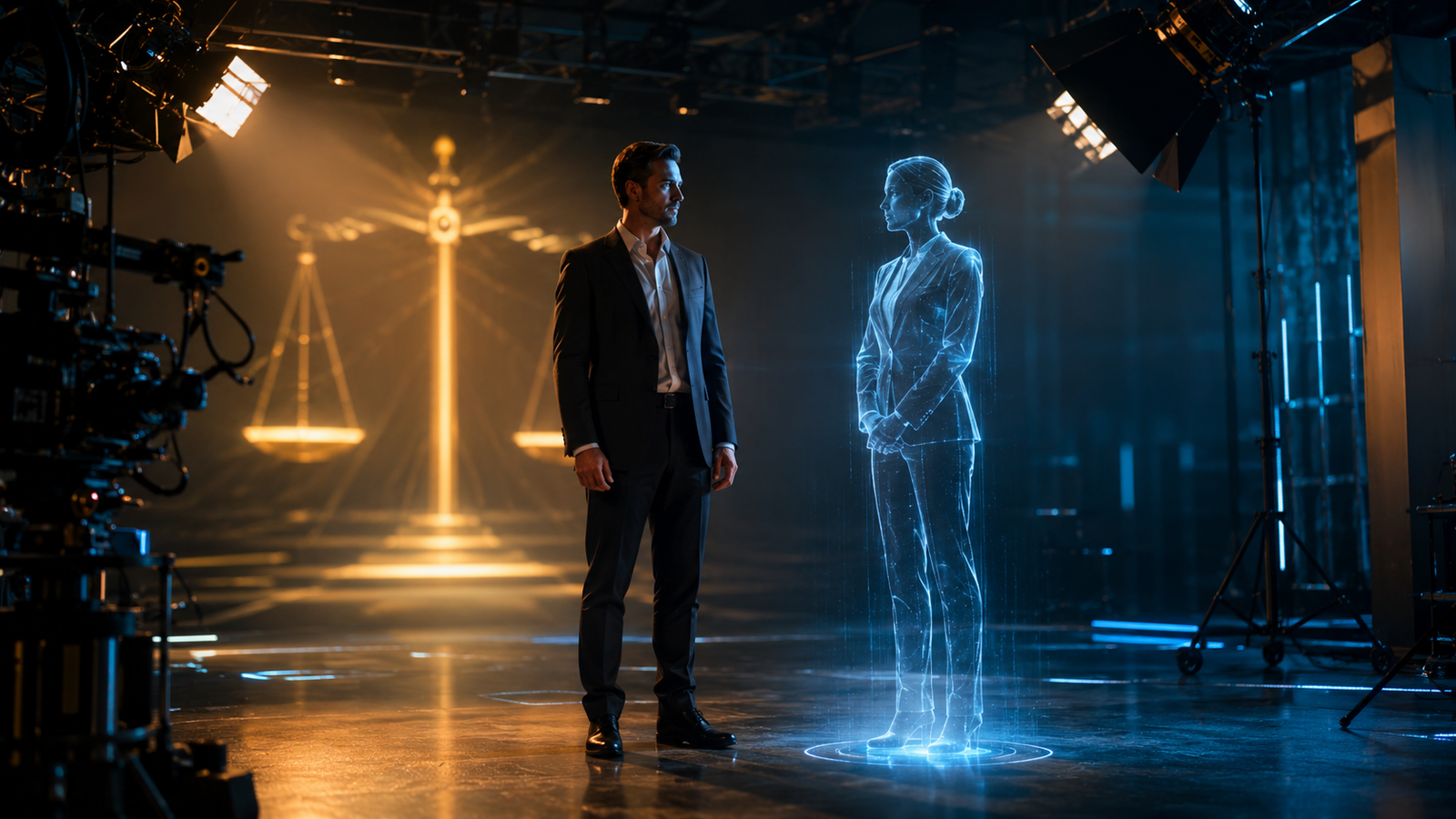
The resulting agreement, and the state laws passed alongside it, created the first real legal and contractual infrastructure for something the industry now calls a digital replica: a synthetic reproduction of a performer’s voice or visual likeness generated or manipulated using digital tools, distinct from traditional makeup, prosthetics, or a body double. Understanding how that infrastructure works, where it still has gaps, and how it has played out in real productions is now a baseline literacy requirement for anyone working in film, television, or game production.
What the 2023 SAG-AFTRA Agreement Actually Requires
The agreement’s digital replica provisions rest on a small number of core principles. A producer must obtain a performer’s informed consent before creating a digital replica, meaning the performer must be told specifically how the replica will be used, not asked to sign a blanket waiver covering unspecified future uses. Consent for one project does not automatically carry over to another project. Background performers whose scans are used to generate synthetic crowd or stand-in replicas are entitled to bargained compensation for that use, addressing a specific practice where a single day of scanning work had previously been used to generate unlimited digital extras without additional pay. The agreement also created a requirement that performers be given the opportunity to have a union representative present during scanning, and set out that the use of a digital replica must be disclosed rather than concealed from the performer whose likeness it draws on.
Critically, the agreement does not ban digital replicas outright. It converts what had been an unregulated gray area into a negotiated, consent-based, compensated process, which is a meaningfully different outcome than either an outright prohibition or the status quo ante where studios could argue existing contract language already covered synthetic reuse.
State Law: ELVIS Act, AB 1836, and AB 2602
Tennessee’s ELVIS Act, signed in March 2024, made Tennessee the first state to explicitly protect an individual’s voice as a property right against unauthorized AI simulation, giving performers, including musicians and voice actors based in Nashville’s recording industry, a direct civil cause of action against unauthorized AI voice cloning rather than having to rely on older right-of-publicity statutes that were written before voice cloning existed as a practical technology.
California took a two-part approach. AB 1836, signed in September 2024, bans commercial use of a digital replica of a deceased performer’s voice or likeness in film, television, sound recordings, or video games without consent from the performer’s estate, with that estate control lasting 70 years after death. This is the provision most directly relevant to using a synthetic version of an actor who has already died, since it closes the gap where a deceased performer cannot personally negotiate or refuse consent. AB 2602 addresses living performers instead, targeting a specific contractual trap: a studio including a vague clause in a personal-services contract that lets it replace an actor’s future performances with a digital replica. The law prohibits enforcement of such a clause unless it describes the intended digital replica use with reasonable specificity and the performer had legal counsel or union representation when signing.
| Case or Production | Technology Used | Rights Question Raised |
|---|---|---|
| “Here” (2024, dir. Robert Zemeckis) | Metaphysic Live real-time de-aging applied to Tom Hanks and Robin Wright | Consent and compensation for a de-aged digital version of a living, actively performing actor |
| Planned James Dean recreation project | AI-driven digital recreation of a deceased performer for a new film role | Estate consent and public backlash over casting a synthetic replica in place of a living actor |
| Background performer scanning disputes (pre-2023 agreement) | 3D body and face scanning for crowd and stand-in replicas | Reuse of a single scan across unlimited productions without additional pay |
| Posthumous voice and likeness licensing cases | AI voice cloning and likeness licensing for deceased musicians and actors | Estate control versus commercial licensing incentives under AB 1836 |
Case Study: De-Aging a Living, Working Actor
“Here,” directed by Robert Zemeckis and starring Tom Hanks and Robin Wright, used Metaphysic Live to apply real-time, photorealistic de-aging and face-swapping directly during filming rather than adding it in post-production compositing. That distinction matters for the rights conversation: real-time de-aging means the actor is performing as their younger digital self live on set, with the synthetic layer applied on top of their actual performance rather than replacing it, which keeps the underlying performance human while the visual output is substantially machine-generated. Because Hanks and Wright were actively consenting, present, and compensated principal performers negotiating directly for the project, this case sits inside the clearest, least contested category the SAG-AFTRA framework addresses: a living performer consenting to a digital alteration of their own current performance, on a project they were hired and paid for.
The harder cases sit outside that boundary, and they are precisely the ones AB 1836 and the union’s estate-related provisions were built to address.
Case Study: Recreating a Deceased Performer
Proposals to digitally recreate deceased performers, including a widely reported plan to use AI to generate a new performance from a long-dead actor for a contemporary film role, drew immediate industry and public pushback specifically because no living person can give informed, current consent on behalf of someone who never had the opportunity to evaluate today’s technology or the specific project. AB 1836 was built directly for this scenario: it requires a production to secure consent from the performer’s estate before commercially using a digital replica of a deceased performer’s voice or likeness, and it gives that estate control for seven decades after death, explicitly closing the gap where a synthetic recreation could otherwise proceed on the theory that a dead performer has no one to object.
The practical effect is that a studio proposing to digitally resurrect a deceased performer now faces a genuine legal gatekeeper in the form of the estate, not just a public-relations calculation about audience reaction. That has already changed how some proposed projects involving deceased performers are being structured, with estate negotiation now treated as a required early step rather than an afterthought.
Where Consent Authority Sits Across Digital Replica Scenarios
A living principal performer consenting to their own de-aged or altered digital replica sits at one end of the spectrum with the clearest consent chain. A deceased performer’s estate exercising AB 1836 control over a posthumous digital replica sits in the middle, requiring negotiated estate consent. A background performer’s scan being reused across unrelated future productions without renewed compensation sits at the most contested end, which is exactly the practice the 2023 SAG-AFTRA agreement was written to stop.
Where the Framework Still Has Gaps
Enforcement mechanics remain uneven across jurisdictions. The ELVIS Act, AB 1836, and AB 2602 are state laws, meaning protection currently depends on where a performer is domiciled, where a production is based, or which state’s law a contract designates, rather than existing as a single federal standard. A performer without union representation, working outside California or Tennessee, has meaningfully less statutory protection than a SAG-AFTRA member working on a signatory production in Los Angeles. International productions add another layer of complexity, since a digital replica generated for a US release may be reused in markets with no equivalent likeness-rights statute at all.
There is also an unresolved tension between the “own the likeness once, license it forever” business model some studios have reportedly pushed for in negotiations, and the union’s position that each new use of a digital replica should trigger renewed consent and compensation. That tension did not fully resolve in the 2023 agreement and is expected to resurface directly in the next round of SAG-AFTRA bargaining, making this one of the more consequential open questions in entertainment labor relations going into the next contract cycle.
Common mistake
Assuming a single blanket consent form signed at the start of a production covers every future digital replica use of a performer. Under both the SAG-AFTRA agreement and AB 2602, consent must be reasonably specific to the intended use, and vague or overly broad digital replica clauses in personal-services contracts are not enforceable as written under California law.
What worked
On “Here,” treating the de-aging technology as a tool applied to a present, consenting, actively performing actor rather than a replacement for that actor kept the production inside the clearest and least legally contested category of digital replica use, avoiding the estate-consent and posthumous-rights questions that have complicated other proposed projects involving deceased performers.
Practical Guidance for Productions and Performers
- Confirm whether a scanning or motion-capture session includes digital replica rights language, and whether that language specifies exact intended uses rather than open-ended future use.
- For any project involving a deceased performer, budget time and legal process for estate negotiation under AB 1836 before creative or marketing plans are finalized.
- For background and stand-in performers, verify that any reuse of a prior scan across a new production triggers renewed compensation under the applicable union agreement.
- Treat voice cloning and visual likeness replication as separate consent questions, since a performer may consent to one without the other.
- Document disclosure to the performer or estate about exactly how a digital replica will be used, since concealment of use is itself a violation under the SAG-AFTRA framework.
Questions a Union Representative Will Ask
- Is this scan or capture session for a single specified production, or open-ended future use?
- Who owns the resulting digital asset once the production wraps?
- What compensation triggers apply if the replica is reused in a sequel, game, or marketing campaign?
- Has the performer or estate had independent legal counsel review the specific replica-use language?
- What happens to the digital asset and training data after the performer’s contract or life ends?
- Digital replicaA synthetic reproduction of a performer’s voice or visual likeness generated or manipulated using digital tools, as defined under the 2023 SAG-AFTRA agreement.
- Right of publicityThe pre-existing legal doctrine giving individuals control over commercial use of their name, image, and likeness, which newer statutes like AB 1836 extend specifically to digital replicas.
- Estate control periodThe 70-year window after a performer’s death during which AB 1836 requires estate consent for commercial digital replica use in California.
- Reasonably specific consentThe AB 2602 standard requiring digital replica contract clauses to describe intended uses concretely rather than in open-ended terms.
- Real-time de-agingApplying a photorealistic digital alteration to a performer’s appearance live during filming, as opposed to adding the effect in post-production.
Glossary
- Digital replica
- A synthetic reproduction of a performer’s voice, image, or movement created using AI or other digital tools, as newly defined and regulated in entertainment union contracts and state statutes.
- ELVIS Act
- Tennessee’s 2024 law, the Ensuring Likeness Voice and Image Security Act, which established an individual’s voice as a protected property right against unauthorized AI simulation.
- AB 1836
- A 2024 California law banning commercial use of a deceased performer’s digital replica in film, television, sound recordings, or games without consent from their estate, enforceable for 70 years after death.
- AB 2602
- A 2024 California law that voids overly broad digital replica clauses in performer contracts unless the use is described with reasonable specificity and the performer had legal or union representation.
- Background performer scanning
- The practice of 3D scanning extras or stand-ins to generate digital crowd or double replicas, a specific compensation dispute addressed directly in the 2023 SAG-AFTRA agreement.
Key Takeaways
- The 2023 SAG-AFTRA agreement requires informed, use-specific consent and bargained compensation before a digital replica of a performer can be created or reused.
- Tennessee’s ELVIS Act was the first US state law to protect voice specifically as a property right against unauthorized AI simulation.
- California’s AB 1836 gives a deceased performer’s estate 70 years of control over commercial digital replica use.
- California’s AB 2602 voids vague digital replica clauses in living performers’ contracts unless the use is specifically described and legally reviewed.
- “Here” (2024) shows the clearest, least contested use case: a living, consenting, actively performing actor de-aged in real time on a project they were hired for.
- Proposed digital recreations of deceased performers have drawn public backlash and now require genuine estate negotiation, not just public-relations management.
- Protection remains state-by-state and union-status-dependent, with no single federal digital likeness rights standard yet in place.
FAQs
What is a digital replica under entertainment union contracts?
A digital replica is a synthetic reproduction of a performer’s voice or visual likeness generated or manipulated using digital tools, as defined in the 2023 SAG-AFTRA agreement. It is distinct from traditional makeup, prosthetics, or a human body double, and its creation and use now require informed, use-specific consent and compensation.
What does the ELVIS Act actually protect?
Tennessee’s ELVIS Act, signed in March 2024, establishes an individual’s voice as a protected property right, giving performers, musicians, and voice actors a direct civil cause of action against unauthorized AI voice cloning or simulation, an update to older right-of-publicity law that predated voice cloning technology.
Can a studio use a dead actor’s likeness without permission under AB 1836?
No. California’s AB 1836 bans commercial use of a deceased performer’s digital replica in film, television, sound recordings, or video games without consent from their estate, and that estate control lasts for 70 years after the performer’s death.
How is AB 2602 different from AB 1836?
AB 1836 covers deceased performers and requires estate consent, while AB 2602 covers living performers’ contracts, voiding digital replica clauses unless they describe the intended use with reasonable specificity and the performer had legal counsel or union representation when signing.
How did the “Here” film handle digital de-aging rights?
“Here,” directed by Robert Zemeckis, used Metaphysic Live’s real-time de-aging technology on consenting, actively performing lead actors Tom Hanks and Robin Wright who were hired and compensated for the project, making it one of the clearest and least legally contested applications of digital replica technology to date.
Why did proposals to digitally recreate deceased actors like James Dean cause controversy?
Because no living person can give current, informed consent on behalf of a deceased performer who never evaluated today’s technology or the specific project, digitally recreating a dead performer raises estate-consent and ethical questions that AB 1836 was specifically written to address by requiring estate approval.
What compensation issue did background performers raise before the 2023 agreement?
Background performers argued that a single day of 3D body and face scanning was being used to generate unlimited synthetic crowd or stand-in replicas across productions without additional pay, a practice the 2023 SAG-AFTRA agreement now requires bargained compensation for.
Is there a federal law covering digital likeness rights in the United States?
Not yet. Protection currently comes from a patchwork of state laws, including Tennessee’s ELVIS Act and California’s AB 1836 and AB 2602, plus union contract provisions like the 2023 SAG-AFTRA agreement, meaning coverage varies significantly depending on where a performer is based and whether they are a union member.
References
- SAG-AFTRA, “Some of the Priority AI Bills SAG-AFTRA Is Supporting”
- SAG-AFTRA, “Artificial Intelligence” member resources page
- SAG-AFTRA, “SAG-AFTRA AI Bargaining and Policy Work Timeline”
- Respeecher, “SAG-AFTRA and AI Voice: What Film Studios Need to Know”
- State of Surveillance, “California AB 2602 and AB 1836: AI Digital Replica Laws 2025”
- AOL, “Tom Hanks to Be De-Aged Using AI in New Film From Forrest Gump Director Robert Zemeckis”
- Respeecher, “How De-Aging Technology Is Changing Hollywood and the Future of Filmmaking”
For the technology underlying voice-based digital replicas, see AI voice cloning, and for how synthetic performance techniques are used more broadly across productions, see AI in film production. The dubbing industry raises closely related performer-consent questions, covered in AI dubbing and lip-sync localisation at scale. Provenance and disclosure requirements for synthetic media are covered in AI content provenance and AI transparency reporting, while the broader ethical debate around deepfakes generally is addressed separately in the ethics of synthetic media and deepfakes.