In the immediate aftermath of a catastrophe—whether an earthquake, a forest fire, or a building collapse—time is the single most critical resource. Emergency responders often refer to the “golden hour,” a window of time following a traumatic injury during which there is the highest likelihood that prompt medical treatment will prevent death. Traditionally, search and rescue (SAR) missions have relied on human teams and trained dogs, often putting rescuers at significant risk while they navigate unstable terrain. While single, sophisticated robots have been deployed in the past, they suffer from a critical weakness: if they fail, the mission stalls.
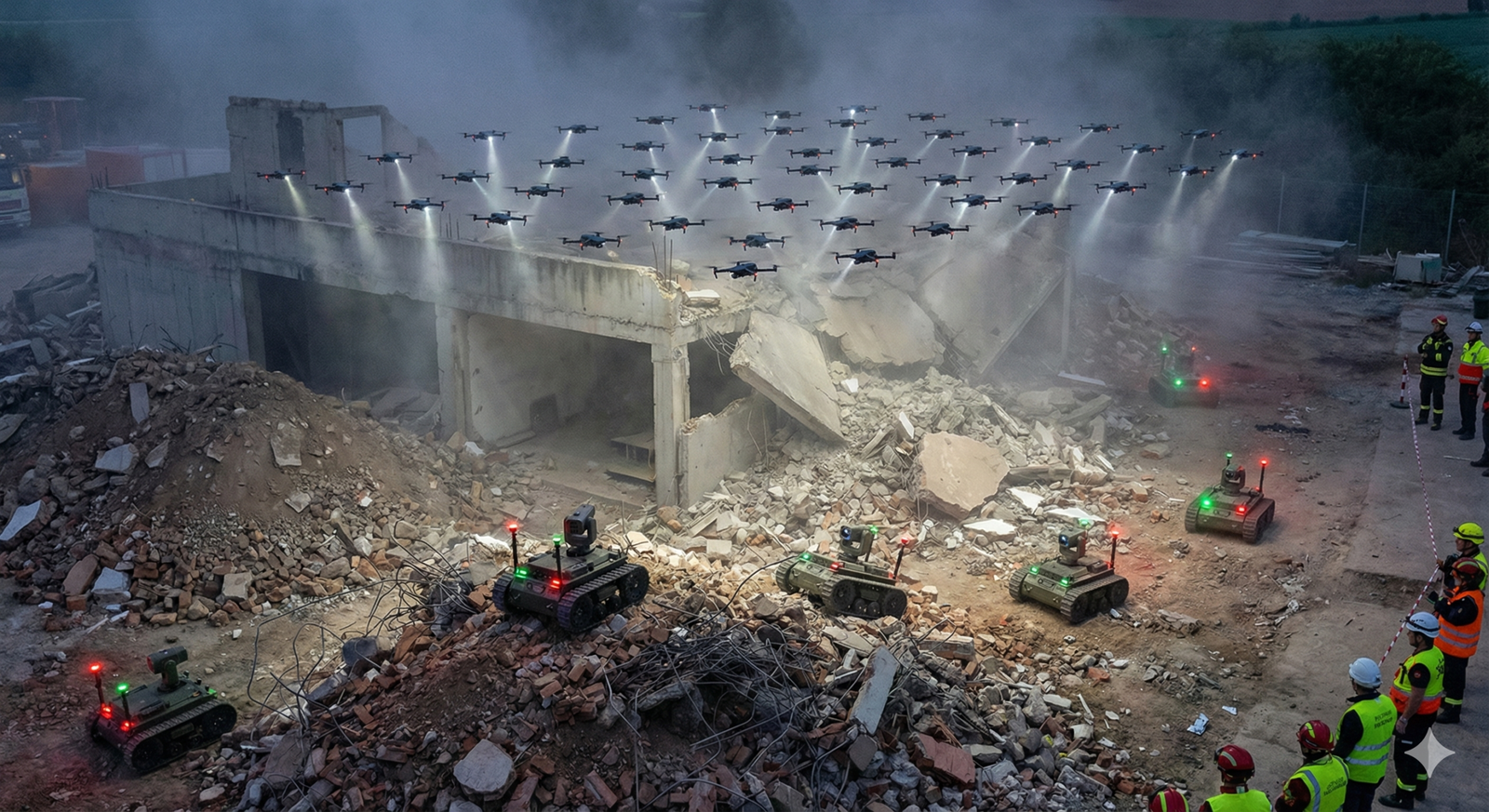
This is where swarm robotics for search and rescue is revolutionizing the field. By mimicking the collective behavior of social insects like ants, bees, and birds, engineers are creating systems where hundreds or even thousands of simple, low-cost robots work together to locate survivors, map hazards, and deliver aid.
In this comprehensive guide, we will explore the mechanisms, applications, and immense potential of swarm robotics in saving lives.
Key Takeaways
- Redundancy saves missions: Unlike a single expensive robot, a swarm can lose multiple units to damage or battery failure and still complete the search mission successfully.
- Scalability is inherent: Swarm algorithms allow operators to add more robots to the mission on the fly without reprogramming the central control system.
- Decentralized intelligence: Swarms operate without a single point of failure; decisions are made locally based on interactions between neighboring robots.
- Diverse environments: Swarm technology applies to aerial drones (UAVs), ground rovers (UGVs), and even aquatic surface vehicles (USVs).
- The “Golden Hour” advantage: Simultaneous coverage of large areas significantly reduces the time required to locate survivors compared to linear human searches.
Scope of This Guide
In Scope:
- The fundamental principles of swarm intelligence and decentralized control as applied to SAR.
- Hardware and software considerations for aerial, ground, and aquatic swarms.
- Real-world use cases, including urban disaster zones, wilderness rescues, and maritime operations.
- Challenges related to communication, battery life, and ethical deployment.
Out of Scope:
- Detailed code-level tutorials for programming specific microcontrollers (e.g., Arduino code for a single bot).
- In-depth mechanical engineering blueprints for building a specific robot chassis.
- General robotics history unrelated to collective behavior or disaster response.
What Is Swarm Robotics in the Context of SAR?
Swarm robotics is a field of multi-robotics that focuses on the coordination of large numbers of relatively simple robots. In the context of Search and Rescue (SAR), the goal is not to have one “super robot” that can do everything (lift rubble, offer medical advice, and fly), but rather to deploy a massive team of specialized, disposable units that function as a cohesive whole.
The Shift from Centralized to Decentralized
Traditional robotic deployments usually involve a human operator controlling a single robot via a joystick, or a central computer sending specific commands to each unit. This is centralized control. It is brittle; if the central computer loses connection or the operator is overwhelmed, the system fails.
Swarm robotics utilizes decentralized control. There is no “leader.” Each robot follows simple rules based on local sensing and communication with its nearest neighbors. Global behavior—like mapping a disaster zone—emerges from these local interactions. This is often referred to as collective intelligence.
Biomimicry: Learning from Nature
The design of swarm robotics for search and rescue is heavily inspired by biological systems:
- Ant Colonies (Stigmergy): Ants communicate indirectly by leaving pheromone trails. Robots can mimic this by leaving “digital pheromones” (data markers) in a virtual map to guide others toward a point of interest, such as a heat signature.
- Bird Flocks (Flocking): Birds fly in formation without colliding by following rules like separation (don’t hit neighbors), alignment (fly in the same general direction), and cohesion (stay close to the group). Drones use these rules to cover wide areas without crashing.
- Fish Schools: Fish move in unison to evade predators or find food. Underwater robot swarms use similar hydrodynamics and formation strategies to scan lake beds or coastlines.
How It Works: The Mechanics of Collective Rescue
To understand how a swarm finds a lost hiker or a trapped survivor, we must look at the underlying mechanics of their operation.
1. Robustness Through Redundancy
In a collapsed building, a robot might get crushed by falling debris, trapped in a void, or run out of battery. In a swarm of 50 miniature rovers, the loss of 5 or even 10 robots is statistically insignificant. The remaining robots automatically reorganize to fill the gaps in coverage. This robustness is vital in SAR environments, which are by definition hazardous and unpredictable.
2. Scalability
Swarm algorithms are designed to be scalable. If a search area is larger than anticipated, response teams can deploy another canister of 50 drones. The existing swarm detects the new peers and integrates them into the mesh network immediately. There is no need to rewrite coordination software or assign new ID numbers manually.
3. Distributed Sensing
A single robot has a limited field of view. A swarm creates a sensor array.
- Optical Cameras: Hundreds of angles provide a 3D reconstruction of a disaster site.
- Thermal Imaging: Drones can triangulate heat sources to distinguish between a fire pocket and a human body temperature.
- Chemical Sniffing: Ground swarms can map gas leaks (e.g., propane or carbon monoxide) to warn human rescuers of invisible dangers.
4. Communication Topologies
Swarms typically use Mobile Ad-hoc Networks (MANETs).
- Mesh Networking: Robot A might be too deep in a cave to reach the base station. However, it can transmit data to Robot B, which transmits to Robot C, which is near the entrance. The data “hops” through the swarm to reach the human operator.
- Local Broadcasting: Robots constantly “ping” their neighbors with status updates: “I am here,” “I found an obstacle,” or “I found a target.”
Key Advantages Over Traditional Methods
Why shift to swarm robotics for search and rescue when we have helicopters and trained dogs? The answer lies in efficiency and safety.
Speed of Coverage
A human line search involves people walking a few meters apart, sweeping an area. It is slow and physically exhausting. A swarm of aerial drones can sweep the same forest area in a fraction of the time, using algorithmic search patterns (like Levy flights) that are mathematically optimized to find targets quickly.
Access to Denied Areas
Large robots or humans cannot fit into the small crevices of a collapsed concrete structure. Swarms of “micro-robots”—sometimes the size of insects or small rodents—can penetrate deep into rubble piles. They can maneuver through pipes, vents, and small gaps to locate survivors who are completely buried.
Cost-Efficiency
Losing a highly specialized, military-grade rescue robot can cost hundreds of thousands of dollars. Swarm robots are designed to be low-cost and disposable. If a $500 drone crashes while confirming a survivor’s location, it is an acceptable loss. This economic shift allows agencies to be more aggressive in their search tactics.
Cognitive Load Reduction
Controlling a single drone requires intense focus. Controlling a swarm requires high-level intent. The operator does not joystick the robots; they issue a command like “Search Sector 4.” The swarm handles the navigation, collision avoidance, and pattern formation autonomously, freeing the human commander to focus on strategy and medical planning.
Real-World Applications and Scenarios
Swarm robotics is not just theoretical; it is moving into practical application across various disaster scenarios.
1. Urban Search and Rescue (USAR)
Scenario: An earthquake causes a high-rise building to pancake. Swarm Application: A team of ground-based micro-rovers is deployed into the rubble. They use simple infrared sensors and microphones. Using “cluster” algorithms, if one robot detects a sound (like a cry for help), it signals nearby robots to converge and verify the source. They build a map of the voids in the rubble, transmitting the location of the survivor to the engineering team outside so they can drill precisely.
2. Wilderness and Mountain Rescue
Scenario: A hiker is lost in dense forest or mountainous terrain during winter. Swarm Application: A squadron of fixed-wing UAVs (which are more energy-efficient than quadcopters) is launched. They fly at different altitudes. The “high” drones provide a communications link, while the “low” drones use thermal cameras to scan through the tree canopy. They use a “repulsion” algorithm to ensure they spread out evenly across the search grid, maximizing the probability of detection.
3. Maritime and Flood Response
Scenario: A flash flood leaves residents stranded on rooftops and in moving water. Swarm Application: A swarm of Unmanned Surface Vehicles (USVs) or amphibious robots is deployed. They coordinate to scan the water surface. If a victim is spotted, multiple robots can converge to form a raft or act as a flotation device until a boat arrives. Aerial drone swarms simultaneously map the changing water levels to predict which areas will be submerged next.
4. Avalanches
Scenario: Skiers are buried under snow. Swarm Application: Rapid deployment of small drones equipped with ground-penetrating radar or signal detectors (for avalanche beacons). The swarm can hover just meters above the snow, covering the avalanche runout zone much faster than a human probe line.
Technological Components of a Rescue Swarm
To make these scenarios reality, several key technologies must converge.
Heterogeneous Swarms
Not all robots in a swarm need to be identical. A heterogeneous swarm combines different types of robots:
- The Scouts: Small, fast, short battery life. They find the targets.
- The Relays: Robots that position themselves to maintain Wi-Fi or radio links between the scouts and the base.
- The Carriers: Larger robots that follow the scouts to deliver medical kits, water, or radios to survivors once located.
Sensor Fusion Algorithms
Data from a single robot is noisy and unreliable. A camera might mistake a rock for a person. Swarm robotics relies on sensor fusion, where data from multiple robots is aggregated. If Robot A sees a shape and Robot B detects heat at the same coordinates, the system assigns a high probability of a survivor, reducing false positives.
Power Management and Energy Harvesting
Battery life is the Achilles’ heel of small robots. Advanced swarms use energy-aware algorithms. If a robot’s battery is low, it automatically retreats to a charging station or lands to conserve power while functioning as a static sensor node. Some research explores “parasitic” charging, where small drones might perch on power lines or use solar skins to extend operations.
Challenges and Limitations
Despite the promise, there are significant hurdles to fully operationalizing swarm robotics for search and rescue.
1. The “Catastrophic Interference” Problem
In confined spaces, too many robots can get in each other’s way. This is known as physical interference. Without precise collision avoidance algorithms, a swarm in a narrow tunnel can create a traffic jam, blocking the very path they need to search.
2. Communication Bandwidth
In a disaster, cellular networks are often down. Swarms must create their own networks. However, as the number of robots increases, the “chatter” between them (status updates, video feeds) can clog the limited bandwidth. Engineers are developing efficient protocols that only transmit essential data (e.g., “target found” rather than a continuous HD video stream).
3. Computational Constraints
Small robots have small processors. They cannot run massive Deep Learning models onboard. They must use “TinyML” (Machine Learning for microcontrollers) or edge computing strategies where heavy processing is offloaded to a slightly larger “mother ship” robot nearby.
4. Environmental Unpredictability
Laboratory tests are clean; disaster zones are wet, muddy, windy, and smoky. Swarm robots must be rugged. Mud can obscure sensors, and wind can scatter lightweight drones. Ensuring hardware reliability in these conditions is an ongoing engineering challenge.
Human-Swarm Interaction: The Operator’s Role
A critical aspect of swarm robotics is how humans interact with the collective. We cannot have one pilot per drone; the ratio must be one human to many robots (1:N).
High-Level Command
The operator uses a tablet or command center interface to set boundaries (geofencing) and objectives. They might draw a circle on a map and drag an icon labeled “Search.” The swarm calculates the optimal path.
Status Monitoring via Aggregation
The operator does not look at 50 different battery indicators. The interface aggregates this data, perhaps showing a “Swarm Health” percentage. If the health drops below a threshold, the operator knows the mission capability is degrading.
Trust and Interpretability
Rescuers must trust the swarm. If the swarm reports “Area Cleared,” the human commander needs to be confident that the area was thoroughly searched. Explainable AI (XAI) features in the dashboard can help, showing a “coverage heat map” that proves exactly where the robots looked and where they might have missed due to terrain.
Who This Is For (and Who It Isn’t)
This technology is ideal for:
- Urban Search and Rescue (USAR) Teams: FEMA, international relief agencies, and local fire departments dealing with structural collapses.
- Coast Guards and Maritime Safety: For large-scale ocean search patterns.
- Forestry Services: For rapid wildfire detection and lost person searches in national parks.
- Military and Defense: For humanitarian aid missions in conflict zones or hazardous environments.
This is likely not for:
- Small, rural volunteer fire departments: The current cost and technical overhead for maintenance may be too high compared to traditional methods (though costs are dropping).
- Single-victim accidents in accessible areas: If a car crash occurs on a highway, standard EMS response is faster and sufficient; a swarm would be overkill.
Common Misconceptions
Myth: Swarms are controlled by a giant “Brain.”
Reality: Most robust swarms have no central brain. The intelligence is distributed. If you destroy the “leader” (because there isn’t one), the swarm continues.
Myth: Swarms will replace human rescuers entirely.
Reality: Swarms are tools for information gathering. A robot swarm can find a survivor and drop a water bottle, but it likely cannot perform a complex medical extraction or provide the emotional comfort a human rescuer can. They are force multipliers, not replacements.
Myth: Bigger is always better.
Reality: In swarm robotics, smaller is often better. Smaller robots are cheaper, consume less energy, and can fit into tighter spaces. The power comes from numbers, not individual size.
Future Outlook and Research Directions
The future of swarm robotics for search and rescue is moving toward higher autonomy and better integration.
1. Cross-Domain Swarms
Research is focusing on swarms that operate across domains simultaneously. Imagine a scenario where aerial drones map the area, amphibious robots cross a river, and ground robots climb the bank, all sharing a unified data model.
2. Self-Healing Swarms
Future swarms may physically dock with one another to share battery power or even replace broken parts. If a ground robot loses a wheel, another robot might tow it or physically combine with it to regain mobility.
3. 5G and Edge Computing
The rollout of private 5G networks in disaster zones (via portable towers) will solve many bandwidth issues, allowing swarms to offload complex computations to edge servers, making the individual robots smarter without draining their onboard batteries.
4. Standardization
Currently, different manufacturers use different protocols. A “ROS for Swarms” (Robot Operating System) standard is emerging, which would allow a drone from Company A to coordinate seamlessly with a rover from Company B during a chaotic international relief effort.
Related Topics to Explore
- TinyML implementation: How to run machine learning models on low-power microcontrollers.
- Mobile Ad-hoc Networks (MANETs): The communication backbone of decentralized systems.
- Simultaneous Localization and Mapping (SLAM): How robots map unknown environments in real-time.
- Soft Robotics: Using flexible materials for robots to squeeze through rubble without breaking.
- Ethical AI in Disaster Response: Managing privacy and data security in vulnerable situations.
Conclusion
Swarm robotics for search and rescue represents a paradigm shift in how we respond to disasters. By moving away from relying on single, fragile, and expensive assets to employing robust, scalable, and decentralized swarms, we can dramatically expand our search capabilities.
These systems offer the ability to see the unseen, reach the unreachable, and maximize the efficiency of the “golden hour.” While challenges in battery life, communication, and regulation remain, the trajectory is clear: the future of rescue is collective. As algorithms improve and hardware costs fall, swarm robotics will transition from academic labs to being a standard operational tool for first responders worldwide, ultimately saving more lives when disaster strikes.
Ready to dive deeper? Consider researching the specific communication protocols like Mesh Wi-Fi or LoRaWAN that enable these robots to talk to each other in the absence of cellular networks.
FAQs
What is the main benefit of swarm robotics in search and rescue?
The main benefit is redundancy and robustness. If several robots in a swarm fail or are damaged, the mission can continue without interruption because the system does not rely on a single unit. Additionally, swarms can cover large areas much faster than human teams or single robots.
How do swarm robots communicate without the internet?
Swarm robots typically use local wireless networks, such as Mesh Wi-Fi, Zigbee, or LoRa. They form a “daisy chain” of communication, passing data from one robot to another until it reaches the human operator, even if the operator is miles away from the furthest robot.
Are swarm robots expensive?
Individually, swarm robots are designed to be low-cost. The idea is to use many cheap robots rather than one expensive one. However, the initial investment for the entire system (50+ robots, control interface, charging infrastructure) can still be significant, though prices are decreasing as component costs drop.
Can swarm robots lift heavy debris?
Generally, no. Most current research focuses on micro-swarms or small drones intended for sensing, mapping, and locating. However, research into “cooperative manipulation” is ongoing, where multiple ground robots work together to drag or lift objects that are too heavy for a single unit.
Do swarm robots replace search dogs?
No. Search dogs have an olfactory (smell) capability that is currently unmatched by technology for detecting specific scents of living humans. Swarm robots complement dogs by visually scanning areas and entering spaces that might be unsafe for dogs, but they do not replace the unique biological advantages of canine units.
How autonomous are these swarms?
They are highly autonomous regarding motion and coordination. A human gives a high-level goal (e.g., “Search this zone”), and the swarm decides how to fly, where to turn, and how to avoid collisions. However, critical decisions—like declaring a rescue complete or interpreting a complex image—still involve human verification.
What happens if the swarm runs out of battery?
Advanced swarms use rotation strategies. As some robots run low on power, they autonomously return to a base station or charging hub, while fresh robots take their place in the formation. This allows for continuous, 24/7 operation during a prolonged rescue mission.
Is this technology used today?
Yes, but largely in testing and pilot programs. Military organizations and advanced research universities frequently demonstrate swarm capabilities. Commercial deployment in local fire departments is just beginning, primarily with drone fleets, but fully autonomous ground swarms are still maturing.
References
- Science Robotics. (2021). Swarm robotics: Past, present, and future. American Association for the Advancement of Science.
- IEEE Robotics and Automation Society. (2023). Decentralized Control in Swarm Robotics for Disaster Management. IEEE Xplore Digital Library. https://ieeexplore.ieee.org/
- Frontiers in Robotics and AI. (2022). Search and Rescue Swarm Robotics: A Review of Algorithms and Hardware. Frontiers Media.
- DARPA (Defense Advanced Research Projects Agency). (2021). OFFensive Swarm-Enabled Tactics (OFFSET) Program Documentation. Official Government Reports.
- Springer Nature. (2020). Handbook of Collective Robotics and Swarm Intelligence. Springer Publishing.
- Association for Computing Machinery (ACM). (2023). Human-Swarm Interaction in Search and Rescue: Challenges and Solutions. ACM Digital Library.
- International Journal of Disaster Risk Reduction. (2022). Technological advancements in UAV swarms for flood response. Elsevier.
- Robotics and Autonomous Systems. (2023). Bio-inspired algorithms for swarm coordination in cluttered environments. ScienceDirect.