As of February 2026, the corporate landscape has shifted from “using AI” to “managing a silicon workforce.” In this new era, AI is no longer a set of static tools like spreadsheets or databases; it is a collection of autonomous agents—digital coworkers capable of planning, executing, and reasoning across complex workflows. This shift necessitates a fundamental redesign of how we measure success. Traditional Key Performance Indicators (KPIs) designed for human employees or legacy software are insufficient for the dynamic, non-deterministic nature of human-agent teams.
Definition and Scope
The Silicon Workforce refers to the ecosystem of autonomous AI agents, LLM-driven “digital workers,” and agentic workflows that operate alongside human employees. Unlike traditional automation, these agents possess a degree of reasoning and autonomy, allowing them to handle end-to-end tasks rather than just repetitive clicks. Silicon Workforce Management is the discipline of orchestrating these digital entities to ensure they align with human goals, remain cost-effective, and enhance rather than replace human ingenuity.
Key Takeaways
- Move Beyond Throughput: Traditional speed metrics are secondary to Verification Effort (VE) and Alignment Scores.
- The Synergy Score: Success is measured by how much an agent amplifies a human’s output, not just the agent’s solo performance.
- Cost of Autonomy (CPA): Managers must now track the trade-off between an agent’s token costs and the human time saved.
- Dynamic Governance: Real-time monitoring of “hallucination rates” and “escalation speeds” is essential for safety.
Who This Is For
This guide is designed for Chief Operating Officers (COOs), HR leaders, and Department Heads who are currently integrating agentic AI into their teams. Whether you are managing a software engineering pod using autonomous coders or a customer success department powered by agentic resolution bots, these new KPIs will provide the framework needed to ensure your hybrid workforce remains productive, ethical, and scalable.
The Dawn of the Silicon Workforce
The transition to the silicon workforce began in earnest in late 2024, but as of early 2026, it has become the standard operating model for Fortune 500 companies. We have moved past “Chatbots” into “Agents.” An agent can be given a goal—for example, “Research our top five competitors’ latest pricing and update our sales deck”—and it will browse the web, parse data, generate visuals, and format a PowerPoint without step-by-step human intervention.
However, this autonomy introduces a “Black Box” problem. If you cannot measure what the agent is doing or how well it is collaborating with its human supervisor, you cannot manage it. The result is “Shadow AI,” where agents run unchecked, burning through budgets and potentially introducing systemic errors.
Why Traditional KPIs Fail Human-Agent Teams
Traditional KPIs typically fall into two categories: Human Productivity (hours worked, tasks completed) and Software Performance (uptime, latency). Human-agent teams defy both.
- Time is Irrelevant for Agents: An agent might complete a 4-hour human task in 30 seconds. Measuring “hours saved” is a starting point, but it doesn’t account for the quality of the output or the risk of errors.
- Software Metrics are Too Shallow: Uptime doesn’t matter if the agent is hallucinating perfectly valid-looking but factually wrong data.
- The “Verification Trap”: If a human spends 30 minutes verifying a task an agent did in 10 seconds, the “efficiency” is often an illusion.
To solve this, we must implement a Collaborative Intelligence Framework that measures the interaction between biological and silicon intelligence.
1. Operational Efficiency KPIs: Measuring the “Heavy Lifting”
The first pillar of silicon workforce management focuses on the raw economic and operational output of the agents.
Task Throughput vs. Outcome Velocity
Instead of counting how many emails an agent sent, measure the Outcome Velocity. This tracks how quickly a high-level business objective is met.
- Metric: $$V_o = \frac{\text{Successful Outcomes}}{\text{Total Cycle Time}}$$
- Why it matters: It prevents “busy work” in agents that might be spinning up thousands of tokens without actually closing a ticket or finishing a report.
Token Efficiency Ratio (TER)
In 2026, the “Silicon Payroll” is paid in tokens. A poorly optimized agent will use a massive context window for a simple task, wasting company resources.
- The KPI: The cost of tokens consumed per unit of value generated.
- Common Mistake: Using the most expensive “Frontier Models” (like GPT-5 or Claude 4) for routine data entry when a smaller, specialized “SLM” (Small Language Model) would suffice.
Cost per Autonomy (CPA)
This measures the financial investment required to get an agent to work without human intervention.
- Formula: $$CPA = \frac{\text{Total Agent Ops Cost}}{\text{Percentage of Tasks Completed Without Intervention}}$$
- Goal: You want this number to decrease over time as the agent “learns” the company’s specific nuances and requires fewer “Human-in-the-Loop” (HITL) corrections.
2. Collaborative Intelligence & Synergy Metrics
This is where management becomes “Human-First.” We must measure how the AI affects the human workers.
Human-Agent Synergy Score (HASS)
The HASS is a qualitative-quantitative hybrid metric. It measures the delta in a human’s output before and after they were paired with an agent.
- Calculation: Compare the human’s “Deep Work” hours before and after agent integration.
- The Goal: A successful “Silicon Teammate” should reduce a human’s “Administrative Burden” by at least 40%, according to 2026 IDC benchmarks.
Verification Effort (VE)
This is perhaps the most critical KPI in the modern stack. It measures the ratio of time a human spends checking an agent’s work versus the time the agent saved.
- The Ratio: If $$VE > 0.5$$, your agent is likely creating more work than it is solving.
- Practical Example: If an AI agent writes a 2,000-word legal brief in 2 minutes, but a lawyer spends 90 minutes fact-checking it for hallucinations, the VE is high. If the agent is tuned to include citations, reducing the check time to 10 minutes, the VE drops, and the ROI soars.
Hand-off Success Rate
Agents often need to “escalate” to a human. For example, a customer service agent might handle a refund but hand off a “high-frustration” customer to a human manager.
- The Metric: How often does the human have to ask the agent for more context after a hand-off?
- Success Look: A “clean hand-off” where the human has all the necessary summaries and data ready to act immediately.
3. The Quality & Reliability Framework
Managing agents requires a “Quality Assurance” mindset. Because LLMs are probabilistic, their performance can “drift” over time.
Hallucination Frequency (HF)
As of early 2026, no model is 100% hallucination-free. Managers must track the HF Rate per 1,000 tasks.
- Safety Disclaimer: In medical, financial, or legal sectors, the HF tolerance must be near zero. Implement “Adversarial Agents”—secondary AI whose only job is to try and find errors in the first agent’s work.
Decision Traceability
If an agent makes a decision (e.g., rejecting a loan application), can a human auditor trace the “Reasoning Path”?
- The KPI: % of agent actions with an attached “Chain of Thought” (CoT) log that is human-readable.
- Common Mistake: Allowing agents to take actions via API without logging the intent behind the action.
Model Drift & Decay
An agent that worked perfectly in January might start failing in February as the underlying data or the model’s API changes.
- The KPI: Weekly benchmarking against a “Golden Dataset” (a set of tasks with known correct answers).
4. Human Capital Resilience & Cultural KPIs
Integrating a silicon workforce can be traumatic for a biological workforce. Ignoring the human element leads to “Technostress” and turnover.
eNPS (Employee Net Promoter Score) Post-AI
Measure employee satisfaction specifically regarding their AI agents. Do they feel empowered or “watched”?
- Observation: Leading firms in 2026 have found that teams with high AI literacy report higher job satisfaction because they offload the tasks they hated most.
Upskilling Velocity
How quickly are your human employees moving from “Task Doers” to “Agent Orchestrators”?
- The KPI: Number of employees who have completed “Agentic Workflow Design” certifications.
- The Shift: In 2026, the most valuable skill isn’t “Coding” or “Writing”—it’s Prompt Orchestration and Strategic Oversight.
Technostress and FOBO (Fear of Becoming Obsolete)
High levels of FOBO lead to “Silent Sabotage,” where employees intentionally let agents fail to prove their own worth.
- The Metric: Anonymous pulse surveys measuring “Trust in Technology.”
- Management Step: Be transparent about the “Human-Agent Roadmap.” Explain that the agent is the “Intern” and the human is the “Partner.”
Implementation: Setting Up Your Silicon Scorecard
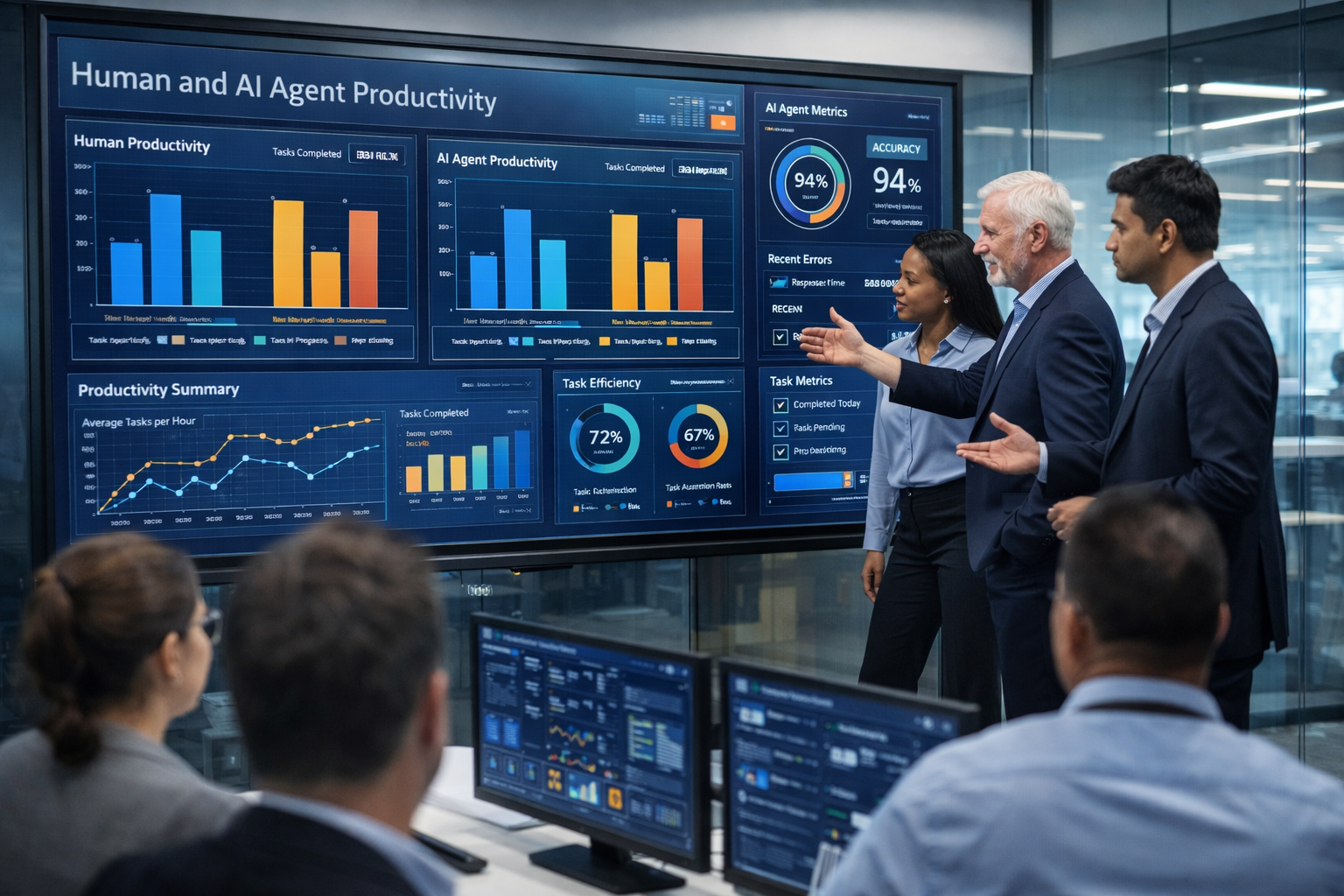
To manage this hybrid workforce, you need a single source of truth—a Silicon Scorecard. This dashboard should be reviewed weekly, just like a sales or marketing report.
Step 1: Establish the Baseline
Before deploying an agent, record exactly how much time and money a human team takes to perform the same tasks. This is your “Pre-Agent Baseline.”
Step 2: Define “Agent Identity”
Treat each agent like a hired contractor. Assign it a name, a set of permissions (Access Control), and a budget.
- Identity First: Use tools like a “Unified Open Directory” to track which agent is doing what. If an agent deletes a file, you need to know which agent did it and under which human’s authority.
Step 3: Set Thresholds for Intervention
Define at what point a human must step in.
- Example: “If the agent’s confidence score on a legal interpretation is below 85%, trigger a mandatory human review.”
Common Pitfalls in Agent Performance Management
- The “Set It and Forget It” Fallacy: Thinking agents are like traditional code. Agents require continuous “re-training” and “prompt tuning.”
- Over-Automation: Automating the “Human Touch” in sensitive areas (like HR performance reviews or high-value client relations). This often leads to a “uncanny valley” effect that destroys brand trust.
- Ignoring the “Shadow AI” Problem: When employees use unapproved personal agents to do their work, creating massive data privacy risks.
Conclusion: Leading the Hybrid Future
Managing the silicon workforce is the definitive leadership challenge of 2026. It requires a paradoxical blend of high-level technical oversight and deep human empathy. We are no longer just managing people; we are managing the collaborative flow between biological creativity and silicon scale.
The most successful managers of this era are those who stop viewing AI as a “cost-saving tool” and start viewing it as a “capacity-expanding teammate.” By implementing the KPIs outlined above—focusing on Verification Effort, Outcome Velocity, and Human-Agent Synergy—you can move past the hype and build a workforce that is truly greater than the sum of its parts.
Your Next Steps:
- Audit Your Current AI Usage: Identify where “Shadow AI” might be operating without oversight.
- Select Two Core KPIs: Start by measuring Verification Effort and Token Efficiency for one specific team.
- Build a Feedback Loop: Schedule monthly “Human-Agent Retrospectives” to ask your team where the agents are helping and where they are getting in the way.
Would you like me to draft a custom Silicon Scorecard template specifically for your industry?
FAQs
1. How do I calculate ROI for an AI agent?
ROI for the silicon workforce is calculated by taking the [Value of Human Time Saved + Value of Increased Output] minus the [Total Cost of Tokens + Development Time + Human Verification Time]. As of 2026, most companies see a positive ROI within 4 months of proper implementation.
2. What is “Verification Effort” (VE) exactly?
VE is a ratio. If a human takes 10 minutes to verify 60 minutes of AI work, the VE is 0.16. If the ratio climbs toward 1.0, the agent is effectively useless because it is not saving any human labor.
3. Should AI agents have their own performance reviews?
Yes, but they are “Technical Audits.” These reviews should check for “Model Drift” (loss of accuracy over time) and “Cost Efficiency.” Many managers now “fire” (decommission) agents that fail to maintain an 85% accuracy rate on the Golden Dataset.
4. How do I stop my team from fearing the “Silicon Workforce”?
Transparency is key. Focus the KPIs on “Reduction in Boring Tasks” rather than “Headcount Reduction.” When employees see that the agent handles the data entry they hate, they become the agent’s biggest advocates.
5. What are “Adversarial Agents”?
These are secondary AI agents programmed to act as “Quality Control.” They review the outputs of the primary agents to catch hallucinations or logic errors before a human ever sees them, drastically reducing the Verification Effort.
References
- Deloitte (2026): The Agentic Reality Check: Preparing for a Silicon-Based Workforce. [Official Tech Trends Report].
- McKinsey & Company (2026): The State of Organizations: Humans and AI Agents – Building a New World of Collaboration.
- IDC FutureScape (2026): Worldwide Future of Work: Navigating the Human-AI Collaboration Wave.
- Anthropic Research (2025/2026): Measuring AI Agent Autonomy in Practice: The Claude Code Analysis.
- IBM Think (2025): Top 5 Tips for Measuring Productivity of Gen AI in the Enterprise.
- Gartner (2026): Why 40% of Agentic AI Projects Fail and How to Avoid It.
- IEEE Standard for AI Governance (2025): Framework for Autonomous and Semi-Autonomous Systems in the Workplace.
- MIT Sloan Management Review (2026): Leadership Reinvented: Managing the Human-Machine Interface.