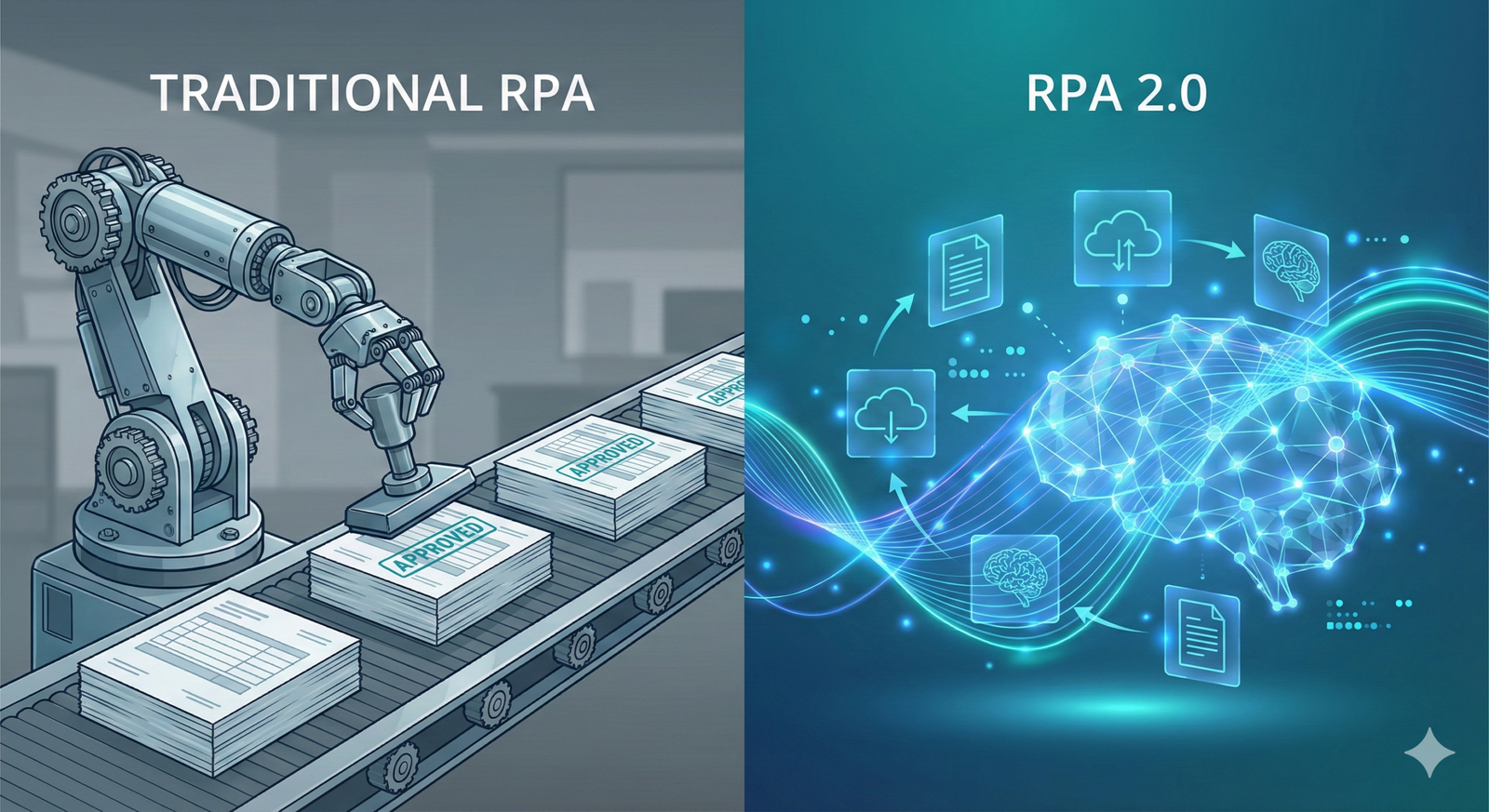
For over a decade, Robotic Process Automation (RPA) has served as the digital workforce for countless enterprises. It excelled at the mundane: copying data from spreadsheets, filling out forms, and executing rigid “if-this-then-that” scripts. However, traditional RPA (RPA 1.0) had a significant fragility problem. If a button moved on a screen, the bot broke. If the data format changed slightly, the process halted.
RPA 2.0 represents the evolution from fragile, rule-based scripts to resilient, cognitive automation. By integrating Artificial Intelligence (AI), Machine Learning (ML), and Natural Language Processing (NLP), RPA 2.0 tools do not just follow instructions—they understand context, handle unstructured data, and adapt to changes.
In this guide, RPA 2.0 refers to the convergence of traditional automation with cognitive AI technologies (often called Intelligent Automation or Hyperautomation), distinct from the legacy screen-scraping bots of the past.
Key takeaways
- From rigidity to resilience: RPA 2.0 uses computer vision and semantic understanding, meaning bots don’t break when user interfaces change.
- Unstructured data mastery: Unlike RPA 1.0, next-gen tools can read emails, interpret PDFs, and understand conversational text.
- Democratization of development: Generative AI allows business users to build automations using natural language prompts rather than complex code.
- Process discovery: RPA 2.0 tools often include process mining capabilities to automatically identify which workflows should be automated.
- Human-in-the-loop: The focus shifts from replacing humans to “copilot” models where humans and bots collaborate on complex decisions.
Who this is for (and who it isn’t)
This guide is designed for IT managers, operations leaders, and digital transformation strategists who are looking to upgrade their current automation stack or are frustrated by the maintenance overhead of legacy RPA. It is also suitable for business analysts seeking to understand the new capabilities of tools like UiPath, Microsoft Power Automate, and Automation Anywhere.
This article is not a coding tutorial for writing Python scripts or a basic introduction to what a computer is. It assumes a basic understanding of business workflows but explains advanced technical concepts in plain English.
Defining RPA 2.0: The shift to Intelligent Automation
To understand where we are going, we must briefly look at where we started. RPA 1.0 was deterministic. It was built on the premise that the underlying environment would never change. It was excellent for stable, high-volume transactional processes—like processing standard invoices where the layout never varied.
RPA 2.0, often synonymous with Intelligent Automation (IA), breaks these chains. It introduces “cognitive” abilities. If RPA 1.0 is the “hands” that do the work, AI is the “brain” that decides what work needs to be done.
The core difference: Structured vs. Unstructured Data
The most significant leap in RPA 2.0 is the ability to handle unstructured data.
- Structured data: Excel rows, database fields, fixed forms. (RPA 1.0 domain).
- Unstructured data: Emails, chat logs, images, variable invoices, voice recordings. (RPA 2.0 domain).
Estimates suggest that over 80% of enterprise data is unstructured. RPA 1.0 could only address the 20% that was structured. RPA 2.0 unlocks the remaining 80%.
Comparison: RPA 1.0 vs. RPA 2.0
| Feature | RPA 1.0 (Traditional) | RPA 2.0 (Intelligent/Cognitive) |
| Primary Driver | Rules and scripts | AI and Machine Learning models |
| Data Handling | Structured only (databases, spreadsheets) | Unstructured (emails, images, voice, PDFs) |
| Resilience | Brittle; breaks with UI changes | Resilient; uses semantic understanding |
| Decision Making | Binary (Yes/No) | Probabilistic (Confidence scores, intent) |
| Setup | Manual coding or recording | Process mining & natural language prompts |
| Maintenance | High (constant script updates) | Low (self-healing capabilities) |
Core components of next-generation automation
RPA 2.0 is not a single technology but a stack of converging technologies. Understanding these components is essential for evaluating vendors and tools.
1. Computer Vision and Semantic Automation
Legacy bots navigated screens using fixed coordinates (x, y) or specific element IDs. If a website updated its layout, the coordinate changed, and the bot failed. RPA 2.0 uses Computer Vision (AI that “sees”) to recognize elements visually, much like a human does. It looks for a “Submit” button regardless of where it is on the page. Semantic automation goes further by understanding the purpose of the field. It knows that a field labeled “Mob,” “Cell,” or “Phone” likely requires a phone number, allowing the bot to adapt without reprogramming.
2. Natural Language Processing (NLP)
NLP allows automation tools to understand human language. This enables:
- Sentiment Analysis: Routing customer support emails based on whether the customer is angry or happy.
- Entity Extraction: Reading a legal contract and automatically pulling out names, dates, and liability clauses, even if they appear in different places in every document.
- Chatbot Integration: Connecting RPA backends to conversational front-ends, allowing users to trigger complex workflows via chat.
3. Intelligent Document Processing (IDP)
IDP is the evolution of OCR (Optical Character Recognition). Standard OCR turns an image of text into text. IDP turns that text into meaning. For example, in an invoice processing workflow, IDP doesn’t just read the text; it identifies which number is the “Total,” which is the “Tax,” and which is the “PO Number,” even if the invoice layout is completely new to the system. This uses Machine Learning models trained on thousands of document types.
4. Process Mining and Task Mining
RPA 2.0 tools don’t just execute processes; they help find them.
- Process Mining: Analyzes system logs (ERP, CRM) to visualize the actual flow of a business process, highlighting bottlenecks.
- Task Mining: Monitors user desktop activity (privacy-compliant) to see how employees interact with apps, identifying repetitive clicks and keystrokes that are prime candidates for automation.
How Generative AI is reshaping RPA
As of January 2026, Generative AI (GenAI) has become the primary catalyst for the transition to RPA 2.0. The integration of Large Language Models (LLMs) into automation platforms has fundamentally changed the developer experience and the capability of the bots.
“Text-to-Automation” development
The barrier to entry for creating automations has lowered drastically. In RPA 1.0, a user had to understand variables, loops, and logic gates. In RPA 2.0, a user can type:
“Whenever I receive an email with an invoice attached, save it to OneDrive, extract the total amount, and add it to my expense Excel sheet.”
The GenAI engine translates this natural language prompt into a functional automation workflow code. This empowers “Citizen Developers”—business users with no coding background—to build their own tools, relieving pressure on IT departments.
Handling ambiguity
RPA 1.0 required exact instructions. If an instruction was “Click the blue button,” and the button turned light blue, it might fail. GenAI provides a reasoning layer. If a bot encounters an error or an unexpected pop-up, it can feed the screen state to an LLM and ask, “What should I do?” The LLM can interpret the pop-up (e.g., “It’s a generic cookie consent banner”) and instruct the bot to close it, allowing the process to continue.
Key benefits of adopting Intelligent Automation
Moving to RPA 2.0 is an investment. Why should organizations make the leap?
1. Massive expansion of use cases
By handling unstructured data, the addressable market for automation within a company triples. Legal teams can automate contract reviews. HR can automate resume screening. Customer service can automate complex email responses. These were previously impossible with simple scripts.
2. Reduced maintenance costs
The “fragility” of RPA 1.0 created a hidden technical debt. Companies hired teams of developers just to fix bots that broke overnight. RPA 2.0’s self-healing capabilities—where the bot attempts to locate a missing element before failing—drastically reduce downtime and maintenance hours.
3. Enhanced compliance and auditability
RPA 2.0 tools often come with advanced analytics. Because they understand the data they process (rather than just moving it), they can flag anomalies. For instance, in accounts payable, an intelligent bot can flag a duplicate invoice or a vendor name that closely resembles a sanctioned entity, acting as a first line of defense against fraud.
4. Employee satisfaction and upskilling
When bots handle the messy, unstructured inputs (like deciphering handwritten notes on a form), employees are freed from the most tedious cognitive loads. This shifts human roles toward exception handling and strategy, which are generally more engaging tasks.
Leading RPA 2.0 tools and platforms
As of January 2026, the market leaders have aggressively pivoted toward AI integration. While many tools exist, the following represent the shift toward next-generation capabilities.
Note: The landscape is competitive. Always verify current feature sets and pricing models.
UiPath
UiPath has long been a market leader and has heavily invested in “AI Center” and semantic automation. They offer integrated IDP and have incorporated generative AI to help build workflows. Their focus is on end-to-end “Hyperautomation,” covering everything from discovery to testing.
- Best for: Large enterprises needing a comprehensive, governance-heavy ecosystem.
Microsoft Power Automate
Leveraging the massive reach of the Microsoft 365 ecosystem, Power Automate has integrated “Copilot” features deeply. Users can build flows using natural language. Its strength lies in its seamless integration with Excel, SharePoint, and Dynamics.
- Best for: Organizations already invested in the Microsoft stack and democratizing automation to business users.
Automation Anywhere
Automation Anywhere focuses on “Cloud-Native” automation. Their “Automation Co-Pilot” is designed to embed automation directly into the apps employees use daily (like Salesforce or Google Sheets), acting as a digital assistant rather than a backend bot.
- Best for: Cloud-first strategies and embedding automation into existing user interfaces.
Nice & SS&C Blue Prism
Both are veterans in the space. Blue Prism (now part of SS&C) focuses on “Digital Workers” for highly regulated industries like banking. NICE specializes in “Attended Automation” (bots that help agents in real-time), specifically in contact centers.
- Best for: Financial services and contact center operations requiring high security and compliance.
Implementation framework: Moving from 1.0 to 2.0
Upgrading to RPA 2.0 is not just a software update; it is a change in strategy. Here is a practical framework for migration.
Phase 1: Assessment and Discovery
Do not try to migrate everything at once. Use process mining tools to analyze your existing RPA 1.0 bots.
- Identify brittle bots: Which bots fail the most? These are prime candidates for RPA 2.0 computer vision upgrades.
- Identify “human glue”: Look for processes where a bot does step 1, hands off to a human to read an email (step 2), and then the human triggers a bot for step 3. RPA 2.0 can likely automate that middle step.
Phase 2: Pilot with Unstructured Data
Choose a pilot project that was previously considered “too complex” for automation. Good examples include:
- Invoice processing with multiple layouts.
- Customer email triage.
- Onboarding workflows involving passport/ID scans.
Phase 3: Governance and Guardrails
RPA 2.0 is more powerful, which means it carries more risk.
- Data Privacy: If your bot is reading emails using an LLM, where is that data going? Ensure your vendor provides “zero-retention” policies for data sent to AI models.
- Human-in-the-loop: Design workflows where the bot executes the task but asks for human confirmation if its “confidence score” drops below a certain threshold (e.g., 90%).
Phase 4: Scaling and Democratization
Once the pilot is successful, roll out the “citizen developer” tools. Allow business units to build their own simple automations using the Generative AI prompts, while IT maintains control over the complex, enterprise-wide bots.
Challenges and risks in the new era
While the technology is exciting, RPA 2.0 introduces new hurdles that organizations must manage.
The “Black Box” problem
In RPA 1.0, you could read the script and know exactly why a bot made a decision. In RPA 2.0, if a Machine Learning model decides to reject a loan application, explaining why can be difficult. This is the challenge of Explainable AI (XAI). For regulated industries, you must ensure your tools provide audit logs that explain the decision logic, not just the outcome.
Bias in automation
If the AI models driving your RPA 2.0 tools were trained on biased data, your automations will scale that bias. For example, a resume-screening bot might inadvertently penalize candidates from certain universities if the training data historically favored others. Regular auditing of bot outcomes for bias is mandatory.
Cost complexity
RPA 1.0 licensing was usually simple (per bot). RPA 2.0 often involves consumption-based pricing (per document processed, per API call to the AI model). Costs can spiral if not monitored. A bot processing 10,000 emails a day using a premium LLM API will be significantly more expensive than a simple script.
Common mistakes in next-gen automation
Even with smarter tools, projects fail. Here are the most common pitfalls to avoid.
Automating broken processes
This is the classic “Paving the Cow Path.” If a business process is inefficient (e.g., requires 5 unnecessary approvals), automating it just makes the inefficiency faster. Optimize the process first, then automate it.
Over-reliance on AI
Not every problem needs a neural network. If a process deals with standard, fixed Excel files, use traditional RPA 1.0 methods. They are cheaper, faster, and 100% predictable. Save the RPA 2.0 capabilities for the problems that actually require cognitive skills.
Ignoring Change Management
RPA 2.0 can feel threatening to employees because it encroaches on tasks that require “thinking” (reading, deciding). Leaders must communicate that these tools are “Copilots” intended to augment human capacity, not eliminate roles. Failure to manage this anxiety leads to sabotage or lack of adoption.
Future trends: Agentic AI and beyond
Looking ahead, the line between RPA and “Agentic AI” is blurring.
Agentic AI refers to autonomous agents that can plan and execute multi-step goals without a pre-defined workflow. While RPA 2.0 follows a flexible path, Agentic AI creates the path.
- Current State: You tell the bot, “Process this invoice.” (The bot follows a flow).
- Future State (Agentic): You tell the bot, “Reduce our outstanding vendor payments by 10% this week.” The agent might analyze invoices, draft emails to vendors negotiating early payment discounts, and queue payments for approval—figuring out the steps on its own.
We are seeing early signs of this in 2026 with “Autonomous Agents” beginning to appear in supply chain and logistics software, where the variables are too complex for even cognitive RPA workflows to map out in advance.
Related topics to explore
- Hyperautomation strategies: How to combine RPA, iBPMS, and AI.
- Process Mining tools: A deep dive into Celonis, UiPath Process Mining, and Microsoft Minit.
- AI Governance frameworks: Managing risk in automated decision-making.
- Low-code/No-code platforms: Empowering business users to build software.
- Data privacy in the age of AI: GDPR and CCPA compliance for bots.
Conclusion
RPA 2.0 marks the maturity of the automation industry. We have moved past the era of fragile bots that break when a pixel moves, entering an era of intelligent, resilient digital workers. By leveraging computer vision, NLP, and Generative AI, businesses can finally unlock the “dark data”—the unstructured 80% of information that drives modern enterprise.
However, technology is only an enabler. Success in next-generation automation requires a shift in mindset: from “replacing humans” to “augmenting humans,” and from “coding scripts” to “managing outcomes.”
Next steps: Audit your current automation portfolio today: identify the top five processes that frequently fail due to UI changes or data variations, and evaluate them as your first pilots for an RPA 2.0 upgrade.
FAQs
What is the main difference between RPA 1.0 and RPA 2.0?
The main difference is intelligence and resilience. RPA 1.0 relies on rigid, rule-based scripts and structured data, making it prone to breaking if software interfaces change. RPA 2.0 integrates AI and Machine Learning (like computer vision and NLP) to understand context, handle unstructured data (documents, emails), and adapt to changes without crashing.
Can RPA 2.0 tools handle handwritten text?
Yes, most RPA 2.0 platforms include Intelligent Document Processing (IDP) capabilities. These use advanced OCR and machine learning models to decipher handwritten text, signatures, and scanned documents with high accuracy, although human verification is often recommended for low-confidence results.
Is coding required for RPA 2.0?
RPA 2.0 significantly reduces the need for coding compared to traditional RPA. With the integration of Generative AI, users can often create workflows using natural language prompts (e.g., “Create a flow that saves email attachments to OneDrive”). However, complex enterprise integrations and governance setups still require technical expertise.
How does Process Mining fit into RPA 2.0?
Process Mining is often considered the “eyes” of RPA 2.0. It analyzes data logs from business systems (like ERPs) to visualize exactly how processes are running in reality, as opposed to how managers think they run. This helps identify bottlenecks and prioritize which tasks will yield the highest ROI from automation.
Are RPA 2.0 tools more expensive?
Generally, yes. While basic RPA licenses might be fixed-cost, RPA 2.0 tools often include consumption-based pricing models for their AI components (e.g., per page processed by IDP or per API call to an LLM). However, the ROI is typically higher because they can automate complex, high-value processes that basic RPA cannot touch.
Is RPA 2.0 the same as Hyperautomation?
They are closely related concepts. Hyperautomation is the overarching strategy of automating everything that can be automated using a mix of tools. RPA 2.0 is the specific set of tools (RPA + AI) that enables Hyperautomation. Think of RPA 2.0 as the engine and Hyperautomation as the destination.
What are the security risks of RPA 2.0?
Risks include data privacy (ensuring sensitive data sent to AI models is not stored or trained upon), algorithmic bias (bots making unfair decisions based on biased training data), and the “black box” issue where it is difficult to audit why an AI model made a specific decision.
Will RPA 2.0 replace human jobs?
RPA 2.0 is designed to automate tasks, not necessarily entire jobs. It excels at high-volume, repetitive cognitive tasks (like data entry or document review). This typically shifts human roles toward “human-in-the-loop” activities, such as handling exceptions, managing relationships, and strategic decision-making.
References
- UiPath. (2025). The Evolution of Automation: From RPA to Agentic AI. UiPath Official Whitepaper. https://www.uipath.com/resources/automation-whitepapers
- Microsoft. (2025). Power Automate and Copilot: The Future of Low-Code Development. Microsoft Learn Documentation. https://learn.microsoft.com/en-us/power-automate/
- Gartner. (2024). Magic Quadrant for Robotic Process Automation. Gartner Research.
- Automation Anywhere. (2025). Intelligent Automation vs. Traditional RPA: A Guide for CIOs. Automation Anywhere Blog. https://www.automationanywhere.com/company/blog
- Forrester. (2024). The State of Automation and AI in the Enterprise. Forrester Reports.
- IBM. (n.d.). What is Intelligent Automation? IBM Cloud Education. https://www.ibm.com/topics/intelligent-automation
- Deloitte. (2024). Global Intelligent Automation Study. Deloitte Insights. https://www2.deloitte.com/us/en/insights/focus/technology-and-the-future-of-work/intelligent-automation-survey.html
- SS&C Blue Prism. (2025). Governance in the Era of Generative AI. SS&C Blue Prism Resources. https://www.blueprism.com/resources/white-papers/