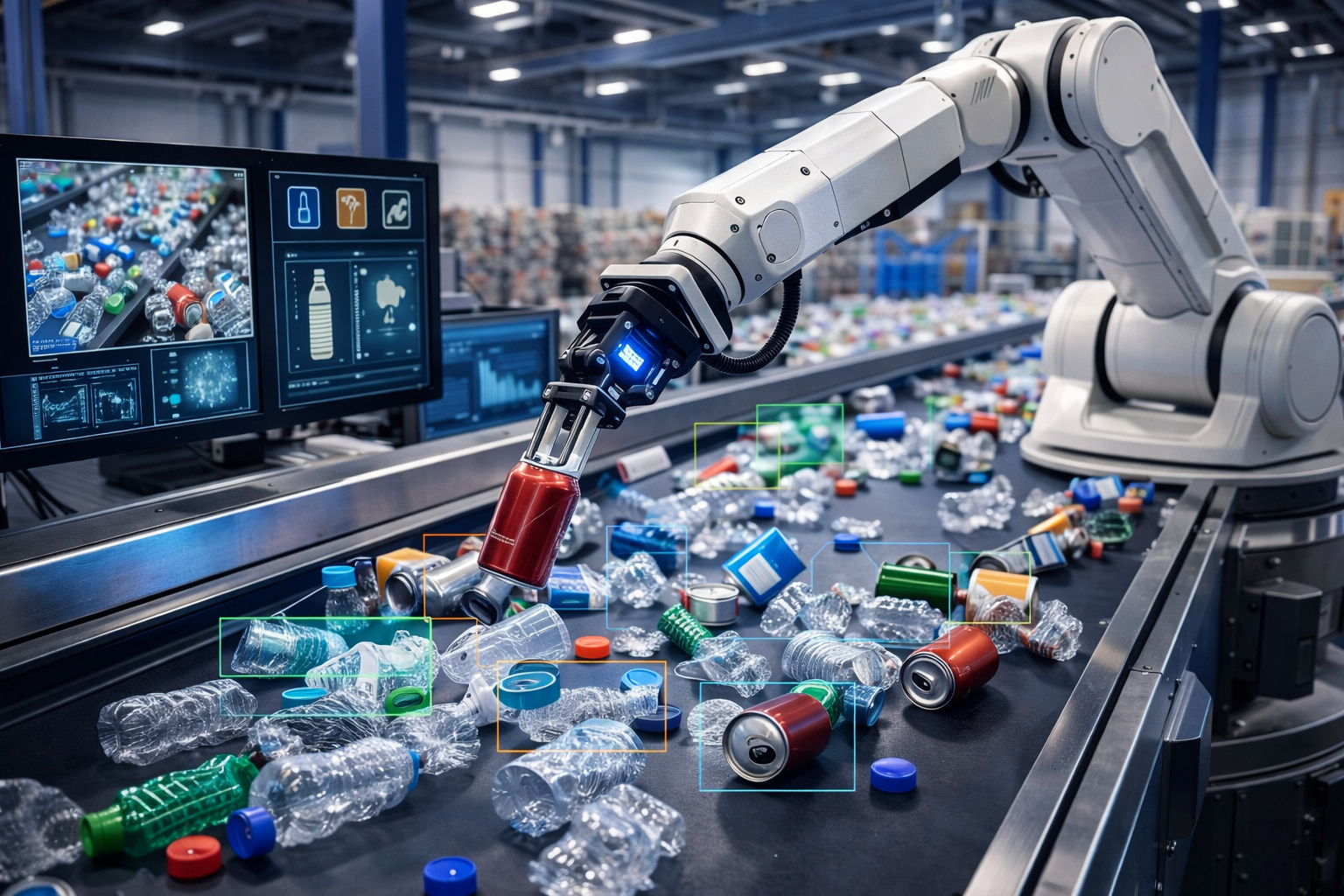
The global waste crisis is no longer a distant threat; it is an immediate operational and environmental challenge. As of March 2026, the transition from a “take-make-dispose” linear model to a regenerative circular economy has become a top priority for governments and corporations alike. Central to this transition is the integration of robotic waste sorting and automation. These technologies are not merely peripheral upgrades; they represent a fundamental shift in how we perceive, categorize, and recover value from what was once considered “trash.” By leveraging artificial intelligence (AI), computer vision, and advanced robotics, the recycling industry is finally achieving the purity levels and throughput necessary to make high-scale resource recovery economically viable.
Key Takeaways
- Precision and Purity: Robots achieve over 99% sorting accuracy, significantly higher than manual labor.
- Economic Viability: Automated systems reduce long-term operational costs and provide consistent ROI despite high initial CAPEX.
- Safety and Health: Automation removes human workers from hazardous environments involving sharp objects and biohazards.
- Data-Driven Insights: AI systems provide real-time data on waste streams, allowing for better policy and design decisions.
- Circular Integration: Robotics bridges the gap between post-consumer waste and high-quality raw material manufacturing.
Who This Article Is For
This deep dive is designed for waste management executives, municipal planners, sustainability consultants, and industrial automation engineers. Whether you are looking to upgrade a Material Recovery Facility (MRF) or simply want to understand the technological backbone of modern sustainability, this guide provides the technical and strategic depth required to navigate the future of automated recycling.
The Intersection of Robotics and Circularity
To understand the role of robots, we must first define the circular economy. Unlike traditional recycling, which often results in “downcycling” (turning high-quality plastic into lower-quality products), a circular economy aims to keep materials at their highest utility and value at all times. This requires an incredible level of material purity. If a batch of recycled Polyethylene Terephthalate (PET) is contaminated with even a small amount of Polyvinyl Chloride (PVC), the entire batch can be ruined for high-end applications like food-grade packaging.
Robotic waste sorting is the “gatekeeper” of this purity. While traditional mechanical sorters (like trommels, magnets, and eddy currents) handle bulk separation, robots provide the surgical precision needed to distinguish between different types of plastics, paper grades, and even specific brands. This level of granularity is the engine that drives circularity.
How Robotic Waste Sorting Works: The Technical Core
The “brain” of a modern recycling robot is a combination of hardware and software working in millisecond intervals. As of March 2026, these systems have evolved far beyond simple color detection.
1. Computer Vision and Deep Learning
The robot “sees” the waste stream using high-resolution cameras. However, seeing isn’t enough; the system must identify. Deep Learning models are trained on millions of images of crushed, dirty, and obscured items. The AI learns to recognize a crumpled soda can regardless of its orientation or if the label is partially torn.
2. Sensor Fusion (NIR and Hyperspectral Imaging)
Standard cameras are often supplemented by Near-Infrared (NIR) sensors. These sensors analyze the light reflected off an object to determine its chemical composition. This is crucial for distinguishing between visually identical plastics like HDPE (High-Density Polyethylene) and PP (Polypropylene). Some advanced systems now use Hyperspectral Imaging, which looks at hundreds of bands of light, allowing the robot to identify complex composite materials that were previously unrecyclable.
3. Robotic Actuation
Once an item is identified, the “hand” of the robot must act. There are two primary types of robotic configurations in MRFs:
- Delta Robots: These are high-speed, spider-like robots suspended over the belt. They use suction cups or pneumatic grippers to “pick” items at speeds of up to 80 picks per minute.
- Articulated Arms: These look like traditional factory robots. While slightly slower than Deltas, they can handle heavier items like scrap metal or construction debris.
Primary Applications in Resource Recovery
Plastic Recycling: The Battle Against Contamination
Plastics are the most difficult material to manage due to the sheer variety of polymers. Robots are now being deployed to sort “flaked” plastic—material that has already been shredded. By sorting at the flake level, robots can remove tiny contaminants that mechanical screens miss, ensuring that the resulting resin can be used to make new bottles rather than just park benches.
E-Waste: Precision Disassembly
Electronic waste (e-waste) contains gold, silver, copper, and rare earth elements. Traditionally, e-waste was shredded, which loses significant value and creates toxic dust. Automated disassembly robots use AI to locate screws and connectors, carefully taking apart smartphones and laptops to recover intact components and pure metal streams.
Construction and Demolition (C&D)
Construction waste is heavy and dangerous. Large-scale robotic arms equipped with “heavy-duty” grippers are now being used to sort wood, concrete, and metal from demolition sites. This not only increases the recycling rate of heavy industry but also prevents huge volumes of material from entering landfills.
The Economic Reality: ROI and CAPEX
A common critique of robotic sorting is the high upfront cost. As of March 2026, a single robotic sorting cell can cost between $250,000 and $500,000. However, the economic argument shifts when looking at the Total Cost of Ownership (TCO).
| Metric | Manual Sorting | Robotic Sorting |
| Consistency | Fluctuates with fatigue | Constant 24/7 |
| Picks Per Minute | 30–45 | 60–80+ |
| Safety Costs | High (Insurance/Workman’s Comp) | Low |
| Purity Level | 80–90% | 99%+ |
| Data Analytics | None | Real-time stream analysis |
For a facility processing 50,000 tons per year, the ROI typically realizes within 18 to 30 months, primarily driven by the “purity premium”—the higher price that clean, sorted bales of material fetch on the global commodities market.
Common Mistakes in Implementing Automation
Even with the best technology, many facilities fail to see results due to avoidable errors.
- Ignoring the “Pre-Sort”: Robots work best when the waste stream is somewhat managed. Throwing raw, unscreened municipal solid waste (MSW) at a high-speed Delta robot will result in “blindness” and mechanical failure. Effective mechanical pre-sorting (removing large films or heavy glass) is essential.
- Poor Lighting Conditions: Computer vision relies on light. Many older MRFs are dark and dusty. Failing to maintain a clean, well-lit environment for the sensors leads to a drastic drop in identification accuracy.
- Underestimating Maintenance: While robots don’t get tired, their suction cups wear out, and their lenses get dusty. A “set it and forget it” mentality leads to system degradation within months.
- Static AI Models: The waste stream changes. New packaging designs enter the market every month. If the robot’s AI isn’t connected to a “cloud-learning” network that updates its library of shapes and brands, it will eventually become obsolete.
The Human Factor: Ethics and Job Displacement
A “human-first” approach to SEO and industry must address the workforce. Critics argue that robots steal jobs from low-skilled workers. However, manual waste sorting is one of the most dangerous and unpleasant jobs in the modern economy, with high rates of respiratory issues and needle-stick injuries.
The shift is not toward “unemployment” but toward “upskilling.” Facilities that implement robotics require technicians, data analysts, and maintenance engineers. The goal is to move the human worker from the “picking line” to the “control room,” where they manage a fleet of robots that do the dangerous work.
As of March 2026: The State of the Industry
In early 2026, we have seen the emergence of “Dark MRFs.” These are fully autonomous facilities that require no human presence on the sorting floor. They utilize “Swarm Robotics,” where multiple small robots collaborate to sort a single stream, communicating via 6G networks to ensure no two robots go for the same bottle. Furthermore, the integration of Digital Product Passports (DPPs) in the EU means that robots can now “read” invisible watermarks on packaging, telling them exactly what chemicals were used in the manufacturing of that specific item.
Conclusion: The Path Forward
The integration of robots into the circular economy is no longer an “innovation project”—it is a survival requirement for the waste management industry. As global regulations on “extended producer responsibility” (EPR) tighten, companies are being held accountable for the end-of-life of their products. This accountability creates a massive demand for the high-purity materials that only robotic systems can provide.
The transition to an automated, circular world requires more than just buying a robot. It requires a systemic rethink of product design, consumer behavior, and industrial policy. We must design products for “robotic recyclability,” ensuring that the AI of tomorrow can easily recognize and disassemble the products of today.
Next Steps for Stakeholders:
- Audit Your Stream: Conduct a waste characterization study to identify which high-value materials are currently being lost to residue.
- Start Small: Implement a “Quality Control” robot at the end of a line to pick out contaminants before investing in a full-scale automated overhaul.
- Prioritize Connectivity: Ensure any robotic investment includes cloud-based AI updates to stay ahead of changing packaging trends.
- Invest in People: Begin training programs for your current staff to transition into “Automation Specialists.”
The circular economy is a loop, and robots are the engine that keeps that loop spinning. By embracing this technology, we move closer to a world where “waste” is a forgotten concept.
FAQs
1. Can robots sort “wet” or organic waste?
While robots are primarily used for dry recyclables (plastics, metals, paper), new advancements in grippers and AI allow some systems to sort organic contaminants out of dry streams. However, pure “wet” waste (food scraps) is still primarily handled by anaerobic digesters or composting systems rather than robotic pickers.
2. What happens if a robot misidentifies an item?
Modern systems are designed with “confidence thresholds.” If a robot is only 60% sure an item is a PET bottle, it may let it pass to a manual check station or a secondary loop. This prevents the contamination of high-value bales.
3. How do robots handle flexible packaging like plastic bags?
Flexible film is notoriously difficult for robots because it wraps around mechanical parts. Most facilities use “Air Classifiers” or “Optical Sorters” to blow film off the belt before it reaches the robotic arms. However, new “soft-touch” grippers are currently being tested to specifically target and remove films.
4. Is the energy consumption of the robots offset by the recycling benefits?
Yes, significantly. The energy required to power a robotic arm is a tiny fraction of the energy saved by recycling aluminum or plastic versus manufacturing them from virgin materials. The carbon “payback” period for a sorting robot is often less than six months.
5. Can these robots be used in small-scale community recycling?
Currently, the high CAPEX makes them most suitable for large-scale MRFs. However, “modular” robotic units are entering the market as of 2026, which are designed for smaller municipalities or even large-scale apartment complexes to pre-sort waste on-site.
References
- Ellen MacArthur Foundation. (2025). The Circular Economy: A Wealth of Flows. [Official Site]
- IEEE Robotics and Automation Society. (2025). Journal of Automated Waste Management and Resource Recovery.
- Environmental Protection Agency (EPA). (2026). National Recycling Strategy: 2026 Update on Automation. [EPA.gov]
- International Federation of Robotics (IFR). (2025). World Robotics Report: Service and Industrial Robotics in Sustainability.
- European Commission. (2024). Circular Economy Action Plan: Requirements for Automated Sorting. [Europa.eu]
- Journal of Cleaner Production. (2026). The Role of AI and Machine Learning in Reducing Contamination in MRFs.
- AMP Robotics / BHS (Bulk Handling Systems). (2025). Case Studies in Automated Material Recovery. [Industrial whitepaper]
- World Economic Forum. (2025). Scaling the Circular Economy through Industrial IoT and Robotics.