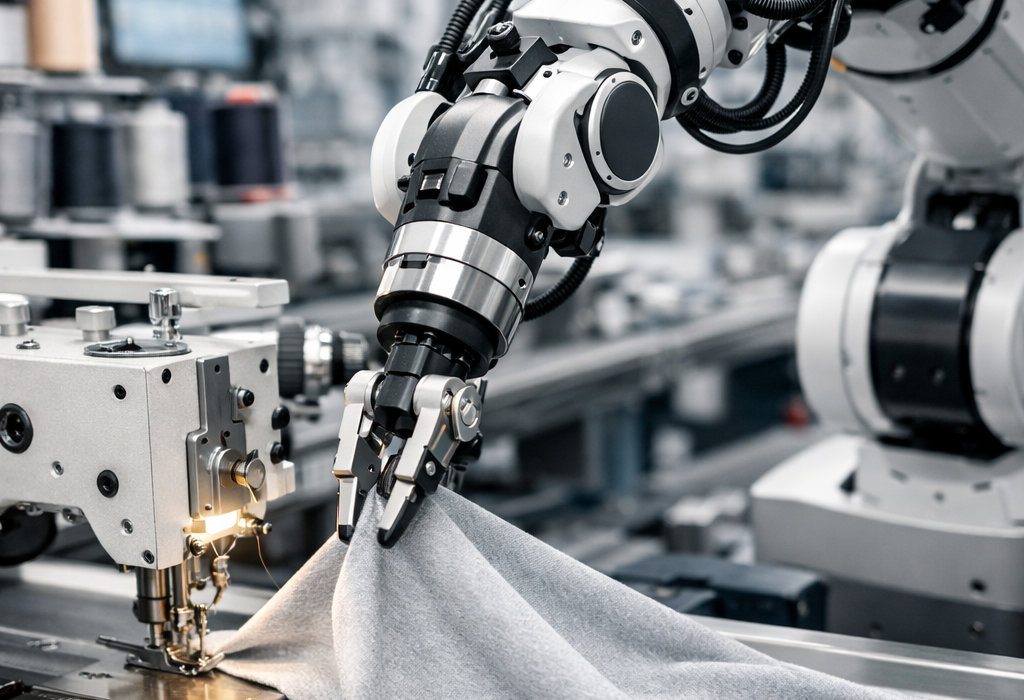
The fashion industry, long reliant on intensive manual labor and complex global supply chains, is currently undergoing a seismic shift. As of March 2026, the integration of fashion industry robotics—specifically in the realms of automated sewing and sorting—has moved from experimental prototypes to essential infrastructure for brands seeking speed, sustainability, and scalability.
This transition isn’t just about replacing human hands with mechanical ones; it is about reimagining the entire lifecycle of a garment. From the initial stitch to the final sorting of recycled textiles, robotics are solving the industry’s most “unsolvable” problems: the unpredictable behavior of limp fabrics and the logistical nightmare of textile waste.
Key Takeaways
- The “Limp Material” Challenge: Unlike automotive robotics, fashion robotics must account for the elasticity and friction of textiles, requiring advanced sensors and “chemical stiffening” techniques.
- Reshoring Potential: Automation is allowing brands to bring manufacturing closer to home (reshoring), reducing shipping times and carbon footprints.
- Circular Economy: AI-driven sorting robots are now capable of identifying fiber blends, making large-scale textile recycling a reality for the first time.
- On-Demand Manufacturing: Robotics enable “micro-factories” that produce garments only after a customer clicks “buy,” drastically reducing overproduction.
Who This Is For
This guide is designed for apparel executives looking to optimize their supply chain, manufacturing engineers specializing in industrial automation, sustainable fashion advocates interested in circularity tech, and tech-forward designers eager to understand the tools shaping the next decade of style.
The Engineering Challenge: Why Sewing is the “Holy Grail” of Robotics
To understand why your t-shirt is still largely made by hand in 2026, you have to understand the physics of fabric. In the world of industrial automation, metal is predictable. It has a fixed shape, a known weight, and it doesn’t “stretch” when a robotic arm picks it up.
Fabric, however, is a nightmare for traditional robots. It is “limp,” meaning it has no structural integrity. It behaves differently based on humidity, weave, and weight. A robot calibrated for heavy denim will fail miserably if handed a piece of silk.
The Problem of “Drape”
When a human sews, they are constantly making micro-adjustments with their fingers—feeling the tension, smoothing out wrinkles, and guiding the fabric under the needle. Traditional robots lacked this “tactile feedback loop.” Early attempts at automated sewing often resulted in bunched-up seams or jammed machines because the robot couldn’t “feel” the fabric slipping.
Overcoming the Barrier
To solve this, modern fashion industry robotics use two primary methods:
- Computer Vision: High-speed cameras that track the weave of the fabric in real-time, allowing the robot to adjust its grip millions of times per second.
- Material Modification: Techniques like the “Sewbo” method, which involves temporarily stiffening fabric with a water-soluble polymer, making it behave like a rigid sheet of plastic until the garment is finished and washed.
Automated Sewing: From Prototypes to Production Lines
Automated sewing is the most difficult stage of garment construction to automate, yet it offers the highest rewards in terms of consistency and speed. As of March 2026, we are seeing a surge in “Sewbots” that handle specific garment types with incredible precision.
1. Vision-Guided Stitching
Modern automated sewing systems use a combination of vacuum grippers and high-definition cameras. Instead of a human guiding the cloth, the robot uses “mapping” to identify the edges of the fabric.
2. The “Sewbo” Revolution
Sewbo’s approach remains a game-changer. By treating fabric like a rigid material, industrial robots (the same ones used to build cars) can pick up, stack, and move garment pieces through a sewing machine.
- The Process: Fabric is dipped in a non-toxic, recyclable polymer. It becomes stiff. The robot sews it. The finished shirt is washed in warm water, and the stiffener is recovered to be used again.
- Benefits: It allows for complex 3D shapes that were previously impossible for robots to handle.
3. SoftWear Automation and the “Lowry” Robot
SoftWear Automation has pioneered the use of “threaded counting” technology. Their Lowry robot doesn’t just look at the edge of the fabric; it counts the individual threads in the weave to determine exactly where it is. This level of precision allows for the production of high-volume items like t-shirts, towels, and jeans with zero human intervention.
Automated Sorting: The Logistics Powerhouse
While sewing gets all the headlines, automated sorting is arguably the more mature and economically impactful side of fashion robotics. Sorting occurs at two critical points: the Warehouse (Pre-Consumer) and the Recycling Center (Post-Consumer).
Warehouse Robotics and “Pick-and-Place”
In the era of e-commerce, the ability to sort thousands of individual SKUs (Stock Keeping Units) is vital. Robots like those from Boston Dynamics and GreyOrange now navigate warehouses, picking specific garments from bins and sorting them into shipping crates.
- RFID Integration: Every garment is tagged with a Radio Frequency Identification (RFID) chip. The sorting robot “reads” the chip and knows exactly where the item belongs without needing to “see” it.
- Collaborative Robots (Cobots): These robots work alongside humans, handling the heavy lifting and repetitive sorting while humans manage the quality control.
Sorting for the Circular Economy (Recycling)
One of the biggest hurdles to sustainable fashion is that we cannot recycle what we cannot identify. A “cotton” shirt might actually be a 60/40 cotton-polyester blend. Traditional recycling methods fail here because the chemical processes for cotton and polyester are different.
AI-Driven NIR (Near-Infrared) Sorting:
Robotic sorting lines now use NIR sensors to “scan” the chemical composition of old clothes.
- Detection: The sensor identifies the fiber blend (e.g., 100% Wool, Poly-Cotton blend).
- Removal: Automated air jets or robotic arms flick the item into the corresponding bin.
- Efficiency: These systems can sort garments at a rate of several tons per hour, far faster and more accurately than any human team.
Impact on Sustainability and the Environment
The fashion industry is responsible for approximately 10% of global carbon emissions. Robotics offers a path toward a significantly smaller footprint through three main avenues:
1. Reduction of Overproduction
The current fashion model relies on “predictive manufacturing”—making 10,000 shirts in hopes that 8,000 will sell. The leftovers end up in landfills. Robotics enables On-Demand Manufacturing. Because a robot doesn’t need to be “trained” for a specific shift or require a large minimum order to be profitable, brands can sew garments only as they are ordered.
2. Near-Shoring and Reshoring
Shipping a shipping container of clothes from Southeast Asia to Europe or North America is carbon-intensive. By automating the sewing process, the labor cost advantage of overseas manufacturing disappears. Factories can be placed in the markets where the clothes are actually sold, cutting down on transoceanic shipping.
3. True Circularity
Automated sorting is the “missing link” in the circular economy. By providing clean, sorted feedstock for chemical recyclers, robotics allow old clothes to be turned back into high-quality virgin-equivalent fibers, rather than being “downcycled” into insulation or rags.
Global Economics: The Shift in the Labor Market
It would be disingenuous to discuss fashion industry robotics without addressing the impact on the global workforce. For decades, millions of workers in developing nations have relied on garment manufacturing.
Job Displacement vs. Upskilling
The “race to the bottom” for cheap labor is ending. As machines take over the repetitive, often dangerous tasks of sewing and sorting, the nature of “fashion jobs” is shifting.
- New Roles: Demand is skyrocketing for “Robotic Technicians,” “AI Fabric Analysts,” and “Digital Pattern Makers.”
- Safety Improvements: Robotics removes humans from environments involving heavy machinery, sharp needles, and toxic dyes.
Safety Disclaimer: The implementation of industrial robotics requires strict adherence to international safety standards (such as ISO 10218). Human operators must be trained in emergency stop procedures and “lockout-tagout” protocols to prevent injury during maintenance.
Common Mistakes in Implementing Fashion Robotics
Many brands jump into automation without a clear strategy, leading to expensive failures. Here are the most common pitfalls:
- Ignoring Fabric Variability: Assuming a robot that sews cotton will work for spandex. You must calibrate for “stretch” and “recovery” properties.
- Poor Software Integration: The robot is only as good as the CAD (Computer-Aided Design) file it receives. If the digital pattern is flawed, the robot will perfectly execute a flawed garment.
- Underestimating Maintenance: These are precision instruments. Dust and lint from textiles can clog sensors and gears. A rigorous cleaning schedule is non-negotiable.
- Neglecting the “Human Element”: Automation works best when it supports humans, not just replaces them. Failing to train your existing staff on how to manage the robots leads to resentment and “shadow work.”
The Future of Fashion Tech: What’s Next?
Looking beyond 2026, the convergence of fashion industry robotics with other emerging techs will create a completely new landscape.
- 4D Printing: Imagine a robotic “printer” that creates a garment that can change shape or insulation properties based on the wearer’s body temperature.
- Bio-Fabrication: Robots “growing” leather or silk from yeast and collagen cells in a lab, then immediately cutting and sewing them into garments within the same facility.
- Hyper-Personalization: Using 3D body scans to create a “digital twin” of a customer, which a robot then uses to custom-tailor a garment in minutes.
Implementation Strategy: How to Start
If you are a manufacturer or brand looking to integrate robotics, follow this roadmap:
Step 1: Identify the “Low-Hanging Fruit”
Don’t start with complex evening gowns. Start with simple, high-volume items:
- Pillowcases
- Tote bags
- Basic t-shirts
- Uniforms
Step 2: Audit Your Data
Robots require digital inputs. Ensure your patterns are digitized in high-fidelity 3D formats (like CLO3D or Browzwear).
Step 3: Pilot a Micro-Factory
Instead of overhauling your entire supply chain, set up one “cell”—a single robotic arm paired with an automated sewing head—to test its efficiency and ROI over a six-month period.
| Feature | Manual Sewing | Robotic Sewing |
| Speed | 10-20 mins (per basic shirt) | 4-6 mins (per basic shirt) |
| Consistency | High (but varies by worker) | Extremely High (identical every time) |
| Setup Cost | Low | High |
| Flexibility | High (humans learn new styles fast) | Moderate (requires reprogramming) |
| Waste | 15-20% (fabric scraps) | < 5% (with precision nesting) |
Conclusion
The integration of fashion industry robotics is no longer a “future” concept—it is the current standard for competitive manufacturing as of March 2026. By bridging the gap between the unpredictability of textiles and the precision of automation, the industry is finally moving toward a model that is both economically viable and environmentally responsible.
Automated sewing is solving the labor crisis and allowing for localized production, while automated sorting is unlocking the true potential of textile-to-textile recycling. For brands, the message is clear: the transition to “Smart Factories” is not just about efficiency; it’s about survival in a market that demands speed and transparency.
Your Next Steps:
- Audit your current waste: Use sensor-based sorting data to see where your scraps are going.
- Explore Digitization: Move your design process into 3D environments to prepare for robotic “readability.”
- Consult an Automation Expert: Evaluate which parts of your assembly line—sewing, folding, or sorting—are most ready for a robotic upgrade.
Would you like me to develop a specific cost-benefit analysis template for integrating a robotic sewing cell into your existing production line?
FAQs
1. Can robots sew complex garments like wedding dresses yet?
As of 2026, robots excel at “flat” and “tubular” sewing (shirts, pants, bags). However, complex “drapery” and multi-layered items like wedding dresses or tailored suits still require significant human intervention due to the delicate nature of the fabrics and the intricacy of the 3D construction.
2. Is robotic sewing actually cheaper than human labor?
In high-wage countries (USA, UK, Germany), yes—the ROI is typically seen within 24–36 months. In low-wage regions, the primary benefit isn’t cost, but rather speed-to-market and quality consistency, which allows brands to sell more full-price items and reduce returns.
3. How do sorting robots identify different fabric types?
They use Near-Infrared (NIR) Spectroscopy. Every material (cotton, polyester, nylon) reflects light differently. The robot’s sensor captures this “light signature,” compares it to a database of fibers, and identifies the blend with over 98% accuracy.
4. What happens to the workers who are displaced by these robots?
The industry is seeing a transition toward upskilling. Workers are being retrained to operate, program, and maintain the robotic systems. Furthermore, the shift to “micro-factories” is creating new local jobs in logistics, digital design, and sustainable waste management.
5. Are these robots energy-efficient?
Generally, yes. Modern robotic arms are designed for low power consumption, and the reduction in fabric waste and shipping emissions far outweighs the electricity used by the machines themselves. Many “smart factories” are now powered by on-site renewable energy.
References
- International Federation of Robotics (IFR): “World Robotics Report 2025: Service and Industrial Trends.” (Official Doc).
- SoftWear Automation: “The Lowry System: Technical Specifications for Automated Garment Assembly.” (Corporate Documentation).
- Journal of Textile and Apparel, Technology and Management (JTATM): “Integrating AI and Robotics in the Global Apparel Supply Chain.” (Academic Paper).
- Sewbo Inc.: “Water-Soluble Polymers for the Automation of Textile Manufacturing.” (Technical Whitepaper).
- Ellen MacArthur Foundation: “A New Textiles Economy: Redesigning Fashion’s Future.” (Sustainability Report).
- IEEE Xplore: “Computer Vision Systems for Real-Time Fabric Tension Control in Robotic Sewing.” (Engineering Journal).
- TOMRA Sorting Solutions: “Automated Textile Sorting for High-Grade Recycling.” (Industry Handbook).
- Adidas AG: “The Speedfactory Initiative: Lessons in Localized Automation.” (Annual Report/Case Study).
- Massachusetts Institute of Technology (MIT) – Self-Assembly Lab: “Programmable Textiles and the Future of Robotic Fabrication.” (Academic Research).
- ISO 10218-1:2021: “Robots and Robotic Devices — Safety Requirements for Industrial Robots.” (Official Standard).