Travel has evolved. For decades, the industry dichotomy was stark: you either traveled alone, navigating the highs and lows of solitude, or you signed up for a mass-market group tour, herded onto a bus with 40 strangers to passively consume sightseeing checkpoints. Today, a powerful middle ground has emerged: micro-community group travel.
This movement isn’t just about splitting the cost of an Airbnb or finding someone to take your photo. It is about the intentional curation of small, like-minded groups—usually between 5 and 15 people—who travel together not just to see a place, but to experience it through a shared lens. Whether united by a professional interest, a creative hobby, a wellness goal, or simply a shared ethos, these micro-communities are redefining what it means to explore the world.
In this guide, “micro-community” refers to a small, cohesive group of travelers who may or may not know each other beforehand but share a specific, defining commonality that acts as a social glue. This differs from “mass tourism” where the only commonality is the destination.
Key Takeaways
- The Shift to Depth: Modern travelers are prioritizing deep social connection over superficial sightseeing, driving the rise of curated micro-trips.
- The “Third Place” on the Road: Micro-communities create a temporary “third place” (distinct from home and work) that fosters rapid bonding and vulnerability.
- Curation is King: The success of these trips relies less on the itinerary and more on the curation of personalities and the setting of expectations.
- Shared struggle leads to bonding: Activities that require cooperation (cooking together, hiking, learning a skill) create stronger bonds than passive consumption.
- Safety and Trust: Vetting mechanisms are critical when forming groups of strangers or loose acquaintances.
Who This Is For (and Who It Isn’t)
This guide is for:
- Community Builders: Creators, influencers, or leaders looking to deepen their relationship with their audience through offline experiences.
- Solo Travelers: Individuals tired of total isolation but allergic to the rigidity of big-bus tours.
- Hobbyists: People who want to travel to practice a skill (photography, surfing, writing) with peers.
- Digital Nomads: Remote workers seeking temporary “coliving” arrangements to combat loneliness.
This is not for:
- Passive Tourists: Those who want every minute scheduled and managed by a traditional guide without social effort.
- Budget-Only Travelers: While cost-sharing is a benefit, micro-communities often require a premium for unique, large-format accommodation and curated activities.
The Psychology of Shared Experiences
To understand why micro-community group travel is booming, we must look at the psychological underpinnings of human connection. Why do we feel closer to a group of strangers after three days of camping than we do to coworkers we’ve sat next to for three years?
The Accelerator Effect of Travel
Travel removes us from our familiar environments, stripping away the social masks we wear at work or in our local neighborhoods. Psychologists often refer to the concept of “communitas,” a Latin noun referring to an unstructured community in which people are equal, or to the very spirit of community itself.
When a micro-community travels, they enter a “liminal space”—a threshold between their past and future. In this space, hierarchies dissolve. The CEO and the student might cook dinner together. This leveling effect accelerates bonding. The shared novelty of a new environment triggers the release of dopamine and oxytocin, fixing the memories of the people present deeply into our minds.
Collective Effervescence
French sociologist Émile Durkheim coined the term “collective effervescence” to describe the feeling of energy and harmony people feel when they come together around a shared purpose. In micro-community group travel, this purpose isn’t just “being on vacation.” It is often specific: capturing the perfect sunrise photo, hiking a difficult trail, or brainstorming business ideas.
When the group achieves a micro-goal together—even something as simple as navigating a confusing subway system or cooking a meal in a foreign kitchen—the shared victory strengthens the tribal bond. This is why “experience-based” travel invariably outperforms “sightseeing-based” travel in community building.
Defining the Micro-Community: Types and Models
Not all group travel is created equal. The structure of the micro-community dictates the logistics, the vibe, and the outcome.
1. The Skill-Based Cohort
These groups are united by a desire to learn or improve a specific craft.
- Examples: A writers’ retreat in Tuscany, a surfing camp in Costa Rica, or a coding bootcamp in Bali.
- Dynamic: High focus during the day, relaxation and debriefing at night. The “shared language” is the skill itself.
- Best For: Solo travelers looking to upskill while socializing.
2. The Values-Based Tribe
These groups are curated based on lifestyle choices or ethical frameworks.
- Examples: Vegan travelers exploring plant-based cuisines in Thailand, sober travel groups, or eco-conscious conservation trips.
- Dynamic: High emotional safety. Participants don’t have to explain or justify their lifestyle choices; they are immediately understood.
- Best For: Individuals who feel marginalized in mainstream travel contexts.
3. The Digital Nomad Pop-Up
These are often month-long stays where location-independent workers live together.
- Examples: “Co-living” pop-ups in Lisbon or Mexico City.
- Dynamic: A mix of work and play. Strong emphasis on reliable Wi-Fi and workspace. The bonding happens in the “in-between” moments—coffee breaks, lunch, and weekend excursions.
- Best For: Remote workers battling the isolation of the road.
4. The Creator-Led Community
An influencer or thought leader invites their most engaged followers on a trip.
- Examples: A fitness YouTuber leading a hiking expedition or a finance podcaster hosting a mastermind week.
- Dynamic: Parasocial relationships become real. The leader acts as the “glure,” but the goal is for followers to bond with each other.
- Best For: Super-fans and creators looking to monetize via high-ticket experiences.
How to Build and Curate a Travel Micro-Community
If you are looking to form a group rather than just join one, the process requires careful architectural planning. It is not enough to rent a villa and hope for the best.
Phase 1: The “Vibe” Definition
Before you pick a destination, you must define the Social Contract of the trip. This is the unspoken (or spoken) set of rules that governs behavior.
- Pace: Is this “go-go-go” or “sleep until 11 AM”?
- Interaction: Is communal dinner mandatory? Is quiet time respected?
- Budget: Are we cooking pasta or eating at Michelin-star restaurants?
Pro Tip: Create a “Trip Manifesto.” This is a one-page document that outlines the philosophy of the trip. If people read it and say “heck yes,” they are a match. If they hesitate, they are not.
Phase 2: The Vetting Process
The biggest risk in micro-community group travel is the “Bad Apple”—one person whose negativity, flakiness, or misalignment drains the group’s energy. Open invites are dangerous for intimate trips.
Recommended Vetting Framework:
- Application Form: Ask questions that reveal personality, not just logistics. “What is your travel pet peeve?” “How do you handle stress when things go wrong?”
- Video Call: A 15-minute vibe check is non-negotiable. You are looking for flexibility, emotional intelligence, and enthusiasm.
- Reference Check (Optional): For longer stays (1 month+), knowing someone who can vouch for the person is helpful.
Phase 3: The Container (Accommodation)
For micro-communities, where you stay matters more than where you go. You need a “Container”—a space that forces interaction but allows for privacy.
- Villas/Large Homes: Superior to hotels. A kitchen and living room are essential for the “in-between” bonding moments.
- Bedroom Parity: Try to ensure rooms are somewhat equal, or price them differently to avoid resentment.
- Breakout Spaces: Ensure there are enough nooks for introverts to recharge. Constant socialization leads to burnout.
Logistics of Shared Experiences: Tools and Tactics
Once the group is formed, the execution determines the success. Moving 10 people around a city is exponentially harder than moving two.
The “Benevolent Dictator” Approach
Democracy in travel planning often leads to paralysis. The most successful micro-communities have a leader (or a leadership duo) who makes the core decisions (accommodation, main activities) while leaving the edges flexible.
- The Rule of 3: Offer three solid options for dinner or an activity, take a quick vote, and execute.
- The “Opt-Out” Clause: Make it clear that, aside from a few anchor events (like a welcome dinner), participation is optional. This reduces pressure and resentment.
Financial Transparency
Money is the number one cause of friction.
- Deposit Strategy: Collect a non-refundable deposit upfront to secure commitment. Flakiness kills group trips.
- The Kitty/Slush Fund: Have everyone contribute a set amount ($100-$200) to a cash pool at the start. Use this for shared Ubers, grocery runs, and rounds of drinks. It saves the headache of splitting every $5 coffee.
- Apps: Use tools like Splitwise or Tricount to track expenses in real-time. Settle up at the end.
Communication Channels
- Pre-Trip: Use email for high-level logistics (flights, packing lists).
- During Trip: Use WhatsApp or Telegram for real-time coordination (“Meeting in the lobby in 10 mins,” “Who wants coffee?”).
- Post-Trip: Create a shared photo album (Google Photos or iCloud) immediately. The “nostalgia window” is potent for cementing the community long-term.
Activities That Forge Bonds
To transition a group from “strangers” to “community,” you need structured interaction. However, “icebreakers” can feel corporate and forced. Instead, integrate bonding into the travel itself.
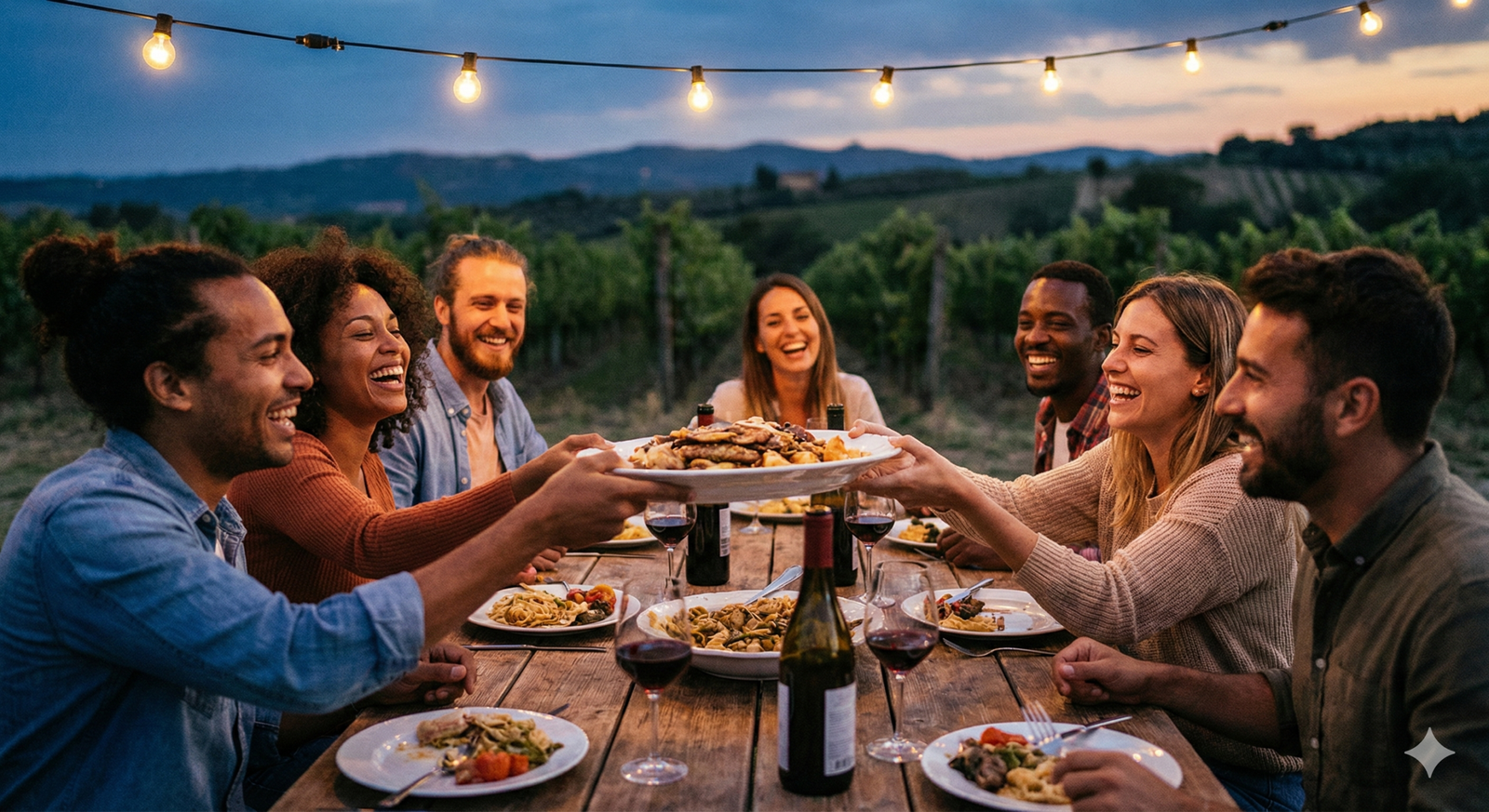
1. The “Family Dinner”
Cooking together is one of the most primal bonding activities.
- How to do it: Divide the group into squads (shoppers, preppers, cookers, cleaners). Navigating a foreign supermarket together is an adventure in itself. Creating a meal provides a shared sense of accomplishment.
2. High-Low Experiences
Mix a challenging activity with a rewarding one.
- Example: A grueling hike followed by a visit to natural hot springs. The shared struggle of the hike breaks down barriers; the relaxation afterwards allows for vulnerable conversation.
3. “Skill Swaps”
If you have a diverse group, host an evening where members teach something to the group for 15 minutes.
- Examples: A mini-workshop on iPhone photography, a quick lesson on salsa dancing, or a primer on crypto investing. This highlights the unique value of each member.
4. The “Hot Seat” or “Rose, Bud, Thorn”
At dinner, facilitate conversation that goes beyond small talk.
- Rose, Bud, Thorn: Share a highlight of the day (Rose), something you’re looking forward to (Bud), and something that was difficult (Thorn). This invites mild vulnerability without being overwhelming.
Common Pitfalls and How to Avoid Them
Even with perfect curation, issues arise. Here is how to handle the friction of group travel.
The “Clinginess” Factor
Some members may be less independent than others, expecting the host or the group to entertain them 24/7.
- Solution: Establish “Quiet Hours” or “Free Time” blocks in the itinerary explicitly labeled “Solo Exploration Time.” Normalize doing things alone.
The Energy Mismatch
Early risers vs. night owls; hikers vs. museum strollers.
- Solution: Split the group. Don’t force the night owls to hike at sunrise. Create “Sub-Squads” for different activities and regroup for dinner.
The Financial Disparity
If half the group wants street food and the other half wants fine dining, tension ensues.
- Solution: Be explicitly clear about the budget range before the trip starts. “We aim for dinners to cost around $30-$50 per person.”
Decision Fatigue
By day 3, no one wants to decide where to eat.
- Solution: The leader must step up. “I have booked a table at X for 8 PM. If you want to come, meet here at 7:30. If not, see you later.”
Platform and Tech Stack for Micro-Communities
You don’t need to build a custom app to organize these trips. A stack of existing tools works best.
Finding Communities
- Meetup: Still relevant for finding local interest groups that often organize larger trips.
- Facebook Groups: Niche groups (e.g., “Female Digital Nomads,” “Hikers of Europe”) are prime hunting grounds for micro-communities.
- Travel-Specific Apps:
- TrovaTrip: Allows creators to host trips while the platform handles logistics.
- Host A Sister: A community for women travelers to find hosts or travel buddies.
- JoinMyTrip: specifically designed to find travel partners for specific itineraries.
Organizing Communities
- Communication: WhatsApp is the global standard. Slack or Discord works for larger, ongoing communities that travel periodically.
- Finance: Splitwise (essential for fairness), Revolut or Wise (for international transfers).
- Planning: Notion (for itineraries and wikis), Google Maps (shared lists).
The Future of Travel: Decentralized and Niche
The trend toward micro-communities signals a shift away from the “bucket list” mentality of checking off famous sites. The future of travel is identity-based.
We are seeing the rise of DAOs (Decentralized Autonomous Organizations) in travel, where members collectively own a network of properties and vote on where the community goes next. We are seeing Subscription Travel, where a monthly fee grants access to a roaming community of professionals.
As the world becomes more digital and lonely, the value of face-to-face interaction skyrockets. Micro-community group travel solves the two biggest problems of the modern age: the desire to see the world, and the desire to be truly known by others. It turns travel from an act of consumption into an act of connection.
When you choose to travel with a micro-community, you are not just choosing a destination. You are choosing a temporary family. You are acknowledging that the sunset over Santorini looks beautiful on Instagram, but it feels infinitely better when you can turn to someone beside you and say, “Can you believe we are seeing this?”—and know that they understand exactly what you mean.
Conclusion
Forming or joining a micro-community for group travel is one of the most rewarding investments you can make in your social life. It bridges the gap between the freedom of solo travel and the safety of group tours. By focusing on shared values, clear communication, and curated “vibes,” you can create experiences that resonate far longer than a typical vacation.
Whether you are a creator looking to bond with your audience, or a solo traveler seeking your tribe, the path is open. Start small, vet carefully, and prioritize the people over the place. The world is vast, but it feels a lot smaller—and warmer—when you explore it with your people.
Next Steps: Identify one core interest you have (e.g., hiking, painting, food) and search for a dedicated micro-community or Facebook group related to that interest and travel. Join the conversation today.
FAQs
1. What is the ideal size for a micro-community travel group? The “sweet spot” is typically between 8 and 12 people. This size is large enough to have diverse conversations and split into smaller sub-groups, but small enough to fit at a single dinner table and move through a city without logistical nightmares.
2. How do you handle safety when traveling with strangers? Always meet via video call before the trip. Trust your gut during this call. Ensure the organizer has a verifiable online presence or references. For accommodation, verify that the address exists and, if possible, have a separate room or a plan B if you need to leave the situation.
3. Is micro-community travel more expensive than solo travel? It varies. Sharing accommodation (like a large villa) can actually be cheaper than booking solitary hotel rooms. However, curated trips organized by hosts often include a “planning fee” or premium for the curation and logistics, making them slightly more expensive than budget solo backpacking.
4. How do I deal with introversion in a group travel setting? Be upfront about your needs. When introducing yourself, mention that you recharge by being alone. Book a private room if your budget allows. Skip one activity per day to rest. A healthy micro-community will respect boundaries.
5. Can I start a travel micro-community if I am not an influencer? Absolutely. You don’t need 100k followers; you just need organizational skills and a clear vision. Start with friends of friends. Post a clear itinerary and budget on your personal social media or in relevant interest groups. People are often just waiting for someone else to take the lead.
6. What are the best destinations for micro-community travel? Look for destinations with “villa culture” rather than “hotel culture.” Places like Bali, Tuscany, Mexico (Tulum/Oaxaca), and Costa Rica offer large rental homes with communal spaces. Cities with good public transit and walkability also help keep logistics easy.
7. How far in advance should a group trip be planned? For international travel involving 8+ people, aim for 6 to 9 months in advance. This allows time for people to clear their work schedules, save money, and secure better rates on flights and accommodation.
8. What happens if someone cancels last minute? This is why non-refundable deposits are crucial. The deposit should cover the fixed costs (like the Airbnb rental) that don’t change regardless of group size. If someone cancels, the deposit protects the rest of the group from having their costs spike.
References
- Durkheim, E. (1912). The Elementary Forms of the Religious Life. (Foundational text on “collective effervescence” and social bonding).
- Turner, V. (1969). The Ritual Process: Structure and Anti-Structure. (Source for the concept of “communitas” and liminality in travel).
- Adventure Travel Trade Association (ATTA). (2023). Industry Trends Report. Available at: https://www.adventuretravel.biz (Provides data on the rise of small group and experiential travel).
- Airbnb Newsroom. (2024). Travel Trends and the Rise of Group Travel. Available at: https://news.airbnb.com (Data on the increase in long-term stays and large group bookings).
- Skift. (2023). The State of Travel Communities and Creator Economies. Available at: https://skift.com (Analysis of creator-led travel trends).
- MBO Partners. (2023). State of Independence in America. (Statistics regarding Digital Nomads and the need for community).
- TrovaTrip. (2024). Creator Economy and Travel Report. Available at: https://trovatrip.com (Insights into how creators are monetizing through travel).