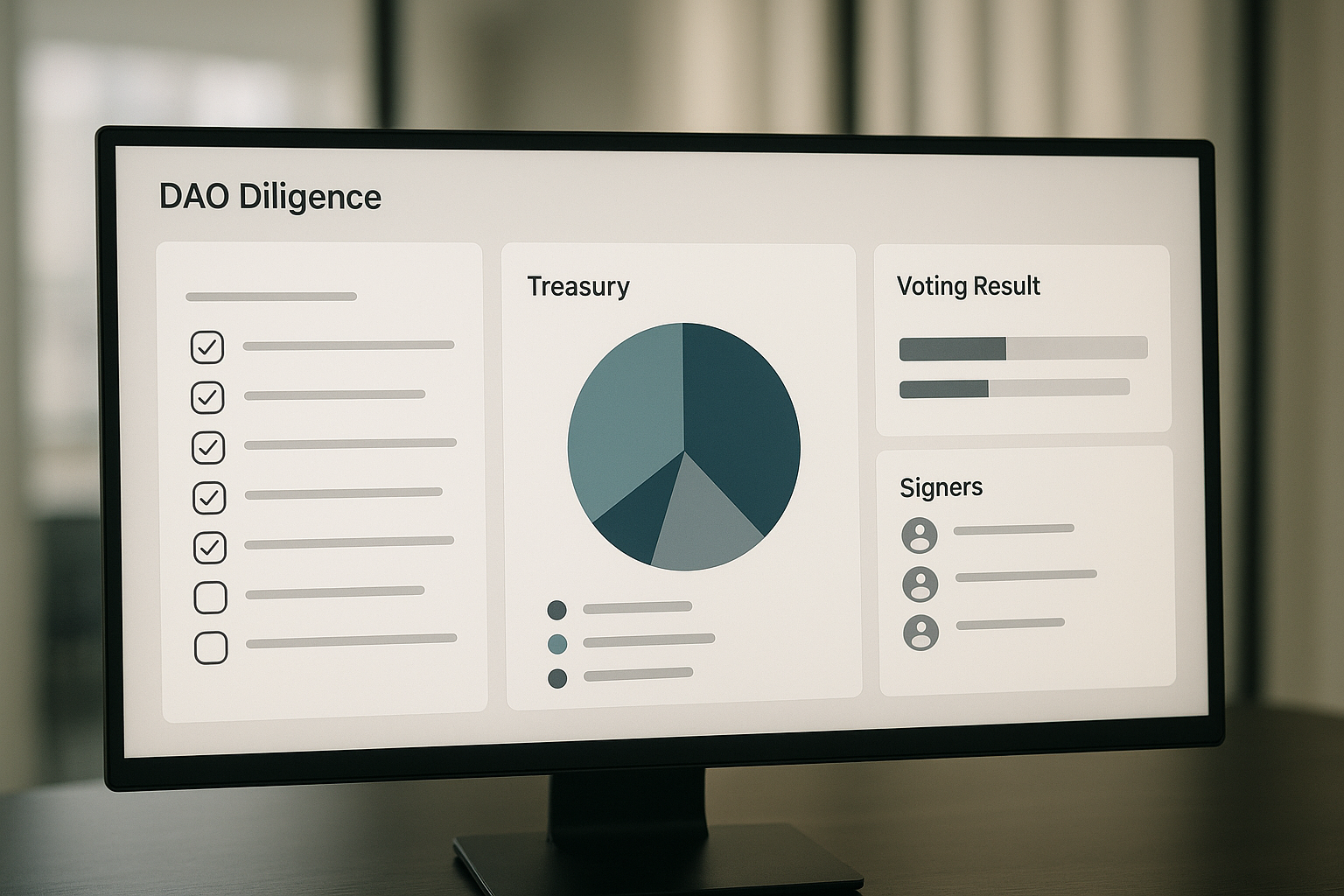
If you’re evaluating a DAO-backed project, rigorous due diligence helps you separate resilient communities from fragile experiments. Due diligence on DAO-backed projects means testing governance mechanics, treasury strength, token design, security posture, and legal exposure—then deciding whether the project’s risk-reward profile fits your mandate. A decentralized autonomous organization (DAO) is software-enabled, community-governed capital and decision-making; your diligence should mirror that reality by verifying claims on-chain and in-process, not just in pitch decks. Below is the complete investor workflow in 12 steps. In brief: (1) define the DAO’s purpose; (2) verify governance; (3) analyze the treasury and runway; (4) assess tokenomics; (5) test multisig controls; (6) review security and audits; (7) map legal and regulatory risk; (8) gauge community health; (9) check roadmap credibility; (10) evaluate operations and grants; (11) verify on-chain data sources; (12) plan monitoring and exits. Done well, you’ll gain a clear view of durability, alignment, and execution.
Quick definition: A DAO is a collectively owned organization that uses smart contracts and transparent rules to coordinate funds and decisions.
Outcome preview: Use these 12 steps to build an investor-grade, repeatable process that reduces avoidable risk while spotting real upside.
1. Clarify the DAO’s purpose, scope, and edges
Start by stating exactly what the DAO is for, how it creates value, and where its authority stops. This sounds basic, but misaligned expectations between tokenholders, contributors, and core teams are the root of many governance blowups. Identify the DAO’s “type” (protocol DAO, grants DAO, service DAO, investment DAO, collector DAO) and write the one-sentence mandate you’d use in an investment memo. If the DAO exists to steward a protocol, determine which parameters it actually controls (fees, emissions, listings) and which are hard-coded or controlled by a foundation. Map the DAO’s “edges”: what decisions are token-voted, what is delegated to working groups, and what sits with a multisig council. When purpose and edges are explicit, you can judge whether structure, incentives, and roadmap match the mission.
How to do it
- Read the DAO charter, constitution, or governance docs; extract the mission and list of controllable levers.
- Classify the DAO: protocol/governance, grants, service, investment, collector; note hybrid models.
- Trace authority paths: token vote → execution, delegate council → multisig → contracts.
- List out-of-scope areas (e.g., foundation HR, trademark control, off-chain partnerships).
- Interview delegates or core contributors to pressure-test mandate clarity.
Synthesis: A crisp mandate with well-defined edges reduces ambiguity, curbs politicized disputes, and lets you evaluate whether the DAO’s structure fits its goals.
2. Inspect governance mechanics: quorum, thresholds, and execution
You want to confirm that decision-making is legitimate, difficult to capture, and actually enforceable. Answer three questions fast: how proposals are made, how votes are counted, and how results are executed. Off-chain signaling (e.g., Snapshot) is common for low-friction votes; on-chain governance (e.g., OpenZeppelin Governor via portals like Tally) is used when proposals must trigger smart-contract actions. Verify quorum (minimum participation), proposal thresholds (who can propose), vote types (single choice, ranked, quadratic), and execution paths (timelocks, queues, guardians). Then check actual history: voter turnout across recent proposals, defeated vs. passed measures, and whether passed votes were executed.
Numbers & guardrails
- Quorum participation: commonly 3–10% of voting power; below ~3% signals apathy or concentration risk.
- Proposal threshold: set to prevent spam but allow credible proposers—often 0.1–1.0% of voting power or a delegate seat.
- Execution delay (timelock): 24–72 hours to allow review/mitigation; longer if proposals move large funds.
Tools/Examples
- Snapshot spaces for off-chain votes and strategies.
- OpenZeppelin Governor modules for on-chain voting rules.
- Tally as a governance portal for proposing, delegating, and executing.
Synthesis: Strong governance combines clear proposal rules, meaningful quorum, and enforceable execution; weak settings or ignored votes are red flags for capture and chaos.
3. Analyze the treasury: composition, liquidity, and runway
Treasury strength determines staying power. Break holdings into stablecoins, reserve assets (e.g., ETH), native token, and other tokens. Discount native tokens for liquidity impact—assume selling meaningful size will move price. Check custody (multisig vs. programmatic), diversification policy, and reporting cadence. Build a runway model: expected monthly outflows for contributors, grants, liquidity incentives, audits, and vendors; match that against liquid, non-native assets. Stress-test with conservative price shocks to reserve assets.
Numbers & guardrails
- Diversity: cap any single asset at ≤40% of treasury; keep ≥12–24 months of fiat-equivalent runway in stables/reserves.
- Native token overhang: treat large native holdings at a 30–70% liquidity haircut, depending on DEX depth.
- Allocation bands: example working bands below—adjust to mandate and phase.
| Bucket | Typical band | Notes |
|---|---|---|
| Stablecoins | 30–60% | Fund ops runway and grants with low volatility |
| Reserve assets | 20–40% | Long-term upside; include hedging plan |
| Native token | 10–40% | Incentives; apply liquidity haircut |
| Strategic | 0–10% | RWA, staking, partnerships—governance-approved |
Mini case
If monthly spend is $450,000, liquid stables are $7.2 million, and reserve assets (after a 40% stress haircut) add $2.4 million, effective runway ≈ (7.2 + 2.4) / 0.45 ≈ 21.3 months. If native token adds $10 million face value but liquidity haircut is 60%, you’d credit only $4 million for contingency, extending runway to ≈30.2 months.
Synthesis: A treasury you can actually spend—liquid, diversified, and policy-constrained—turns governance intent into durable execution.
4. Evaluate tokenomics: supply, emissions, and insider alignment
Token design is governance power and incentive plumbing. Start with total supply, circulating supply, emissions schedule, and vesting cliffs. Identify allocations to insiders (team, investors, foundation) vs. community (airdrops, liquidity mining, grants). Model future unlocks and their potential sell pressure, and check whether governance power tracks circulating supply or includes delegated/locked positions. Examine utility: does the token control fees, parameter changes, or treasury decisions, or is it purely symbolic?
Numbers & guardrails
- Insider allocations (team + private investors): prefer ≤40–50% fully diluted; higher requires strong lockups and governance checks.
- Emissions: front-loaded distributions increase churn; look for decelerating schedules with explicit sunset or review points.
- Vesting: ≥12–36 months with cliffs for core contributors; governance power for unvested tokens should be limited or delegated with constraints.
Checklist
- Map unlock calendar; note large cliffs.
- Compare FDV vs. circulating market cap; beware huge gaps unsupported by revenue or usage.
- Confirm whether protocol revenue flows to the treasury, burn, or stakers/lockers.
- Evaluate vote power from staked/locked tokens and delegation patterns.
- Test alignment by reading prior proposals tied to token incentives.
Synthesis: Well-structured tokenomics align insiders with long-term stewardship, avoid reflexive sell pressure, and give holders real, bounded power.
5. Verify treasury custody and multisig controls
Most DAOs rely on multisig wallets for treasury execution. You’re looking for a clear signer roster, a rational signature threshold (e.g., 3/5, 4/7, 6/9), robust key operations (backup, rotation, recovery), and transaction policies (spending limits, simulation, labels). Check geographic and organizational distribution of signers to avoid single-jurisdiction or single-entity risk. Review change logs: who can add/remove signers, with what notice and vote? Inspect historical transactions for adherence to policy and identify any emergency powers or guardians.
Numbers & guardrails
- Thresholds: aim for ≥60% of signers required; avoid thresholds that any two insiders can satisfy.
- Signer independence: at least 3 distinct entities or contributors; avoid all signers from a single company.
- Policy: set per-tx spending caps (e.g., ≤2% of treasury) without full governance vote; larger moves require on-chain approval.
Tools/Examples
- Use a reputable multisig (e.g., Safe) with transaction simulation and batched execution.
- Label all signers and tag roles (finance lead, grants lead, independent reviewer).
- Publish rotation and recovery runbooks; rehearse key-loss drills.
Synthesis: Competent multisig design with independent signers and enforced limits is your first line of defense against operational loss.
6. Review smart-contract security, audits, and incident response
Security risk compounds across protocol code, governance modules, and treasury tooling. Confirm audits for core contracts and any governance adapters, bug bounty coverage, and continuous monitoring. Ask how proposals that modify contract parameters are tested (simulation on forked networks, formal verification where relevant). Evaluate upgradeability risks, proxies, and admin roles: who can pause, upgrade, or seize? Read past incidents and postmortems and, crucially, what changed afterward. If third-party dependencies are critical (oracles, bridges), include their risk in your model.
Numbers & guardrails
- Audit coverage: aim for 100% of core contracts and modules with at least 2 independent firms over time.
- Bug bounties: meaningful upper bounds (e.g., $250,000+ for critical) drive disclosures.
- Change management: timelock of ≥24 hours before sensitive parameter changes; emergency pause powers documented and constrained.
Mini case
A DAO that routes all executions through an upgradeable Governor with a 48-hour timelock, mandates a 4/7 multisig for treasury, and runs a $500,000 critical bounty demonstrates layered controls: compromise of a single layer is unlikely to drain funds without alert and recourse.
Synthesis: Multiple, overlapping controls—audits, bounties, delays, and constrained admin powers—turn inevitable bugs into survivable events.
7. Map legal and regulatory exposure across jurisdictions
DAOs intersect with securities, commodities, payments, sanctions, tax, and consumer laws. Your goal isn’t to give legal advice but to flag exposure areas and confirm the DAO’s counsel and processes. For tokens, apply the investment-contract analysis (e.g., the Howey framework) to understand whether fundraising or distributions could implicate securities laws. If the DAO controls a product touching financial flows, assess AML/CFT practices and sanctions screening, especially where contributors are paid or grants disbursed. Review any foundation or non-profit wrapper and its responsibilities; understand whether on-chain votes are advisory or binding upon entities that sign contracts in the real world.
Region-specific notes
- Securities: Token sales, promises of profit, or reliance on managerial efforts may trigger registration or exemptions.
- AML/Sanctions: Grants and payments programs often add KYC tiers for vendors; sanctions screening is a common control.
- Foundations: Legal wrappers can limit liability and execute contracts but must faithfully implement governance outcomes.
Mini checklist
- Identify counsel and compliance owners; ask for policy docs.
- Review token distribution history for potential offering issues.
- Confirm sanctions/AML policies for treasury disbursements.
- Understand how the wrapper implements or can veto DAO votes.
Synthesis: Clear legal posture and basic compliance processes reduce existential risk and keep contributors—and your capital—out of preventable trouble.
8. Gauge community health, delegate quality, and participation
A DAO is as strong as its active participants. Start with engagement metrics: proposal discussion threads, forum activity, delegate updates, and the tone of debate. Review voter turnout trends, the distribution of voting power across top delegates, and how often delegates explain their votes. High-quality delegates publish rationales, host calls, and solicit feedback; low-quality delegates chase incentives or abstain. Evaluate contributor pipelines: bounties, fellowships, working group elections. Finally, look for inclusion signals—language accessibility, documentation quality, and mentorship—for durability beyond the current core.
Numbers & guardrails
- Voter turnout trend: stable or rising over ≥10 proposals is a good sign; collapsing turnout suggests fatigue.
- Delegate concentration: top 5 delegates < 50% of voting power reduces capture risk.
- Discussion-to-vote ratio: healthy DAOs show days of open discussion before votes and clear RFC processes.
Tips
- Read delegate platforms and performance; favor those with consistent, reasoned voting histories.
- Track how feedback in forums maps to proposal revisions.
- Watch for pay-to-vote dynamics that distort deliberation.
Synthesis: A vibrant, transparent, and plural community turns governance from theatre into real stewardship.
9. Test the roadmap for feasibility and capital efficiency
The best roadmaps convert mission into prioritized, measurable milestones with clear budgets and owners. Work from recent proposals and working group plans to estimate burn vs. shipped outcomes. Seek product-market signals: active users, retention, revenue, integrations. Scrutinize “growth” spending—are incentives tied to incremental usage or vanity metrics? For research-heavy or standards-driven projects, look for well-scoped milestones and community validation (grants matched by other DAOs, pilot partners, or independent audits of deliverables).
Numbers & guardrails
- Milestone funding: tranche large initiatives with stage gates; release next tranches on proof-of-work delivered.
- Budget split: clear ratios for contributors vs. incentives vs. vendors; unbounded “miscellaneous” lines are a red flag.
- Outcome metrics: define 3–5 KPIs appropriate to the product (e.g., contracts secured, TVL quality, recurring contributors).
Mini case
A grants program asks for $3 million over three cycles. You propose $1 million per cycle with milestone reports, a 10% audit set-aside, and clawbacks for missed deliverables. This improves accountability without starving execution.
Synthesis: A credible roadmap with staged funding and proof-of-work milestones aligns spend with learning and progress—not with politics.
10. Evaluate operations, grants, and financial controls
Operations signal whether the DAO can spend responsibly. Review the finance process end-to-end: proposal approval, invoice intake, payment scheduling, accounting, and reporting cadence. Look for spend dashboards and labeled transactions, not mystery transfers. Grants should have transparent criteria, scoring rubrics, conflict-of-interest policies, and public progress updates. Check whether the DAO uses standardized rubrics and RFPs, and whether there’s a documented vendor onboarding (including compliance checks where necessary). Finally, evaluate internal controls: dual review for large payments, periodic reconciliations, and quarterly treasury reviews.
Tips
- Require budget-to-actuals reporting for funded workstreams.
- Publish clear grant caps and review timelines; avoid never-ending pilots.
- Adopt line-item labels for outgoing transactions and memo links to proposals.
- Keep an emergency buffer with strict access rules and after-action reporting.
Mini case
A DAO with quarterly spend reports, labeled payments, and a grant rubric (weights for relevance, feasibility, and public good) can reduce waste and improve community trust, even when experiments fail.
Synthesis: Tight, transparent operations convert community trust into efficient capital allocation.
11. Verify on-chain reality: contracts, wallets, and data sources
Trust, but verify—on-chain. Pull contract addresses from official docs and confirm they’re verified on reputable explorers. Inspect admin roles, proxies, and upgrade rights. Cross-check treasury wallets and multisigs; match balances against reported treasuries and dashboards. When you see metrics in pitches, replicate them using open analytics or at least reconcile to a known source. For off-chain voting systems, confirm how snapshots are taken, how strategies compute voting power, and how results sync to on-chain execution if applicable.
Practical steps
- Use block explorers to confirm verified source code, ABI, and contract creators.
- Read governance contract settings (quorum, voting delay/period, timelock) directly from the chain or portal.
- Trace treasury flows and label known counterparties; reconcile to forum reports.
- Document every address used in your model with links and a one-line purpose.
Mini checklist
- Contracts verified?
- Admin/upgrade roles inventoried?
- Treasury addresses labeled and reconciled?
- Voting strategies understood and reproducible?
Synthesis: Independent verification prevents narrative drift and anchors your investment thesis in facts, not screenshots.
12. Set monitoring, alerts, and exit criteria before you invest
Diligence is a snapshot; monitoring is the movie. Define what you’ll watch, how often, and what triggers action. Track governance proposals, treasury balances, large transfers, and security advisories. Subscribe to delegate updates and set alerts on key contracts and wallets. Predefine exit or reduce criteria tied to objective signals: failed audits, sudden governance capture, depleted runway, or a major roadmap pivot without process. Also set positive triggers for scaling exposure: shipping milestones, credible partnerships ratified via governance, or improved diversification.
Numbers & guardrails
- Runway threshold: consider exit or engagement escalation when liquid runway dips below 12 months without a replenishment plan.
- Concentration trigger: if top 5 wallets > 60% of voting power and rising, treat as heightened capture risk.
- Incident response: require an incident report within 72 hours of a critical event and a remediation timeline.
Tips
- Maintain a living diligence doc with addresses, policies, and renewal dates.
- Rotate who attends governance calls to avoid knowledge silos.
- Review monitoring rules quarterly; prune noisy alerts, add new ones.
Synthesis: Pre-agreed triggers and continuous monitoring keep you disciplined—protecting capital while letting you compound into strength.
Conclusion
DAO investing rewards rigor and humility. These organizations blend software, markets, and communities; your diligence should do the same. By clarifying mandate and edges, testing governance that truly executes, and counting only the treasury you can actually spend, you see the DAO as it is—not as it advertises itself. Layer in tokenomics alignment, multisig hygiene, and security depth, and you filter out structural risks that headlines miss. Legal posture and basic compliance practices reduce tail risk; community health and credible roadmaps determine whether capital translates into durable progress. Finally, verify claims on-chain and set monitoring rules ahead of time so decisions remain principled when conditions change. Use this 12-step workflow as a repeatable template, and you’ll build a portfolio that is both antifragile and aligned with credible, mission-driven communities. Ready to operationalize this? Copy these steps into your diligence checklist and start your first review today.
FAQs
1) What’s the fastest way to tell if a DAO vote is binding or just signaling?
Check whether proposals are executed by an on-chain governor contract or only recorded off-chain. If votes route through a timelocked governor that can call protocol functions, they’re binding. If the DAO relies on an off-chain poll with manual multisig follow-up, outcomes are advisory unless mirrored in on-chain execution rules. Always read recent proposals to see whether passed votes actually triggered transactions.
2) How do I estimate realistic treasury runway when most assets are volatile or in the native token?
Separate liquid, low-volatility assets (stablecoins, diversified reserves) from native tokens. Apply a haircut to reserve assets for price shocks and a deeper haircut to native tokens to reflect liquidity and market impact. Then divide the sum of liquid assets by average monthly burn. This yields a conservative, decision-ready runway number you can compare quarter to quarter.
3) What quorum level is reasonable, and does lower always mean worse?
Reasonable quorum depends on token distribution and participation culture. Many DAOs target single-digit percent quorums to avoid governance paralysis, paired with robust proposal thresholds and execution delays. Lower quorum is not inherently bad if there are strong safeguards like timelocks, multi-stage proposal processes, and active delegate oversight. Watch historical turnout; if it drifts down over time, dig into why.
4) How should I think about multisig signer selection and rotation?
Diversity across entities, geographies, and functional roles reduces correlated risk. Favor thresholds that require collaboration (e.g., 3/5, 4/7) and publish signer identities and roles. Rotation should be governed by clear policies, including how to add or remove signers, how keys are stored, and how emergency recoveries work. Practice rotations and key-loss drills before they are needed.
5) Are off-chain voting systems acceptable for serious treasuries?
Yes—if their results are operationalized with explicit policies and constraints. Off-chain voting lowers friction and can boost participation, but it needs alignment with on-chain execution via timelocks, multisigs, and documented procedures. For parameter changes and large fund movements, on-chain execution is safer because it minimizes human discretion and ambiguity.
6) What tokenomics red flags deserve immediate attention?
Watch for extremely high insider allocations without long vesting, emissions that never decelerate, and governance that awards disproportionate power to unvested or illiquid positions. Large unlock cliffs without a liquidity or market-making plan can overwhelm price and governance dynamics. Treat any mismatch between stated utility and actual control as a serious risk.
7) How can I verify marketing claims without being a Solidity expert?
Use verified contract pages on reputable explorers to read admin roles and parameters, governance portals to view settings, and public analytics to replicate core metrics. You can also follow step-by-step verification guides and use read-only functions to confirm who can upgrade or pause contracts. Combine this with forum and proposal archives to reconcile words with on-chain reality.
8) What basic compliance steps are practical for DAOs that pay contributors or vendors?
Even without becoming a regulated financial institution, DAOs can implement sanctions screening for outgoing payments, vendor onboarding checklists, and record-keeping for invoices and deliverables. Grants programs commonly add tiered checks based on grant size and risk. Publishing these processes fosters trust and reduces the chance of inadvertently engaging sanctioned parties.
9) How do I decide when to scale into a position after initial diligence?
Predefine positive triggers that reflect real progress: shipped milestones, improved treasury diversification, stable or rising voter turnout, and clear incident response. Add on size when these show up consistently, not after price surges alone. Similarly, set reduction or exit triggers tied to runway, governance capture, or repeated security lapses so decisions are timely and consistent.
10) What’s the role of delegates, and how do I evaluate them?
Delegates convert passive ownership into informed governance. Evaluate them by published platforms, voting rationales, office hours, and responsiveness to community feedback. Concentration of voting power among a few delegates can be okay if they’re transparent and accountable; it’s risky if they rarely explain decisions or if their incentives are misaligned with long-term health.
References
- What is a DAO? Ethereum.org — undated. ethereum.org
- Snapshot Documentation (Voting & Architecture). Snapshot — various pages (published dates available on docs pages). ; https://docs.snapshot.box/snapshot-x/user-guides/voting ; https://snapshot.mirror.xyz/-C3bd5TI3XEbPRt_FIBB97fkhwXk-81w59CMcoofWUk Snapshot Docs
- Safe (Multisig) Documentation. Safe Global — dated on docs site. Safe Docs
- OpenZeppelin Governor Contracts (On-Chain Governance). OpenZeppelin — current docs. ; https://docs.openzeppelin.com/contracts/4.x/governance OpenZeppelin Docs
- Verifying Contracts on Etherscan. Etherscan Information Center — Mar 21, 2025. Etherscan Information Center
- Framework for “Investment Contract” Analysis of Digital Assets. U.S. SEC — Apr 3, 2019. SEC
- ENS DAO Governance Process (Example of Hybrid Governance). ENS Docs — updated periodically. ENS Documentation
- U.S. Treasury: Illicit Finance Risk Assessment of DeFi. U.S. Department of the Treasury — publication PDF. U.S. Department of the Treasury
- How to Evaluate Blockchain Analysis Tools. Chainalysis — Feb 17, 2023. Chainalysis
- Contracts API & Verification Endpoints. Etherscan Docs — Jul 23, 2025. docs.etherscan.io
Disclaimer: This guide is for informational purposes only and is not legal, tax, accounting, or investment advice. Consider consulting qualified professionals for your specific situation.