The traditional image of corporate culture—ping-pong tables, water cooler gossip, and brainstorming sessions in glass-walled conference rooms—is obsolete for a significant portion of the modern workforce. As distributed work matures, we have moved beyond simply “working remotely” to “working asynchronously.” In this environment, culture is not defined by who you sit next to, but by how you communicate, document, and trust one another across time zones.
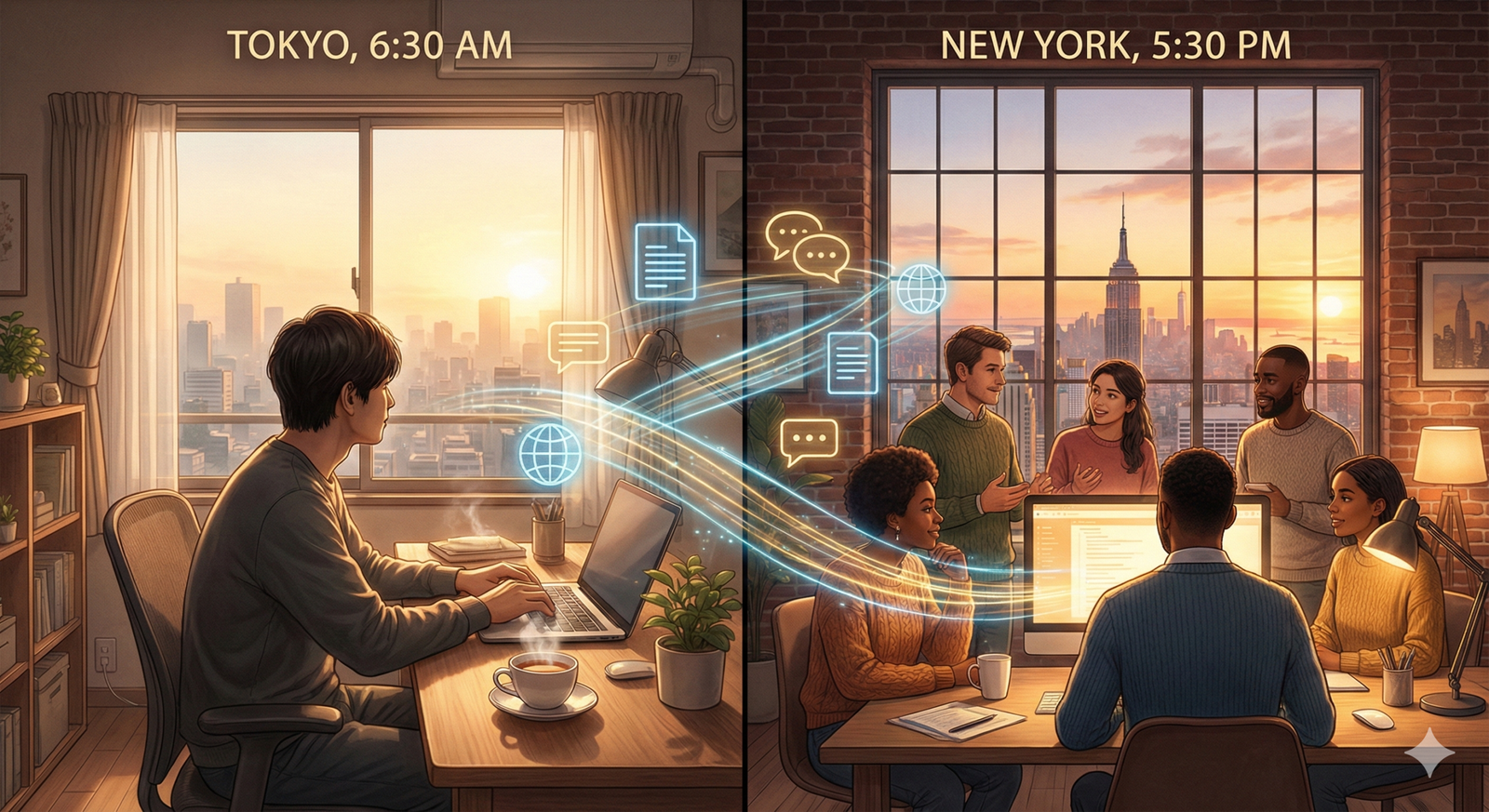
Building culture in asynchronous teams is the definitive management challenge of this decade. It requires a deliberate shift from relying on presence (being seen) to relying on artifacts (what is written and produced). When a team is spread across London, Manila, and San Francisco, there is no “real-time” that works for everyone. Therefore, culture must be built into the very workflows and tools that enable the work itself.
In this guide, “asynchronous culture” refers to a shared set of values, norms, and behaviors that allow a team to feel connected and aligned without requiring simultaneous presence. It is about fostering belonging when the primary mode of interaction is delayed communication.
Key takeaways
- Culture is documentation: In async teams, your shared values are only as real as they are written down. Implicit norms destroy distributed teams; explicit handbooks build them.
- Writing is the core skill: The ability to write clearly, concisely, and with emotional intelligence is the single biggest predictor of cultural fit in an async environment.
- Trust is the engine: Async culture relies on “trust by default.” You cannot police hours; you can only measure outcomes.
- Intentionality replaces osmosis: You will not absorb culture by accident. Social interactions, praise, and feedback must be scheduled and structured.
- The “always-on” myth: True async culture respects disconnection. It does not mean replying to Slack at 2 AM; it means replying when you are working, and having systems that handle the gap.
Who this is for (and who it isn’t)
This guide is for:
- Remote-first Leaders: Founders and managers running fully distributed companies where time zones overlap minimally.
- Hybrid Managers: Leaders trying to bridge the gap between in-office and remote employees to prevent proximity bias.
- HR and People Ops: Professionals tasked with designing engagement strategies that don’t rely on Zoom happy hours.
This guide isn’t for:
- Strictly local teams: If everyone is in the same office, asynchronous principles can boost productivity, but they aren’t your primary culture driver.
- Surveillance-based managers: If your management style relies on monitoring keystrokes or “green dot” status, this guide will contradict your fundamental operating model.
The shift: Why presence is no longer a proxy for culture
For decades, management confused “presence” with “commitment.” If you were at your desk at 6:00 PM, you were dedicated. In an asynchronous team, presence is a bug, not a feature. Requiring presence creates bottlenecks. If a decision requires a meeting, and that meeting requires three people in incompatible time zones, the company slows down.
Building culture in asynchronous teams requires decoupling “work” from “time.” Culture becomes the operating system of the company. It is the answer to the question: “How do we make decisions when the boss is asleep?”
The psychology of the async worker
To build culture, you must understand the psychological reality of the async worker. They often battle two conflicting feelings:
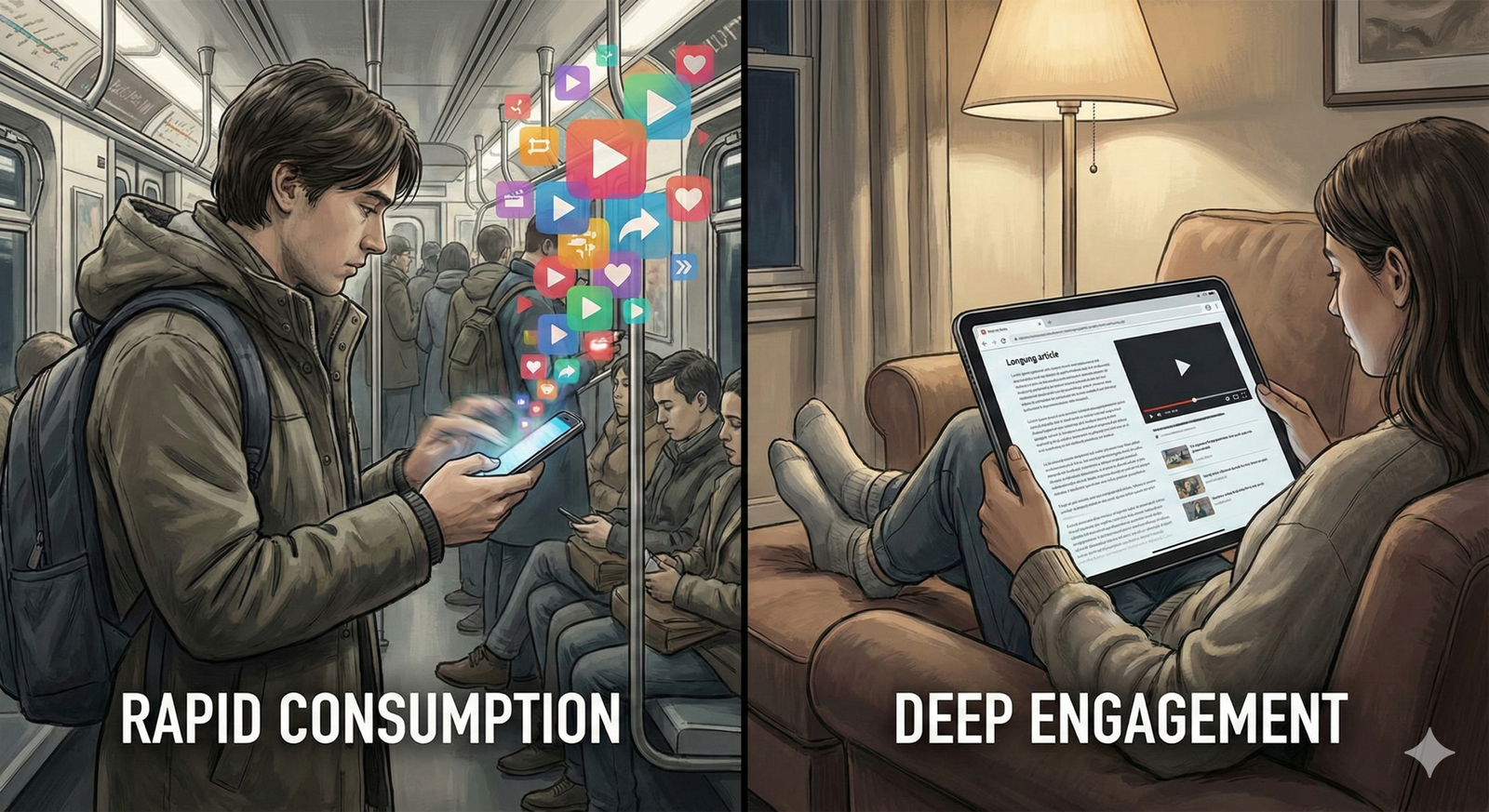
- Freedom: The autonomy to design their day, work from anywhere, and focus deeply without interruptions.
- Isolation: The lack of incidental social friction. There is no one to notice if they are sighing in frustration or smiling at a win.
A successful async culture maximizes the freedom while structurally mitigating the isolation. It provides “psychological safety”—the belief that one can speak up without risk of punishment—through text and recorded video, rather than face-to-face reassurance.
1. Documentation as the cultural backbone
In an office, you can tap someone on the shoulder to ask how to file an expense report or what the company’s stance is on a specific client issue. In an async team, that tap on the shoulder is a notification that might not be answered for 12 hours.
Therefore, the first pillar of building culture in asynchronous teams is aggressive, transparent documentation.
The “Handbook First” mentality
Your company handbook is not a legal document to be signed during onboarding and ignored. It is the living “brain” of your organization. Companies like GitLab and Doist have pioneered this approach. If it isn’t in the handbook, it doesn’t exist.
What this looks like in practice:
- Decision Logs: When a decision is made, it isn’t just announced in a meeting. The context, the alternatives considered, and the final verdict are written down in a searchable repository (e.g., Notion, Slab, or GitHub). This allows someone waking up in a different time zone to understand why a decision was made, not just what changed.
- Meeting Notes are Mandatory: If a synchronous meeting happens, it is considered exclusionary unless notes (or a recording/transcript) are posted for the rest of the team.
- Explicit Communication Protocols: The handbook should explicitly state expected response times. For example: “We expect responses to emails within 24 hours, and Slack mentions within 4 working hours. We do not expect responses on weekends.” This creates a culture of respect for time.
Writing with “Low Context”
Anthropologist Edward T. Hall distinguished between high-context and low-context cultures. High-context communication relies on shared history, non-verbal cues, and implied meaning (common in close-knit physical offices). Low-context communication is explicit, detailed, and leaves nothing to interpretation.
Async teams must operate as low-context cultures.
- Bad Async Writing: “Can you check that thing?” (Assumes the receiver knows what “that thing” is).
- Good Async Writing: “Can you review the Q3 Marketing Deck (link here)? Specifically slide 4 regarding the budget allocation. I need your approval by Thursday at 2 PM EST so we can finalize the spend.”
By enforcing low-context writing, you build a culture of clarity and reduce the anxiety of ambiguity.
2. Redefining “connection” through written communication
Many leaders fear that without voice and video, emotion and connection are lost. This is a failure of imagination. Written communication can be deeply empathetic and connecting, but it requires different skills.
The art of “Emoji-Ops” and reaction culture
In a physical office, a nod, a smile, or a thumbs-up provides instant social validation. In Slack or Microsoft Teams, silence is deafening. If an employee posts an update and no one reacts, they feel ignored.
Building a culture of visible acknowledgement is crucial.
- Reaction Norms: Encourage the team to use emoji reactions liberally. A “eyes” emoji means “I’ve seen this.” A “fire” emoji means “Great work.” These micro-interactions replace the head nods of a meeting room.
- Custom Emojis: Create custom emojis that reflect your company’s inside jokes and values. This builds a unique tribal language that fosters belonging.
Radical candor in text
Text lacks tone. A direct sentence can be read as rude depending on the reader’s mood. Async culture requires “assuming positive intent” as a core value, but it also requires writers to “add warmth.”
Tactical tip: Use video for critique, text for praise. If you need to give critical feedback, text is often too harsh and open to misinterpretation. Record a short Loom video or voice note. Hearing the voice humanizes the feedback. Conversely, praise should be public and written so it acts as a permanent artifact of recognition.
3. Rituals for the asynchronous era
You cannot copy-paste office rituals into a remote setting. A “virtual happy hour” usually devolves into three extroverts talking while ten introverts stare awkwardly at their webcams. Instead, you need async-native rituals.
The “Check-in” threads
Instead of a daily standup meeting (which forces everyone to be awake at the same time), use an automated check-in thread.
- How it works: A bot asks three questions at the start of each person’s workday: “What did you do yesterday? What are you doing today? Any blockers?”
- Cultural benefit: This creates visibility into work without interruption. It also allows team members to offer help on blockers regardless of when they log on.
Social “AMAs” (Ask Me Anything)
To replace getting to know people over lunch, host async AMAs.
- Process: Each week, one team member is the focus. A channel is opened where anyone can ask them questions—about work, hobbies, life history, or favorite foods. The person answers whenever they have time during the week.
- Why it works: It allows for deep, thoughtful answers rather than surface-level small talk. Introverts often shine here because they have time to compose their thoughts.
The “Friday Wins” thread
Create a dedicated space for celebrating the week’s victories.
- Process: Every Friday (or Thursday depending on time zones), open a thread for personal and professional wins.
- Cultural benefit: This fosters a culture of gratitude and progress. It helps the team see the momentum of the organization, which is often invisible when working from home.
Virtual coworking (The Library Rule)
Sometimes, people just want to feel the presence of others.
- Process: Set up a permanent “Coworking” video channel. The rule is: Mics off, video on (optional). It simulates sitting in a library with friends.
- Why it works: It provides a sense of body doubling—a productivity technique where the presence of others helps focus—without the pressure to converse.
4. Leadership: Trust, output, and the death of micromanagement
Building culture in asynchronous teams is impossible if leadership operates on a surveillance model. If you track mouse movements or screen time, you are building a culture of fear, not performance.
Moving to Outcome-Based Management
In an async culture, the manager’s role shifts from “overseer” to “unblocker.”
- Define Clear Outcomes: Instead of “Work 8 hours today,” the instruction is “Complete the draft of the project proposal by Wednesday.”
- Trust by Default: Assume employees are working unless proven otherwise by a lack of output.
- The “Manager of One” Mindset: Hire and train employees who can manage themselves. In an async environment, every employee is the CEO of their own day.
Vulnerability in leadership
Leaders must model the behavior they want. If a leader never admits a mistake, never shows their face without a filter, or sends messages at all hours, the team will mirror that stress.
- Share “Works in Progress”: Leaders should share drafts and rough ideas, inviting feedback early. This signals that perfectionism is not required and collaboration is valued.
- Publicly disconnect: Leaders should explicitly state, “I am signing off for the day/vacation.” This gives permission for the team to do the same.
5. Tools and technology: The digital office architecture
Your tech stack is your office building. If the tools are clunky, the “office” feels dilapidated. If they are intuitive, the “office” feels modern and supportive.
The Async Stack
- The Source of Truth (Long-form): Notion, Slab, Confluence. This is your library. Nothing is “official” until it lives here.
- The Project Tracker (Status): Asana, Linear, Trello, Jira. This replaces “Hey, where are we on this?” status meetings. The status should always be visible here.
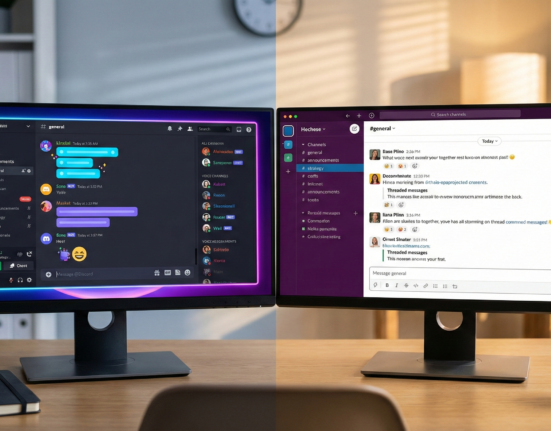
- The Discussion Layer (Short-form): Slack, Microsoft Teams, Discord. This is for quick coordination and social chatter.
- The Video Layer (Async): Loom, bubbles, Vimeo Record. This allows for tone and complexity without scheduling a meeting.
Designing “Channels” for culture
Do not just have #general and #random. Design your communication architecture to encourage specific cultural behaviors.
- #shoutouts: Strictly for praising others.
- #learning: For sharing articles, courses, or mistakes made (and lessons learned).
- #pets / #kids / #plants: Niche interest channels allow people to connect over shared non-work passions.
- #fiat-discussions: A channel specifically for hard debates where consensus isn’t required but input is solicited.
Common mistakes and pitfalls
Even with good intentions, companies fail at async culture. Here are the most common failure modes.
The “Half-Async” Trap
This occurs when part of the team (usually leadership) is co-located or works in the same time zone, and they make decisions verbally, only informing the remote team later.
- The Fix: “If one person is remote, everyone is remote.” Even if you are in the same office, write the decision down in the digital tool so the async team has the same opportunity to contribute.
Weaponized Urgency
Treating every Slack message as a text message that requires an instant reply. This destroys the “deep work” benefit of async.
- The Fix: disable notifications by default. Establish a true emergency channel (e.g., PagerDuty or a specific WhatsApp group) that is only used for genuine crises (site down, legal emergency). If it’s not on that channel, it can wait.
The “Wall of Text” Burnout
Over-documenting can lead to information overload.
- The Fix: Curate content. Have a librarian or “knowledge manager” responsible for archiving old docs and keeping the handbook concise. Use executive summaries at the top of long documents.
Onboarding: The critical first 30 days
Culture is most malleable during onboarding. A new hire in an async team cannot look around to see how others behave; they only see what you show them.
The Buddy System
Assign a “Culture Buddy” who is not their manager and ideally in a different time zone.
- Role: The buddy helps navigate the unspoken norms (e.g., “Is it okay to use gifs in the CEO channel?” or “How do I ask for time off?”).
- Cadence: They should have a recurring 1:1 sync call for the first month to provide human connection.
The “Scavenger Hunt”
Gamify the reading of the handbook. Create an onboarding scavenger hunt that requires the new hire to find specific cultural artifacts, comment on a specific thread, introduce themselves in the #social channel, and record a Loom video. This forces engagement with the tools and culture immediately.
Strategies for conflict resolution without calls
Conflict is inevitable. In async teams, conflict often festers because people avoid the effort of typing out a confrontation, or they misread a curt message as aggression.
The “Move to Sync” Rule
Establish a clear rule: If a text exchange goes back and forth more than three times with rising tension, move to a synchronous method immediately. This could be a quick call or a video message. Text is terrible for de-escalating emotion. Voice and face are required to restore empathy.
The “Draft and Wait” Protocol
Encourage a culture where, if someone reads something that makes them angry, they must wait 24 hours before responding (unless urgent). Usually, the charitable interpretation becomes clear after a cooling-off period.
Real-world examples of async culture
GitLab
GitLab is the pioneer of all-remote, async culture. Their defining cultural artifact is their Handbook, which is open to the public and thousands of pages long. They operate on the principle of “Short toes”—meaning anyone can propose a change to any part of the company, and people shouldn’t be offended (step on toes) easily. This promotes extreme ownership and agency.
Automattic (WordPress)
Automattic uses internal blogs (P2s) instead of email. Conversations happen in threaded comments. This democratizes the conversation; the CEO’s post looks the same as a junior developer’s post. This fosters a culture of meritocracy of ideas rather than hierarchy of position.
Doist
The creators of Todoist operate with very few synchronous meetings. They emphasize “Ambition & Balance.” They actively discourage employees from being always on, viewing long hours as a failure of planning rather than a badge of honor. Their culture is built on deep work and sustainable pace.
Conclusion
Building culture in asynchronous teams is not about replicating the office online; it is about building something better. It is about moving from a culture of presence to a culture of substance. It requires trading the comfort of “seeing” people work for the discipline of “trusting” people to work.
When done correctly, an async culture is more inclusive, as it accommodates different neurotypes, time zones, and life circumstances. It is more resilient, as it relies on systems rather than individuals. And ultimately, it is more productive, as it respects the most valuable resource your team has: their time and attention.
Next steps for leaders
- Audit your meetings: Cancel every recurring meeting for one week. See what breaks. Only bring back the ones that are absolutely necessary.
- Start a “Manager Readme”: Write a document explaining how you like to work, your communication preferences, and your values. Share it with your team and ask them to do the same.
- Define your “Golden Hours”: Have the team explicitly list the hours they overlap for synchronous collaboration, and strictly protect the rest for deep work.
FAQs
Q: How do we brainstorm creatively without real-time meetings? A: Use virtual whiteboards like Miro or Mural. Set a timeframe (e.g., 3 days) for everyone to add ideas asynchronously. This often yields better results than live brainstorming because it avoids “groupthink” and allows people to process ideas deeply before contributing. You can then have a short sync meeting to synthesize the best ideas.
Q: Can a hybrid team truly have an asynchronous culture? A: Yes, but it requires “remote-first” discipline. If a conversation happens in the office that impacts the team, it must be documented immediately in the digital channel. If hybrid teams don’t commit to this, the remote employees will become second-class citizens, and the async culture will fail.
Q: How do we handle time-sensitive emergencies in an async team? A: You need an escalation protocol. Differentiate between “urgent” (needs attention today) and “emergency” (needs attention now). Emergencies warrant a phone call or a text alert. Everything else goes into the async queue. If everything is treated as an emergency, your process is broken.
Q: Does asynchronous work kill friendships at work? A: It changes them, but doesn’t kill them. Async friendships are often built on shared interests and intentional 1:1 interactions rather than proximity. Many async teams report having deeper, more meaningful conversations because they skip the small talk and connect over substance in channels dedicated to life outside of work.
Q: How do junior employees learn if they can’t shadow seniors? A: Mentorship must be structured. Use screen-recording tools (Loom) to narrate workflows so juniors can watch how a senior solves a problem. Create a library of these “how-to” videos. Additionally, pair programming or “co-working” sessions can be scheduled specifically for knowledge transfer.
Q: What is the biggest red flag that async culture is failing? A: The “Hidden Factory.” If work is happening in DMs (Direct Messages) rather than public channels, your culture is fragmenting. DMs create silos and exclude people. If you see anxiety about “missing out” on information, it means your public documentation is insufficient.
Q: How do we celebrate success without a party? A: Send physical gifts to homes, offer “time off” bonuses, or use tools like Bonusly for peer-to-peer recognition that creates a public feed of gratitude. Handwritten notes sent via mail also have a massive impact because they are tangible artifacts in a digital world.
Q: Is asynchronous work suitable for all personality types? A: It leans heavily towards those who are self-starters and strong writers. People who rely entirely on external validation and social pressure to motivate themselves may struggle. However, these are skills that can be coached with the right onboarding and clear expectations.
References
- GitLab. (n.d.). The GitLab Handbook. GitLab. https://about.gitlab.com/handbook/
- Doist. (2023). Async: The future of work. Doist.
- Mullenweg, M. (2020). Distributed Work’s Five Levels of Autonomy. Matt Mullenweg. https://ma.tt/2020/04/five-levels-of-autonomy/
- Edmondson, A. (2018). The Fearless Organization: Creating Psychological Safety in the Workplace for Learning, Innovation, and Growth. Wiley.
- Twist. (n.d.). The Art of Async: A guide to remote communication. Twist.
- Buffer. (2024). State of Remote Work. Buffer. https://buffer.com/state-of-remote-work
- Newport, C. (2016). Deep Work: Rules for Focused Success in a Distracted World. Grand Central Publishing.
- Remote. (n.d.). The Remote Work Culture Guide. Remote.com.
- Atlassian. (n.d.). How to build a strong remote team culture. Atlassian.
- Harvard Business Review. (2021). How to manage a hybrid team. HBR.org. https://hbr.org/2021/07/how-to-manage-a-hybrid-team