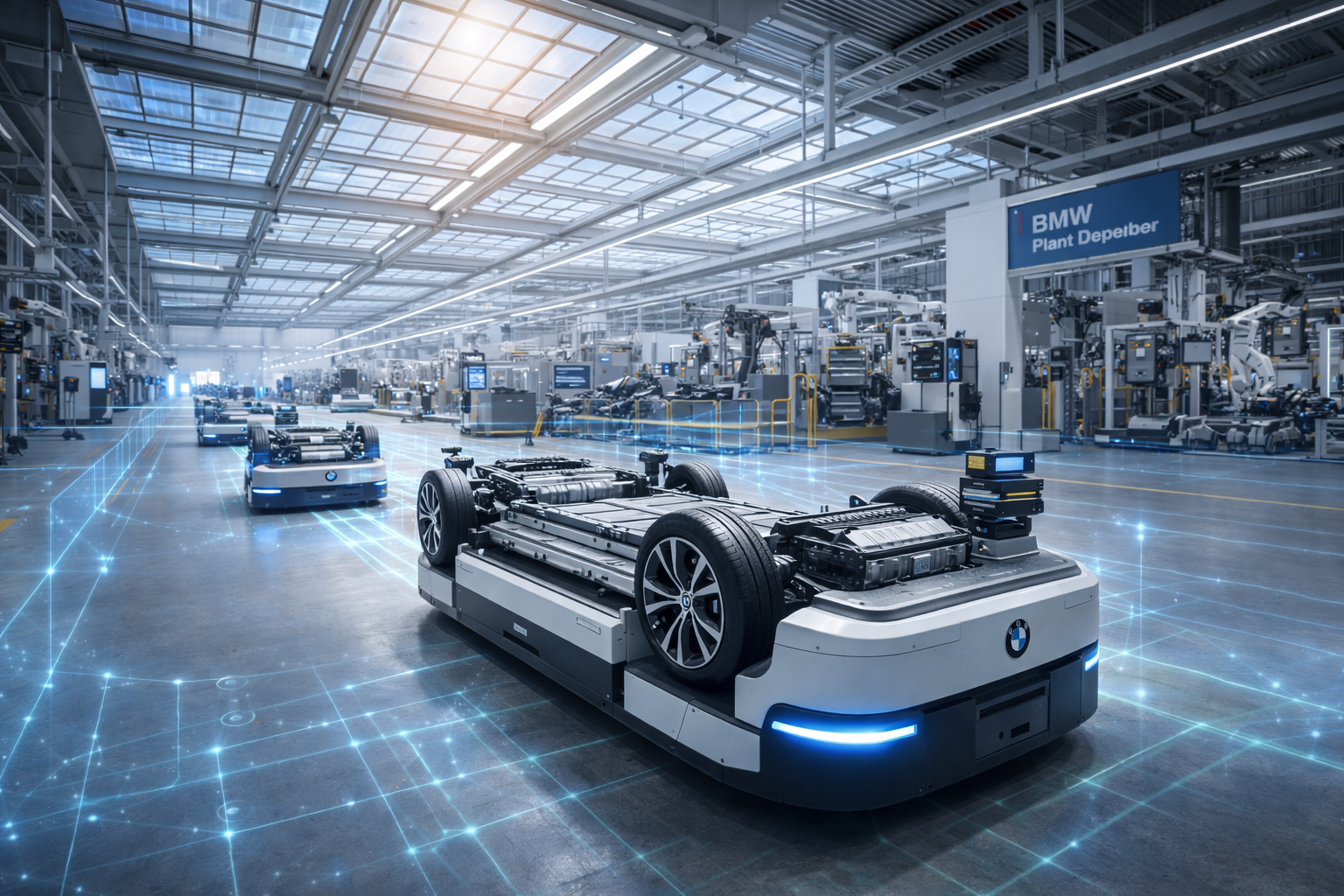
In the heart of the fourth industrial revolution, the automotive industry is undergoing a seismic shift that transcends the simple transition from internal combustion engines to electric powertrains. The real revolution is happening on the factory floor. As of March 2026, the BMW Group has emerged as the global blueprint for the “Autonomous Factory” through its visionary iFACTORY strategy. This is not merely an incremental update to manufacturing; it is a fundamental redefinition of autonomous production logistics.
Definition: What is Autonomous Production Logistics?
Autonomous production logistics refers to a self-organizing, data-driven ecosystem where material flow, vehicle assembly, and quality control are managed by intelligent systems with minimal human intervention. At BMW, this involves a “Virtual First” approach, where every physical movement is simulated in a digital twin before a single robot moves on the shop floor.
Key Takeaways
- LEAN, GREEN, DIGITAL: The three pillars of BMW’s iFACTORY strategy that harmonize efficiency with sustainability.
- Digital Twins: Using NVIDIA Omniverse to simulate 100% of factory operations, reducing planning time by 30%.
- Physical AI: The integration of humanoid robots and Autonomous Mobile Robots (AMRs) to handle ergonomically demanding tasks.
- Fossil-Free Production: Lead by Plant Debrecen, BMW is proving that high-tech logistics can operate on 100% renewable energy.
Who This Is For
This deep dive is designed for supply chain executives, automotive engineers, Industry 4.0 enthusiasts, and digital transformation leaders who want to understand the practical application of AI and robotics in a global manufacturing network.
The iFACTORY Master Plan: Lean, Green, and Digital
To understand how BMW is redefining logistics, one must first understand the iFACTORY framework. Launched to coincide with the “Neue Klasse” (New Class) of electric vehicles, iFACTORY is BMW’s answer to the complexities of modern manufacturing.
1. LEAN: The Pursuit of Perfection
Lean logistics at BMW isn’t just about reducing waste; it’s about extreme flexibility. In the traditional model, a production line was a rigid sequence. In the autonomous factory, the “finger structure” of the building allows for non-linear production. If one station is delayed, autonomous systems can re-route components in real-time.
2. GREEN: Sustainability as a Logistics Metric
BMW has committed to a 100% circular economy. Logistics plays a crucial role here through the direct delivery concept. By 2026, 80% of parts in the Debrecen plant move directly from the delivery truck to the assembly line, bypassing massive warehouses. This reduces the carbon footprint of internal transport and minimizes the physical footprint of the factory itself.
3. DIGITAL: The Enabler of Autonomy
Digitalization is the “nervous system” of the factory. With over 200 AI applications in active use as of early 2026, BMW uses data science to predict machine failures before they happen and uses computer vision to ensure every bolt is tightened to the exact Newton-meter required.
NVIDIA Omniverse: Planning the Future in the Metaverse
One of the most radical shifts in BMW’s logistics is the move to Virtual-First planning. Traditionally, retooling a factory for a new model took months of physical testing. Today, BMW uses the NVIDIA Omniverse to create a high-fidelity digital twin of its entire production network.
The Power of the Digital Twin
A digital twin is more than a 3D map; it is a live, data-integrated simulation. In March 2026, BMW’s planners in Munich can collaborate with engineers in Spartanburg within the same virtual space. They can:
- Simulate Robot Workflows: Before a Smart Transport Robot (STR) is deployed, its path is optimized in the virtual world to avoid bottlenecks.
- Ergonomic Testing: Digital humans are used to test assembly steps, ensuring that the physical workflow is safe and efficient for real employees.
- Zero-Collision Paths: AI agents calculate the movement of thousands of parts simultaneously, ensuring that autonomous vehicles never cross paths in a way that causes a standstill.
Technical Insight: BMW integrates over 40 different IT systems—from ERP to CAD—into the Omniverse platform using the OpenUSD (Universal Scene Description) standard, allowing for seamless data flow between the virtual and physical worlds.
The Rise of the Machines: AMRs and Humanoid Robots
Logistics in a BMW plant is no longer about forklifts and conveyor belts. It is about a fleet of diverse, intelligent machines that navigate the factory floor with the grace of a choreographed ballet.
Smart Transport Robots (STR)
The STR is the workhorse of BMW’s autonomous logistics. These flat, disc-like robots can carry loads of up to one ton. Using LiDAR (Light Detection and Ranging) and SLAM (Simultaneous Localization and Mapping), they navigate without the need for floor markings or magnetic strips.
Humanoid Robots: The New Frontier
In February 2026, BMW expanded its pilot program for humanoid robots to its European plants after successful trials in Spartanburg. These robots, such as those co-developed with Figure AI and Hexagon Robotics, are tasked with:
- Component Manipulation: Picking up small, irregular parts that traditional grippers struggle with.
- High-Voltage Battery Assembly: Maneuvering heavy battery cells into position with sub-millimeter precision.
- Ergonomic Relief: Taking over tasks that require repetitive bending or stretching, reducing workplace injuries.
SORT and AI-Driven Logistics
The SORT project uses AI and camera systems to allow robots to recognize and grab components from unsorted bins. This “bin-picking” was once the “holy grail” of robotics. Today, thanks to deep learning, BMW’s robots can identify thousands of different parts in real-time, drastically reducing the time needed for kit preparation.
AIQX: The AI Quality Next Platform
Autonomous logistics isn’t just about moving things; it’s about moving things correctly. BMW’s AIQX (Artificial Intelligence Quality Next) platform uses a massive network of sensors and cameras to monitor the production process.
Real-Time Quality Assurance
As a vehicle moves through the autonomous line, AIQX compares the physical car to its “digital birth certificate.” If the AI detects a slight misalignment in a door hinge or a speck of dust in the paint shop, it triggers an immediate logistics response. The vehicle can be automatically diverted to a rework station without stopping the entire line.
Predictive Maintenance (Factory Genius)
The Factory Genius AI assistant monitors the “health” of every motor and belt in the logistics chain. By analyzing power consumption and vibration data, it can predict a breakdown weeks in advance. This ensures that the autonomous logistics chain never suffers from unplanned downtime.
Case Study: Plant Debrecen – The World’s First Digital-First Factory
Located in Hungary, Plant Debrecen is the crown jewel of BMW’s autonomous strategy. It is the first plant to start production of the Neue Klasse iX3 in late 2025/early 2026.
Why Debrecen is Different:
- Fossil-Free: The plant runs entirely on green energy, with a 50-hectare photovoltaic system on-site.
- No Central Warehouse: Logistics is so efficient that the plant operates with minimal buffer stock, relying on just-in-sequence (JIS) deliveries from local suppliers.
- Closed-Loop Logistics: Every part is tracked via GPS from the supplier’s gate to the assembly point.
- AI Integration: The plant was “born” in the Omniverse, meaning every robot was calibrated before the building’s foundation was even poured.
Common Mistakes in Autonomous Logistics Implementation
While BMW makes it look seamless, the road to autonomy is fraught with challenges.
- Data Silos: Many companies fail because their logistics data doesn’t “talk” to their production data. BMW solved this with the LogiDataCloud.
- Over-Automation: Automating a bad process only makes it fail faster. BMW emphasizes “Lean” (optimizing the process) before “Digital” (automating it).
- Ignoring the Human Element: Autonomy can cause anxiety among the workforce. BMW’s focus on upskilling and using robots to assist rather than replace has been key to their success.
The Human Factor: The “Social” Autonomous Factory
Despite the high level of automation, BMW maintains that its most flexible asset is the human worker. The role of the factory worker is shifting from “operator” to “system supervisor.”
- AR Training: New employees use Augmented Reality glasses to learn assembly steps in a virtual environment before touching a real car.
- Cobots: Collaborative robots work side-by-side with humans, providing the “muscle” while the human provides the “finesse.”
- AI Assistants: Workers use generative AI tools to query the factory’s status, asking questions like, “Why is the STR-45 delayed?” and receiving instant, data-backed answers.
Conclusion: The Next Steps for Industry Leaders
BMW has demonstrated that the autonomous factory is no longer science fiction—it is a competitive necessity. By integrating digital twins, physical AI, and a “green” philosophy, they have created a logistics model that is as sustainable as it is efficient.
If you are looking to follow in BMW’s footsteps, your next steps should be:
- Audit Your Data: Ensure your logistics and production data are standardized and accessible.
- Start Small with AMRs: Replace fixed conveyor systems with flexible, autonomous mobile robots in a pilot area.
- Invest in Digital Twins: Begin mapping your physical assets into a 3D environment to enable virtual planning.
Would you like me to create a detailed implementation roadmap for transitioning a traditional warehouse into an autonomous logistics hub?
FAQs
Q1: How does BMW ensure the cybersecurity of its autonomous factories? BMW uses a “Security by Design” approach, employing edge computing to process sensitive data locally and using encrypted cloud environments like the BMW LogiDataCloud for global synchronization.
Q2: Will autonomous logistics lead to job losses at BMW? BMW focuses on “value-adding” tasks. While repetitive manual labor is being automated, they are significantly increasing their headcount in software engineering, data science, and robot maintenance.
Q3: Can small-scale manufacturers adopt iFACTORY principles? Yes. While the scale of NVIDIA Omniverse might be out of reach for some, the principles of “Lean before Digital” and the use of standardized AMRs are scalable to smaller operations.
Q4: What is the ROI of a digital twin for factory planning? BMW reports a 30% reduction in planning costs and significantly faster ramp-up times for new vehicle models.
Q5: How do the robots navigate without GPS indoors? They use SLAM technology, which creates a map of the surroundings using LiDAR and cameras, allowing them to “see” their environment and adapt to obstacles in real-time.
References
- BMW Group PressClub (2026): “BMW Group to deploy humanoid robots in production in Germany for the first time.”
- NVIDIA Case Study (2025): “BMW Group Develops Custom Application on NVIDIA Omniverse.”
- Automotive Logistics Media (2026): “Inside BMW’s smart logistics strategy in Debrecen and Munich.”
- BMW iFACTORY Official Portal: “LEAN. GREEN. DIGITAL. Master plan for production of the future.”
- MIT Technology Review (2025): “How Digital Twins are Transforming Automotive Manufacturing.”
- Journal of Industrial Information Integration (2024): “Autonomous Mobile Robots in Automotive Logistics: A BMW Case Study.”
- IEEE Xplore: “AIQX: Artificial Intelligence for Quality Next in Smart Factories.”
- World Economic Forum: “Global Lighthouse Network: BMW Plant Regensburg.”