| Myth | Reality |
|---|---|
| “Virtual DOM frameworks are always slower than compiler-based ones.” | React’s virtual DOM reconciliation is slower than Svelte 5’s compiled output or Solid’s fine-grained updates on raw DOM-mutation benchmarks, but for most CRUD-shaped apps the gap is invisible next to network latency and data-fetching waterfalls. |
| “Svelte 5 runes made Svelte just like React.” | Runes changed the authoring syntax to look more explicit, but the compilation model is unchanged: Svelte still ships no runtime diffing engine, compiling components into imperative DOM-update instructions at build time. |
| “SolidJS is basically React with signals bolted on.” | Solid’s JSX looks like React’s, but components in Solid run once — there is no re-render cycle at all. Reactivity is handled entirely by signals updating discrete DOM nodes, which is a fundamentally different execution model. |
| “Nobody hires for Svelte or Solid, so they’re a career risk.” | Hiring volume for Svelte and Solid roles is genuinely smaller than React, but both skill sets transfer almost completely — reactive-programming fundamentals, component composition, and TypeScript patterns carry over in either direction. |
| “React Server Components replaced client-side React entirely.” | RSC changed the default data-fetching model in Next.js-style frameworks, but plenty of production React apps — dashboards, internal tools, SPAs behind auth — still run almost entirely as client components with no server rendering boundary at all. |
Why this comparison matters in 2027
Frontend framework debates used to be about syntax preference. That is no longer true. By 2027, the three approaches represented by React, Svelte, and Solid have matured into genuinely different architectural bets: React has doubled down on server-first rendering and a compiler (React Compiler, formerly “React Forget”) that automatically memoizes components; Svelte 5 rebuilt its reactivity model around explicit “runes” while keeping its zero-runtime compiled output; and SolidJS has stayed the course on fine-grained signals, becoming the reference implementation that inspired signal primitives now appearing in Angular, Vue, Preact, and even Svelte’s own internals. Choosing between them is now a decision about hiring strategy, deployment topology, and long-term maintenance cost as much as it is about developer experience. It’s also happening against the backdrop of AI-assisted development reshaping how teams write frontend code in the first place — a trend covered in more depth in our piece on how AI-assisted coding is changing professional development workflows, which matters here because the framework with the largest training-data footprint currently gets the most reliable AI-generated code.
Figure 1: Three rendering philosophies, side by side
A conceptual diagram would show three parallel pipelines. React’s pipeline: JSX to Virtual DOM tree to diff against previous tree to patch real DOM, with React Compiler inserting automatic memoization boundaries during the build step. Svelte’s pipeline: a component with runes goes through compiler analysis of reactive dependencies to plain, imperative JavaScript that directly mutates specific DOM text nodes and attributes, with no diffing step and no framework runtime shipped to the browser. Solid’s pipeline: JSX with signals is compiled into real DOM-creation calls once; signals subscribe individual DOM node updates directly to state changes, so re-renders of whole components never happen after the first mount. The throughline: React diffs trees at runtime, Svelte eliminates the runtime by doing the diffing at compile time, and Solid eliminates re-renders altogether by binding state directly to nodes.
Rendering model differences: virtual DOM vs. compiler reactivity vs. fine-grained signals
The rendering model is the single biggest technical differentiator and it cascades into every other decision — bundle size, debugging experience, and how “surprising” performance cliffs feel in production.
React: virtual DOM plus an optimizing compiler
React still renders by calling your component function, building a virtual DOM tree, diffing it against the previous tree, and patching the real DOM with the minimal set of changes. What changed since React 19 is that the React Compiler can now auto-insert memoization (the equivalent of manual useMemo, useCallback, and React.memo) at build time, closing much of the historical gap where React apps re-rendered more than necessary because developers forgot to memoize. The mental model is still “components re-run,” but the compiler makes that cheaper by skipping subtrees whose inputs haven’t changed. React Server Components add a second axis entirely: components marked as server components render once on the server (or at build time) and ship zero JavaScript to the client, while client components hydrate normally. This means a modern React app is really running two different rendering models simultaneously, chosen per-component.
Svelte 5: runes plus compile-time reactivity
Svelte never used a virtual DOM. Its compiler reads your component, figures out exactly which pieces of the DOM depend on which pieces of state, and emits plain JavaScript that updates only those exact nodes when state changes — no diffing, no framework runtime shipped at all beyond a tiny reactivity helper. Svelte 5’s rune system ($state, $derived, $effect, $props) replaced the older “any top-level variable is reactive” magic with explicit function calls that are easier for the compiler, and for readers, to reason about, and it unlocked reactivity outside component files for the first time, in plain reactive JavaScript and TypeScript modules. The tradeoff is that Svelte’s reactivity is still resolved by a compiler pass tied to its file format, so the mental model is “the compiler already knows the update graph before your code ever runs in a browser.”
SolidJS: signals and true fine-grained reactivity
Solid’s JSX looks almost identical to React’s, which is the most common source of confusion. Under the hood it is nothing like React. A Solid component function runs exactly once, at mount. There is no re-render cycle. Instead, signals (created with a signal-creation primitive) are the base reactive value, and any DOM expression that reads a signal is compiled into a subscription that updates that specific text node, attribute, or child directly when the signal changes — bypassing the component function entirely. Memos and effects build on the same signal graph. Because there’s no component re-execution, patterns that are performance foot-guns in React (creating a new callback in a render body, for instance) simply don’t exist as a category of problem in Solid, because “render body” only ever executes once per component instance.
| Dimension | React 19+ | Svelte 5 | SolidJS |
|---|---|---|---|
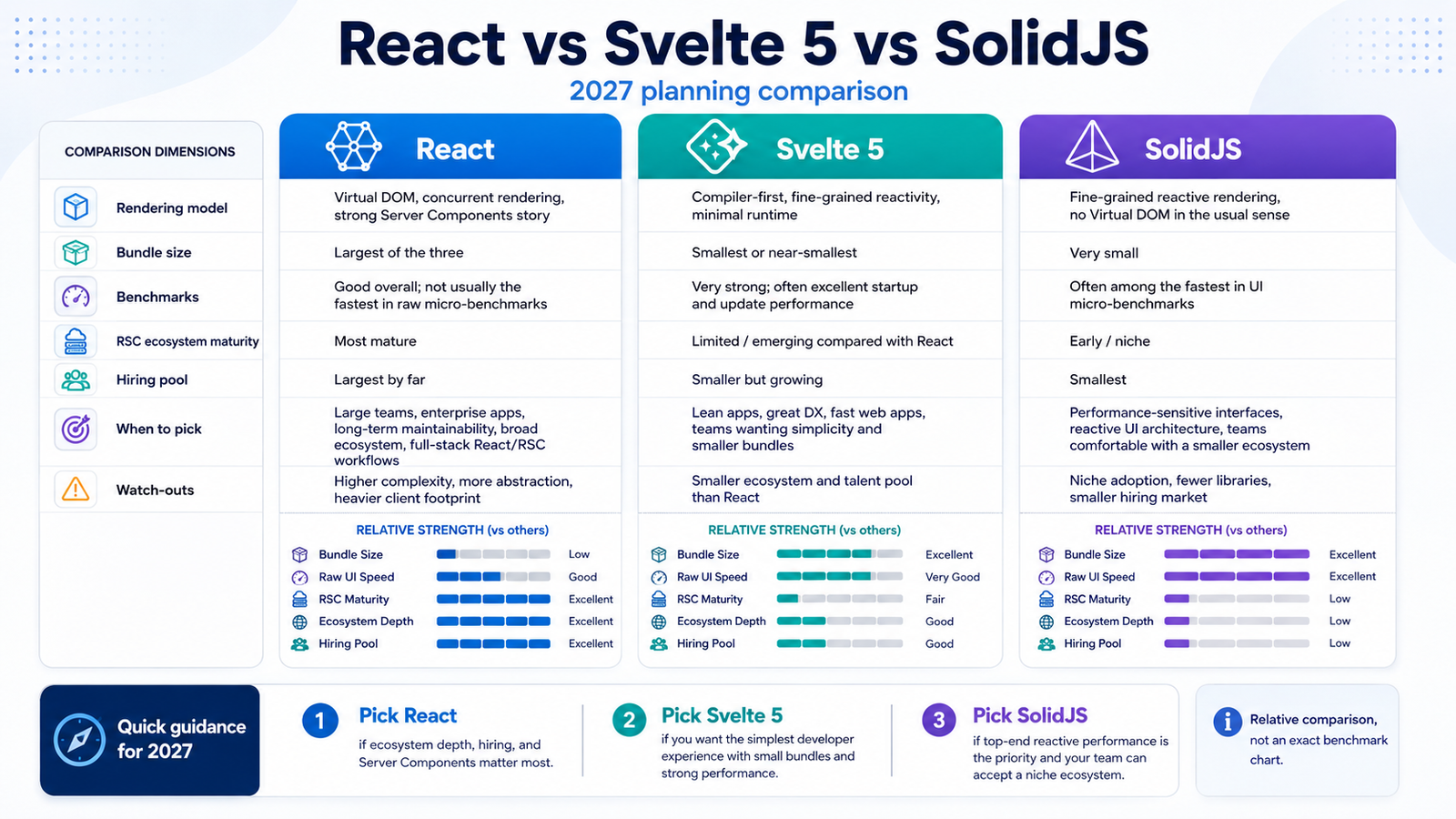
| Core mechanism | Virtual DOM diffing plus compiler-assisted memoization | Compile-time dependency analysis, no runtime diffing | Fine-grained signals, DOM bound directly to state |
| Component re-renders | Yes, per state change (mitigated by React Compiler) | No re-render concept; only affected DOM nodes update | No; component body runs once at mount |
| Runtime shipped to browser | Roughly 40-45 KB gzipped (react plus react-dom baseline) | Near-zero; a few KB of reactivity glue | Roughly 7 KB gzipped core runtime |
| Server rendering model | React Server Components, streaming SSR | SvelteKit SSR, islands-style hydration | SolidStart SSR, resumable in some configurations |
Bundle size and runtime performance benchmarks
Independent benchmarking suites remain the most credible source here because they are not run by any single framework’s core team. On the widely-cited js-framework-benchmark project (which measures operations like creating 1,000 rows, partial updates, and swapping rows), Solid and Svelte both post results close to vanilla JavaScript, while React consistently sits further down the leaderboard, typically 1.5-3x slower on raw DOM-manipulation-heavy operations depending on the exact operation and React version. That gap narrows significantly with the React Compiler enabled and largely disappears for apps that aren’t doing thousands of simultaneous list-row updates, which describes most business applications.
Bundle size tells a similar but distinct story. A minimal “hello world” Svelte 5 app can ship well under 5 KB of framework code because the compiler strips out anything unused; a comparable Solid app lands around 7-8 KB thanks to its small but non-zero runtime; a comparable React app carries the baseline cost of the React and React DOM libraries, historically in the 40-45 KB gzipped range before your own code is added, though React Server Components can reduce the client-shipped total substantially by keeping non-interactive components server-only. For content-heavy, SEO-sensitive marketing sites where every kilobyte affects Core Web Vitals, this difference is material. For internal dashboards behind authentication, it rarely is. Teams still evaluating their broader open-source toolchain around any of these three frameworks may find our roundup of open-source web development tools, which covers Next.js and Node.js fundamentals, a useful companion reference.
Figure 2: Where each framework’s performance edge actually shows up
A bar-style comparison would plot four scenario categories: initial page load on a marketing site, large list re-rendering in a data grid with 10,000-plus rows, typical CRUD form interaction, and server-rendered content with light interactivity. Svelte would lead on initial load and typical form interaction due to minimal shipped JS. Solid would lead on large list re-rendering due to its lack of any re-render or reconciliation overhead. React would be roughly competitive on typical CRUD forms, especially with the compiler enabled, and would lead on server-rendered content with light interactivity once React Server Components are factored in, since large swaths of the page ship no client JavaScript at all.
React Server Components and the React 19+ ecosystem vs. Svelte 5 runes vs. SolidJS signals
Ecosystem maturity is where the three diverge most sharply, and it’s the axis most likely to actually decide your project.
React’s ecosystem is the deepest by a wide margin. Next.js’s App Router made React Server Components the default mental model for a huge share of new React projects, and the broader ecosystem — component libraries, state managers, meta-frameworks, testing tooling, and AI-assisted coding tools that were overwhelmingly trained on React-shaped code — has adjusted around it. That shift toward server-rendered, agent-friendly component trees is part of a larger move away from traditional CRUD-style interfaces, explored in our analysis of why agent-centric user interfaces are replacing the classic CRUD app. The tradeoff is complexity: understanding which components are server components, which need explicit client directives, and how server actions interact with caching is a genuinely steep learning curve that didn’t exist in earlier React versions.
Svelte 5’s runes closed the biggest historical gap between Svelte and its competitors: reactivity that previously only worked inside Svelte’s own component files now works in plain TypeScript modules, and the explicit rune syntax made Svelte’s reactivity easier to statically analyze and to explain in code review. SvelteKit remains the dominant meta-framework and is mature enough for production use at real scale, though its plugin and third-party component ecosystem is still meaningfully smaller than React’s.
SolidJS’s ecosystem is the smallest of the three, but it is no longer experimental. SolidStart provides SSR, and Solid’s signal model has become influential well beyond its own userbase — it’s the closest thing frontend development has to a reference implementation for fine-grained reactivity, which is why Vue’s Composition API, Angular’s signals, Preact Signals, and even Svelte 5’s runes all converge conceptually on the same primitive. Choosing Solid in 2027 means choosing a technically excellent but ecosystem-constrained option: fewer pre-built component libraries, a smaller pool of community answers and AI-tool training data, and more “build it yourself” moments. This same “smaller ecosystem, deliberate tradeoff” pattern shows up in mobile development too, as covered in our review of popular mobile app libraries and SDKs, where teams weigh a similarly React-centric ecosystem against smaller, more specialized alternatives.
Hiring pool and ecosystem size
This is the section that tends to override every technical argument once a team has more than a handful of engineers. React’s job market dominance is not close: React remains the most-used frontend library in nearly every industry developer survey, which means a far larger pool of engineers already know it, more bootcamps and computer-science programs teach it as the default, and recruiting is materially easier at scale. Svelte occupies a middle position — strong developer satisfaction scores and steady adoption growth, but noticeably fewer engineers list it as a primary skill, which mostly matters when you need to hire quickly rather than when you’re building a small, stable team. Solid has the smallest hiring pool of the three by a significant margin; teams that adopt it successfully usually do so with an existing core of engineers who already know it well, or with a deliberate plan to train React or Vue engineers into it, since the conceptual leap (no re-renders, ever) is real but learnable within a few weeks for most experienced frontend developers.
None of this is fixed forever — developer sentiment surveys have shown Svelte and Solid posting some of the highest satisfaction and retention scores of any frontend tool for several years running, even as their raw usage numbers stay well behind React’s, so the hiring gap is a lagging indicator rather than a signal about technical quality. Teams thinking hard about how frontend skills map onto broader engineering careers may also find it useful to read about non-traditional paths into tech, since bootcamp curricula are one of the clearest leading indicators of where the hiring pool is headed next.
- Step 1 — Identify your constraint. Is the limiting factor hiring speed, initial load performance, runtime performance under heavy interactivity, or long-term maintenance by a large team? Write this down before looking at benchmarks — it changes which numbers matter.
- Step 2 — Match to team size and hiring urgency. Large team, need to hire fast, or currently AI-tool-heavy workflow which is trained overwhelmingly on React patterns: default to React 19 with a Server Components-capable meta-framework.
- Step 3 — Weigh bundle size against interactivity needs. Marketing sites, content sites, and anything scored on Core Web Vitals with modest interactivity: Svelte 5 typically ships the least JavaScript and gives the fastest perceived load.
- Step 4 — Weigh raw runtime performance against ecosystem depth. Data-dense dashboards, real-time visualizations, or apps with thousands of simultaneously live DOM nodes: SolidJS’s lack of re-render overhead is a genuine, measurable advantage worth the smaller ecosystem.
- Step 5 — Sanity-check against existing team skills. A technically “better fit” framework that nobody on the team knows and that you can’t hire for quickly is often the wrong choice for a deadline-driven project, even if the benchmarks favor it.
- Step 6 — Prototype the riskiest screen first, not the easiest one. Build the most interaction-heavy or performance-sensitive screen in your two finalist frameworks before committing — that screen will reveal real ergonomics that benchmarks and blog posts can’t.
Common mistakes
- Choosing a framework based on a synthetic benchmark, like a 10,000-row list swap, that has nothing to do with your actual application’s interaction patterns.
- Adopting Solid or Svelte for a large team without budgeting real onboarding time, then blaming the framework when velocity dips in month one.
- Assuming React Server Components are mandatory in 2027 — plenty of legitimate, well-architected React apps are still fully client-rendered single-page apps and that remains a valid choice.
- Ignoring that AI coding assistants currently generate meaningfully higher-quality, more idiomatic code for React than for Svelte or Solid, simply due to training data volume — a real, if temporary, productivity factor.
- Rewriting a stable, working React app to Svelte or Solid purely for a bundle-size win that Core Web Vitals data doesn’t actually show is hurting your conversion or SEO.
In practice
Teams that get this decision right in 2027 tend to treat it as a portfolio question rather than a single company-wide bet. A mid-size SaaS company might run its public marketing site and blog in Svelte 5 or SvelteKit for the load-time win, its core authenticated product in React 19 with a Server Components-capable framework because that’s where the team’s hiring pipeline and AI-tooling investment already live, and reserve SolidJS for one specific internal tool — a real-time operations dashboard rendering thousands of live data points — where the fine-grained reactivity model produces a measurable, demoed performance difference that justifies training two engineers on a new mental model. The unifying discipline is writing down the actual constraint, whether hiring, load time, or runtime performance, before comparing frameworks, and revisiting the decision only when that constraint changes, not every time a new benchmark post goes viral.
Glossary
- Virtual DOM
- An in-memory representation of the UI that a framework diffs against a previous version to compute the minimal set of real DOM changes needed.
- Signal
- A reactive primitive holding a value that automatically notifies dependent computations or DOM bindings when it changes, without requiring a component to re-run.
- Rune
- Svelte 5’s compiler-recognized function syntax, such as state and derived-value declarations, used to declare reactive state and computed values explicitly.
- React Server Component (RSC)
- A React component that renders on the server, or at build time, and sends no JavaScript for its own logic to the client, reducing bundle size for non-interactive UI.
- Fine-grained reactivity
- A reactivity model where individual DOM nodes subscribe directly to the specific state they depend on, avoiding whole-component re-execution entirely.
- Hydration
- The process of attaching client-side interactivity to server-rendered HTML so it becomes a fully interactive application in the browser.
- React Compiler
- An opt-in build-time tool, formerly known as React Forge, that automatically inserts memoization to skip unnecessary re-renders without manual memoization calls.
Key Takeaways
- React 19+’s virtual DOM plus an optional compiler and Server Components gives it the deepest ecosystem and largest hiring pool, at the cost of more conceptual surface area to learn.
- Svelte 5’s runes made its compile-time reactivity model explicit and extended it beyond component files, while keeping its near-zero runtime bundle size advantage.
- SolidJS’s signals eliminate component re-renders entirely, giving it a genuine, benchmarked runtime performance edge for interaction-heavy, data-dense UIs.
- Independent benchmarks like js-framework-benchmark consistently show Solid and Svelte outperforming React on raw DOM-manipulation operations, though the gap narrows for typical business apps.
- Hiring pool size still favors React by a wide margin; Svelte and Solid post higher developer satisfaction scores but far smaller adoption numbers.
- Bundle size and initial load favor Svelte for content-heavy, SEO-sensitive sites; runtime performance under heavy interactivity favors Solid.
- The right choice depends on which constraint dominates your project — hiring speed, load time, or raw interactivity performance — not on which framework “wins” a generic benchmark.
FAQs
Is React still worth learning in 2027 given Svelte and Solid’s performance advantages?
Yes. React’s hiring pool, ecosystem breadth, and AI-tooling support remain unmatched, and React Server Components close much of the historical bundle-size gap for content-heavy pages. Learning React first and adding Svelte or Solid later remains a low-risk career path for most frontend engineers.
Do Svelte 5 runes make migrating from React easier?
Somewhat. Runes for state and derived values map conceptually to React’s state and memoization hooks, which shortens the learning curve, but Svelte’s compile-time model and lack of a re-render cycle still require React developers to unlearn some virtual-DOM-era habits.
Why does SolidJS feel like React but perform so differently?
Solid deliberately copied React’s JSX syntax for familiarity, but its components run once at mount rather than re-running on every state change. Signals bind DOM updates directly to state, which is why Solid avoids the re-render overhead that React’s virtual DOM diffing incurs.
Which framework has the smallest production bundle size?
Svelte 5 typically produces the smallest shipped JavaScript for a given app because its compiler strips out unused reactivity code entirely; Solid’s small (roughly 7 KB) runtime is close behind; React’s baseline library cost is largest, though React Server Components can offset this by keeping static content off the client bundle entirely.
Can I mix React Server Components with a fully client-rendered React app?
Yes, within limits. Modern React meta-frameworks let you mark specific components as server components while keeping the rest of the tree as client components, but this requires understanding the server-client boundary carefully, since data serialization rules apply at that boundary.
Is it realistic to hire a team for SolidJS in 2027?
It’s realistic but slower than hiring for React or even Svelte. Most successful Solid adoptions either start with engineers who already know it or train existing React or Vue engineers, since the signals-based mental model is learnable in weeks for experienced frontend developers.
Do AI coding assistants work equally well across all three frameworks?
No. Because React has by far the largest volume of public training data, AI coding assistants currently tend to generate more idiomatic, higher-quality code for React than for Svelte or Solid, though this gap has been narrowing as more Svelte 5 and Solid code becomes publicly available.
Should a startup choose based purely on the js-framework-benchmark results?
No. Synthetic benchmarks like large list operations rarely reflect real application behavior. A better approach is prototyping your actual highest-risk screen, meaning the most interactive or performance-sensitive one, in your top two candidate frameworks before committing.
References
- React Team, “React v19,” react.dev, react.dev/blog/2024/12/05/react-19
- React Team, “Server Components,” React Reference Documentation, react.dev/reference/rsc/server-components
- Svelte Team, “Introducing runes,” Svelte Blog, svelte.dev/blog/runes
- Svelte Team, “Svelte 5 migration guide,” Svelte Docs, svelte.dev/docs/svelte/v5-migration-guide
- Solid Team, “Fine-grained reactivity,” SolidJS Documentation, docs.solidjs.com/advanced-concepts/fine-grained-reactivity
- Krause, S., “js-framework-benchmark,” open benchmark suite comparing DOM-operation performance across frameworks, github.com/krausest/js-framework-benchmark
- State of JS Survey Team, “State of JavaScript 2025: Libraries,” 2025.stateofjs.com/en-US/libraries