| Myth | Reality |
|---|---|
| Zero-knowledge proofs are only a blockchain or crypto-token technology. | Enterprise deployments in identity verification, supply chain, and credentialing run entirely off-chain, with no token or ledger involved. |
| Using a ZKP means an enterprise gives up the ability to verify anything meaningfully. | ZKPs prove a specific predicate is true, such as “this person is over 18” or “this component passed inspection,” with cryptographic certainty, just without exposing the source data. |
| ZKP-based verification cannot satisfy regulators or auditors. | Frameworks like the EU’s eIDAS 2 digital identity wallets explicitly build selective-disclosure proofs into regulator-approved verification flows. |
| Implementing ZKPs requires replacing your entire identity or ERP stack. | Most enterprise deployments add a proof-generation layer downstream of existing verification systems rather than replacing them. |
Zero-knowledge proofs, without the blockchain framing
Most explanations of zero-knowledge proofs reach for a blockchain example within the first paragraph, and for good reason: SNARKs and STARKs found their first large-scale production use inside rollups, private transactions, and on-chain identity systems. That history has left a widespread impression that ZKPs are fundamentally a crypto-token technology. They are not. A zero-knowledge proof is a general cryptographic protocol that lets one party, the prover, convince another party, the verifier, that a statement is true without revealing anything beyond the truth of that statement. Nothing in that definition requires a blockchain, a token, or a distributed ledger.
The enterprise use cases below run entirely off-chain. A bank’s compliance system, a manufacturer’s supplier-audit pipeline, or a hospital’s credential-verification service can all use ZKPs as a component of an ordinary backend architecture, generating and verifying proofs the same way they might call a hashing function or a digital signature library. For readers who want the underlying cryptographic mechanics, including how SNARKs and STARKs are constructed and why on-chain privacy applications adopted them first, our companion piece on how zero-knowledge proofs transform privacy in Web3 covers that ground. This article focuses on what changes when the same primitive is applied to traditional enterprise verification problems that have nothing to do with a token or a chain.
Privacy-preserving KYC and identity verification
Know Your Customer processes have historically required an enterprise to collect, store, and repeatedly re-verify a customer’s full identity documents: passport scans, proof of address, date of birth, and increasingly biometric data. Every one of those data points becomes a liability the moment it is stored, because a breach exposes exactly the information regulators required the enterprise to collect in the first place. The pattern is well established: large identity-verification vendors have suffered breaches that exposed exactly this kind of centrally stored document data, turning a compliance obligation into a systemic risk.
ZKP-based identity verification restructures this. A regulated identity provider still performs the underlying verification once, checking a government ID, running a liveness check, screening against sanctions and politically exposed person lists. Instead of handing the raw result to every business that needs to confirm the customer’s status, the provider issues a signed attestation, and from that attestation generates zero-knowledge proofs for specific predicates: over 18, EU-resident, sanctions-clear, verified at KYC level three or above. A bank, exchange, or marketplace that needs to confirm one of those predicates verifies the proof in constant time and never receives the underlying passport number, address, or biometric template.
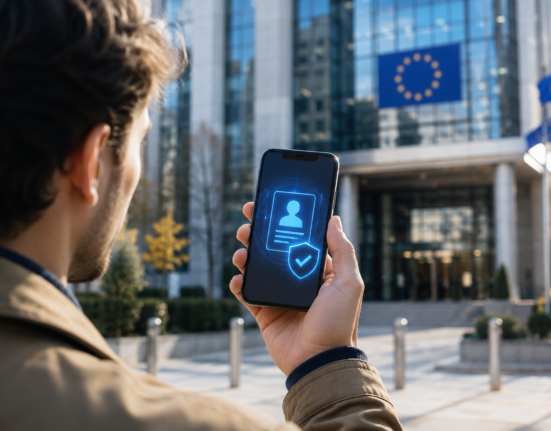
This is not a hypothetical. The EU’s eIDAS 2 regulation, in force since 2024 with national digital identity wallet rollouts running through 2026, mandates that member states issue citizen wallets supporting selective-disclosure mechanisms based on cryptographic proofs. A regulated business onboarding an EU citizen can request a ZKP that the citizen is over 18 and EU-resident, satisfying identity verification requirements under frameworks like MiCA, without the business ever seeing the citizen’s underlying identity document. Industry estimates put the zero-knowledge KYC market on a growth path from roughly 84 million dollars in 2025 to over 900 million dollars, reflecting how quickly this pattern is moving from pilot to standard practice among compliance-first identity vendors.
| Verification need | Traditional approach | ZKP-based approach |
|---|---|---|
| Confirm customer is over 18 | Collect and store full date of birth and ID scan | Verify a proof of the “over 18” predicate only |
| Confirm sanctions-clear status | Store screening result alongside full identity record | Verify a proof that screening passed, without the underlying record |
| Confirm supplier passed an audit | Share full audit report, including proprietary process detail | Verify a proof that specific compliance thresholds were met |
| Confirm a professional credential is valid | Contact issuing institution or share full transcript | Verify a cryptographic proof issued against the credential record |
Supply chain provenance without exposing trade secrets
Supply chain verification has a structurally similar problem to KYC: the party that needs to confirm a fact, a retailer confirming ethical sourcing, a regulator confirming safety compliance, an automaker confirming a part meets a specification, is not the party that should see every detail behind that fact. A supplier is understandably reluctant to hand a full bill of materials, process yields, and supplier-of-supplier relationships to every downstream customer that asks, because that information is itself commercially sensitive.
Zero-knowledge proofs let a supplier prove specific claims, this batch met the required tensile strength threshold, this material was sourced from an approved region, this facility passed its most recent safety audit, without disclosing the underlying test data, the supplier list, or proprietary process parameters. The verifying party gets cryptographic assurance that the claim is true, backed by whatever inspection or measurement process generated the underlying attestation, without needing to trust the supplier’s word alone or demand disclosure of information the supplier has legitimate reasons to protect.
This matters most in industries with layered, multi-tier supply chains, semiconductors, pharmaceuticals, automotive components, and conflict-mineral-sensitive electronics, where a single end product might depend on dozens of suppliers, each reluctant to expose their own supplier relationships. A verification architecture built around selective disclosure lets provenance claims flow up the chain, each tier proving compliance to the next without a full disclosure cascade that would otherwise require every participant to trust every other participant with commercially sensitive data.
Credential verification without full disclosure
Professional licensing, academic credentials, and employment history checks share the same shape again. An employer verifying a candidate’s degree does not need the candidate’s full transcript, grades, and coursework; it needs confirmation that a specific degree was conferred by a specific accredited institution. A hospital credentialing a visiting physician needs confirmation of an active license in good standing, not the physician’s entire disciplinary history unless a specific flag is relevant.
The W3C’s Verifiable Credentials 2.0 specification, published as a full Recommendation in May 2025, formalizes exactly this pattern at the standards level: an issuer signs a credential, a holder controls it, and a verifier can confirm specific claims within that credential without necessarily seeing every field. Zero-knowledge proofs extend that model further by letting the holder prove derived predicates about the credential, such as “this credential is currently valid and was issued after a given date,” rather than presenting the credential’s full contents to every verifier that asks.
Figure: Enterprise ZKP verification flow
A regulated issuer, an identity provider, a certification body, or a licensing authority, performs the underlying verification once and produces a signed attestation. From that attestation, the holder’s system generates a zero-knowledge proof for a specific predicate. A verifying enterprise, a bank, a retailer, an employer, checks the proof in constant time and learns only whether the predicate is true, never the underlying document, transcript, or process data behind it.
The architectural building blocks
Enterprise ZKP deployments outside blockchain contexts tend to share a small set of architectural components, regardless of industry.
- Off-chain attestation issuance. A trusted, regulated party performs the underlying verification and signs a structured attestation containing verified attributes, a policy version, and a timestamp.
- Predicate-specific proof circuits. Separate proof circuits are built for each predicate an enterprise needs to verify, such as age threshold, residency, or compliance status, so that proof generation stays fast and purpose-built.
- Holder-controlled proving keys. The individual or organization being verified typically controls the proving key, often on-device, so the issuer cannot be compelled or breached into producing proofs without consent.
- Constant-time verification. The verifying enterprise’s backend checks the proof through a lightweight verification routine, independent of how complex the underlying predicate computation was.
- Auditable, privacy-preserving logs. Every proof issuance and verification is logged, often with threshold encryption, so regulators can confirm the verification process ran correctly without gaining routine access to the underlying personal or commercial data.
Real constraints enterprises should plan for
None of this is free of engineering trade-offs, and enterprise buyers evaluating ZKP-based verification vendors should go in with clear eyes about the current limits.
| Constraint | Why it matters |
|---|---|
| Trusted setup for some proof systems | Groth16-style SNARKs require a one-time ceremony per circuit; a compromised ceremony can undermine the proof system’s soundness |
| Proof generation cost | Complex predicates can take seconds to prove on consumer-grade hardware, which matters for real-time onboarding flows |
| Predicate definition is a policy decision | Deciding which sanctions list, which audit threshold, or which accreditation counts is a governance question the cryptography does not answer |
| Key custody and recovery | If a holder loses control of a proving key, they lose the ability to generate new proofs until a recovery process runs |
Common mistake
Assuming that adopting zero-knowledge proofs eliminates the underlying verification step entirely. It does not. ZKPs are downstream of verification, not a replacement for it. A regulated identity provider, a certification body, or a quality auditor still has to do the actual work of confirming a fact about a person, a supplier, or a credential. What the ZKP changes is how that already-verified fact is subsequently proven to third parties, compressing a full disclosure into a narrow, predicate-specific proof. Enterprises that skip the upstream verification step and expect the cryptography alone to produce trustworthy claims are building on a false foundation, regardless of how sound the proof system is.
What worked
Enterprises that successfully deployed ZKP-based verification generally started with a single, narrow predicate, such as age or residency verification, rather than attempting a full identity or supply-chain overhaul at once. They kept the upstream verification process unchanged, adding a proof-generation layer on top of existing KYC or supplier-audit workflows rather than replacing them, which limited the blast radius of any early cryptographic or integration issues while still delivering a measurable reduction in stored personal or commercial data.
Who should evaluate a ZKP-based verification vendor, and how
Procurement for this category is still maturing, and different roles inside an enterprise need to ask different questions before signing a contract. Compliance and legal teams need to confirm that a vendor’s audit trail is genuinely defensible to a regulator without exposing customer or supplier data at scale, since a system that cannot produce evidence of what was verified, when, and under which policy version is not actually solving the compliance problem it claims to solve. Security teams need to understand exactly which proof system a vendor uses, whether it depends on a trusted setup ceremony, and whether that ceremony has been publicly documented or audited. Procurement and legal should also ask where the proving key lives and who controls it, because a vendor that quietly retains custody of the proving key on the customer’s behalf has reintroduced much of the centralized risk the architecture was meant to remove.
Engineering and architecture teams, meanwhile, need a realistic answer on integration effort. The most successful enterprise deployments treat the proof-generation layer as an addition to an existing verification pipeline rather than a replacement, meaning the identity provider, auditor, or credential issuer keeps doing what it already does, and a new component sits downstream translating verified attestations into narrow, reusable proofs. Vendors who propose ripping out an existing KYC or supplier-audit system entirely in favor of a ZKP-native rebuild are proposing a much larger, riskier project than the underlying use case usually requires.
How this differs from the blockchain narrative
It is worth being explicit about the differentiation, because the two contexts are easy to conflate. Blockchain-based ZKP applications, private transactions, rollup scaling, and on-chain identity, generally exist to let a public, permissionless ledger retain privacy properties it would otherwise lack, since a blockchain’s default behavior is to publish everything. Enterprise verification use cases are the opposite starting point: private backend systems that already keep data confidential from the public, but that currently over-share between business parties who each only need to confirm a narrow fact about the other. The cryptography is the same family of tools; the problem it is solving, and the trust model around who controls the ledger, issuer, and verifier, is different enough that vendors, architectures, and even regulatory treatment diverge sharply between the two.
Frequently overlooked considerations
- Predicate scope creepOnce a proof-of-age circuit exists, there is pressure to bolt on additional predicates without re-evaluating whether each new predicate genuinely needs zero-knowledge treatment.
- Revocation handlingA proof issued against an attestation that has since been revoked, such as an expired license, needs a defined mechanism to become invalid, which is easy to overlook during initial design.
- Cross-jurisdiction policy versionsA predicate like “sanctions-clear” may need different underlying lists or thresholds depending on jurisdiction, requiring policy versioning inside the proof circuit itself.
- Vendor lock-in on proof circuitsPredicate circuits built on a proprietary vendor framework can be costly to migrate away from if the vendor relationship ends.
- Auditor unfamiliarityMany compliance auditors have not yet reviewed ZKP-based systems and may need additional education on how to evaluate audit trails that never expose underlying PII.
- Underlying verification qualityA cryptographically sound proof is only as trustworthy as the upstream verification process that produced the attestation it is built on.
Glossary
- Zero-knowledge proof
- A cryptographic protocol letting one party prove a statement is true to another party without revealing any information beyond the statement’s truth.
- Predicate
- A specific, narrow claim a zero-knowledge proof is built to verify, such as “over 18” or “sanctions-clear,” rather than a full disclosure of underlying data.
- Selective disclosure
- An identity or credential verification approach in which only the specific attributes a verifier needs are revealed or proven, rather than the entire underlying record.
- Attestation
- A signed statement issued by a trusted party, such as an identity provider or certification body, confirming that specific attributes were verified as of a given time.
- Verifiable Credentials
- A W3C standard, formalized as a full Recommendation in May 2025, defining how issuers, holders, and verifiers exchange and confirm cryptographically signed credentials.
- Trusted setup
- A one-time cryptographic ceremony required by some zero-knowledge proof systems, such as Groth16 SNARKs, to generate parameters the proof system depends on for security.
Key Takeaways
- Zero-knowledge proofs are a general cryptographic primitive, not an inherently blockchain-specific technology, and enterprise deployments run entirely off-chain.
- Privacy-preserving KYC lets identity providers issue predicate proofs, such as age or residency, without exposing full documents to every verifying business.
- The EU’s eIDAS 2 digital identity wallets are building regulator-approved selective disclosure directly into national identity infrastructure through 2026.
- Supply chain provenance verification lets suppliers prove compliance claims without disclosing proprietary process data or full supplier relationships.
- Credential verification under the W3C Verifiable Credentials 2.0 standard can use ZKPs to prove derived facts about a credential without full disclosure.
- ZKPs do not replace upstream verification; they change how an already-verified fact is subsequently proven to third parties.
- Enterprises should start with a single, narrow predicate rather than attempting a full identity or supply-chain overhaul in one step.
FAQs
Are zero-knowledge proofs only used in blockchain applications?
No. While ZKPs first reached large-scale production use in blockchain contexts like private transactions and rollups, the underlying cryptographic protocol is general-purpose. Enterprise applications in KYC, supply chain verification, and credential checking run entirely off-chain, with no token or ledger involved.
How do zero-knowledge proofs improve KYC compliance?
They let a regulated identity provider verify a customer once and then issue narrow, predicate-specific proofs, such as “over 18” or “sanctions-clear,” to businesses that need that confirmation. The verifying business learns only the predicate’s truth value, never the customer’s underlying passport, address, or biometric data.
What role does eIDAS 2 play in enterprise ZKP adoption?
The EU’s eIDAS 2 regulation mandates that member states issue digital identity wallets supporting selective-disclosure mechanisms based on cryptographic proofs. This gives ZKP-based identity verification a regulator-approved path into mainstream compliance workflows across the EU through the ongoing 2026 wallet rollout.
Can zero-knowledge proofs verify supply chain claims without exposing trade secrets?
Yes. A supplier can generate a proof that a specific compliance threshold, such as a safety audit result or sourcing requirement, was met without disclosing the underlying test data, process parameters, or supplier relationships that a full audit report would otherwise reveal.
Do zero-knowledge proofs eliminate the need for traditional verification processes?
No. A regulated party still has to perform the actual verification, whether that is checking an identity document, auditing a supplier, or confirming a credential. The zero-knowledge proof changes how that already-verified fact is subsequently proven to other parties, not whether the initial verification happens.
What is the difference between a zero-knowledge proof and a verifiable credential?
A verifiable credential, as defined by the W3C’s Verifiable Credentials 2.0 standard, is a signed record of verified attributes held by an individual or organization. A zero-knowledge proof can be layered on top of that credential to prove a derived predicate about it without disclosing the credential’s full contents.
What are the practical limits of enterprise zero-knowledge proof deployments today?
Key constraints include trusted setup requirements for some proof systems, proof generation time on standard hardware for complex predicates, the need to define policy questions like which sanctions list applies, and key custody and recovery for the party holding the proving key.
How is enterprise ZKP verification different from blockchain-based ZKP privacy?
Blockchain applications use ZKPs to add privacy to a public, permissionless ledger that otherwise publishes everything by default. Enterprise verification uses the same cryptographic family to reduce over-sharing between already-private business systems, which is a different problem with a different trust model around issuers and verifiers.
References
- European Union, eIDAS 2 Regulation (EU) 2024/1183, European Digital Identity Wallet framework
- W3C, “Verifiable Credentials Data Model 2.0,” Full Recommendation, May 2025
- Zyphe, “How Zyphe Uses Zero-Knowledge Proofs in Production KYC”
- ChainLaunch, “Zero-Knowledge Proofs for Enterprise Blockchain”
- Open Security Architecture, “Zero-Knowledge Proof Architecture” pattern SP-053
Enterprises building the broader trust infrastructure around these proofs should also review the nine pillars of PKI trust in decentralized systems. For organizations exploring related privacy-preserving computation techniques, see our guides to fully homomorphic encryption, confidential computing, and secure multi-party computation for cross-org analytics. Enterprises also modernizing their cryptographic stack for the post-quantum era should see our companion piece on designing systems that can swap algorithms.