| Myth | Reality |
|---|---|
| Supply chain attacks are rare, one-off incidents that only hit large, high-profile vendors. | Attackers now systematically target open source maintainers, CI/CD tooling, and package registries at scale, because compromising one upstream component reaches thousands of downstream victims at once. |
| Antivirus and endpoint detection on developer laptops is enough to catch a compromised dependency. | Malicious code frequently activates only inside build environments or at runtime in production, meaning it never touches an endpoint scanner and requires pipeline-level and behavioral monitoring instead. |
| A signed package or a green CI check means the artifact is trustworthy. | Signing keys and CI credentials are themselves common attack targets; provenance must be verified against build attestations, not just presence of a signature. |
| Containment means pulling the plug on the whole pipeline the moment something looks wrong. | Effective containment isolates the specific blast radius, an image tag, a build job, a credential scope, so the rest of delivery keeps functioning while the incident is scoped and cleaned up. |
Why the Software Supply Chain Became the Preferred Attack Path
Every modern application is assembled, not written. A typical production service pulls in hundreds or thousands of open source packages, container base images, CI/CD plugins, and third-party build tools before a single line of custom code ever runs. Attackers understood this shift years before most security teams caught up, and by 2026 the supply chain has become the most reliably profitable path into an organization: compromise one upstream component and you inherit the trust that thousands of downstream consumers have already extended to it.
This article breaks down how software supply chain attacks actually unfold in practice, the detection patterns that catch them before they spread, and the containment playbooks that limit damage once a compromise is confirmed. The goal is not a theoretical framework, it is an operational reference you can map directly onto your own build systems, registries, and deployment pipelines.
The Three Dominant Attack Patterns
Compromised Dependencies
The most common pattern is the silent compromise of an existing, trusted dependency. This usually happens one of three ways: a maintainer’s account or publishing credentials are stolen through phishing or credential stuffing, a maintainer is socially engineered into handing over commit or publish access to an unfamiliar “co-maintainer,” or a maintainer’s own development machine is compromised and malicious commits are pushed under a legitimate identity. Because the package already has an established reputation, download count, and version history, a poisoned release frequently passes through automated dependency update tools with no human review at all.
A well-documented variant of this pattern involved a widely used open source package where a single maintainer was gradually social-engineered over several months into transferring ownership. The malicious code that followed sat dormant, avoiding any obvious behavior change, until it activated inside production builds and reached millions of downstream end users before detection. The lesson is not that the maintainer was careless, it is that dependency trust decays over time and needs continuous reverification, not a one-time vetting decision.
Build-System Compromise
The second pattern targets the infrastructure that turns source code into shippable artifacts: CI/CD runners, self-hosted build agents, artifact signing services, and the security tooling that scans those pipelines. Because build systems typically hold broad credentials, cloud deployment keys, registry publish tokens, signing keys, they are a far more efficient target than any single application.
A striking example from early 2026 involved the compromise of a widely deployed vulnerability scanning tool itself. Attackers executed a multi-phase intrusion combining stolen credentials, tampering with container image tags, binary-level tampering, and a self-propagating worm that spread across dozens of connected package repositories, turning a security tool into the delivery mechanism for the very class of attack it was built to catch. This incident reframed how security teams think about their own tooling: scanners, SBOM generators, and signing services are now first-class targets, not passive defensive infrastructure.
Malicious Package Publishing
The third pattern skips compromise entirely and instead publishes brand-new malicious packages designed to be pulled in by mistake or by automated tooling. This includes typosquatting (publishing “reqeusts” next to “requests”), dependency confusion (publishing a public package with the same name as an internal private package, tricking package managers into preferring the public, attacker-controlled version), and star-jacking or fake-popularity campaigns that make a malicious package look established enough to pass a cursory review.
These packages are cheap to produce at scale. Automated tooling can generate hundreds of near-identical package names targeting popular ecosystems in a single run, betting that a small percentage will be pulled in somewhere across thousands of build pipelines.
| Attack Pattern | Typical Entry Point | Time to Activation | Primary Detection Signal |
|---|---|---|---|
| Compromised dependency (account takeover) | Maintainer credentials or social engineering | Weeks to months (dormant code) | Unexpected new maintainer, anomalous commit timing or geography |
| Build-system compromise | CI/CD runner, signing service, or scanner plugin | Minutes to hours (near-immediate) | Unusual outbound network calls from build agents, unexpected artifact hashes |
| Malicious/typosquat publishing | Public package registry | Immediate on install | Package name similarity to internal or popular packages, new-publisher risk score |
| Dependency confusion | Package manager resolution order | Immediate on install | Namespace mismatch between internal registry and public registry |
Detection Patterns That Actually Catch These Attacks
SBOM-Driven Continuous Monitoring
A software bill of materials generated once at release time is a snapshot, and snapshots go stale the moment a new CVE is disclosed against a component you already shipped. Mature programs generate an SBOM at every build, store it centrally, and continuously re-check every historical SBOM against newly disclosed vulnerabilities and newly flagged malicious packages. This turns the SBOM from a compliance artifact into a live detection feed: the moment a package you depend on is flagged anywhere in the ecosystem, you already know every service, every environment, and every version where it is running.
Behavioral Anomaly Detection in Build Pipelines
Static analysis of a dependency’s source code catches known bad patterns, but dormant or obfuscated malicious code often will not trigger a static rule. Behavioral detection instead watches what the build process actually does: unexpected outbound network connections during a build step, a build script suddenly reading environment variables or secrets it has never touched before, a container image growing in size without a corresponding source change, or a build agent spawning a shell process it has never spawned in that pipeline’s history. These are strong anomaly signals precisely because legitimate build steps are highly repetitive, and repetitive processes are easy to baseline.
Provenance and Attestation Verification
Detection also means verifying that an artifact was actually built by the pipeline it claims to come from, using signed build attestations rather than trusting a filename or a registry tag. When provenance metadata is enforced at deployment time, a tampered image or a swapped binary fails verification even if it carries a technically valid-looking signature, because the attestation will not match the expected build source, commit hash, or builder identity.
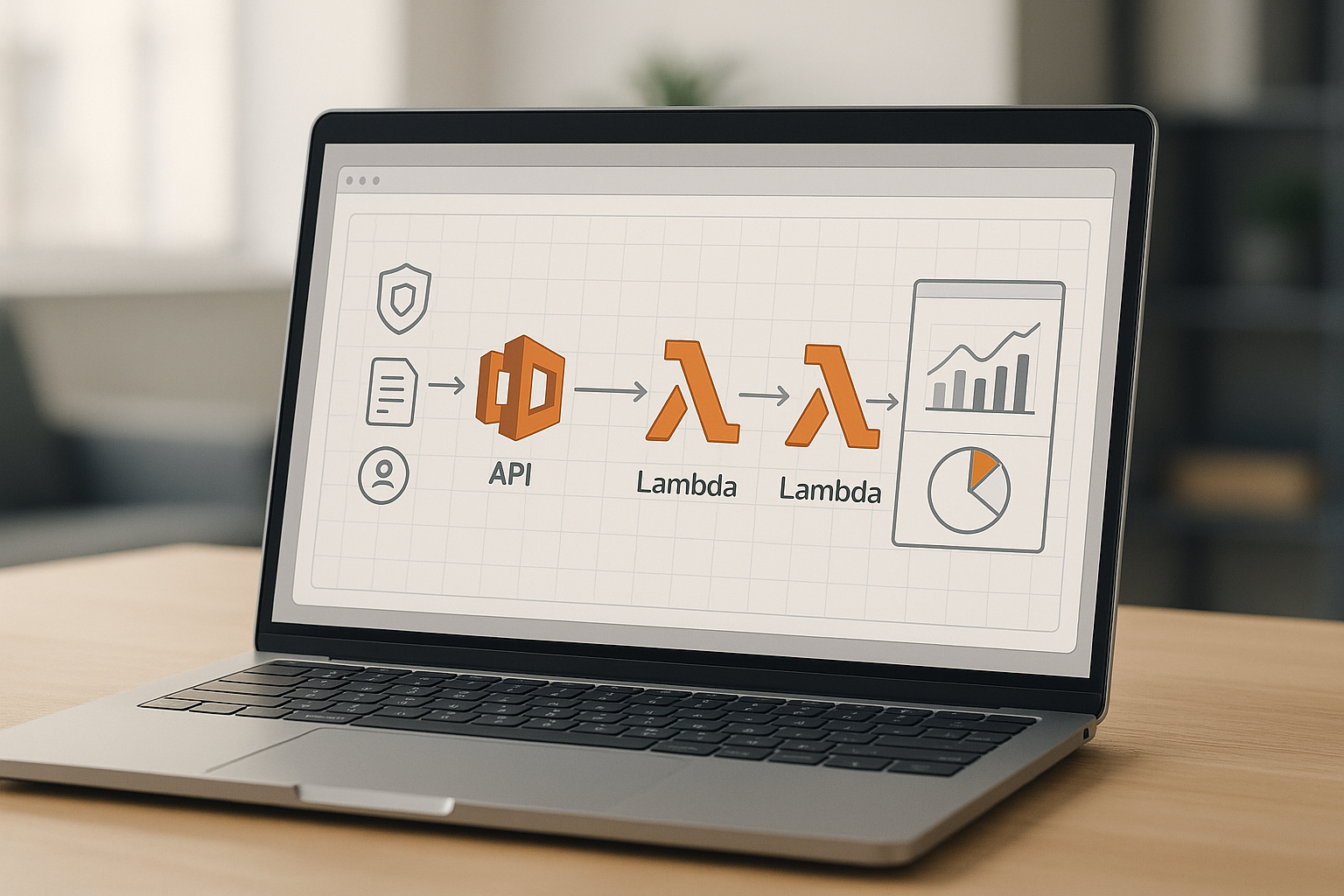
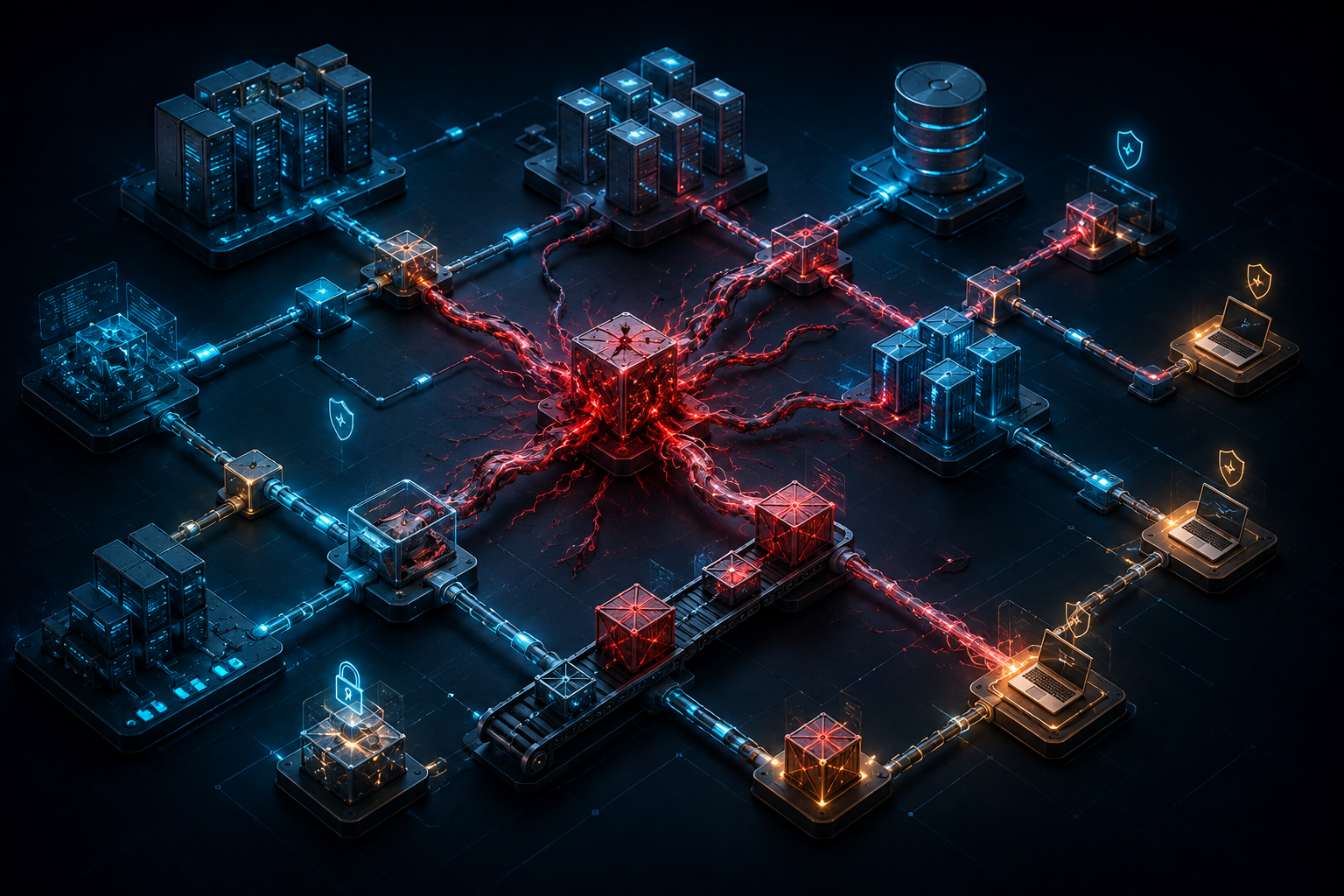
Figure: The Detection-to-Containment Decision Flow
An anomaly signal from SBOM monitoring or build-behavior baselining triggers automatic quarantine of the affected artifact, a scoped credential rotation limited to the build job’s blast radius, and a provenance re-check across every downstream deployment that consumed the same artifact hash, before any human is paged for manual investigation.
Containment Patterns: Limiting Blast Radius Once Compromise Is Confirmed
Blast-Radius Mapping Before You Need It
Containment speed depends entirely on whether you already know, before an incident starts, exactly which services, environments, and credentials touch a given component. Teams that only build this map during an active incident lose hours re-deriving basic facts: which running containers use image X, which build jobs published artifact Y, which secrets that build job had access to. A living dependency graph tied to your SBOM data turns this into a query instead of an investigation.
Scoped Credential Rotation
Rather than rotating every secret in the organization, effective containment rotates only the credentials scoped to the compromised build job, pipeline, or service account, then expands outward only as evidence justifies it. Overly broad rotation both slows recovery and creates its own outage risk; overly narrow rotation leaves the attacker’s foothold intact. The right scope is derived directly from the blast-radius map, not guessed under pressure.
Quarantine, Not Deletion
Compromised artifacts should be quarantined, tagged, and preserved for forensic analysis rather than immediately deleted. Deleting the evidence destroys your ability to understand how deep the compromise went, what else it touched, and whether the same technique is present elsewhere in your environment.
Rebuild From Known-Good, Not Patch-in-Place
Once a build-system compromise is confirmed, the safest recovery path is to rebuild affected artifacts from a known-good, isolated environment rather than attempting to “clean” the existing compromised pipeline. Attackers who achieved build-system access frequently leave more than one foothold, and a partial cleanup that misses a secondary persistence mechanism simply resets the clock on the same intrusion.
| Containment Phase | Primary Action | Owner | Target Time |
|---|---|---|---|
| Detection confirmed | Quarantine artifact, freeze affected pipeline | Security operations | Under 15 minutes |
| Scoping | Query blast-radius map, identify all consumers of the artifact hash | Platform engineering | Under 1 hour |
| Credential response | Rotate scoped secrets tied to affected build job | Security operations plus platform engineering | Under 2 hours |
| Recovery | Rebuild from known-good source in isolated environment | Engineering owning team | Under 24 hours |
| Post-incident | Update detection baselines, publish internal advisory | Security engineering | Within 5 business days |
Building the Program: Where Most Teams Actually Start
- Generate SBOMs at every build, not just at release, and store them in a queryable central inventory tied to running deployments.
- Establish behavioral baselines for build pipelines, network calls, process spawning, secret access, before you need them for incident response.
- Require signed build attestations and verify provenance at deploy time, not just at publish time.
- Pre-build a blast-radius query capability so that “what else uses this component” is a lookup, not a war-room exercise.
- Practice scoped credential rotation in tabletop exercises so the team is not improvising scope decisions during a live incident.
- Treat your own security tooling, scanners, SBOM generators, signing services, as attack surface requiring the same monitoring as production applications.
- Maintainer trust decayA dependency vetted once at onboarding needs periodic reverification, since ownership and maintainer behavior can change long after initial approval.
- Tooling as attack surfaceSecurity scanners and SBOM generators hold broad access and are increasingly targeted directly rather than treated as trusted infrastructure.
- Dormant activation windowsMalicious code often waits weeks or months before activating, so a clean scan today does not guarantee a clean dependency tomorrow.
- Blast-radius pre-mappingKnowing which services consume a component before an incident starts is what separates a fifteen-minute containment from a multi-day one.
- Evidence preservationQuarantining a compromised artifact instead of deleting it preserves the forensic trail needed to find secondary footholds, and is the last item overlooked most often.
Common mistake
Treating a clean static scan as proof a dependency is safe, then never revisiting that verdict. Many of the most damaging compromises activate only after a delay of weeks or months, well after the package passed its initial review, so detection has to be continuous rather than a one-time gate at intake.
What worked
Teams that pre-built a queryable blast-radius map, tying SBOM data directly to running deployments, consistently cut containment time from days to hours during real incidents. The map turned “which services are affected” from an open investigation into a direct lookup, freeing the incident team to focus on rotation and rebuild instead of discovery.
Where This Fits With the Rest of Your Security Program
Supply chain detection and containment does not stand alone. It depends on solid CI/CD pipeline security practices to limit what a compromised build job can reach, on disciplined secrets management so scoped rotation is actually possible, and on mature SBOM implementation so the dependency inventory this whole approach relies on actually exists and stays current. It also overlaps heavily with dependency confusion and typosquatting defence, since several of the attack patterns above are variants of the same underlying trust exploitation, and with firmware and hardware supply chain integrity for teams whose blast radius extends below the application layer. If your program also touches infrastructure definitions, the scanning approach in infrastructure as code security scanning uses many of the same pre-deployment gating principles described here.
Glossary
- SBOM (Software Bill of Materials)
- A structured inventory of every component, library, and dependency that makes up a software artifact, used to trace exposure when a new vulnerability or malicious package is disclosed.
- Blast radius
- The full set of services, environments, credentials, and deployments that could be affected by a given compromised component or credential.
- Provenance attestation
- A signed record proving that an artifact was produced by a specific, verified build process from a specific source commit, used to detect tampering even when a valid-looking signature is present.
- Dependency confusion
- An attack technique where a public package is published under the same name as an internal private package, tricking package managers into pulling the attacker-controlled public version instead.
- Typosquatting
- Publishing a malicious package under a name deliberately similar to a popular legitimate package, relying on developer typos or automated install mistakes.
Key Takeaways
- Software supply chain attacks exploit inherited trust between systems, so detection has to look at behavior and provenance, not just static package content.
- Compromised dependencies, build-system compromise, and malicious package publishing are distinct patterns that each need a different detection signal.
- SBOMs only work as a detection tool when they are generated continuously and cross-checked against new disclosures in real time.
- Behavioral anomaly detection in build pipelines catches dormant malicious code that static scanning misses entirely.
- Security tooling itself, scanners, SBOM generators, signing services, is now a direct attack target and needs its own monitoring.
- Pre-mapped blast radius is the single biggest factor separating fast containment from a multi-day incident.
- Recovery should rebuild from known-good sources rather than patch a potentially still-compromised pipeline in place.
FAQs
What is a software supply chain attack?
A software supply chain attack compromises a trusted upstream component, a dependency, build tool, or package registry entry, so that malicious code reaches an organization indirectly through software it already trusts, rather than through a direct attack on its own systems or network perimeter.
How is a supply chain attack different from a typical malware infection?
A typical infection targets one system directly, while a supply chain attack targets a shared upstream component so that a single compromise propagates automatically to every downstream consumer of that component, often reaching far more organizations with far less individual effort from the attacker.
Can antivirus software detect a compromised dependency?
Rarely on its own, because malicious code in a dependency often stays dormant until it runs inside a specific build or production context, meaning it never triggers signature-based detection on a developer’s endpoint and requires pipeline-level and behavioral monitoring instead.
What is the role of an SBOM in detecting these attacks?
An SBOM provides a complete, current inventory of every component in a deployed artifact, so when a new vulnerability or malicious package is disclosed anywhere in the ecosystem, security teams can immediately identify every affected service without manually auditing dependency lists.
What does blast-radius containment mean in practice?
It means isolating exactly the services, credentials, and environments that a confirmed compromise could reach, based on a pre-built dependency map, rather than either ignoring the scope question or over-rotating every credential in the organization out of caution.
Why do attackers target build systems instead of applications directly?
Build systems typically hold broad credentials such as deployment keys, registry publish tokens, and signing keys, making a single compromise there far more valuable than compromising one application, since it can taint every artifact that pipeline produces afterward.
What is dependency confusion and how is it prevented?
Dependency confusion tricks a package manager into pulling a public, attacker-controlled package instead of an internal private package with the same name, and is prevented by scoping internal package namespaces, pinning exact registry sources, and blocking public registry fallback for internal package names.
How quickly should a confirmed supply chain compromise be contained?
Leading teams quarantine the affected artifact within fifteen minutes of confirmation, complete blast-radius scoping within an hour, and finish scoped credential rotation within two hours, with full rebuild and recovery from known-good sources completed within twenty-four hours.
- Torq, “2026 Supply Chain Attack Prevention Strategies for Businesses,” torq.io
- Cloudsmith, “The 2026 Guide to Software Supply Chain Security: From Static SBOMs to Agentic Governance,” cloudsmith.com
- RedFoxSec, “Software Supply Chain Attacks 2026: Latest Incidents, Analysis, and How to Protect Your Pipeline,” redfoxsec.com
- ReversingLabs, “2026 Software Supply Chain Security Report,” reversinglabs.com
- Palo Alto Networks, “When Security Scanners Become the Weapon: Breaking Down the Trivy Supply Chain Attack,” paloaltonetworks.com
- Black Kite, “2026 Supply Chain Vulnerability Report,” blackkite.com
- Panorays, “Cyber Security Supply Chain Attacks: Navigating the 2026 Threat Landscape,” panorays.com