| Approach | What Changes Per User | What Stays Fixed |
|---|---|---|
| Static UI | Nothing | Layout, components, and content are identical for every user |
| Personalized content feed | Which content items appear and in what order | The underlying page layout, components, and navigation structure |
| Generative UI | The layout, component selection, and interaction pattern itself | Only the underlying design system and component library the AI draws from |
What Generative UI Actually Means
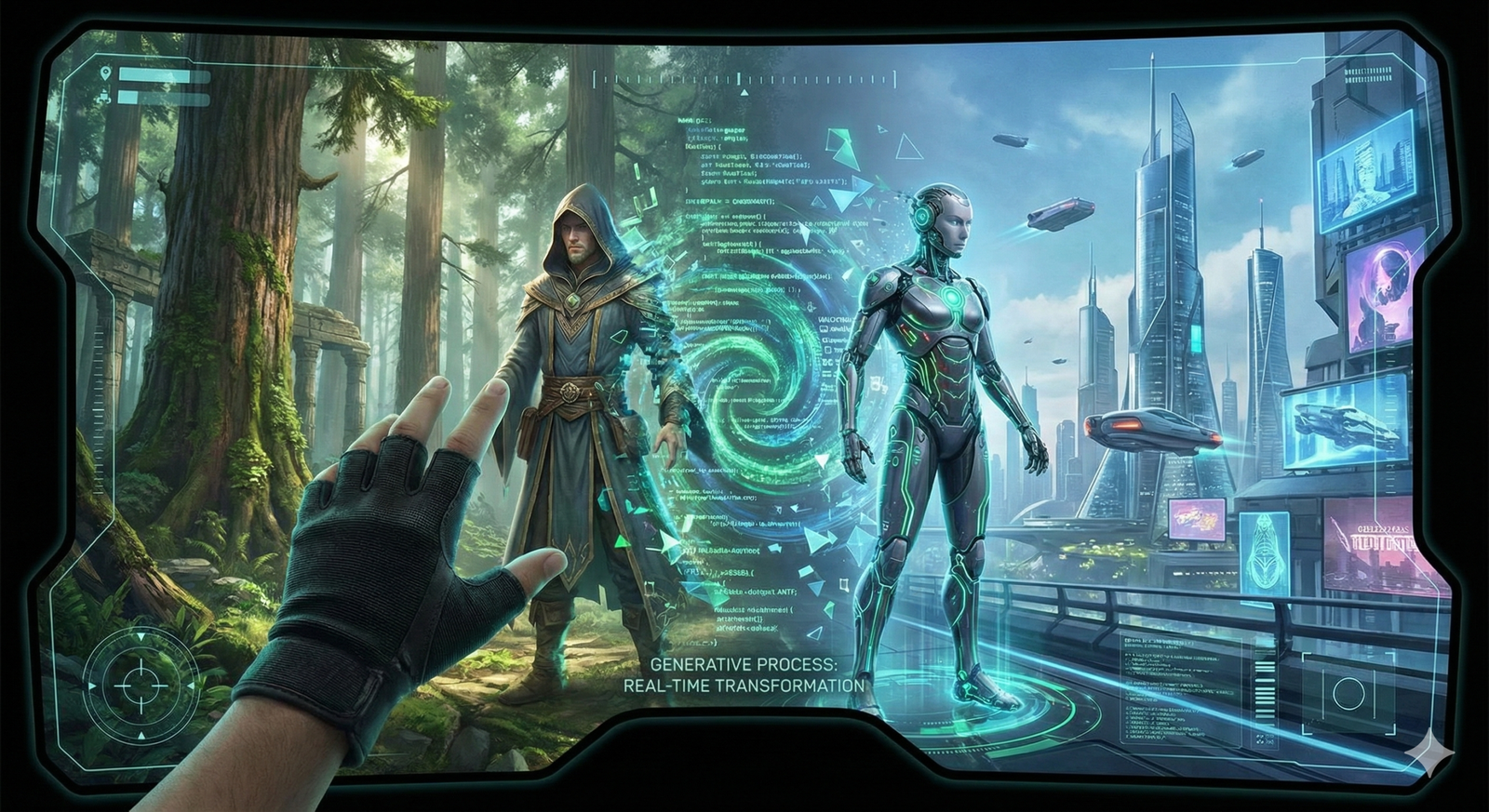
Generative UI describes interfaces that are not pre-designed and stored as a fixed set of screens, but instead assembled by an AI system at the moment a user needs them, based on that user’s specific intent, context, and task. This is a materially different concept from personalization as most people currently understand it. A personalized news feed changes which articles appear and in what order, but the page itself, its layout, its navigation bar, its component structure, is identical for every user. Generative UI instead changes the structure itself: for one user’s request, the system might render a data table and a filter panel; for a differently phrased request carrying a different underlying intent, it might render a multi-step form or a chart, because the AI has determined that a different arrangement of components better serves what that specific user is trying to do at that specific moment.
The clearest way to state the distinction: personalization swaps content inside a fixed shell. Generative UI builds a different shell.
How LLM-Driven UI Generation Works Technically
The dominant technical pattern pairs a language model with tool calling, where the model is given access to a defined set of functions that each correspond to a renderable UI component, such as a chart, a form, a table, or a confirmation dialog, rather than being asked to generate raw interface code from scratch on every request. When a user expresses an intent, the model selects which of those defined components are relevant, populates them with the appropriate data or fields, and the resulting structured output is streamed to the client and rendered as an actual interactive interface rather than a block of static text.
Vercel’s AI SDK is a widely cited reference implementation of this pattern: it lets a model call tools that map to actual interface components, streaming those components from the server to the client using a framework capability that allows rendering to begin before the full response is complete. The result is a chat-like interaction that produces a genuine, functioning interface component, such as a live chart or booking form, instead of a text description of one. This tool-calling-to-component approach is currently the most production-mature version of generative UI, precisely because it constrains the AI to a known, pre-vetted set of components rather than asking it to invent arbitrary interface code, which would carry much higher risk of broken or unusable output.
| Technical Layer | Role in Generative UI | Maturity in 2026 |
|---|---|---|
| Intent interpretation | Determines what the user is actually trying to accomplish from their input | Reasonably mature for narrow, well-scoped domains |
| Component tool-calling | Maps interpreted intent to a defined set of pre-built, renderable components | Most production-ready layer, used in shipped products today |
| Full layout generation from scratch | AI generates arbitrary new interface code or structure with no fixed component set | Early-stage and largely experimental, high failure risk |
| Streaming render | Delivers generated UI to the client incrementally rather than all at once | Mature, supported by mainstream frontend frameworks |
Where This Is Real Production Use Versus Early-Stage Experimentation
It is important to be direct about where the hype outpaces deployed reality. The most production-mature form of generative UI today is the constrained, tool-calling variety: an AI agent selecting from a defined, pre-approved set of components, such as inside developer tools, internal enterprise dashboards, and AI coding assistants that render forms, tables, or charts as part of a conversational workflow. This pattern is genuinely shipping in real products used by real customers right now.
The more ambitious version, where an AI generates an entirely novel interface structure from scratch with no fixed component library constraining it, remains substantially earlier-stage. Industry analysis projecting that a meaningful share of new applications will use some form of AI-driven adaptive interface by 2026 is describing a broad category that includes the more conservative tool-calling pattern, not primarily fully free-form interface generation. Full free-form generation faces real unresolved problems: accessibility compliance is much harder to guarantee when the interface structure itself is unpredictable, consistent design-system adherence is difficult to enforce on generated layouts, and testing an interface that is different for every user is a fundamentally harder quality assurance problem than testing a fixed set of screens.
The Generative UI Maturity Spectrum
At one end sits static UI with fixed layouts and content, currently the overwhelming majority of production software. In the middle sits component-level generative UI, where an AI selects and populates from a defined library of pre-built components based on user intent, the pattern most shipped products actually use today. At the far end sits fully free-form generative UI, where an AI constructs interface structure from scratch with no fixed component constraints, a pattern still largely confined to research demos and early internal experiments rather than mainstream consumer products.
Why Enterprises Are Interested Despite the Immaturity
The business case for generative UI centers on a specific inefficiency in conventional software: most applications are built with a fixed set of screens designed to cover the most common user tasks, which means less common or more complex tasks are often forced through an interface that was not really designed for them, requiring users to navigate multiple disconnected screens or fall back to manual workarounds. A system that can assemble a purpose-built interface for a specific, less-common task on demand removes the need to pre-build and maintain a screen for every possible task combination in advance, which is particularly attractive for internal enterprise tools and data-heavy dashboards where the space of possible user queries is large and unpredictable, but the underlying data and component library is well understood and controllable.
This also explains why the tool-calling pattern, not full free-form generation, is where real adoption is concentrated: enterprises can tolerate an AI assembling a novel combination of existing, pre-tested components far more comfortably than they can tolerate an AI writing genuinely new, unreviewed interface code that ships directly to users.
Common mistake
Treating a personalized content feed or a dynamically reordered dashboard as an example of generative UI. If the underlying layout, components, and navigation structure are identical for every user and only the content within them changes, that is personalization, not generative UI. Generative UI specifically requires the structure itself to be assembled differently per user or per task.
What worked
Teams that scoped their first generative UI implementation to a small, well-defined library of pre-built, pre-tested components, and let the AI choose and populate among them rather than generate arbitrary new layouts, shipped working production features faster and with far fewer accessibility and consistency problems than teams that attempted fully free-form interface generation from the outset.
Evaluating a Generative UI Claim or Vendor
- Ask directly whether the system changes interface structure and component selection, or only reorders and personalizes content within a fixed layout.
- Determine whether generation draws from a defined, pre-vetted component library or attempts genuinely free-form layout generation from scratch.
- Check how accessibility compliance is handled when the interface structure itself is not fixed and cannot be manually audited screen by screen.
- Ask how the system is tested, given that a traditional fixed test suite covering a known set of screens does not directly apply to dynamically assembled interfaces.
- Confirm whether the underlying design system’s visual consistency is enforced programmatically or left to the model’s own judgment.
A Practical Adoption Path
- Start with a narrow, well-scoped internal tool where the space of user tasks is large but the underlying data and component library is fully understood.
- Build a defined, pre-tested set of components the AI can select from, rather than attempting free-form generation immediately.
- Add intent interpretation on top of that fixed component library, so the AI’s job is component selection and population, not code generation.
- Instrument the system to log which components get selected for which intents, building a feedback loop for improving the selection logic over time.
- Only consider expanding toward more open-ended generation once the constrained version has a strong track record in production.
- Structural personalizationChanging the layout and component selection of an interface itself, as opposed to only the content displayed within a fixed layout.
- Component tool-callingA pattern where a language model selects and populates from a defined set of pre-built, renderable interface components rather than generating raw interface code.
- Streaming renderDelivering a generated interface to the client incrementally as it is produced, rather than waiting for the entire response to complete.
- Design-system adherenceThe degree to which AI-assembled interface output stays visually and structurally consistent with an organization’s established design standards.
- Free-form layout generationAn AI constructing interface structure from scratch with no fixed component library constraining it, currently the least production-mature form of generative UI.
Glossary
- Generative UI
- An approach in which an AI system assembles the structure of a user interface, including layout and component selection, at runtime based on a specific user’s intent, rather than serving a pre-designed fixed screen.
- Tool calling
- A technique where a language model invokes predefined functions, in this context functions that each render a specific UI component, based on its interpretation of a user’s request.
- React Server Components
- A frontend architecture pattern that allows components to be rendered on the server and streamed to the client, used as the underlying delivery mechanism in several generative UI implementations.
- Adaptive interface
- A broader industry term covering any interface that changes based on user behavior or context, of which generative UI is the most structurally dynamic subtype.
- Intent interpretation
- The process by which a system determines what a user is actually trying to accomplish from their input, used to select which components a generative UI system should render.
Key Takeaways
- Generative UI assembles the actual structure of an interface at runtime, unlike personalization, which only changes content within a fixed layout.
- The dominant production pattern pairs a language model with tool calling against a defined, pre-built component library, not free-form code generation.
- Frameworks like Vercel’s AI SDK demonstrate this pattern by streaming AI-selected components directly to the client as functioning interface elements.
- Fully free-form generative UI, with no fixed component constraints, remains early-stage and faces real accessibility and testing challenges.
- Enterprises are adopting generative UI first in internal tools and dashboards where task variety is high but the component library is well understood.
- Evaluating a generative UI claim requires checking whether structure itself changes, not just displayed content.
- A narrow, component-constrained pilot is the more reliable adoption path than attempting fully open-ended interface generation from the start.
FAQs
What is generative UI in simple terms?
Generative UI is when an AI system builds the actual structure of an interface, such as its layout and which components appear, at the moment a user needs it, based on that user’s specific goal, rather than showing everyone the same pre-designed screen with different content swapped in.
How is generative UI different from personalized content feeds?
A personalized content feed changes which items appear and in what order within a fixed page layout that is identical for every user. Generative UI changes the layout and component structure itself, meaning two users can be shown genuinely different interface arrangements for the same underlying task.
How does an AI actually generate a working interface?
The dominant technical pattern uses tool calling, where a language model selects from a defined set of functions that each correspond to a pre-built, renderable component, such as a chart or form, populates them with relevant data, and streams the result to the client as an actual functioning interface.
Is generative UI actually used in production today?
The constrained, component-based version is genuinely used in production, particularly in developer tools, internal dashboards, and AI coding assistants. Fully free-form interface generation with no fixed component library remains substantially earlier-stage and largely experimental.
What is Vercel’s AI SDK’s role in generative UI?
Vercel’s AI SDK is a widely cited reference implementation that lets a language model call tools mapped to actual interface components, streaming those components from server to client using React Server Components, producing a functioning interface element rather than a text description of one.
Why isn’t fully free-form generative UI more widely deployed yet?
Free-form generation faces real unresolved problems, including difficulty guaranteeing accessibility compliance for unpredictable structures, enforcing consistent design-system adherence, and testing an interface that differs for every user rather than a fixed, auditable set of screens.
Where are enterprises adopting generative UI first?
Adoption is concentrated in internal enterprise tools and data-heavy dashboards, where the range of possible user tasks is large and unpredictable but the underlying data and component library is well understood and can be safely constrained.
How should a team evaluate whether a generative UI vendor claim is real?
Ask whether the system changes interface structure itself or only reorders content in a fixed layout, whether generation draws from a pre-vetted component library or free-form code, and how accessibility and testing are handled given the interface is not fixed across users.
References
- Vercel, “Introducing AI SDK 3.0 With Generative UI Support”
- Vercel, “Introducing Vercel AI SDK 3.2”
- Vercel Academy, “Multi-Step and Generative UI”
- Eleken, “Inside Generative UI in 2026: Examples, Use Cases, and Future Trends”
- ZeeFrames, “Generative UI 2026: Interfaces That Build Themselves Around Each User”
- Very Good Ventures, “Generative UI (GenUI) for Enterprise: The Complete Guide”
The retrieval systems that supply context for these AI-driven decisions are covered in RAG architecture in 2027, and related workflow considerations appear in generative AI workflows for design teams. The distinction between structural adaptation and content personalization is explored further in personalised media. Interactive systems that generate content live in response to user input share technical ground with interactive narrative engines, while provenance and training-data questions for AI-generated interface code are covered in AI content provenance and copyright and training data.