
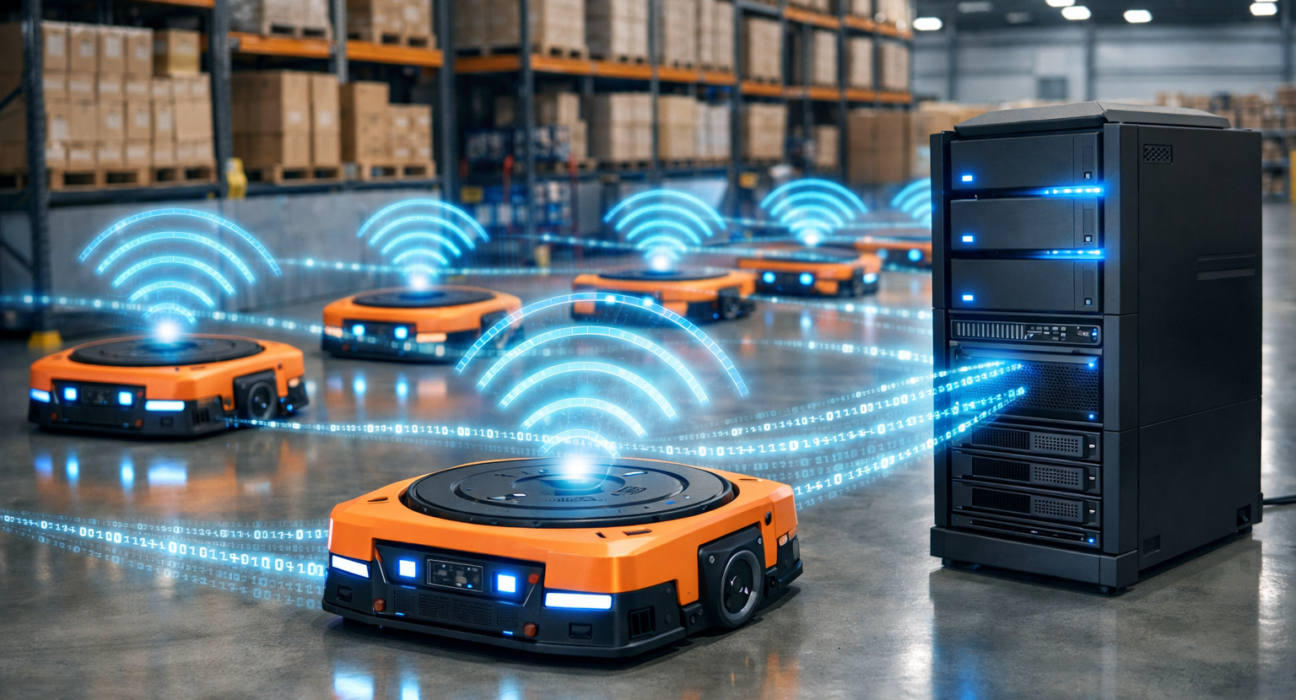
As of March 2026, the industrial landscape has reached a definitive tipping point. The “pilot phase” of digital transformation is over. Today, the efficiency of a warehouse, a manufacturing plant, or a port is no longer measured solely by the speed of its individual machines, but by the orchestration of its entire robot fleet.
Robot fleet orchestration is the centralized management and coordination of multiple autonomous mobile robots (AMRs) and automated guided vehicles (AGVs) to work as a unified system. While the robots themselves have become smarter through Agentic AI and advanced computer vision, their ability to work together depends entirely on the “nervous system” that connects them. That nervous system is 5G.
Key Takeaways
- Sub-1ms Latency: 5G’s Ultra-Reliable Low-Latency Communication (URLLC) allows robots to react to environmental changes in near real-time, preventing collisions and optimizing paths.
- Network Slicing: Enterprises can now reserve dedicated “slices” of their 5G network for critical robot traffic, ensuring that a surge in office data doesn’t slow down the factory floor.
- MEC Integration: Multi-access Edge Computing (MEC) moves the “brain” of the robot to the edge of the network, reducing the weight and cost of individual units while increasing collective intelligence.
- Massive Connectivity: 5G supports up to 1 million devices per square kilometer, enabling massive swarm deployments that were physically impossible under Wi-Fi or 4G.
Who This Is For
This guide is designed for Operations Managers, Industrial Engineers, and CTOs who are tasked with scaling robotic deployments from 10 units to 1,000. Whether you are in logistics, smart manufacturing, or large-scale agriculture, understanding the interplay between 5G protocols and robotic middleware is essential for staying competitive in 2026.
1. The Technical Foundation: Why 5G is Different
In previous years, fleet managers struggled with the limitations of Wi-Fi 6 or 4G LTE. These technologies were designed for “best-effort” delivery—meaning they try their best to deliver data, but they don’t guarantee it. In a robot fleet orchestration environment, “best-effort” is a safety hazard.
5G, specifically under the 3GPP Release 18 (5G-Advanced) standards active in 2026, introduces three core pillars that solve the orchestration puzzle:
URLLC (Ultra-Reliable Low-Latency Communication)
This is the most critical feature for robotics. URLLC ensures that data packets are delivered with 99.9999% reliability and a latency of less than $1 \text{ms}$ over the air. In practical terms, this means if a human walks into the path of an AMR moving at $2 \text{m/s}$, the robot receives the “stop” command from the orchestrator before it has traveled even $2 \text{mm}$.
mMTC (Massive Machine-Type Communications)
Previous networks would “choke” when too many devices tried to connect to a single access point. 5G’s mMTC allows for a density of $10^6$ devices per $km^2$. This is vital for “Lighthouse Factories” where thousands of small sensors, actuators, and robots all need to talk to the same control center simultaneously.
eMBB (Enhanced Mobile Broadband)
While orchestration commands are small data packets, robots also need to stream high-definition video for teleoperation and 3D LiDAR data for mapping. eMBB provides the throughput (up to $10 \text{Gbps}$) necessary to handle these “fat” data streams without interfering with the critical control signals.
2. Network Slicing: The Secret to Guaranteed Performance
One of the most common mistakes companies made in the early 2020s was running their entire facility on a single wireless network. When the marketing department uploaded a 4K video, the robots in the warehouse would “lag.”
In 2026, Network Slicing has become the industry standard for 5G Robot Fleet Orchestration. Slicing allows a single physical 5G infrastructure to be partitioned into multiple virtual networks.
| Slice Type | Priority | Use Case | Target Latency |
| Safety Slice | Critical | Emergency stops, collision avoidance | $< 1 \text{ms}$ |
| Control Slice | High | Path planning, task assignment | $5\text{–}10 \text{ms}$ |
| Video/Telemetry Slice | Medium | Remote monitoring, LiDAR streams | $20 \text{ms}$ |
| Guest/Office Slice | Low | Email, web browsing, VOIP | Best Effort |
By using “hard slicing” with Flexible Ethernet (FlexE), the industrial network is physically isolated. This means that even if the Guest Slice suffers a DDoS attack, the Safety Slice remains 100% operational. This level of deterministic performance is what makes 5G the only viable choice for high-stakes orchestration.
3. Multi-Access Edge Computing (MEC): Moving the Brain
Traditional robotics relied on “On-Board Intelligence.” Each robot had a powerful (and expensive) GPU to process its sensor data. While this worked for individual units, it made fleet orchestration difficult because each robot was essentially “thinking” for itself without knowing what others were doing.
MEC changes this dynamic by moving the computational power to the edge of the 5G network—typically a server rack located inside the same building as the robots.
Benefits of MEC-Based Orchestration:
- Lower Unit Cost: Robots no longer need massive on-board processors. They become “thin clients” that stream sensor data to the MEC and receive movement commands back.
- Global Optimization: Because the MEC “sees” the data from every robot simultaneously, it can perform swarm-level optimization. Instead of Robot A stopping to let Robot B pass, the MEC can adjust the speed of both robots so they cross paths without either one ever coming to a full stop.
- Data Sovereignty: Unlike cloud computing, MEC keeps all sensitive facility data on-site. As of March 2026, data privacy regulations (especially in the EU and North America) have made on-premise edge computing a legal necessity for many manufacturers.
4. Robot Fleet Orchestration Software: The “Conductor”
The 5G network is the wire; the Robot Management System (RMS) is the software that plays the music. In 2026, the leading orchestration platforms (like those from Amazon Robotics, Otto Motors, or specialized startups like Meili Robots) have fully integrated with 5G APIs.
The Role of the Orchestrator
The orchestrator acts as the “Air Traffic Control” for the facility. Its primary functions include:
- Traffic Management: Managing intersections and preventing deadlocks.
- Task Allocation: Deciding which robot is closest to a new picking order and has enough battery life to complete it.
- Interoperability: Managing a “heterogeneous fleet”—where robots from different manufacturers (e.g., a MiR AMR and a Fanuc arm) need to communicate.
API Integration and “Network-as-Code”
A major shift in 2026 is the use of Network APIs. Orchestration software can now programmatically “ask” the 5G network for more bandwidth or lower latency for a specific robot in real-time. For example, if a robot enters a high-risk “Human-Robot Collaboration Zone,” the orchestrator can trigger a temporary “Ultra-Low Latency” boost for that specific device via the 5G Core.
5. Case Study: Smart Warehousing and the 5G Leap
To understand the impact of 5G on orchestration, we can look at a mid-sized distribution center in the United States that transitioned from Wi-Fi to a Private 5G Network in early 2025.
The Challenge
The facility operated 150 AMRs using Wi-Fi 6. They faced three major issues:
- Handover Failures: As robots moved between Wi-Fi access points, they would lose connection for 200–500ms, causing them to “stutter” or trigger emergency stops.
- Blind Spots: Metal racking created “Faraday cages” where Wi-Fi signals couldn’t reach, leading to lost robots.
- Congestion: The 150 robots generated so much “chatter” that the network became saturated, increasing latency to $100 \text{ms}$.
The 5G Solution
The company replaced 120 Wi-Fi access points with just 8 Private 5G Small Cells.
The Results (As of March 2026)
- Throughput Increase: Fleet efficiency increased by 22% because robots no longer stopped during handovers.
- Reliability: Emergency stops due to “lost heartbeat” signals dropped from 50 per day to zero.
- Cost Savings: The reduction in hardware (8 cells vs. 120 APs) reduced maintenance costs by 40% annually.
6. Swarm Intelligence and V2X Communication
In 2026, we are seeing the rise of V2X (Vehicle-to-Everything) in industrial settings. While V2X is usually discussed in the context of self-driving cars on public roads, it is equally transformative for robot fleets.
5G enables robots to communicate directly with each other (Sidelink/PC5 interface) without going through the base station. This is known as Swarm Intelligence.
How Swarm Intelligence Works in a 5G Environment:
- Cooperative Perception: If Robot A sees an obstacle around a corner, it broadcasts that data directly to Robot B and Robot C. They can adjust their paths before their own sensors ever see the obstacle.
- Platooning: Robots can follow each other with mere centimeters of distance, effectively acting as a flexible “train.” This maximizes floor space and reduces energy consumption by optimizing drafting.
- Dynamic Load Balancing: If one robot’s sensor fails, it can “borrow” the visual data from a nearby robot to navigate safely to a repair station.
7. Security and Safety Protocols in 2026
With great connectivity comes great risk. A robot fleet is a collection of heavy, moving objects; if a bad actor gains control of the orchestrator, the results could be catastrophic.
5G Security Advantages
Unlike Wi-Fi, which relies on password-based authentication, 5G uses SIM-based authentication. Each robot has a physical or digital eSIM that provides hardware-level encryption.
Current Threats and Mitigations:
- Cross-Slice Attacks: As of 2026, researchers have identified theoretical vulnerabilities where a hacker could move from a low-security slice to a high-security one. To mitigate this, “Hard Slicing” using FlexE is mandatory for safety-critical systems.
- Side-Channel Exploitation: Hackers may try to analyze the power consumption or timing of 5G signals to gain information. The latest 5G-Advanced routers now include AI-driven anomaly detection that identifies these patterns instantly.
- Physical Tampering: Because 5G allows for fewer, more powerful access points, they can be placed in more secure, hard-to-reach locations compared to hundreds of Wi-Fi routers.
8. Implementation Roadmap: Transitioning to 5G Orchestration
Moving to a 5G-enabled fleet is a significant capital investment. Based on successful deployments in 2025 and early 2026, here is the recommended roadmap.
Phase 1: Site Audit and Spectrum Selection
You must decide between Public 5G (from a carrier like Verizon or Vodafone) and Private 5G. For fleet orchestration, Private 5G is almost always preferred due to the ability to control the spectrum and ensure 99.9999% uptime.
- CBRS (3.5 GHz): Popular in the US for private networks.
- n78 / n79 Bands: Common in Europe and Asia for industrial use.
Phase 2: MEC Integration
Don’t just install the 5G cells; install the Edge Compute nodes simultaneously. The orchestrator needs to live as close to the robots as possible to realize the $<1 \text{ms}$ latency benefits.
Phase 3: Hardware Retrofit or Refresh
Most robots built after 2024 are “5G-Ready.” For older fleets, you may need to install 5G industrial gateways. Ensure these gateways support 3GPP Release 16 or higher to enable URLLC features.
Phase 4: Slicing Configuration
Work with your network provider to define your slices. At a minimum, you need a Safety Slice (Priority 1) and a Management Slice (Priority 2).
9. Common Mistakes in Robot Fleet Orchestration
Even with the best technology, deployments can fail. Here are the “lessons learned” from the field as of March 2026:
- Mistake 1: Treating 5G Like “Faster Wi-Fi.” If you don’t use network slicing and MEC, you are just buying a faster pipe without the reliability. You won’t solve the orchestration problem.
- Mistake 2: Ignoring “Jitter.” Latency is the average delay; jitter is the variation in that delay. For robots, high jitter is worse than high latency. A robot can adapt to a constant $10 \text{ms}$ delay, but it cannot adapt if the delay jumps from $2 \text{ms}$ to $50 \text{ms}$ randomly.
- Mistake 3: Vendor Lock-in at the Orchestrator Level. Ensure your orchestration software is “Robot Agnostic.” The 5G network allows you to mix and match hardware; don’t let a proprietary software layer take that flexibility away.
- Mistake 4: Over-reliance on Public 5G. Public networks are subject to “congestion events” (e.g., a nearby stadium event). For 24/7 industrial operations, a Private 5G network is the only way to guarantee the SLA (Service Level Agreement).
10. The Future: Toward 6G and Beyond
While we are currently maximizing the potential of 5G-Advanced, the industry is already looking toward 2030 and 6G.
What to expect after 2026:
- THz Frequencies: 6G will move into the Terahertz range, allowing for “Joint Communication and Sensing.” The 5G signal itself will act like a radar, allowing the network to “see” objects even if they don’t have a sensor.
- AI-Native Air Interface: The 6G network will use Deep Learning to optimize signal beamforming for every individual robot, even in environments with massive metal interference.
- Global Haptic Control: We will move from simple orchestration to “Full-Immersion Telepresence,” where a technician in London can control a repair robot in a Tokyo factory with zero perceptible lag and full haptic (touch) feedback.
Conclusion
The role of 5G in real-time robot fleet orchestration is transformative. It is the difference between a collection of independent machines and a truly intelligent, synchronized system. By providing the deterministic latency, massive device density, and isolated network slices required for modern Industry 4.0, 5G has become the foundation of the autonomous world.
As of March 2026, the question is no longer if you should adopt 5G for your robot fleet, but how fast you can implement it. The competitive advantage goes to those who can orchestrate their assets with the highest precision and the lowest delay.
Your Next Steps:
- Conduct a Wireless Audit: Measure your current network’s latency, jitter, and dead zones under peak load.
- Evaluate Private 5G Vendors: Reach out to infrastructure providers (e.g., Nokia, Ericsson, Samsung) to discuss a proof-of-concept for a Private 5G “slice.”
- Audit Your Fleet: Determine which of your current robots can be retrofitted with 5G gateways and which will require a hardware refresh to meet 2026 safety standards.
FAQs
1. Can I use Wi-Fi 7 instead of 5G for robot orchestration?
While Wi-Fi 7 offers significant speed improvements and lower latency than Wi-Fi 6, it still operates in unlicensed spectrum. This means it is susceptible to interference from other devices. For mission-critical orchestration where safety and 100% uptime are required, 5G’s licensed spectrum and SIM-based security provide a level of reliability that Wi-Fi 7 cannot yet match.
2. Is 5G safe for human workers in a factory?
Yes. 5G signals used in industrial settings (Mid-band and mmWave) are non-ionizing radiation and fall well within international safety guidelines. Furthermore, 5G actually improves worker safety by enabling more reliable emergency stops and better “Cooperative Perception” between robots and humans.
3. How much does a Private 5G network cost in 2026?
Costs have decreased significantly since 2023. While still a major investment, many providers now offer “Network-as-a-Service” (NaaS) models, where you pay a monthly fee instead of a massive upfront capital expenditure. Small-scale industrial deployments can start at approximately $30,000 \text{–} $50,000 for hardware and installation, plus ongoing licensing.
4. What is the difference between 5G NSA and 5G SA for robotics?
5G Non-Standalone (NSA) uses a 4G core, which limits its ability to provide ultra-low latency and network slicing. 5G Standalone (SA) is the “true” 5G that uses a 5G core. For robot fleet orchestration, 5G SA is mandatory to access the URLLC and slicing features discussed in this article.
5. Do all robots in the fleet have to be from the same manufacturer?
No. Thanks to 5G-enabled orchestration platforms and standards like VDA 5050, you can run a heterogeneous fleet. The orchestrator acts as the universal translator, and the 5G network provides a common communication highway for all of them.
References
- 3GPP (2025). Release 18: The Global Standard for 5G-Advanced and Beyond. Official Technical Specifications. https://www.3gpp.org/specifications-technologies/releases/release-18
- Ericsson (2026). Mobility Report March 2026: The Rise of Industrial Private Networks. https://www.ericsson.com/en/reports-and-papers/mobility-report
- International Federation of Robotics (IFR). World Robotics Report 2025: Service Robots and the 5G Revolution. https://ifr.org/worldrobotics/
- Nokia Bell Labs (2025). Deterministic Wireless for Industry 4.0: Achieving 99.9999% Reliability. White Paper. https://www.bell-labs.com/research-innovation/
- IEEE Xplore (2024). Deep Reinforcement Learning for 5G-Enabled Swarm Robotics. Academic Journal of Communications. https://ieeexplore.ieee.org/
- GSMA (2026). 5G IoT Strategy: Scaling the Industrial Metaverse. Industry Report. https://www.gsma.com/iot/
- Amazon Science (2025). Large-Scale Multi-Agent Pathfinding in 5G-Connected Warehouses. https://www.amazon.science/
- VDA (Verband der Automobilindustrie). VDA 5050 – AGV-Communication Interface Standard. https://www.vda.de/en