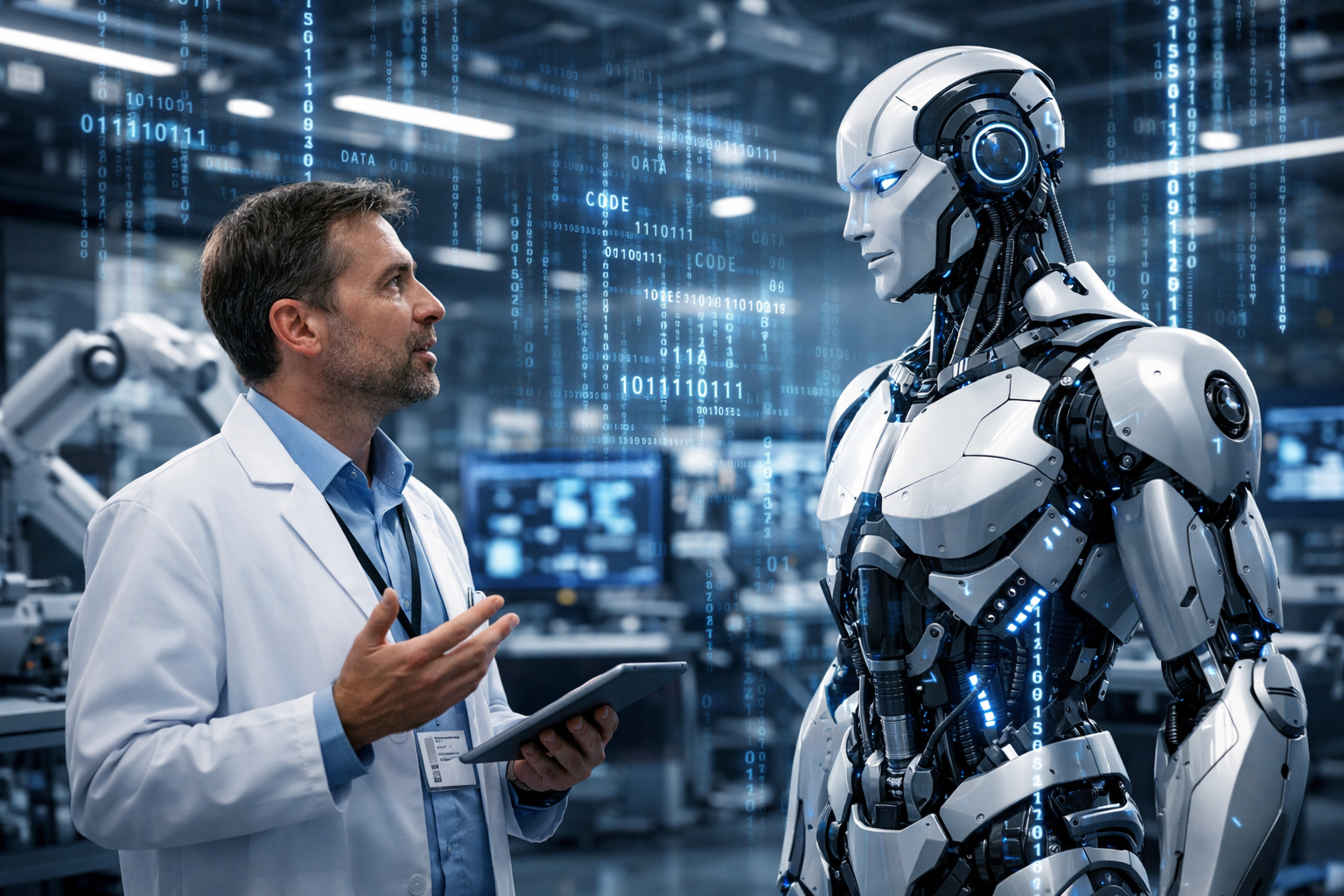
As of March 2026, the landscape of software engineering has undergone a seismic shift. We have moved past the era of manual syntax toward a paradigm often called “Vibe Coding.” While this term originated in the world of web development and app creation—referring to the process of using Large Language Models (LLMs) to generate code based on high-level intent rather than granular typing—it is now making an aggressive entry into the most physically demanding field of all: robotics.
In the traditional robotics lab, progress was measured in millimeters and C++ header files. Today, it is measured by the “vibe” of the instruction.
What is Vibe Coding in Robotics?
Vibe Coding in the context of robotics is the practice of using generative AI and natural language interfaces to orchestrate complex hardware behaviors. Instead of writing 500 lines of code to define a robot arm’s inverse kinematics for picking up a strawberry, a researcher describes the “vibe” of the movement: “Pick it up gently, like you’re handling an egg, and place it in the red bowl.” The underlying AI agents translate this fuzzy, human intent into precise motor voltages and joint trajectories.
Key Takeaways
- Abstraction Shift: Programming is moving from “How to move” to “What to achieve.”
- Speed of Iteration: Robotics startups are reducing prototyping times from months to days by bypassing manual driver configuration.
- The Rise of VLA Models: Vision-Language-Action models are the backbone of this movement, allowing robots to see, understand, and act via a single neural pipeline.
- Democratization: Non-engineers (domain experts in surgery, agriculture, or logistics) can now “program” robots using natural language.
Who This is For
This guide is designed for robotics engineers, AI researchers, CTOs of automation firms, and tech-forward hobbyists who want to understand how the “Vibe Coding” phenomenon is transitioning from the browser to the physical world.
The Evolution of the Robotics Stack: From Assembly to Intent
To understand why Vibe Coding is inevitable, we must look at where we started. For decades, robotics was the “boss level” of programming. You couldn’t just write code; you had to understand real-time operating systems (RTOS), signal processing, and the unforgiving laws of physics.
The Era of Manual Control (1960s–1990s)
In the early days, robots were programmed using teach pendants or low-level assembly. Every movement was a hard-coded coordinate. If you moved the robot’s base by one inch, the entire program broke.
The Middleware Revolution (2000s–2015)
The introduction of ROS (Robot Operating System) changed the game. It provided a standardized way for different parts of a robot (sensors, actuators, planners) to talk to each other. However, you still needed a Master’s degree in Robotics to make a robot navigate a room without hitting a wall.
The Vibe Coding Pivot (2023–Present)
With the explosion of models like GPT-4o, Gemini 1.5 Pro, and specialized robotics models like Google DeepMind’s RT-2, the “middleware” is becoming invisible. We are entering a phase where the “vibe” is the code.
Safety Disclaimer: Robotics involves heavy machinery and high-voltage systems. While Vibe Coding simplifies instructions, it does not replace the necessity for hardware safety interlocks, emergency stops (E-stops), and compliance with ISO 10218 standards. Always test AI-generated movements in a simulation environment (like NVIDIA Isaac Sim) before deploying to physical hardware.
The Mechanics of Vibe Coding: How Intent Becomes Action
How does a “vibe” actually turn into a 7-degree-of-freedom movement? This isn’t magic; it’s a sophisticated multi-layered architecture.
1. The Natural Language Interface
The process starts with a prompt. In a modern robotics lab, this might be a voice command or a typed instruction. The AI doesn’t just look for keywords; it uses Semantic Understanding to grasp the context of the environment.
2. Large Behavior Models (LBMs)
Just as LLMs are trained on text, LBMs are trained on “trajectories.” By consuming millions of hours of video data and robotic telemetry, these models learn the “vibe” of human movement. They understand that “cleaning a table” involves a specific circular motion and a certain amount of downward pressure.
3. Vision-Language-Action (VLA) Integration
The “Vibe” is nothing without “Vision.” Modern Vibe Coding environments use VLA models to close the loop.
- Vision: The robot sees the table and identifies a spill.
- Language: The robot understands the instruction “Clean that up.”
- Action: The model generates the specific motor commands to grab a sponge and wipe.
Why the Lab is Changing: Practical Benefits
The transition to Vibe Coding isn’t just a trend; it’s an economic and technical necessity.
Radical Reduction in Development Costs
In 2020, hiring a team to program a humanoid robot for a specific warehouse task could cost millions in R&D. Today, Vibe Coding allows a single engineer to “prompt” a foundation model to handle the task, using the model’s pre-existing knowledge of spatial reasoning.
Bridging the “Sim-to-Real” Gap
One of the biggest headaches in robotics is that code that works in a simulation often fails in the real world due to friction, lighting, or sensor noise. Vibe Coding handles this through Adaptive Inference. Because the AI is “vibing” (iterating based on visual feedback) rather than following a rigid script, it can adjust its grip in real-time if a surface is more slippery than expected.
Real-Time Problem Solving
Traditional robots are “brittle.” If a programmed path is blocked by a stray box, the robot stops and throws an error. A Vibe-Coded robot sees the box, understands the “vibe” of its mission is still “get to the dock,” and autonomously decides to walk around the obstacle.
The Role of Foundation Models: The “Brains” Behind the Vibe
You cannot have Vibe Coding without a powerful foundation model. As of 2026, several key players have emerged in the robotics space.
Google DeepMind (RT-Series)
The Robotics Transformer (RT) models were the first to demonstrate that a model trained on web-scale text and images could actually get better at picking up a toy dinosaur. These models provide the “common sense” that Vibe Coding relies on.
OpenAI and Figure
The partnership between OpenAI and Figure AI has led to robots that can have full-speed conversations while performing tasks. When the user says, “I’m hungry,” the robot doesn’t need a if_hungry_then_apple() function. It understands the vibe, identifies edible objects in the room, and offers one.
NVIDIA (Project GR00T)
NVIDIA provides the “foundry” for Vibe Coding. Their GR00T model is a general-purpose foundation model for humanoid robots, designed to understand natural language and emulate movements by watching humans.
Common Mistakes in Vibe-Driven Robotics
While Vibe Coding feels like a superpower, it is easy to get wrong. Here are the most frequent pitfalls observed in modern labs.
1. Over-Reliance on “Zero-Shot” Success
Many developers assume the robot will get the “vibe” perfectly the first time. In reality, Vibe Coding requires Iterative Prompting. You must watch the robot’s first attempt and refine the instruction: “A little more to the left, and don’t squeeze so hard.”
2. Ignoring Edge Cases
Natural language is often ambiguous. If you tell a robot to “Throw away the trash,” and there is a valuable document next to a crumpled soda can, a Vibe-Coded robot might make a catastrophic error in judgment.
3. Neglecting Latency
Vibe Coding often relies on cloud-based LLMs. In robotics, a 500ms delay in processing can be the difference between a successful catch and a broken sensor. Labs often fail to implement Edge Inference, where the “vibe” is processed locally on the robot’s hardware.
The Cultural Shift: From “Coder” to “Orchestrator”
The most significant change is the identity of the roboticist. We are seeing the rise of the “Robotics Orchestrator.”
The New Skillset
- Prompt Engineering for Kinematics: Learning how to describe physical space in a way that AI models understand.
- Behavioral Auditing: Instead of debugging lines of code, engineers now “audit” the robot’s behavior, looking for biases or inefficiencies in its movement.
- System Integration: The job is now about hooking up the right sensors to the right “vibe” engine.
Case Study: Warehouse Automation in 2026
Consider a mid-sized logistics firm. In 2022, they would have spent $500,000 on custom Python scripts to integrate a new sorting arm.
In 2026, they purchase an off-the-shelf arm with a Vibe Coding interface. The floor manager, who has no coding experience, stands in front of the robot and says:
“See these blue crates? Move them to the conveyor belt, but only if the label says ‘Priority.’ If the crate looks damaged, put it in the bin on my right.”
The robot’s VLA model identifies “blue crates,” reads the “Priority” text via OCR, and uses a depth camera to assess “damage” (dents or tears). The “coding” is done in thirty seconds.
Technical Deep Dive: The Architecture of a Vibe-Coded System
For the engineers reading this, here is how a Vibe Coding pipeline is typically structured in a 2026-era lab.
Layer 1: The Perception Engine
This layer uses Vision Transformers (ViTs) to turn raw camera feeds into a semantic map. It doesn’t just see pixels; it sees “objects with properties” (e.g., a “heavy, metallic wrench”).
Layer 2: The Reasoning Core (The “Vibe” Layer)
This is usually an LLM or a specialized LBM. It takes the natural language input and the semantic map to create a high-level plan.
- Input: “Hand me the tool for tightening this bolt.”
- Reasoning: “The user is holding a bolt. The appropriate tool is the wrench. The wrench is at coordinates [X, Y, Z].”
Layer 3: The Policy Network
This layer translates the high-level plan into low-level control. It outputs the specific joint torques needed. Most labs now use Diffusion Policies, which allow for smooth, non-robotic, fluid movements that look more like biological life than traditional machinery.
The Economics of Vibe Coding: ROI for Laboratories
Why are labs switching? Because the Return on Investment (ROI) is undeniable.
| Metric | Traditional Coding | Vibe Coding (2026) |
| Time to Deployment | 6–12 Months | 2–4 Weeks |
| Staffing Requirements | 5+ Specialized Engineers | 1 Orchestrator + 1 Domain Expert |
| Maintenance | High (Code rots, APIs change) | Low (Model improves over time) |
| Flexibility | Low (Single-task focused) | High (General-purpose) |
Future Outlook: Where the Vibe Takes Us
As we look toward 2030, Vibe Coding will likely evolve into Silent Vibe Coding. This involves Brain-Computer Interfaces (BCIs) or gesture-based intent, where the robot anticipates the “vibe” of what you need before you even speak.
We will also see the rise of Autonomous Lab Discovery. Robots will be given a “vibe” of a scientific goal—“Find a polymer that is 20% more heat resistant”—and they will autonomously code their own experiments, run them, and iterate on the results.
Conclusion: Embracing the “Fluid” Future
The arrival of Vibe Coding in the robotics lab marks the end of the “Mechanical Age” of software and the beginning of the “Biological Age.” For decades, we tried to force robots to think like computers—in 1s and 0s, in strict loops, and in rigid logic. We are finally realizing that for robots to succeed in a human world, they need to understand the world the way we do: through context, intent, and “vibes.”
For the researcher, this change is liberating. It removes the friction between a brilliant idea and a physical demonstration. It allows for a more inclusive laboratory where the ability to communicate a vision is just as important as the ability to debug a compiler.
However, this transition requires a new kind of responsibility. As we move away from readable, line-by-line code, we must become masters of AI Interpretability. We need to ensure that when we give a robot a “vibe,” we are also giving it a framework of safety and ethics that it cannot vibrate out of.
Next Steps for Your Lab:
- Audit your current stack: Identify which repetitive tasks can be replaced by a VLA model.
- Invest in Simulation: Before you “vibe” on your $100k hardware, ensure your team is proficient in NVIDIA Isaac Sim or similar digital twin environments.
- Cross-train your staff: Start moving your C++ developers toward prompt engineering and behavioral auditing.
The robots are ready to listen. The question is: do you know what vibe you want to set?
FAQs
What is the difference between Vibe Coding and No-Code?
No-code platforms usually rely on visual drag-and-drop interfaces with underlying rigid logic. Vibe Coding is much more fluid; it uses natural language and generative AI to create logic on the fly, allowing for much more complex and unscripted behaviors than traditional no-code tools.
Do I still need to learn Python or C++ for robotics?
Yes. While Vibe Coding handles the “high-level” behavior, the “low-level” drivers, safety protocols, and hardware optimizations still require traditional programming. Think of Vibe Coding as the steering wheel and Python/C++ as the engine.
Is Vibe Coding safe for industrial use?
As of March 2026, Vibe Coding is primarily used for task planning and rapid prototyping. In high-stakes industrial environments, the AI-generated “vibe” is usually passed through a “Safety Filter” (a piece of deterministic code) that ensures the robot cannot enter restricted zones or exceed speed limits.
Can Vibe Coding work on older robots?
Generally, yes, provided the robot supports ROS (Robot Operating System) or has an accessible API. The “vibe” is processed on a powerful computer (or the cloud) and then sent to the robot as standard coordinate commands.
How does Vibe Coding handle complex math?
The LLMs behind Vibe Coding are increasingly proficient at symbolic math and physics. If a task requires precise torque calculations, the model “calls” a physics engine tool to get the exact numbers, integrating the result back into its natural language plan.
References
- Google DeepMind (2023). RT-2: Vision-Language-Action Models Transferred to Real-World Control. [Official Research Portal]
- Andrej Karpathy (2024). The “Vibe Coding” Manifesto. [Personal Blog/Technical Keynote]
- NVIDIA Corporation (2025). Project GR00T: Foundation Models for Humanoid Robots. [NVIDIA Developer Docs]
- Stanford University (2024). The Sociology of Robotics: How Natural Language Changes the Lab Dynamic. [Stanford AI Lab (SAIL)]
- International Organization for Standardization. ISO 10218-1:2011 Robots and robotic devices — Safety requirements. [ISO Official Store]
- OpenAI (2024). Language Models as Robotic Planners. [OpenAI Research]
- Figure AI. Technical Specifications of Figure 01: The First AI Humanoid. [Corporate Documentation]
- IEEE Robotics & Automation Society. The Shift Toward Embodied Intelligence in Manufacturing. [IEEE Xplore]
- MIT CSAIL (2025). VoxPoser: Composable 3D Value Maps for Robotic Manipulation. [MIT Open Access]
- GitHub Next. Copilot for Robotics: Bridging the Text-to-Actuator Gap. [GitHub Engineering Blog]