
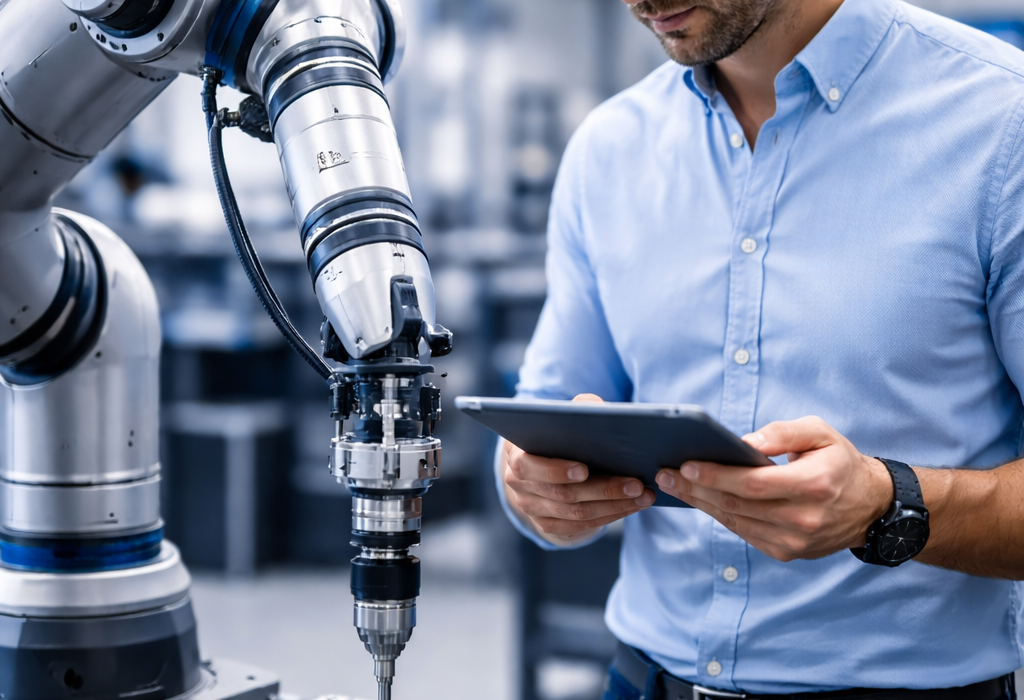
As of March 2026, the global industrial landscape is undergoing a transformation unlike any since the first assembly line. We are no longer merely “incorporating” machines; we are entering the era of Physical AI, where robotics and generative intelligence merge to create autonomous systems that perceive, reason, and act in the physical world. However, this rapid advancement has widened a chasm known as the “skills gap”—the disconnect between the high-tech capabilities of modern machinery and the current proficiency of the human workforce.
Definition and Context
The robotics skills gap refers to the shortage of workers who possess the multidisciplinary expertise required to design, program, maintain, and collaborate with advanced automated systems. This gap isn’t just about a lack of “coders”; it involves a scarcity of “mechatronics” experts—those who understand the intersection of mechanical engineering, electronics, and software—and “AI orchestrators” who can manage agentic workflows.
Key Takeaways
- The Shift to Physical AI: In 2026, robotics has moved from rigid, pre-programmed tasks to “Physical AI” agents that learn through simulation and real-world interaction.
- Human-Machine Collaboration: The focus is shifting from “replacement” to “augmentation.” Collaborative robots (cobots) are now workforce multipliers, not substitutes.
- Lifelong Learning is Mandatory: With 40% of job skills expected to change by 2030, continuous upskilling is the only way to maintain professional relevance.
- Soft Skills are the New Technical Skills: Creativity, ethical judgment, and complex problem-solving are becoming as valuable as Python proficiency.
Who This Is For
This guide is designed for manufacturing professionals looking to pivot their careers, HR leaders tasked with future-proofing their teams, students entering the STEM field, and policy makers aiming to understand the economic implications of the machine era. Whether you are a floor technician or a C-suite executive, understanding the roadmap for upskilling is essential for navigating the next decade of work.
1. The State of the Robotics Skills Gap in 2026
The “skills gap” is no longer a localized issue; it is a global economic bottleneck. According to the International Federation of Robotics (IFR) World Robotics 2025 report, global robot installations have surpassed 540,000 units annually, with a total operational stock exceeding 4.6 million. Despite this influx of hardware, nearly 63% of employers cite the lack of skilled talent as their primary barrier to digital transformation.
The Rise of Physical AI and Humanoids
The gap has been exacerbated by the transition from “Traditional Robotics” to Physical AI. In the past, industrial robots were “blind” and “deaf,” confined to safety cages and repeating the same motion a million times. In 2026, we are seeing the mainstreaming of Humanoid Labor and Agentic AI.
- Humanoids: Robots like those being piloted by Tesla, Figure, and Boston Dynamics are moving into “brownfield” facilities—factories designed for humans, not machines. Upskilling now requires understanding how to manage robots that navigate stairs, open doors, and interact with human tools.
- Agentic Workflows: We have moved beyond simple automation to autonomous systems. These robots don’t just follow a script; they use “Agentic AI” to detect an anomaly (like a vibrating sensor), schedule their own maintenance, and reroute production without human intervention.
The “Simulate-then-Procure” Paradigm
One of the most significant shifts in 2026 is the end of “CapEx guessing.” Companies now use Digital Twins—high-fidelity virtual replicas of their factories—to test every robot before it is even purchased. This has created a massive demand for “Simulation Engineers” who can bridge the gap between virtual testing and physical deployment (Sim-to-Real).
2. The Technical Toolkit: Hard Skills for the Automated Era
To close the skills gap, we must redefine what “technical proficiency” looks like. It is no longer enough to know how to grease a gear or write a line of C++. The 2026 technician must be a cross-disciplinary generalist.
The Mechatronics Foundation
Mechatronics remains the bedrock of robotics. It requires a balanced understanding of three domains:
- Mechanical Engineering: Understanding actuators, kinematics, and the physical limits of robotic joints.
- Electronics: Mastering sensors (LiDAR, tactile arrays, and “event-based” vision), power systems, and circuit troubleshooting.
- Software: Proficiency in the Robot Operating System (ROS 2), which has become the industry standard for robot middleware.
IT/OT Convergence
In 2026, the wall between Information Technology (IT) and Operational Technology (OT) has crumbled. A robotics professional must understand how a physical robot arm (OT) connects to the company’s cloud-based data analytics platform (IT).
- Key Skill: Data Literacy. Being able to interpret the terabytes of data a humanoid robot generates every hour to optimize cycle times and energy consumption.
Programming: Beyond the Basics
While “low-code” and “no-code” interfaces are making robots easier to use, deep technical roles still require:
- Python: The lingua franca of AI and robotics.
- C++: Critical for real-time control and high-performance applications.
- PLC Programming: Standard for industrial automation (e.g., Siemens TIA Portal, Rockwell Studio 5000).
3. The Cognitive Advantage: Why “Human” Skills Matter More Than Ever
A common mistake in the upskilling conversation is overemphasizing the “hard” skills while neglecting the “soft” ones. In an era where AI can write code and optimize schedules, the value of the human worker shifts toward judgment, ethics, and adaptability.
Creative Problem Solving
Robots excel at “closed” problems—tasks with a defined start, end, and set of rules. Humans excel at “open” problems. When a logistics robot in a warehouse encounters a spill it wasn’t programmed to recognize, it is the human supervisor who must decide whether to stop the line, divert traffic, or perform an emergency override.
Ethical Reasoning and AI Oversight
As robots move into healthcare and hospitality, the ethical implications of their actions become paramount.
- The “Human-in-the-Loop” Model: Humans are now the “orchestrators.” We set the intent (the “why”) while the machine handles the execution (the “how”). This requires a deep understanding of AI bias, safety protocols, and privacy regulations.
Resilience and Agility
The 2026 job market is volatile. A skill learned today may be automated by an AI agent tomorrow. Upskilling for robotics is less about mastering a specific tool and more about developing a growth mindset. The ability to unlearn old methods and rapidly adopt new ones is the most “future-proof” skill a worker can have.
4. Industry-Specific Roadmaps: Where the Demand Is
The skills gap looks different depending on the sector. If you are looking to upskill, you should target industries with the highest growth rates as of 2026.
| Industry | Current Robotic Trend | Required Skills to Learn |
| Logistics | Mobile Manipulation & Swarm Robotics | SLAM navigation, fleet management software, warehouse optimization. |
| Healthcare | Surgical & Rehabilitation Robots | Medical device regulation, tele-operation, bio-mechanics. |
| Manufacturing | Collaborative Robots (Cobots) | HMI (Human-Machine Interface) design, safety sensor integration. |
| Hospitality | Service Humanoids & Food Prep | Natural Language Processing (NLP), customer experience design. |
Case Study: Logistics and the Supply Chain
The “nearshoring” trend—bringing manufacturing closer to home—has led to a massive spike in robotic logistics. In these environments, workers are transitioning from “pickers” to “fleet managers.” Instead of walking 10 miles a day, they supervise a fleet of 50 Autonomous Mobile Robots (AMRs) via a digital dashboard.
Case Study: Healthcare and the Aging Population
With an aging global population, demand for “Medical Robots” has grown by over 90% since 2024. Upskilling in this sector requires a unique blend of empathy and technical precision. Nurses are now being trained to use robotic exoskeletons for patient lifting and AI diagnostics for early disease detection.
5. Educational Pathways: How to Upskill Effectively
The traditional four-year degree is no longer the only (or even the best) way to bridge the skills gap. In 2026, educational pathways are becoming modular, digital, and hands-on.
Micro-credentials and Bootcamps
Platforms like Coursera, Udacity, and specialized robotics bootcamps offer “Nano-degrees” in specific areas like “ROS 2 for Developers” or “AI in Manufacturing.” These are often co-developed with industry giants like Google, NVIDIA, or FANUC.
Apprenticeships and On-the-Job Training (OJT)
Forward-thinking companies are no longer waiting for the perfect candidate; they are building them.
- Robots-as-a-Service (RaaS): This business model allows small and medium enterprises (SMEs) to rent robots. Often, the RaaS provider includes “upskilling as a service,” training the company’s existing staff to operate the new hardware.
Simulation and VR Training
In 2026, you don’t need a $100,000 robot to learn how to program one. Tools like NVIDIA Isaac Sim or RoboDK allow learners to practice in a risk-free virtual environment. High-fidelity VR headsets now provide tactile feedback, allowing a technician in Kansas to “feel” the resistance of a robotic joint in a Tokyo factory.
6. Common Mistakes in Upskilling and Automation
Even with the best intentions, many individuals and organizations fail their upskilling initiatives. Here are the most frequent pitfalls to avoid:
- Ignoring the “Culture of Fear”: If employees think the robot is there to replace them, they will resist learning how to use it. Upskilling must start with a transparent conversation about job evolution, not just replacement.
- Focusing on Hardware, Ignoring Software: Many companies buy a state-of-the-art robot but fail to train their staff on the software needed to run it. In 2026, the “brain” of the robot is more important than its “body.”
- The “One-and-Done” Mentality: Upskilling is not a weekend seminar. It is a continuous process. Organizations must provide “learning time” during the work week to keep pace with technological shifts.
- Over-Automation: Automating a broken process only makes it break faster. Before upskilling for a specific task, evaluate if that task should even exist in its current form.
7. Safety and Ethical Considerations
Safety Disclaimer: Robotics involves high-voltage electricity, high-pressure hydraulics, and heavy moving parts. Always follow OSHA (or local equivalent) standards. Upskilling must include rigorous training in “Safety-Rated Monitored Stops” and “Hand Guiding” protocols.
The Ethics of Automation
As we close the skills gap, we must ensure the transition is equitable. There is a risk that the “digital divide” will grow, where high-skilled workers see their wages skyrocket while low-skilled workers are left behind.
- Inclusive Workforce Transformation: 2026 policies are increasingly focusing on “Universal Basic Skills”—ensuring every citizen has the digital literacy required to function in a machine-augmented world.
Data Privacy and Surveillance
Modern robots are essentially “roving cameras.” As of March 2026, new regulations (like the evolved EU AI Act) require robotics professionals to be well-versed in data anonymization and worker privacy rights. Upskilling now includes a legal and compliance component that was nonexistent a decade ago.
Conclusion: Stepping Into the Machine Era
The robotics skills gap is not a wall; it is an invitation. For the individual, it represents an opportunity to transition into high-paying, intellectually stimulating roles that leverage the best of human and machine capabilities. For the organization, it is the key to remaining competitive in a “nearshored,” high-speed global economy.
As we move deeper into 2026, the distinction between “blue-collar” and “white-collar” work is blurring into “new-collar” work. These roles require the technical savvy to troubleshoot a Physical AI agent and the human empathy to explain its benefits to a concerned customer.
The machine era is not coming; it is here. The question is no longer whether your job will change, but how quickly you can adapt to lead that change. By focusing on mechatronics, AI literacy, and the “human” advantage, you can bridge the gap and thrive in the most exciting era of human productivity in history.
Your Next Steps:
- Audit your current skill set: Where do you sit on the mechatronics spectrum?
- Start small: Enroll in an introductory ROS 2 or Python for Robotics course.
- Engage with simulation: Download a trial of a robot simulator and “get your hands dirty” in the virtual world.
- Advocate for OJT: If you are an employee, ask your manager about the company’s roadmap for robotic integration and available training funds.
FAQs
Q1: Do I need a degree in Engineering to work in robotics in 2026?
A: Not necessarily. While R&D roles still require advanced degrees, the “technician” and “operator” roles of 2026 are increasingly filled by people with specialized certifications, associate degrees, or military backgrounds. Practical experience and specific software certifications (like ROS or PLC) often carry more weight than a general degree.
Q2: Will AI eventually program the robots, making my upskilling obsolete?
A: Generative AI is already writing robot code, but it lacks the physical intuition and situational awareness of a human. AI will change how you program (moving from writing code to giving natural language instructions), but the need for a human to oversee, validate, and troubleshoot the system remains critical.
Q3: Is it too late to start upskilling if I’m mid-career?
A: Absolutely not. Mid-career professionals often have the “domain expertise” that young graduates lack. A factory floor veteran who understands why a process works is the perfect candidate to learn how to automate it. Your industry knowledge is your greatest asset.
Q4: What is the most important programming language to learn first?
A: Python. It is the bridge between the world of AI and the world of physical hardware. Its readability makes it the best starting point for those without a traditional computer science background.
Q5: How much does it cost to get certified in robotics?
A: As of 2026, costs vary widely. Online certifications can range from $50 to $500, while intensive bootcamps can cost between $5,000 and $15,000. Many employers now provide tuition reimbursement or internal training programs as part of their retention strategy.
References
- International Federation of Robotics (IFR). (2025). World Robotics Report 2025: Industrial Robots. Official Site
- World Economic Forum (WEF). (2025). The Future of Jobs Report 2025. WEF Publications
- Deloitte Insights. (2026). The Convergence of IT and OT in Industry 4.0. Deloitte Official
- McKinsey Global Institute. (2025). The State of AI in 2025: Year of the Agent. McKinsey.com
- IEEE Robotics and Automation Society. (2026). Standard for Human-Robot Collaboration and Safety. IEEE Xplore
- National Institute of Standards and Technology (NIST). (2026). Framework for Cyber-Physical Systems. NIST.gov
- MIT Task Force on the Work of the Future. (2025). Building a Robotics-Ready Workforce. MIT Workplace Center
- NVIDIA Research. (2026). Advances in Sim-to-Real Transfer for Physical AI. NVIDIA Developer