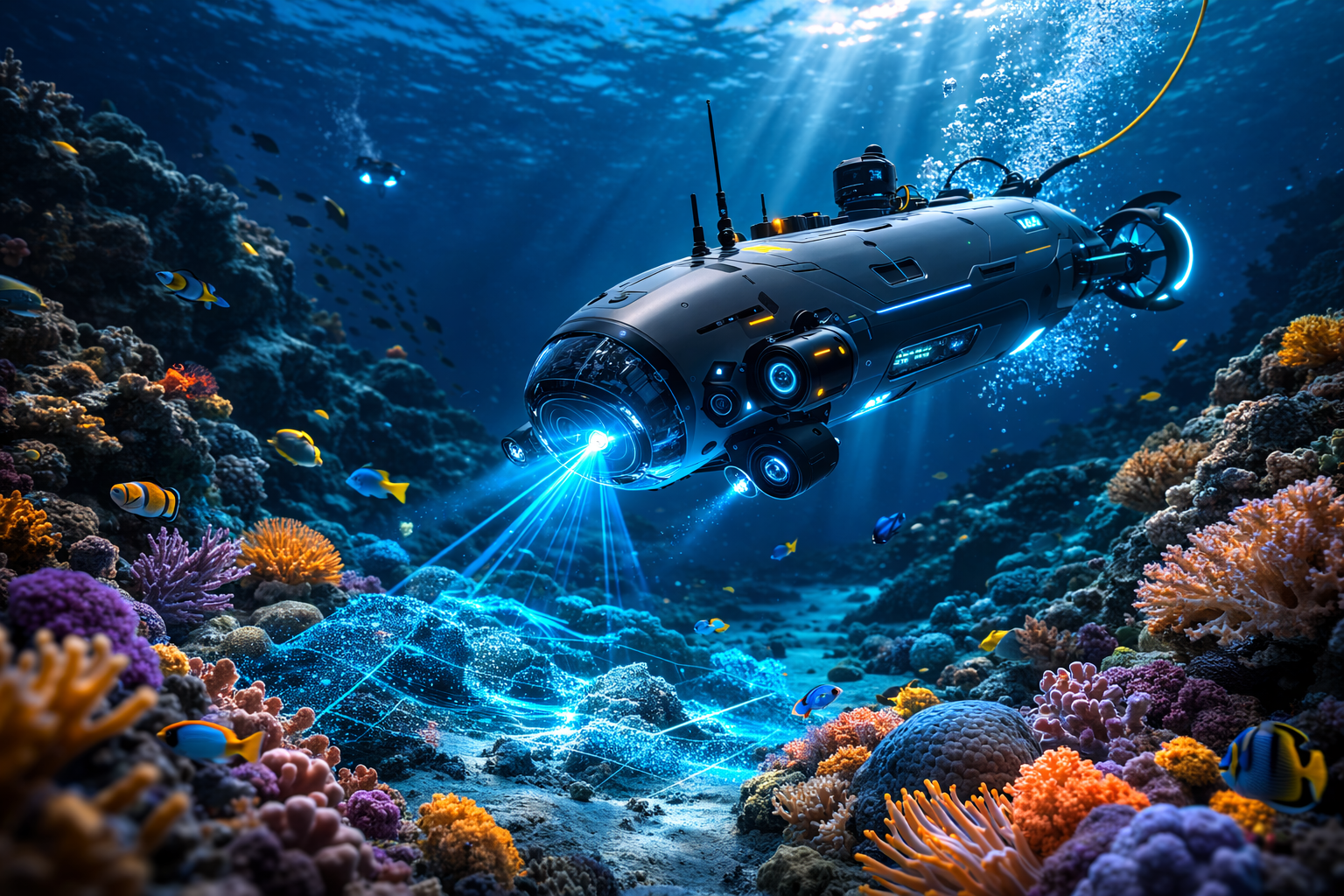
As of March 2026, the horizon of marine science is no longer defined by the limits of human divers or the tethered constraints of surface-controlled robots. We have entered the era of true subsea autonomy. Autonomous Underwater Vehicles (AUVs) have transitioned from experimental prototypes to the primary workhorses of global oceanography, archaeology, and environmental monitoring.
This article explores the cutting-edge technological shifts, the emerging “swarm” methodologies, and the persistent operational frameworks that are defining the future of Autonomous Underwater Vehicles research.
Key Takeaways
- AI Integration: Deep learning has replaced traditional rule-based logic, allowing AUVs to make real-time decisions in unstructured environments.
- Persistence is Priority: Subsea docking stations and wireless power transfer (WPT) now allow vehicles to remain submerged for months rather than hours.
- Swarm Intelligence: Collaborative fleets of small AUVs are outperforming single, large-scale platforms in mapping and search-and-rescue.
- The Blue Economy: AUVs are the critical link in scaling offshore renewable energy and monitoring carbon sequestration sites.
Who This Article Is For
This deep dive is designed for marine researchers, ocean engineers, defense analysts, and environmental policymakers seeking to understand the 2026-2030 trajectory of subsea robotics. Whether you are planning a decade-long longitudinal study of the Atlantic Meridional Overturning Circulation (AMOC) or developing subsea infrastructure for offshore wind, these insights provide the technical and strategic roadmap required for the next generation of underwater exploration.
Safety & Regulatory Disclaimer: Operations involving AUVs in deep-sea environments involve high-pressure systems and sensitive marine ecosystems. All deployments must adhere to the United Nations Convention on the Law of the Sea (UNCLOS) and local maritime safety protocols. For financial investments in subsea mining or energy, consult with specialized maritime legal counsel regarding evolving international seabed regulations as of 2026.
1. The Intelligence Shift: From “Automated” to “Autonomous”
Historically, AUVs followed pre-programmed waypoints. If the vehicle encountered an unexpected obstacle or a changing current, its only “intelligent” response was often to abort the mission and surface. In 2026, the paradigm has shifted toward cognitive autonomy.
Deep Learning and Real-Time Decision Making
Modern AUVs utilize Deep Reinforcement Learning (DRL) to navigate. Unlike older models, these vehicles “learn” through continuous interaction with their environment. By processing massive datasets from previous missions, an AUV can now identify a rare biological species or a structural crack in a pipeline and autonomously decide to circle back for high-resolution imaging without human intervention.
Underwater SLAM (Simultaneous Localization and Mapping)
Navigation in a GPS-denied environment remains the greatest hurdle for AUV research. The future lies in advanced SLAM algorithms that fuse data from:
- DVL (Doppler Velocity Log): Measuring velocity relative to the seafloor.
- INS (Inertial Navigation Systems): High-precision gyroscopes tracking orientation.
- Synthetic Aperture Sonar (SAS): Providing photographic-quality acoustic imagery.
The mathematical backbone of these systems often involves the Extended Kalman Filter (EKF), which estimates the state of the vehicle by minimizing the variance of the sensor noise. The state vector $x_k$ at time $k$ is represented as:
$$x_k = f(x_{k-1}, u_k) + w_k$$
where $u_k$ is the control input and $w_k$ represents the process noise. By 2026, neural-network-enhanced filters have significantly reduced “drift,” allowing AUVs to operate for hundreds of kilometers with sub-meter accuracy.
2. Swarm Robotics: The Strength of the Fleet
One of the most significant trends in Autonomous Underwater Vehicles research is the move away from “flagship” AUVs toward Underwater Swarms. Instead of one $5 million vehicle, researchers are deploying 50 units costing $100,000 each.
Advantages of Swarm Intelligence
- Redundancy: If one unit fails due to high pressure or hardware malfunction, the mission continues.
- Spatial Coverage: A swarm can map a square kilometer of the seabed in a fraction of the time it takes a single vehicle, using synchronized “mowing the lawn” patterns.
- Collaborative Sensing: By utilizing multi-static sonar, one AUV can emit a “ping” while five others listen for the return, creating a 3D acoustic map that is far more detailed than a single-source scan.
Digital Twins and Swarm Control
As of early 2026, researchers are using Digital Twin (DT) technology to manage these swarms. A virtual replica of the fleet exists in a surface cloud, updated in near-real-time via acoustic modems. This allows operators to run “what-if” simulations on the fly, optimizing the swarm’s pathing based on real-time current data and battery levels.
3. Power and Persistence: Breaking the 24-Hour Barrier
The “Achilles’ heel” of AUV research has always been battery life. Conventional lithium-ion packs typically provide 8 to 24 hours of mission time. The future of AUVs in 2026 is defined by persistence.
Subsea Docking Stations
The development of the PEARL (Platform for Expanding AUV exploRation to Longer ranges) and similar docking systems has revolutionized field research. These stations are anchored to the seabed or suspended from a buoy. When an AUV’s battery drops to 15%, it autonomously navigates to the dock, locks in using an electromagnetic latch, and begins wireless inductive charging.
Solid-State and Hydrogen Fuel Cells
While lithium-ion remains the standard, 2026 has seen the first successful deployments of solid-state batteries in deep-sea AUVs. These offer:
- Higher Energy Density: 2x the range in the same physical footprint.
- Safety: Reduced risk of thermal runaway in high-pressure environments.
- Longevity: More charge cycles before capacity degradation.
For ultra-long-range missions (e.g., crossing the Arctic Ocean under ice), Hydrogen Fuel Cell AUVs are now entering the market, providing endurance measured in weeks rather than days.
4. Communication Frontiers: The Data Bottleneck
Water is famously hostile to radio waves. In the past, this meant AUVs were “black boxes” until they surfaced. The future of communication in marine research is multi-modal.
Acoustic vs. Optical Comms
- Acoustic: Reliable over long distances (kilometers) but extremely low bandwidth (think 1990s dial-up speeds).
- Optical (Blue-Green Laser): Extremely high bandwidth (Mbps) but only over short distances (10–50 meters).
The emerging standard is a hybrid approach: AUVs use acoustic “pings” for status updates and navigation, but when they approach a docking station or a fellow swarm member, they switch to high-speed optical links to transfer gigabytes of 4K video and sonar data.
LEO Satellite Integration
Companies like Ocean Infinity and Fugro are now leveraging Low Earth Orbit (LEO) satellite constellations (like Starlink or Kuiper) to provide high-bandwidth links to surface vessels. When an AUV docks or surfaces, it can now offload data to the global cloud in minutes, allowing a scientist in Switzerland to analyze seabed samples from the Mariana Trench in near-real-time.
5. Major Research Frontiers
The application of AUVs is no longer limited to basic “mapping.” In 2026, they are the primary sensors for Earth’s most critical systems.
Ocean Acidification and Climate Change
AUVs equipped with ISFET (Ion-Sensitive Field-Effect Transistor) pH sensors are providing the first granular maps of ocean acidification. These vehicles can hover at specific depths to monitor the “saturation horizon” where calcium carbonate begins to dissolve, providing vital data for climate modeling.
Marine Bioacoustics and Biodiversity
“Silent” AUVs—those using buoyancy-driven gliders or ultra-quiet brushless motors—are being used to track whale migrations and monitor the health of coral reefs. By carrying sophisticated hydrophone arrays, these vehicles can identify individual species of marine life by their acoustic signatures, creating a “census of the sea” without the invasive noise of research ships.
Deep-Sea Geology and Seismology
The future of earthquake early-warning systems lies on the seafloor. AUVs are now being used to deploy and service Ocean Bottom Seismometers (OBS). Instead of expensive ship-based recovery, an AUV can navigate to a sensor, download its data via optical link, and even replace its battery, keeping the seismic network active for years.
6. Underwater Archaeology & Cultural Heritage
The “Golden Age” of shipwreck discovery has arrived, fueled by AUVs. In 2026, maritime archaeologists are using Long-Range AUVs (LRAUVs) to survey vast swaths of the seafloor that were previously inaccessible.
Photogrammetry and 3D Modeling
Using strobe-synced 4K cameras and laser profilers, AUVs can create millimeter-accurate 3D models of shipwrecks. This allows for “digital excavation,” where archaeologists can study a site in virtual reality without disturbing the physical remains.
Deep-Sea Search and Recovery
The 2026 AUV models are equipped with probabilistic search algorithms. If a plane goes missing or a historical wreck is suspected in a 1,000-square-mile area, the AUV doesn’t just scan; it calculates the “Probability of Containment” (POC) and focuses its sensors on high-probability anomalies, reducing search times by up to 70%.
7. The Blue Economy: Industry Meets Research
The distinction between “commercial” and “scientific” AUV research is blurring. The Blue Economy is a multi-trillion dollar sector that relies on the same data scientists need.
Offshore Wind and Renewables
By March 2026, the global shift toward offshore wind has created a massive demand for AUVs to inspect subsea cables and turbine foundations. These AUVs are now performing Contactless CP (Cathodic Protection) inspections, using sensors to detect corrosion without touching the structure.
Carbon Capture and Storage (CCS)
Monitoring subsea carbon storage sites is a legal requirement. AUVs are the only cost-effective way to patrol thousands of kilometers of seabed to detect CO2 leaks. They use Chemical Sniffers (mass spectrometers) to detect minute changes in dissolved gas concentrations.
8. Common Mistakes in AUV Deployment
Even with 2026 technology, subsea missions are fraught with risk. Learning from “common mistakes” is essential for any research team.
- Overestimating Acoustic Range: High-frequency noise from surface ships or biological activity (like snapping shrimp) can effectively “blind” an AUV’s communication.
- Neglecting Biofouling: In shallow, warm waters, algae and barnacles can cover sensors in weeks. Failing to use UV-C anti-fouling lights or specialized coatings leads to data degradation.
- Inadequate Buoyancy Calibration: Small changes in salinity (e.g., near an estuary) can turn a neutrally buoyant AUV into a “sinker” or a “floater,” stressing motors and draining batteries.
- Data Overload: Collecting terabytes of video is useless if you don’t have the edge-computing power to process it. Modern teams use “In-Situ Data Reduction,” where the AUV only saves high-interest frames.
9. Future Policy and Ethical Frameworks
As AUVs become more capable, the legal landscape is struggling to keep pace. As of 2026, several key ethical and policy questions remain at the forefront of the research community:
- Sovereignty and “Ghost” Drones: Who is responsible if an autonomous vehicle from Country A drifts into the territorial waters of Country B? The IMO (International Maritime Organization) is currently drafting the MASS (Maritime Autonomous Surface Ships) Code, which many believe will be extended to subsea vehicles.
- Environmental Impact: While AUVs are cleaner than ships, the loss of lithium batteries in the deep sea poses a localized toxic risk. “Biodegradable” AUV frames and non-toxic battery chemistries are active areas of research.
- Dual-Use Concerns: AUVs designed for “seabed mapping” can easily be repurposed for “underwater cable sabotage.” Transparency in scientific mission data is becoming a requirement for international research permits.
Conclusion: The Path Ahead
The future of Autonomous Underwater Vehicles research is a journey from the surface to the abyss, driven by a convergence of AI, energy density, and collaborative robotics. We are moving toward a “Transparent Ocean,” where the deep sea is as well-mapped and monitored as the lunar surface.
As of March 2026, the technology has matured to the point where the bottleneck is no longer the hardware—it is our ability to process the staggering volume of data these vehicles return. For the individual researcher or the large-scale institution, the next step is not just “buying an AUV,” but building the digital infrastructure to support it.
Next Steps for Researchers:
- Audit your data stack: Ensure your team is trained in Python and ROS (Robot Operating System) to handle the AI-driven data flows of modern platforms.
- Explore Swarm Options: Before investing in a single heavy-class AUV, evaluate if a fleet of micro-AUVs could provide better spatial coverage for your specific KPIs.
- Collaborate on Infrastructure: Join international consortia focusing on subsea docking standards to ensure your vehicles can “refuel” at global stations.
The deep ocean remains Earth’s last frontier, but with AUVs, it is a frontier that is finally coming into focus.
FAQs
1. What is the difference between an AUV and an ROV?
An ROV (Remotely Operated Vehicle) is tethered to a ship and controlled by a human operator in real-time. An AUV (Autonomous Underwater Vehicle) has no tether and follows an internal mission plan, making its own decisions via onboard computers.
2. Can AUVs communicate through the water in real-time?
Real-time communication is limited. While AUVs use acoustic modems to send small text-based status updates, they cannot stream high-definition video through water over long distances. High-speed data transfer usually happens when the vehicle is docked or on the surface.
3. How deep can current AUVs go?
In 2026, standard “Workclass” AUVs can reach 3,000 to 6,000 meters. Specialized “Hadalkit” vehicles are capable of reaching the bottom of the Mariana Trench (approx. 11,000 meters), though these are still considered “specialized research” platforms.
4. Are AUVs safe for the environment?
Generally, yes. They are electric and produce zero emissions during operation. However, “noise pollution” is a concern for marine mammals, and research is ongoing into “ultra-quiet” propulsion systems to minimize the impact on sensitive bio-acoustic environments.
5. What is the average cost of an AUV for research?
Prices vary wildly. Small, “portable” AUVs for shallow water can start at $50,000, while deep-sea, long-endurance platforms with high-end sonar suites (like the Kongsberg Hugin) can exceed $5 million.
References
- National Oceanic and Atmospheric Administration (NOAA): Strategic Plan for Unmanned Systems (2025-2030). [Link]
- Woods Hole Oceanographic Institution (WHOI): Autonomous Systems Lab – Future of Deep Sea Robotics (2026 Report). [Link]
- IEEE Oceanic Engineering Society: Review of Underwater Swarm Intelligence and Communication Latency. (January 2026). [Link]
- Kongsberg Maritime: HUGIN AUV Operational Manual & Tech Specs (2026 Edition). [Link]
- Monterey Bay Aquarium Research Institute (MBARI): Long-Range AUV (LRAUV) Environmental Impact Study. [Link]
- United Nations Division for Ocean Affairs: The Law of the Sea and Autonomous Undersea Vehicles (March 2026 Update). [Link]
- Oceanology International (Oi): 2026 Conference Proceedings on Subsea Docking and Wireless Power Transfer. [Link]
- Marine Technology Society (MTS): Standardization of Subsea Docking Interfaces for Multi-Vendor AUV Support. [Link]