
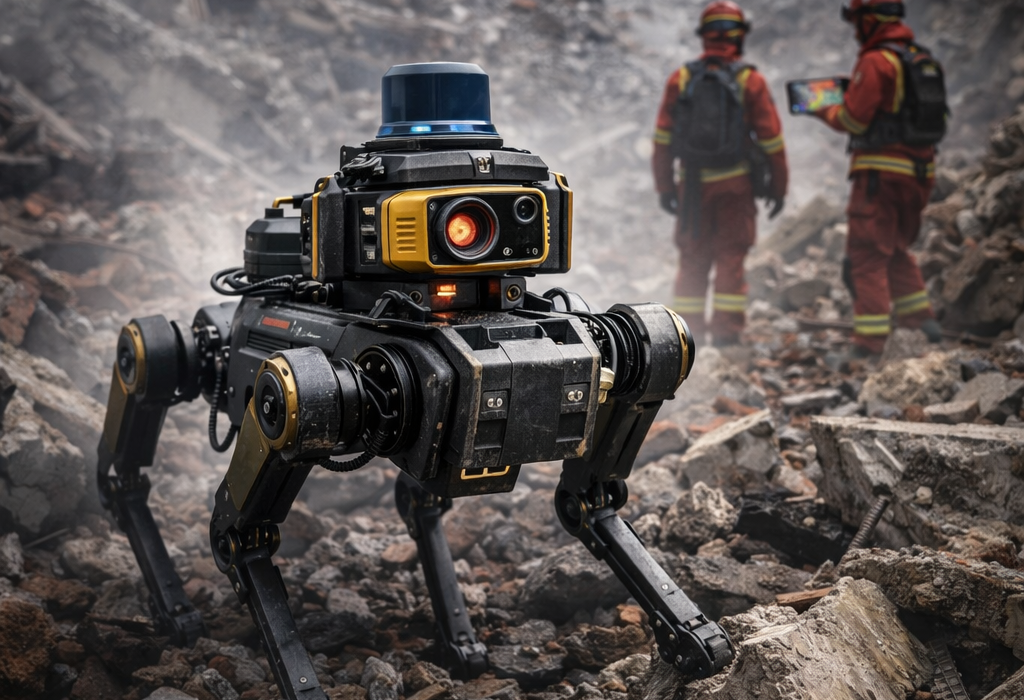
Tactical robotics refers to the deployment of specialized, mobile, and often autonomous machines designed to assist first responders, military personnel, and disaster management teams in high-risk environments. As of March 2026, the field has transitioned from experimental prototypes to “Physical AI”—the integration of advanced large-scale foundation models into physical hardware. These systems are no longer just tools; they are teammates capable of interpreting complex environments, making split-second safety decisions, and performing tasks that were once considered suicidal for human responders.
Key Takeaways
- Physical AI Integration: In 2026, robots like the production-version Boston Dynamics Atlas use Gemini-based foundation models to understand natural language commands in the field.
- Autonomous Navigation: Advances in SLAM (Simultaneous Localization and Mapping) allow robots to operate in GPS-denied environments, such as collapsed tunnels or dense urban canyons.
- Human-Robot Teaming (HRT): The shift from “one operator per robot” to “one operator per swarm” (1:N ratio) is maximizing coverage during the “Golden Hour” of rescue operations.
- Market Growth: The rescue robot market is valued at approximately $44.69 billion in 2026, reflecting a significant surge in municipal and federal procurement.
Who This Is For
This guide is designed for emergency management directors, fire chiefs, law enforcement tactical leads, and policy makers who need to understand the current technical landscape, procurement costs, and ethical frameworks of AI-driven tactical systems. It also serves as a deep dive for technology developers seeking to understand the “Human-First” requirements of the field.
The Evolution of Physical AI in Emergency Response
For years, robotics in emergency response were limited by “brittle” programming. If a robot encountered a piece of debris it hadn’t been programmed for, it would fail. As of March 2026, the industry has embraced Physical AI, a paradigm where robots learn through massive-scale simulation and real-world reinforcement.
From Code to Contact
Modern tactical systems utilize “Agentic AI,” which allows them to reason, plan, and act. Instead of a pilot steering a drone through a window, a responder can now say, “Scan the third floor for heat signatures,” and the system handles the trajectory, obstacle avoidance, and data filtering autonomously. This is powered by high-fidelity simulation platforms like NVIDIA Isaac Sim, which allow AI models to “practice” millions of disaster scenarios before the robot ever touches the ground.
The Role of Edge Computing
In a disaster, communication infrastructure is often the first thing to fail. Tactical robotics in 2026 rely on Edge AI—processing power located directly on the robot rather than in the cloud. This ensures that even if the connection to the command center is severed, the robot can continue its mission, avoid obstacles, and return to a designated “home” point using breadcrumb navigation.
Hardware Platforms: The Three Pillars of Tactical Response
The hardware of 2026 is categorized by its mobility and specific utility. Each platform serves a distinct role in the “Tactical Stack.”
1. Quadrupedal and Legged Systems
Quadrupeds, often called “robot dogs,” have become the workhorses of urban search and rescue (USAR).
- Boston Dynamics Spot: Known for its reliability and “Orbit” software, it is used primarily for industrial inspection and public safety.
- Ghost Robotics Vision 60: A “mid-size” high-endurance quadruped that is frequently used by the military and specialized law enforcement for its all-weather durability and ability to carry heavy sensors or even robotic arms for manipulation.
- Production Atlas (2026): Boston Dynamics’ transition to a fully electric, production-ready humanoid has opened doors for robots that can use human tools, open heavy doors, and navigate environments designed specifically for people.
2. Unmanned Aerial Systems (UAS) and Swarms
Drones have evolved from simple cameras to autonomous scanning nodes.
- Skydio X10: A leader in autonomous flight, using 360-degree vision to fly through dense forests or inside buildings without a pilot.
- Swarm Intelligence: Multiple small drones (nano-drones) can now be deployed to map an entire city block in minutes. They communicate with each other to ensure no two drones cover the same area, creating a “mesh” of data.
3. Specialized Heavy-Duty and Aquatic Systems
- Thermite EV1: A tracked firefighting robot capable of pumping 2,500 gallons of water per minute while protecting human firefighters from extreme heat and structural collapse.
- Snake Robots: Modular systems developed for slithering through tight gaps in collapsed buildings or inspecting underwater infrastructure after floods.
Core Technologies: How Robots “See” and “Think”
To function in a disaster zone, a robot must solve three problems: Where am I?, What is around me?, and What should I do next?
SLAM and GPS-Denied Navigation
Simultaneous Localization and Mapping (SLAM) is the “brain” of tactical mobility. Using a combination of LiDAR (Light Detection and Ranging) and Visual Odometry, a robot builds a 3D map of its surroundings while simultaneously tracking its position within that map.
Mathematically, the state of the robot at time $t$ can be represented as:
$$x_t = f(x_{t-1}, u_t, w_t)$$
Where:
- $x_t$ is the position and orientation (pose).
- $u_t$ is the control input (movement commands).
- $w_t$ is the noise or uncertainty in the environment.
By processing thousands of these data points per second, robots in 2026 can navigate pitch-black, smoke-filled corridors with centimeter-level precision.
Vision-Language Models (VLM)
The most significant breakthrough of 2025/2026 is the integration of VLMs. These allow robots to “understand” what they see. A robot’s camera doesn’t just see a “red object”; the AI identifies it as “a leaking chemical drum” and alerts the HAZMAT team. This semantic understanding changes the data from a simple video feed into actionable intelligence.
Practical Applications in Emergency Response
Urban Search and Rescue (USAR)
In the aftermath of an earthquake, the first 72 hours are critical. AI-driven quadrupeds are deployed to “clear” structures. They use thermal imaging to detect body heat and acoustic sensors to pick up on faint cries or tapping sounds that human ears might miss.
- Example: During the 2024 Noto Peninsula Earthquake response, robot dogs were used to inspect traditional wooden structures that were too unstable for human teams to enter.
Firefighting and HAZMAT
Robots like the Thermite EV1 or the Shark Robotics Colossus allow fire departments to combat “megafires” and industrial chemical leaks safely.
- High-Heat Operation: These robots can withstand temperatures up to 500°C for extended periods, providing a shield for human firefighters or acting as the primary nozzle operator in the heart of the blaze.
- Chemical Sensing: AI-driven sensors can identify over 100 different hazardous gases in real-time, mapping the “plume” of a leak to direct evacuation orders.
Tactical Law Enforcement and EOD
Explosive Ordnance Disposal (EOD) has been transformed by the addition of dexterous robotic arms on mobile bases. In 2026, robots can perform delicate “cut or don’t cut” maneuvers with haptic feedback, allowing the human operator to “feel” the resistance of a wire through their controller.
Human-Robot Teaming (HRT): The Synergy of 2026
The goal of tactical robotics is not to replace human responders but to act as a force multiplier. Effective HRT relies on trust and intuitive interfaces.
The 1:N Ratio
Traditionally, one robot required one or more operators. Today, a single incident commander can manage a “pack” of robots. The AI handles the “low-level” tasks (not tripping over a curb), while the human focuses on “high-level” strategy (deciding which building to prioritize).
Common Mistakes in Deployment
- Over-Reliance on Connectivity: Assuming the robot will always have a high-bandwidth link to the cloud. Solution: Prioritize systems with high “local intelligence” (Edge AI).
- Poor Sensor Hygiene: In smoke-filled or muddy environments, sensors get blocked. Solution: Use robots with self-cleaning lens systems or redundant sensor arrays (LiDAR + Radar + Thermal).
- Lack of Training: Buying the tech but not training the team. Tactical robotics require a “pilot” mindset, even when they are autonomous.
Market Dynamics: Costs and Procurement in 2026
Investing in tactical robotics is a significant financial commitment. As of March 2026, pricing has stabilized but remains high for professional-grade systems.
| Robot Category | Typical Price Range (USD) | Primary Use Case |
| Small Recon Drones | $15,000 – $35,000 | Quick aerial scouting, indoor flight |
| Entry-Level Quadrupeds | $50,000 – $85,000 | Basic patrol, visual inspection |
| Tactical Quadrupeds (Vision 60) | $150,000 – $250,000 | USAR, All-terrain, military-grade |
| Firefighting UGVs (Thermite) | $200,000 – $500,000 | Heavy industrial fire, HAZMAT |
| Humanoid Systems (Atlas) | $1,000,000+ (Initial) | Research, complex manipulation, disaster prep |
Robots-as-a-Service (RaaS)
Many smaller municipalities are now using the RaaS model. Instead of a $200,000 upfront cost, they pay a monthly subscription fee (ranging from $3,000 to $8,000) that includes hardware, software updates, and maintenance. This lowers the barrier to entry for local fire and police departments.
Ethical and Legal Frameworks
The deployment of AI that makes “life or death” decisions is the most debated topic in robotics today.
The “Black Box” Problem
When an AI-driven robot makes a mistake—such as failing to identify a survivor or accidentally causing a secondary collapse—the logic path must be traceable. Current ISO 10218 standards in 2026 require “Explainable AI” (XAI) in tactical systems, ensuring that developers can audit why a robot made a specific decision.
Safety Disclaimers
Safety Warning: AI-driven robotics are decision-support tools. They should never be the sole factor in determining the safety of a structure for human entry. Always follow established Incident Command System (ICS) protocols and use robots to augment, not replace, human judgment in life-critical scenarios.
Accountability and Trust
Who is responsible if a robot fails? As of 2026, legal frameworks are shifting toward the “Human-in-the-Loop” (HITL) model. This means that while a robot can be autonomous, a human must authorize high-consequence actions, such as opening a pressurized valve or initiating a breach.
The Future: 2026 to 2030
The next four years will see the perfection of “Multi-Modal” response. Imagine a scenario where a drone swarm detects a survivor, a quadruped navigates the rubble to provide medical supplies, and a humanoid robot follows behind to assist with extraction—all communicating on a single, unified AI mesh.
Energy Density and Endurance
The primary bottleneck remains battery life. Current high-performance quadrupeds last between 90 and 150 minutes. By 2030, the industry expects solid-state battery technology to double these runtimes, allowing for true “all-day” disaster response.
Conclusion
Tactical robotics has reached a point of no return. The “Physical AI” revolution of 2026 has turned once-clunky machines into agile, intelligent partners for first responders. By leveraging SLAM, Edge AI, and autonomous hardware like quadrupeds and heavy-duty UGVs, emergency services can now operate in environments that were previously deemed too dangerous.
However, the technology is only as effective as the humans who manage it. Successful integration requires a shift in mindset: seeing the robot not as a remote-controlled toy, but as a specialized team member. As costs continue to fall through RaaS models and AI becomes more “explainable,” we are moving toward a world where no human has to risk their life just to “take a look” at a dangerous scene.
Next Steps:
- Audit your current toolkit: Identify high-risk tasks (e.g., initial structure entry) that could be offloaded to a robot.
- Request a Field Demo: Most major manufacturers (Boston Dynamics, Ghost Robotics, Skydio) offer regional demos for qualified agencies.
- Develop an AI Policy: Establish clear guidelines on autonomy levels and data privacy before deployment.
FAQs
1. Can tactical robots operate in complete darkness?
Yes. Most professional tactical robots use LiDAR and Thermal Imaging rather than standard RGB cameras. LiDAR uses laser pulses to “see” the shape of the environment, which does not require external light, while thermal cameras detect heat signatures from humans or fire.
2. How do these robots handle stairs and uneven rubble?
Legged robots (quadrupeds) are specifically designed for this. They use “blind locomotion” algorithms that allow them to feel the ground and adjust their gait in milliseconds, much like a person or a dog. If they slip, the AI can usually perform a “self-righting” maneuver to stand back up.
3. Are these robots waterproof?
It depends on the IP (Ingress Protection) rating. Most tactical quadrupeds like the Ghost Robotics Vision 60 are IP67-rated, meaning they can be submerged in shallow water and operate in heavy rain. Firefighting robots are designed with water-cooling jackets to handle both water and extreme heat.
4. What is the “Golden Hour” in robotics terms?
The “Golden Hour” refers to the first 60 minutes after a trauma or disaster when medical intervention is most likely to prevent death. Robots accelerate this by performing rapid, autonomous “triage scans” of large areas, identifying where survivors are located so humans can go straight to the point of need.
5. Can a hacker take control of a tactical robot?
Security is a major concern. Professional systems in 2026 use AES-256 encryption and dedicated radio frequencies (like Silvus or Mesh networks). Many also include a physical “kill switch” and “anti-tamper” software that bricks the robot if it detects an unauthorized attempt to bypass its security protocols.
References
- International Federation of Robotics (IFR). (2026). Top 5 Global Robotics Trends 2026. 2. Fortune Business Insights. (2026). Search and Rescue Robots Market Size, Industry Share, and 2034 Forecast.
- World Economic Forum. (2026). Industrial AI: Transforming Disaster Response through Orchestration.
- Boston Dynamics. (2026). Product Specification: The All-Electric Production Atlas.
- National Institutes of Health (PMC). (2026). An AI Ethics Framework for Trustworthy Autonomous Drone Systems.
- ResearchGate. (2025). AI-Driven Innovations in Emergency and Disaster Response: Strategies for Planning.
- U.S. Department of Commerce. (2026). Standards for Human-Robot Collaboration in Hazardous Environments (ISO 10218 Update).
- Ghost Robotics Corp. (2026). Field Reports: Legged Robots in Earthquake Relief Operations.
- IEEE Xplore. (2025). Edge Computing and SLAM Optimization for GPS-Denied Disaster Zones.
- The Robot Report. (2026). Ghost Robotics: Innovating for Safety in Tactical Environments.