Artificial intelligence has rapidly evolved from a niche research field into a global utility, driving advancements in healthcare, finance, and creative industries. However, this explosive growth comes with a hidden physical cost: a massive and growing appetite for electricity. As of early 2026, the energy consumption of large-scale AI models rivals that of small nations, creating an urgent imperative for the industry to pivot. The solution lies in a holistic approach combining sustainable AI infrastructure, breakthrough low-power hardware, and smarter algorithmic design.
In this guide, sustainable AI infrastructure refers to the end-to-end ecosystem of energy-efficient hardware, green data center design, and low-carbon operational strategies required to run AI workloads responsibly (not just purchasing carbon offsets).
Key Takeaways
- The Scale is Massive: AI energy demand is split between the intense burst of training models and the continuous, accumulating load of inference (daily usage).
- Hardware is Evolving: New “low-power AI chips” are moving beyond traditional GPUs, utilizing neuromorphic architectures and photonics to process data with a fraction of the electricity.
- Cooling Matters: Sustainable infrastructure isn’t just about the chips; it’s about how we cool them. Liquid and immersion cooling are becoming standard for high-density AI clusters.
- Software Efficiency: “Green AI” techniques like quantization and sparse modeling can reduce energy consumption by orders of magnitude without upgrading hardware.
- Location is Strategy: Placing data centers near renewable energy sources and waste-heat customers is as critical as the technology inside them.
Who This Is For (And Who It Isn’t)
This guide is written for CTOs, IT infrastructure managers, sustainability officers, and tech-forward developers who need to understand the physical constraints of scaling AI. It is also relevant for policy researchers looking at the environmental impact of digital transformation.
- It is not a tutorial on how to code a neural network.
- It is not a financial investment guide for chip stocks.
The Reality of AI Energy Demand
To solve a problem, one must first measure it. The energy demand of AI is distinct from general cloud computing because of its density and computational intensity. While a standard web server might run at 30-40% utilization, an AI training cluster often runs at nearly 100% utilization for weeks or months at a time.
Training vs. Inference: Where Does the Power Go?
A common misconception is that the environmental cost of AI is entirely in the “training” phase—the weeks spent teaching a model like GPT-4 or Gemini. While training is incredibly energy-intensive, often consuming gigawatt-hours (GWh) of electricity in a single run, it is a finite event.
Inference, the process of the model answering user queries, generating images, or analyzing data in real-time, is the hidden iceberg. As of 2025, industry estimates suggest that for widely deployed models, inference energy consumption creates a far larger cumulative footprint than training. Every time a user generates a summary or a code snippet, a specialized processor somewhere must fire up.
The Jevons Paradox in AI
In environmental economics, the Jevons Paradox occurs when technological progress increases the efficiency with which a resource is used (reducing the amount necessary for any one use), but the rate of consumption of that resource rises so much that total consumption increases.
We are seeing this clearly in AI. As chips become more efficient and “low-power,” the cost of inference drops. This induces more demand—integrating AI into toasters, word processors, and cars—which ultimately drives the aggregate energy demand of the sector higher, even as individual operations become greener. This makes sustainable AI infrastructure not just a “nice to have,” but a critical hard cap on the industry’s ability to scale.
Low-Power AI Chips: The Silicon Revolution
The current backbone of AI, the Graphics Processing Unit (GPU), was originally designed for rendering video games. While GPUs are powerful parallel processors, they are not inherently optimized for the specific mathematics of neural networks, leading to wasted energy. The next generation of low-power AI chips focuses on specialization.
ASIC: Application-Specific Integrated Circuits
The most immediate step toward efficiency is the shift from general-purpose GPUs to ASICs—chips designed for one specific task.
- TPUs and NPUs: Tech giants have developed Tensor Processing Units (TPUs) and Neural Processing Units (NPUs) that strip away the graphics-rendering silicon of a GPU to focus entirely on matrix multiplication, the core math of AI.
- Efficiency Gains: In practice, a well-designed ASIC can deliver 10x to 30x better performance-per-watt than a general-purpose GPU because it doesn’t spend energy on instruction sets it doesn’t need.
Neuromorphic Computing: Mimicking the Brain
The human brain consumes roughly 20 watts of power to perform tasks that currently require megawatts in a data center. Neuromorphic computing aims to bridge this gap by mimicking biological neural structures in silicon.
- Spiking Neural Networks (SNNs): Unlike traditional deep learning, where every neuron fires every cycle, SNNs operate on “spikes.” A section of the chip remains dormant (using zero power) until data specifically activates it.
- Event-Based Processing: This architecture is particularly revolutionary for edge AI (cameras, sensors) where the system only processes changes in the environment rather than analyzing every single frame, drastically cutting power draw.
Analog and In-Memory Computing
Traditional computers suffer from the “von Neumann bottleneck”—the energy cost of moving data back and forth between the memory (RAM) and the processor (CPU/GPU). For large AI models, moving the weights costs more energy than doing the math.
- Compute-in-Memory (CIM): This technology performs calculations directly inside the memory arrays, eliminating data movement.
- Analog Optical/Photonics: Some startups are developing chips that use light (photons) instead of electricity (electrons) to perform calculations. Light generates virtually no heat compared to resistance in copper wires, promising a future where matrix math is performed at the speed of light with minimal energy loss.
Sustainable AI Infrastructure: Designing Green Data Centers
Putting efficient chips into an inefficient data center is like putting a hybrid engine in a tank. Sustainable AI infrastructure requires a complete rethink of the facility itself.
The Cooling Conundrum
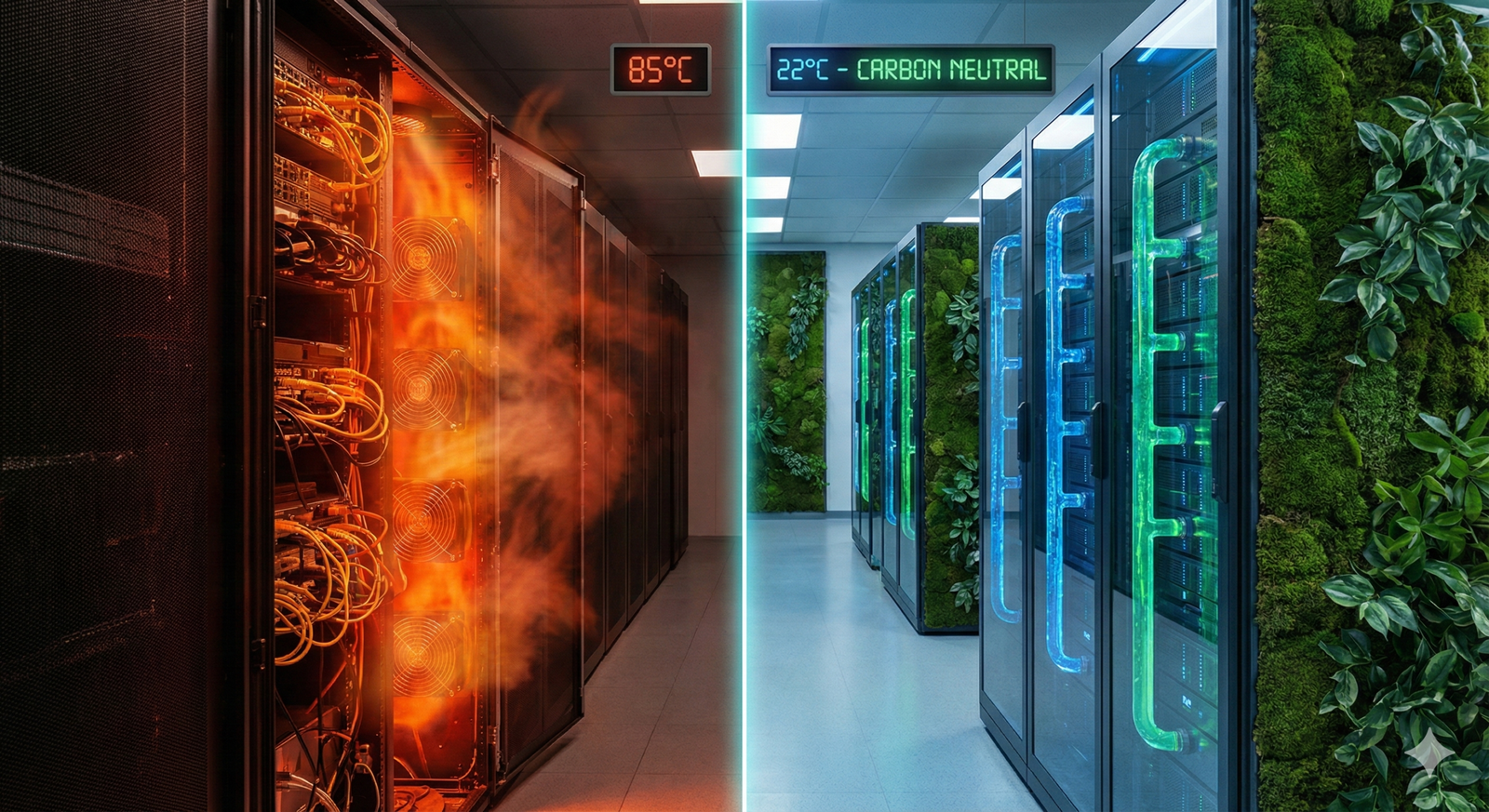
AI chips run hot—significantly hotter than standard web servers. Traditional air cooling (huge air conditioners blowing cold air through raised floors) is reaching its physical limit and is incredibly wasteful.
1. Direct-to-Chip Liquid Cooling
This method involves piping coolant fluid directly to a cold plate that sits on top of the GPU or ASIC. Water conducts heat 24 times better than air, allowing facilities to remove heat more efficiently.
- Pros: Can handle much higher power densities per rack.
- Cons: Complex plumbing; risk of leaks (though modern coolants are non-conductive).
2. Immersion Cooling
In this “extreme” but increasingly common approach, the entire server rack is submerged in a bath of dielectric fluid (a liquid that doesn’t conduct electricity). The fluid touches every component, capturing 100% of the heat.
- Efficiency: This eliminates the need for server fans (which can consume 10-15% of a server’s power) and allows for higher ambient temperatures.
- PUE Impact: Immersion cooling can bring a data center’s Power Usage Effectiveness (PUE) down to nearly 1.03 (where 1.0 is perfect efficiency), compared to the industry average of 1.5+.
Waste Heat Recovery
A sustainable AI infrastructure treats heat not as a waste product, but as a resource.
- District Heating: In Nordic countries and parts of Europe, data centers are being connected to municipal heating grids. The heat generated by training an LLM can be used to warm thousands of nearby homes or swimming pools.
- Industrial Symbiosis: Some facilities are co-locating with greenhouses or fish farms that require constant warmth, creating a circular energy economy.
“Green AI”: Algorithmic and Software Efficiency
Hardware is only half the battle. If the code running on the chips is bloated, the best infrastructure in the world won’t save it. The “Green AI” movement focuses on making the models themselves leaner.
Sparse Modeling
Most parameters in a giant neural network are rarely used. “Sparsity” involves forcing the network to have many zeros in its mathematical weights.
- Pruning: This technique removes connections in the neural network that contribute little to the output. A pruned model might be 50% smaller and faster, requiring 50% less energy to run inference, with negligible loss in accuracy.
Quantization
Standard AI models often use 32-bit floating-point numbers (high precision) for their weights. Quantization reduces this precision to 8-bit, 4-bit, or even 1-bit formats.
- Impact: This dramatically reduces the memory bandwidth required (solving the von Neumann bottleneck mentioned earlier) and simplifies the math the chip has to perform, directly translating to power savings.
Carbon-Aware Scheduling
This is a software layer innovation. Instead of running a non-urgent training job immediately, “carbon-aware” software checks the local energy grid.
- Time-Shifting: If the sun is down and the grid is relying on coal, the software pauses the job. When the sun comes up and solar energy floods the grid, the job resumes.
- Location-Shifting: A cloud provider might move a workload from a data center in Virginia (often coal/gas heavy) to one in Quebec or Norway (hydro-heavy) specifically to lower the carbon intensity of the training run.
The Role of Renewable Energy in AI
Buying carbon offsets (paying someone else not to pollute) is no longer considered sufficient for true sustainable AI infrastructure. The industry is moving toward “24/7 Carbon-Free Energy” (CFE).
The Flaw of Annual Matching
Historically, a tech company would consume dirty energy at night, buy solar credits generated during the day, and claim “100% renewable” on an annual basis. However, the atmosphere still felt the carbon from the nighttime usage.
24/7 CFE (Carbon-Free Energy)
The new gold standard, championed by organizations like the United Nations and major tech hyperscalers, involves matching consumption with clean generation every hour of every day.
- Batteries and Storage: This requires massive investment in on-site battery storage to smooth out the intermittency of wind and solar.
- Geothermal and Nuclear: To achieve true 24/7 sustainability, AI data centers are increasingly looking at baseload clean energy sources like advanced geothermal or small modular nuclear reactors (SMRs) to provide constant power without emissions.
Measuring Success: Metrics That Matter
To navigate this landscape, decision-makers must look beyond simple electricity bills. Here are the key metrics for evaluating sustainable AI infrastructure.
| Metric | Definition | Why it matters for AI |
| PUE (Power Usage Effectiveness) | Total facility energy / IT equipment energy. | Measures how efficient the building is (cooling/lighting). Closer to 1.0 is better. |
| CUE (Carbon Usage Effectiveness) | Carbon emissions / IT equipment energy. | Measures the “greenness” of the electrons you are using. |
| TDP (Thermal Design Power) | The maximum heat a chip generates. | Critical for planning cooling density in AI racks. |
| FLOPS per Watt | Floating-point operations per watt of energy. | The ultimate measure of chip efficiency. |
| Water Usage Effectiveness (WUE) | Liters of water used / kWh of energy. | Crucial for liquid-cooled facilities in drought-prone areas. |
Common Mistakes and Pitfalls
Transitioning to sustainable AI is complex. Here are common traps organizations fall into.
1. The “Greenwashing” Trap
Labeling an AI product as “green” simply because it runs in the cloud is misleading. If that cloud region is powered by coal and the hardware is five years old, the footprint is massive.
- Solution: Demand transparency. Ask providers for “Scope 2” (electricity) and “Scope 3” (supply chain) emission data specific to your workloads, not just company-wide averages.
2. Ignoring Embodied Carbon
A low-power chip is great, but manufacturing chips is an incredibly energy-intensive process involving extreme heat and rare chemicals.
- The Trade-off: If you replace hardware every 18 months to get a 10% efficiency gain, the carbon cost of manufacturing the new chips might outweigh the operational savings. Sustainable infrastructure involves extending the useful life of hardware where possible (“circularity”).
3. Over-Provisioning
Engineers often allocate massive GPU clusters for tasks that could be handled by smaller, more efficient CPUs or older GPUs.
- Right-Sizing: Using a sledgehammer to crack a nut wastes energy. Sustainable AI involves matching the hardware capacity strictly to the model’s needs.
Case Study Scenarios: What This Looks Like in Practice
To illustrate how these technologies converge, consider two theoretical implementations of sustainable AI infrastructure.
Scenario A: The Retrofit Enterprise
A financial services firm has an existing on-premise data center. They cannot afford to build a new facility.
- Action: They implement Rear Door Heat Exchangers (RDHx), a form of liquid cooling that attaches to the back of existing server racks to capture heat without rebuilding the room.
- Hardware: They switch inference workloads from GPUs to specialized inference ASICs, reducing power draw by 40%.
- Result: A 30% reduction in cooling costs and a significant drop in Scope 2 emissions without a new building.
Scenario B: The “Greenfield” AI Startup
A startup building a foundation model decides to build infrastructure from scratch.
- Location: They choose a location in Iceland, utilizing natural ambient cooling and 100% geothermal energy.
- Design: The facility uses immersion cooling tanks.
- Compute: They utilize a mix of photonics-based accelerators for specific matrix workloads and general NPUs.
- Result: A near-zero carbon footprint for operations, with energy costs 60% lower than US-based equivalents.
Future Outlook: The Road to Net-Zero AI
As we look toward 2030, the intersection of AI and energy will be defined by regulation and physics. Governments in the EU and elsewhere are beginning to draft reporting requirements for the energy usage of AI models. We can expect:
- Energy Star for AI: A standardized rating system for models, certifying that a specific model was trained and runs within certain efficiency parameters.
- Grid-Interactive Data Centers: AI facilities acting as batteries for the grid—pausing training loads instantly when the grid is stressed to prevent brownouts.
- Biological Computing: Long-term research into DNA storage and biological processing that could theoretically operate at distinct orders of magnitude more efficiency than silicon.
Conclusion
The demand for AI energy is a physical constraint that cannot be wished away with software updates alone. It requires a tangible shift in sustainable AI infrastructure—moving electrons more efficiently through low-power chips, dissipating heat more effectively through liquid cooling, and sourcing power more responsibly through 24/7 renewable matching.
For organizations leveraging AI, the next step is not just “doing more with AI,” but “doing more with less.” The winners of the AI race won’t just be those with the smartest models, but those who can run them without bankrupting the planet or their own operating budgets.
Next Steps
- Audit your current workloads: Identify which models are running 24/7 inference and prioritize them for optimization (quantization or hardware migration).
- Review cloud regions: Check if your cloud provider offers a “carbon-aware” region selector and move non-latency-sensitive workloads to greener grids.
- Ask the hard questions: When purchasing AI hardware or services, ask for the “FLOPS per watt” and the source of electricity.
FAQs
1. What is the difference between training energy and inference energy? Training is the process of teaching a model, which requires a massive, one-time burst of energy (often weeks of running thousands of GPUs). Inference is the ongoing use of the model (answering questions, recognizing faces), which consumes less energy per second but runs continuously for years. Over the life of a popular model, inference usually consumes far more total energy than training.
2. Can renewable energy completely power AI data centers? Ideally, yes, but it is challenging due to the intermittency of wind and solar. AI data centers need constant power. To be 100% renewable, facilities need massive battery storage, geothermal power, or nuclear energy to cover the times when the sun isn’t shining or the wind isn’t blowing.
3. Do low-power AI chips reduce performance? Not necessarily. Low-power chips like ASICs or neuromorphic processors are often faster for AI tasks than general-purpose chips because they are specialized. However, they may lack the flexibility to perform non-AI tasks (like rendering graphics or running standard databases) effectively.
4. What is PUE and what is a good score for an AI data center? PUE stands for Power Usage Effectiveness. It is the ratio of total facility energy to the energy used by the IT equipment. A PUE of 1.0 is perfect (all energy goes to computing). A traditional data center averages around 1.58. A state-of-the-art sustainable AI data center using liquid cooling can achieve a PUE of 1.05 to 1.10.
5. How does sparse modeling help the environment? Sparse modeling reduces the number of calculations required to get an answer from an AI. By “pruning” unnecessary connections in the neural network, the chip does less work, generates less heat, and finishes the task faster, all of which reduce electricity consumption.
6. Is liquid cooling safe for electronics? Yes. Modern liquid cooling uses dielectric fluids (engineered liquids) that do not conduct electricity. Even if the fluid touches the electronics directly (as in immersion cooling), it will not cause a short circuit or damage the hardware.
7. Why are GPUs considered energy inefficient for AI? GPUs are excellent parallel processors, but they were designed for graphics. They have hardware components dedicated to video output and texture mapping that are useless for AI but still consume power and occupy silicon space. Specialized AI chips (TPUs/NPUs) remove these components to maximize efficiency for AI math.
8. What is the carbon footprint of generating one AI image? Estimates vary widely based on the model and hardware, but generating a single image using a high-end diffusion model can consume as much energy as fully charging a smartphone. While small individually, at the scale of millions of users, this adds up to significant demand.
9. Can waste heat from data centers really heat homes? Yes, this is already happening, particularly in Northern Europe. The “waste” heat from servers is captured by water loops and pumped into district heating systems. For example, data centers in Stockholm and Helsinki provide heat to thousands of local apartments, offsetting the need for fossil-fuel heating.
References
- International Energy Agency (IEA). (2024). Electricity 2024: Analysis and forecast to 2026. IEA. https://www.iea.org/reports/electricity-2024
- Green Software Foundation. (n.d.). Software Carbon Intensity (SCI) Specification. https://greensoftware.foundation/
- Strubell, E., Ganesh, A., & McCallum, A. (2019). Energy and Policy Considerations for Deep Learning in NLP. University of Massachusetts Amherst. https://arxiv.org/abs/1906.02243
- Google. (2024). Environmental Report 2024. Google Sustainability. https://sustainability.google/reports/
- Microsoft. (2024). Environmental Sustainability Report. Microsoft Corp. https://www.microsoft.com/en-us/corporate-responsibility/sustainability/report
- Patterson, D., et al. (2021). Carbon Emissions and Large Neural Network Training. arXiv preprint. https://arxiv.org/abs/2104.10350
- Uptime Institute. (2023). Global Data Center Survey 2023. https://uptimeinstitute.com/
- MIT Technology Review. (2023). The computing power needed to train AI is now rising seven times faster than before. https://www.technologyreview.com/
- NVIDIA. (2024). Sustainable Computing and the Future of the Data Center. Technical Blog. https://developer.nvidia.com/blog/
- Bash, C. E., & Forman, G. (2007). Cool Job Allocation: Measuring the Power Savings of Placing Jobs at Cooling-Efficient Locations. HP Laboratories. (Foundational concept for carbon-aware scheduling).