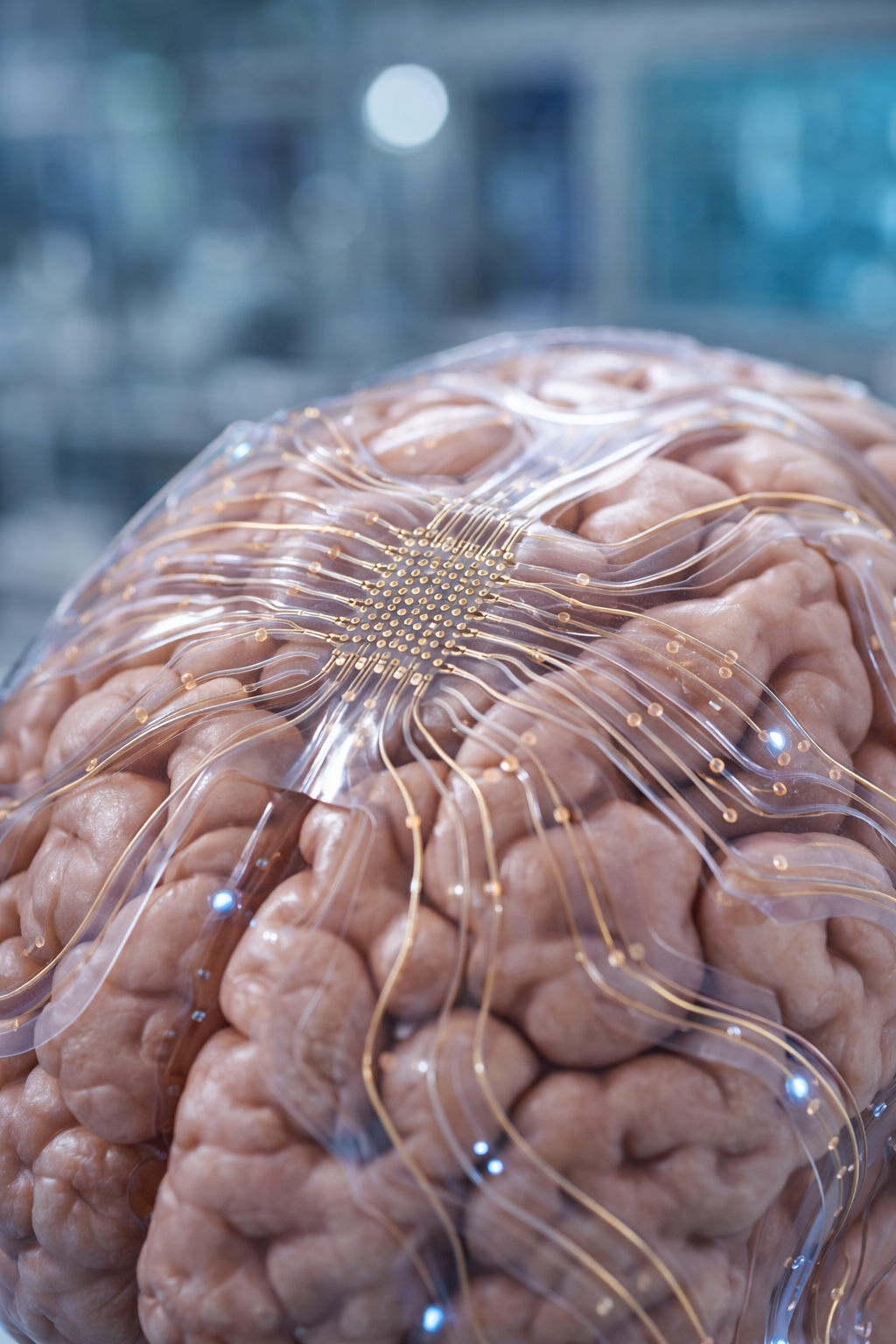
The integration of advanced materials science with neuronal engineering is ushering in a new era of human-machine interaction. This convergence is perhaps most visibly realized in the development of soft brain implants. Unlike the rigid, silicon-based technologies of the past, these next-generation interfaces prioritize biocompatibility and mechanical matching with delicate brain tissue. This shift is not just an incremental technological improvement; it is the critical facilitator allowing high-bandwidth Brain-Computer Interfaces (BCI) to move from laboratory settings to practical, long-term integration with assistive robotics.
A Soft Brain Implant is a neural interface designed to record from or stimulate neural populations using materials that are mechanically compliant with the modulus of brain tissue. By mimicking the “softness” and flexibility of the biological environment, these devices aim to reduce the immune response, minimize scarring, and maintain high-quality signal acquisition over extended periods.
Key Takeaways
- Mechanical Matching: Soft implants use flexible, stretchable materials (like hydrogels and polymers) that match the low Young’s modulus of brain tissue, reducing mechanical trauma.
- Enhanced Biocompatibility: The improved mechanical compliance significantly mitigates the chronic foreign body response (gliosis), leading to higher longevity and stable recording.
- The BCI-Robotics Bridge: Soft implants provide the high-density, reliable neural data stream necessary for the intuitive control of complex robotic systems, such as prosthetic limbs and exoskeletons.
- Shift to Intracortical: While non-invasive BCIs exist, soft implants are driving the transition toward invasive, high-resolution intracortical solutions for severe motor impairments.
Who this is for
This deep dive is intended for individuals curious about the frontier of neurotechnology, including patients seeking information on future therapies for spinal cord injuries or neurodegenerative diseases, biomedical engineers, roboticists, and tech enthusiasts interested in how emerging materials are unlocking new potentials in human augmentation and rehabilitation.
Defining the “Soft” Revolution in Neural Interfaces
The brain is arguably the softest organ in the human body, with a consistency similar to soft pudding or Jell-O. When engineers try to insert rigid microelectrodes—traditionally made of silicon or metal wires—into this delicate environment, the brain reacts strongly. The historical approach to invasive BCI has been analogous to inserting a nail into a block of tofu. The brain tissue moves constantly due to blood flow and respiration, but the rigid implant stays put, causing continuous micro-trauma and inflammation.
Soft brain implants revolutionize this dynamic by employing novel materials that conform to the brain’s geometry and move with its oscillations.
Understanding the Materials Science
The defining characteristic of soft implants is their mechanical properties. The stiffness of a material is measured by its Young’s modulus. Traditional silicon electrodes have a modulus in the range of tens of gigapascals (GPa). Human brain tissue, in contrast, has a modulus in the kilopascal (kPa) range—magnitudes of difference softer.
The foreign body response (FBR) in the brain, where glial cells encapsulate the foreign object, is highly correlated with this stiffness mismatch. This glial scar insulates the electrodes, pushing them away from functioning neurons and eventually making them useless for recording.
Soft neural interfaces utilize two main categories of materials to overcome this:
- Flexible Polymers: Materials like Polyimide (PI) and Parylene-C are robust yet flexible. When fabricated as extremely thin micro-ribbons, their overall bending stiffness becomes incredibly low, allowing them to twist and flex.
- Elastomers and Hydrogels: This is where the true revolution lies. Silicone-based elastomers and advanced hydrogels can have moduli that directly match the mechanical properties of brain tissue (1–100 kPa). Hydrogels are particularly interesting because they are water-rich, ionically conductive, and often tissue-mimetic, providing a seamless interface.
Fabricating Soft Electrodes
Creating conductive pathways within these soft substrates is the core engineering challenge. You cannot simply lay gold traces on a stretchable elastomer, as the metal will fracture. Engineers use clever techniques to achieve elasticity in these conductors:
- Buckled Structures: Creating conductive films in pre-strained wavy patterns that flatten when stretched.
- Liquid Metals: Utilizing conductive liquid metals, like Eutectic Gallium-Indium (EGaIn), encapsulated within soft polymer channels.
- Conductive Polymers: Using intrinsically conductive polymers like PEDOT:PSS, which can be engineered for low impedance and reasonable flexibility.
The Critical Role of Brain-Computer Interfaces (BCI)
Before we can merge neural implants with robotics, the implant must effectively communicate with the brain. A Brain-Computer Interface (BCI) serves this function. The BCI process follows a classic input-output model.
Signal Acquisition (The Input)
The soft implant’s primary job is high-density recording of neural activity. The goal is to record spikes (action potentials) from individual neurons and local field potentials (LFPs) from small populations. The density of recording sites (electrodes per square millimeter) determines the resolution of the interface. High-density, soft microelectrode arrays are the gold standard for invasive BCIs because they offer a balanced compromise between resolution and long-term stability.
Signal Processing and Feature Extraction
The raw, noisy electrical signals recorded by the implant are processed to extract useful features. This often involves filtering out noise (like muscle movements), identifying spikes, and sorting those spikes (assigning them to specific neurons).
Neural Decoding
This is the mathematical process of turning brain signals into predictions of intention. If a person thinks about moving their hand up, a complex pattern of neurons fires in their motor cortex. Modern BCIs use sophisticated machine learning (ML) models, particularly deep neural networks, to learn these patterns. For instance, a model can learn that “Pattern A” means “Move robotic arm left” and “Pattern B” means “Close robotic hand.”
The Convergence: Linking Neural Signals to Robotics
The convergence of BCI and robotics occurs when the decoded neural intentions are translated into actionable commands for a physical machine. This is not just about moving a cursor on a screen; it is about physically manipulating the environment through an artificial medium.
Closed-Loop Systems: The BCI-Robot-Brain Triangle
The most advanced applications utilize closed-loop control, a fundamental concept in cybernetics.
- The Brain Intent: The user forms an intention (e.g., “pick up the coffee cup”).
- Neural Recording (Soft Implant): The soft BCI records the neural activity corresponding to this intent with high resolution and minimal noise.
- Decoding and Control: The ML algorithms decode this intention and send velocity or position commands to the robotic system.
- Robotic Action: The robotic limb moves and executes the command.
- Sensory Feedback: This is the critical step that defines a closed-loop system. Advanced robotics now incorporate sensors (force, touch, position). This sensory data is transmitted back to the user, either through visual feedback (watching the arm move) or, ideally, via electrical microstimulation back through the soft implant itself, stimulating sensory areas of the brain to provide a crude sense of touch or proprioception.
- User Learning: The brain uses this feedback to adjust its next commands, just as it does when controlling biological limbs.
The high-resolution, long-term stability of soft implants is the bottleneck that has historically limited these systems. Rigid implants degraded, making the AI’s job harder and rendering the control unintuitive and unreliable. Soft implants offer the potential for consistent, “always-on” control.
Bandwidth and Latency Challenges
For robotic control to feel natural, the system must operate with high bandwidth and low latency. The system needs to transmit a significant amount of data per second (bits per second) with minimal delay. When you want to move your biological hand, there is a barely perceptible delay. If the BCI-to-robot path has a significant lag (e.g., >100ms), control becomes difficult and frustrating, similar to playing a video game with severe input lag.
Soft, high-density arrays are necessary because more electrodes equal more neural features (higher bandwidth), enabling finer, multi-degree-of-freedom control (like controlling individual fingers).
Key Applications at the Intersection of BCIs and Robotics
The combining of soft implants and robotics is driving innovations in several key areas.
Neuroprosthetics: Restoring Movement
This is perhaps the most well-known and socially impactful application. The goal is to allow individuals with limb loss (amputation) to control a robotic prosthetic limb directly with their thoughts, as if it were their biological limb.
By implanting soft electrode arrays in the motor cortex (for overall arm movement) and the supplementary motor area (for fine finger control), researchers are making significant strides. With sensory feedback, these neuroprosthetics are becoming intuitive tools rather than simple tools. Soft interfaces are vital here for stability, ensuring that the control scheme the user learns one day remains functional the next month.
Assistive Robotics and Exoskeletons
For individuals with severe paralysis (spinal cord injury, stroke, or ALS), a prosthetic limb is not suitable. Instead, the BCI-robot convergence manifests as a wearable exoskeleton or a robotic assistant.
In exoskeleton applications, soft implants can record the user’s intent to walk or grasp. The decoded signals activate the motors of the exoskeleton, enabling mobility or hand function. This application differs from prosthetics because it requires coordinating artificial actuators with the user’s remaining body (if any), which increases control complexity.
Teleoperation and Remote Robotics
While the primary focus is medical, the BCI-robotics convergence has non-medical implications. High-bandwidth, intuitive control of robotic systems can be applied to teleoperation, allowing users to control complex robots in hazardous environments (e.g., deep-sea, outer space, nuclear decommissioning). Soft implants could enable a higher degree of immersion and intuitive control over these remote mechanical bodies.
Safety and Ethical Considerations in Neurotechnology
Any discussion of invasive neurotechnology must prioritize safety and ethics.
Disclaimer: This information is for educational purposes and is not a substitute for professional medical advice. Individuals considering neural implants for therapeutic purposes should consult with qualified neurologists and neurosurgeons to discuss specific medical contexts, risks, and regulatory status.
Physical and Long-Term Medical Risks
Despite the benefits of soft materials, significant risks remain:
- Infection: Any intracortical implantation involves penetrating the skull and the brain’s protective membranes (dura mater), creating a path for infection.
- The Unknowns of Glial Scarring: While soft implants drastically reduce gliosis, they do not eliminate it entirely. We still do not fully understand the decades-long consequences of having soft, polymer-based foreign bodies in the human brain.
- Surgical Challenges: Soft materials are, by definition, floppy. Inserting a flexible microthread array into the brain requires innovative insertion tools (e.g., bio-dissolvable shuttles or specialized, fast insertion techniques), adding another layer of surgical complexity.
Cognitive and Societal Ethical Issues
The convergence of BCIs and robotics presents unique ethical challenges:
- Identity and Agency: If a robotic limb executes a movement based on a user’s decoded thoughts, who owns that action? If the AI misinterprets a thought, who is liable for potential damage? These questions of agency are non-trivial.
- Neural Privacy and Data Security: The signals recorded by soft implants are the fundamental drivers of a person’s thoughts. This data is sensitive. Securing these interfaces from hacking or unauthorized data access is paramount.
- Equitable Access: Advanced neurotechnology will be expensive. There is a real risk of creating a divide between those who can afford augmentation (medical or otherwise) and those who cannot.
Case Study: Materials Driving the Field
To visualize the convergence, it’s helpful to look at the practical implementation. Consider the challenge of a stroke patient who has lost all hand function.
The Solution:
- The Implant: Surgeons implant a soft, transparent array of conductive polymer (e.g., PEDOT) electrodes on a hydrogel substrate onto the patient’s motor cortex. This is not just one electrode; it is perhaps 1,024 microscopic recording points, each no thicker than a human hair.
- The Robot: The patient is fitted with a wearable robotic glove that can open and close their fingers.
- The Operation: The patient visualizes the act of closing their hand. Their brain signals are remarkably consistent, and because the soft hydrogel matches the brain’s modulus, the FBR is minimal, resulting in very high signal-to-noise ratios. The AI decoder quickly learns this specific, stable pattern of activity and triggers the robotic glove to close.
- The Convergence: The result is seamless. Within weeks, the patient can use the BCI to control the glove to pick up utensils or write. This level of intuitive, stable control simply wasn’t possible with first-generation, rigid microelectrode technologies.
Practical Engineering Considerations and “Common Mistakes”
The field is nascent, and navigating its complexities, whether as an engineer or a user, requires understanding common pitfalls.
Mechanical Impedance vs. Electrical Impedance
Common Mistake: Focusing only on electrical properties (low impedance for better recording) while ignoring mechanical properties. Correction: The best soft implants optimize both. The mechanical properties must match the tissue, and the electrical properties must match the recorder. If the electrode is too soft, it might not offer stable electrical conductivity. Modern research in conductive elastomers and ionically conductive hydrogels addresses this dual optimization.
Longevity and Degradation
Common Mistake: Assuming that soft equals durable. Correction: The brain is a hostile environment (warm, saline, with active biochemical and cellular defense mechanisms). Long-term functionality of soft implants (years to decades) is the key remaining hurdle. Even the best soft polymers and conductors can hydrolyze, swell, or fracture over time. This is a critical area of ongoing research.
Data Overload and On-Board Processing
Common Mistake: Trying to transmit every raw neural signal wirelessly. Correction: A high-density array with thousands of electrodes generates vast amounts of data. This presents wireless bandwidth and power issues (transmitting data generates heat). The solution is on-chip processing. Soft electronics need to incorporate basic processing units to perform data compression and feature extraction (e.g., spike sorting) on the implant before wireless transmission, reducing the required bandwidth.
The Future of Soft BCIs and Robotics
As of November 2023, soft brain implants are transitioning from academia to early clinical feasibility studies. We are seeing a move away from passive recording sites toward active electronics integrated directly into soft substrates, enabling multiplexing (reading many electrodes through fewer output wires) and on-chip processing.
The Role of Regulatory Approval
The path forward is governed by regulatory bodies like the FDA in the United States. Regulatory approval (e.g., through Investigational Device Exemptions, IDE) is the bottleneck for human trials. The development of rigorous safety and reliability standards for soft, chronic interfaces is essential for widespread commercialization.
Integrated Manufacturing and Scale
Currently, most soft implants are handmade or use custom, multi-step lithography processes. For the BCI-robot convergence to scale, the industry must develop reliable, low-cost micro-manufacturing techniques that integrate soft substrates, micro-electronics, and thin-film conductors. Techniques like roll-to-roll printing and advanced 3D printing of bio-ink-electronics are being explored.
Conclusion
The emergence of soft brain implants represents the resolution of a decades-long mechanical conflict between technology and biology. For too long, the integration of brain and machine was hampered by the stiffness mismatch, leading to chronic failure and limited data rates. By employing advanced materials science, soft brain implants now provide the essential, stable, high-bandwidth communication link required to control complex robotic systems.
This technology is moving beyond simple “cursor control” and into the realm of physically acting upon the world. The convergence is not theoretical; it is happening now in advanced prosthetics and exoskeleton development, offering a renewed sense of autonomy and functional independence to individuals with severe motor deficits.
The future of this field is inherently multidisciplinary. Success will require material scientists to invent more durable bio-interfaces, electrical engineers to design low-power, high-density circuits on flexible substrates, computer scientists to build smarter decoding algorithms, and neurosurgeons to develop safer insertion techniques. While significant technical, safety, and ethical hurdles remain, the convergence of soft BCI and robotics stands as one of the most promising avenues for restoring human function and enhancing human capability in the decades to come.
The next steps involve rigorous chronic animal testing and, crucially, early-stage, long-term human feasibility trials that assess not just initial functionality, but longevity, safety, and the true, daily-life value these systems provide to the user.
FAQs (Schema-style)
Q1: What exactly are soft brain implants made of? A1: They are neural interfaces that use flexible, low-modulus materials that mechanically match brain tissue (1-100 kPa stiffness). Key materials include biocompatible polymers (Polyimide, Parylene-C), elastomers (silicones), and water-rich hydrogels (both natural and synthetic).
Q2: Are soft implants safer than traditional, rigid brain implants? A2: Conceptually, yes. The mechanical matching of soft implants reduces the chronic foreign body response (scarring or gliosis) that plagues rigid, silicon-based electrodes. By minimizing this inflammatory response, soft implants are expected to offer significantly greater longevity and signal stability over months and years, but long-term human data is still limited.
Q3: Can these implants be used to control any robot? A3: In theory, yes, as long as the robot can accept standard control signals. The critical barrier is the neural decoding. The implant must record enough distinct signals (bandwidth) from the relevant part of the brain (e.g., motor cortex for movement), and the computer must be trained to decode the specific user intents (like “close robotic hand”).
Q4: Do soft brain implants hurt when they are inserted or used? A4: While the insertion requires surgery and presents risks, the brain itself does not have pain receptors. Therefore, the ongoing recording or stimulation by the implant is painless. Surgical recovery involves standard postoperative pain management, but the presence of the soft implant is generally not felt by the user.
Q5: When will soft brain implants for robotics become widely available? A5: This is a rapidly evolving field. Currently, most systems are in the research or early clinical trial phase (Feasibility Study/Pilot Study). Wide availability depends on overcoming technical challenges (like long-term durability) and clearing rigorous regulatory hurdles (FDA/EMA approval). Estimates suggest 5–10 years before the first commercial soft BCI systems for prosthetic control might become available.
References
- Nature Biotechnology: “Bio-integrated electronics” by Kim, D.-H. et al. (Discussing early concepts in soft, bio-conformal electronics).
- Nature Materials: “A tissue-mimetic electrode for stimulating and recording with low chronic neural immune response” by Jeong, J.-W. et al. (Focusing on materials for reducing the foreign body response).
- Journal of Neural Engineering: “Materials, technologies and manufacturing of flexible neural implants: a review” by Chen, R. et al. (Comprehensive review of materials science and fabrication).
- Advanced Materials: “Brain–Computer Interfaces and Robotics: A Review of Soft Solutions” by various authors (Deep-dive into the specific convergence this article addresses).
- Science Advances: “Ultrathin, bio-integrated electronics: methods and applications” by some lead research group.
- Science: “Conductive Hydrogel Biointerfaces” by Liu, Y. et al. (Discussing hydrogels as neural interfaces).
- IEEE Transactions on Biomedical Engineering: Papers on closed-loop neural decoding and robotic control.
- Current Opinion in Neurobiology: “Recent advances in neural engineering for restoring function after paralysis” by diverse authors.
- U.S. Food and Drug Administration (FDA): “Implanted Brain-Computer Interface (BCI) Devices for Patients with Paralysis or Amputation – Non-binding recommendations” (Crucial for understanding the regulatory pathway).
- The Neuroethics Blog: (Reputable source for ongoing ethical discussions surrounding BCI and robotics).