
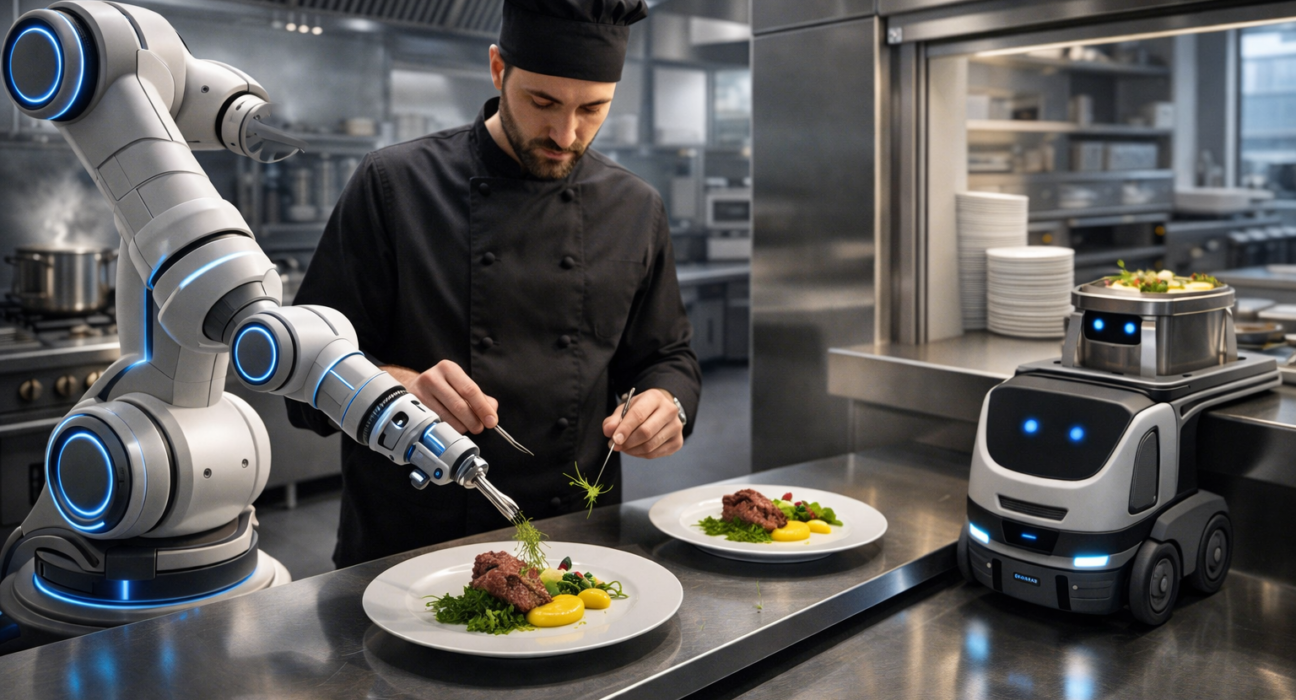
As of March 2026, the culinary landscape is undergoing a tectonic shift. If you’ve stepped into a fast-casual chain or a high-volume production facility recently, you’ve likely encountered the silent, tireless workers of the modern age: robots. Robots in the food industry are no longer a sci-fi trope or a niche experiment; they are a multi-billion dollar pillar of the global economy, projected to reach a market valuation of over $18 billion this year alone.
This transformation spans the entire “farm-to-fork” journey. It begins with AI-driven sorters that pick the perfect tomato and ends with autonomous sidewalk droids that bring a hot pizza to your doorstep. For business owners, these machines offer a solution to the persistent labor shortages that have plagued the industry since 2020. For consumers, they promise a level of consistency, hygiene, and speed that was previously unattainable.
Key Takeaways
- Market Growth: The food automation market has reached roughly $18.12 billion in 2026, driven by a 10.1% CAGR.
- Labor Efficiency: Automation typically reduces labor costs by 20–25% while improving table turnover by nearly 20%.
- Safety First: Robots are now a primary tool for FDA compliance, providing digital audit trails for food safety and temperature control.
- Diverse Applications: Technology ranges from heavy-duty articulated arms for palletizing to delicate “cobots” that work alongside human chefs.
Who This Guide Is For
This article is designed for restaurant owners and operators looking to scale, food manufacturing executives seeking efficiency, and tech-curious consumers who want to understand the mechanics behind their next meal. Whether you are considering a $100,000 investment in a robotic kitchen or simply want to know how delivery drones navigate your neighborhood, this guide provides a deep, expert-level dive into the state of food robotics today.
Safety & Financial Disclaimer: This article provides information on industrial trends and technology. It does not constitute financial or legal advice. Implementation of robotic systems should be done in compliance with local health department regulations and OSHA safety standards.
1. The Evolution of Food Automation: Why Now?
To understand where we are in March 2026, we must look at the “perfect storm” of the last five years. The food industry has historically been one of the slowest to adopt robotics due to the “irregularity” of food. Unlike a car part, every chicken breast is a different shape; every strawberry has a different level of ripeness.
However, three major breakthroughs have changed the game:
- Computer Vision: Advanced AI can now “see” in 3D, allowing robots to identify and handle delicate, non-uniform items.
- Soft Robotics: New “end-effectors” (the robot’s hands) use air-filled grippers to pick up an egg or a peach without bruising it.
- Labor Scarcity: With over 60% of restaurants reporting understaffing in early 2026, the “ROI” (Return on Investment) for a robot has dropped from five years to under eighteen months.
2. Primary Processing: The “Prep” Phase
Before food ever reaches a restaurant, it goes through a massive industrial prep phase. This is where articulated robots and SCARA (Selective Compliance Assembly Robot Arm) robots dominate.
Sorting and Grading
In 2026, the days of humans standing over a conveyor belt to pick out “bad” potatoes are largely over. Optical sorting machines use multi-spectral cameras to scan thousands of items per minute. They can detect internal rot, moisture levels, and even chemical compositions that the human eye cannot see.
- Grains and Pulses: AI sorters remove impurities like stones or glass with 99.9% accuracy.
- Seafood: The seafood segment is seeing an 18.4% growth rate in robotics because machines can now de-bone and portion fragile fillets with zero waste.
Pick-and-Place Operations
This is the “heavy lifting” of the industry. Articulated arms—those giant, multi-axis machines you see in car factories—are now used to palletize crates of soda or stack frozen meal trays. These robots can handle payloads from 5kg to over 50kg, operating in sub-zero freezers where human workers can only stay for short bursts.
3. The Robotic Chef: Inside the Commercial Kitchen
This is the most visible area of the “Robots in the Food Industry” revolution. We are seeing a shift from “single-task” machines to “modular kitchen cells.”
Automated Cooking Systems
Think of the automated pizza maker. Companies like Picnic have pioneered systems that can produce hundreds of pizzas per hour with perfect topping distribution.
- Flippy 3 (Miso Robotics): As of March 2026, the latest iteration of the famous frying robot is now standard in several major fast-food chains. It doesn’t just flip burgers; it uses AI to predict when a rush is coming and adjusts fry times accordingly.
- Pasta and Wok Bots: In Asian markets, robotic woks are now capable of mimicking the “breath of the wok” (wok hei) by using precise induction heating and tossing motions that ensure consistent flavor.
The Rise of “Cobots”
Collaborative robots, or cobots, are designed to work safely next to humans without the need for safety cages. In a 2026 kitchen, a cobot might be responsible for “repetitive prep”—chopping onions, portioning sauces, or plating salads—while the human chef focuses on the “creative” aspects, like flavor balancing and final garnishing.
Common Mistake: The “Set and Forget” Fallacy
Many operators believe a kitchen robot is a “buy once” solution. In reality, these machines require predictive maintenance. A common mistake is failing to account for the “washdown” requirements. In food environments, robots must be “IP69K rated,” meaning they can withstand high-pressure, high-temperature cleaning.
4. Front-of-House: The Service Revolution
If you’ve visited a sushi spot or a large hotel buffet recently, you may have been greeted by a server robot.
Table Service and Hosting
Robots like those from Bear Robotics or Pudu Robotics are now ubiquitous in mid-tier dining. These machines use SLAM (Simultaneous Localization and Mapping) technology to navigate around toddlers, spilled drinks, and moving chairs.
- Efficiency: A robot can carry four heavy trays at once, allowing human servers to stay on the floor to interact with guests rather than running back and forth to the kitchen.
- Consumer Sentiment: While some feared robots would feel “cold,” 2026 surveys show that customers appreciate the speed and the “novelty” factor, especially when robots are programmed with friendly personalities or used to sing “Happy Birthday.”
Smart Vending and Micro-Markets
The “vending machine” has evolved into a miniature robotic restaurant. As of March 2026, companies are deploying “salad stations” in airports and hospitals that assemble fresh, customizable bowls in under 90 seconds. These are essentially self-contained ghost kitchens.
5. Last-Mile Delivery: From Counter to Doorstep
The “Delivery” part of our title is where the most radical change is happening. The “last mile” is the most expensive part of the food supply chain, often accounting for 50% of total shipping costs.
Sidewalk Robots
Small, six-wheeled droids (like those from Starship Technologies) are now a common sight in over 60 cities worldwide.
- Capacity: Most models carry 20–40 pounds of food.
- Navigation: They use a suite of LiDAR, GPS, and cameras to cross streets and navigate sidewalks autonomously, with human “tele-operators” only stepping in for 1% of the journey.
Delivery Drones
In 2026, the FAA has expanded “Beyond Visual Line of Sight” (BVLOS) permissions. In suburban areas, VTOL (Vertical Take-Off and Landing) drones can deliver a hot meal within a 10-mile radius in under 15 minutes. This bypasses traffic entirely, ensuring your fries aren’t soggy when they arrive.
Case Study: The Ghost Kitchen Hub
Ghost kitchens (delivery-only restaurants) are the natural habitat for these robots. By 2026, we are seeing “clusters” where a robotic kitchen prepares the food and immediately hands it off to a waiting delivery droid at a specialized docking station. This “full-cycle” automation is what makes a $10 delivery feasible in a high-wage economy.
6. Food Safety and Traceability: The Silent Benefit
Beyond speed and cost, robots in the food industry are a major win for public health.
Digital Audit Trails
Under the FDA’s 2026 Human Foods Program deliverables, there is a massive push for “digital traceability.” Humans are prone to error when logging temperatures or cleaning schedules. Robots, however, record every millisecond of their operation.
- Automated HACCP: Systems now automatically log “Hazard Analysis and Critical Control Points.” If a refrigerator’s temperature dips for even five minutes, the IoT system sends an alert to the manager’s phone and tags any potentially affected ingredients.
- Contamination Reduction: By limiting “human-to-food” contact, the risk of norovirus or cross-contamination is significantly reduced.
7. Challenges and the Path Forward
It isn’t all smooth sailing. The industry faces significant “bottlenecks” in 2026:
- Initial CapEx: A fully automated prep line can cost upwards of $500,000. For small mom-and-pop shops, this is a bridge too far.
- Energy Consumption: Moving from gas-powered kitchens to high-output electrical robotic systems requires significant infrastructure upgrades.
- The “Human Element”: There is an ongoing debate about the displacement of entry-level workers. However, the 2026 consensus is that robots are “upskilling” the workforce—turning fry cooks into “robot technicians.”
Conclusion
The integration of robots in the food industry has reached a point of no return as of March 2026. We have moved past the era of “expensive toys” and into an era of “essential infrastructure.” From the articulated arms that pack our groceries to the sidewalk droids that deliver our dinner, automation is the only way to meet the global demand for fresh, safe, and affordable food.
The transition isn’t just about replacing people; it’s about augmenting them. By offloading the “3 Ds”—tasks that are Dull, Dirty, or Dangerous—to machines, we allow humans to return to the heart of hospitality: creativity, empathy, and service.
Your Next Step: If you are a business owner, start by conducting a “task audit.” Identify which 20% of your tasks are purely repetitive and look for modular “robot-as-a-service” (RaaS) models to test automation without a massive upfront investment.
FAQs (Schema-Style)
1. Are robots in the food industry safe for food handling?
Yes. Modern robots are designed with food-grade materials (like stainless steel and specialized plastics) and are IP69K-rated for high-pressure cleaning. They actually reduce the risk of foodborne illness by minimizing human contact and providing precise, automated temperature monitoring.
2. How much does a kitchen robot cost in 2026?
Costs vary by complexity. A simple server robot may cost $10,000–$15,000, while a fully integrated robotic frying station like “Flippy” can range from $30,000 to $100,000. Many companies now offer “Robot-as-a-Service” (RaaS) models with monthly fees starting around $2,000.
3. Will robots replace human chefs?
Unlikely. While robots excel at repetitive tasks (chopping, frying, portioning), they lack the sensory nuance for creative cooking, plating aesthetics, and flavor profile development. The 2026 trend is “Human-Robot Collaboration,” where chefs manage a fleet of machines.
4. What is the most common type of robot in food processing?
The Articulated Robot remains the most popular due to its flexibility and multi-axis movement. However, Delta robots are the industry standard for high-speed “pick-and-place” tasks, such as putting cookies into trays or sorting fruit.
5. Are delivery robots legal in all cities?
Not yet. While over 60 global cities have established legal frameworks for sidewalk robots as of 2026, many municipalities still have strict “pilot-only” rules or bans on heavy droids in high-pedestrian areas.
References
- FDA (2026): Human Foods Program Priority Deliverables and Guidance Agenda. [Official Govt Site]
- Fortune Business Insights (2026): Food Robotics Market Size, Share, & Trends 2026-2034. [Market Research]
- Coherent Market Insights: Global Restaurant Robots Market Forecast – 2026 to 2033. [Industry Analysis]
- Miso Robotics: Technical Specifications for Flippy 3 and Kitchen Automation. [Manufacturer Docs]
- IEEE Robotics & Automation Society: Standards for Food-Grade Robotic End-Effectors. [Academic/Technical]
- McKinsey & Company: The Future of Labor: Automation in the Food & Beverage Sector. [Strategic Analysis]
- Association for Advancing Automation (A3): 2025-2026 Industrial Robot Shipment Data. [Trade Association]
- World Agricultural Supply and Demand Estimates (USDA): Grains and Processing Trends. [Official Statistics]