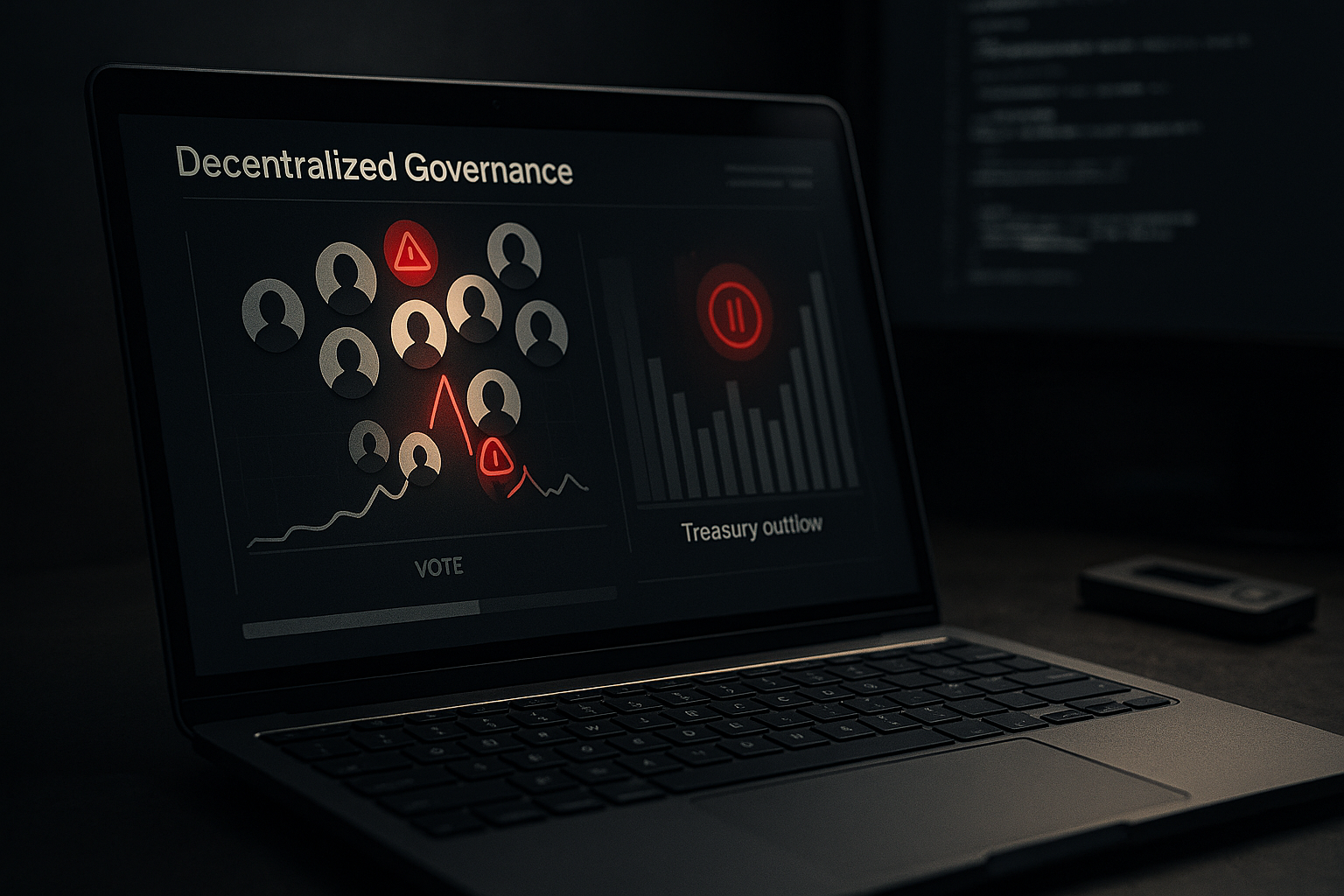
If you’re participating in or designing a decentralized autonomous organization, the risks in DAOs are not abstract—they are specific, repeatable patterns that can be anticipated and mitigated. In short, DAO risk spans people (collusion, apathy), process (governance rules, quorum), and code (smart contracts, oracles). A practical answer is a layered defense: strengthen identity and voting, harden contracts and treasuries, and monitor on-chain behavior continuously. Here’s a compact playbook to scan first, then dive deeper: set proposal thresholds that resist manipulation; snapshot voting power to defeat flash-loan attacks; use robust price oracles with circuit breakers; keep treasuries diversified and time-locked; and require incident-response drills with clear pause permissions. Follow the sections below to understand the top failure modes and how to guard against them. The goal is simple: reduce your attack surface and make bad outcomes improbable, detected early, and limited in blast radius. This article is educational and not legal, financial, or investment advice—consult qualified professionals for decisions that affect funds, compliance, or safety.
1. Collusion and Vote Cartels
Collusion occurs when a coordinated minority steers a vote against the broader community’s intent, often via private deals, off-platform promises, or outright vote markets. The direct answer is to make coordination harder to weaponize and less profitable: require meaningful proposal thresholds, use delegation programs that distribute influence, and add friction to last-minute vote swings. Collusion thrives in low-quorum contexts, ambiguous rules about conflicts of interest, and opaque delegation—so your baseline defense is sunlight and structure. Expect collusion risks to rise around high-value proposals (treasury transfers, parameter changes) and near voting deadlines when back-room deals are easiest. Design rules that force early signaling and longer deliberation, and treat disclosed conflicts as a first-class governance concern rather than an afterthought. When you do, you convert stealth pressure into public debate, where it is weaker.
How to mitigate
- Require proposal thresholds (e.g., a minimum percentage of total supply or delegated power) to advance to a vote.
- Enforce early locking of votes or progressive penalties for last-minute flips that change outcomes.
- Publish conflict-of-interest disclosures for large delegates; require recusal on self-benefiting proposals.
- Use quadratic voting/funding for public-goods decisions to blunt single-whale dominance.
- Maintain a delegate transparency page: voting history, attendance, rationale, conflicts.
Numbers & guardrails
- Set proposal thresholds between 1–5% of circulating or delegated supply for high-impact actions; lower for routine items with limited scope.
- Require at least two full days between proposal publication and voting to allow due diligence.
- Cap any single delegate’s influence by encouraging re-delegation programs when a delegate exceeds 10–15% of effective voting power.
Synthesis: Collusion can’t be outlawed by decree, but it can be priced out and surfaced early. Structure incentives so that legitimacy requires openness—and the cheapest path to victory is to persuade, not to conspire.
2. Sybil Attacks and Identity Evasion
A Sybil attack is when one actor pretends to be many, fragmenting identity to gain extra votes, grants, or roles. The direct fix is to separate personhood from wallet count by adding portable proofs of uniqueness and reputation. Early-stage DAOs often avoid this conversation, defaulting to “one token, one vote,” which leaves grants programs and quadratic mechanisms vulnerable to fake accounts. You don’t need perfect identity; you need enough friction that mass fabrication becomes unprofitable and detectable. Combine attestations (social graphs, verification badges, phone/email attestations, proof-of-humanity attestations) with rate limits, reputation decay for inactive wallets, and on-chain behavior analysis. Expect some false negatives and positives; the goal is to lower attack throughput and signal anomalies quickly.
How to mitigate
- Use Sybil-resistance frameworks (e.g., multi-source attestations and proofs of uniqueness) before allowing quadratic rewards or “one-human” votes.
- Add per-wallet caps for airdrops and grants, with stronger caps for newly created wallets.
- Gate sensitive actions behind age and activity requirements (e.g., minimum account age, prior participation).
- Introduce reputation points with decay to reward sustained contributors, not disposable identities.
- Monitor clustered funding patterns and batch-created addresses to flag probable farms.
Numbers & guardrails
- Require at least 7–14 days of wallet age and a minimum of 3–5 prior governance interactions before eligibility for quadratic benefits.
- For grants, set per-recipient ceilings (e.g., no more than 1–2% of a round’s pool to a single identity cluster).
- For voting, use proof bundles: at least 3 independent attestations (device, social, previous participation) to unlock “one-human” weightings.
Synthesis: You won’t eliminate Sybils entirely, but layered identity proofs, wallet-age gating, and behavioral analytics can make sock-puppet swarms too costly and too visible to matter.
3. Flash-Loan Governance Attacks
Flash loans let attackers borrow massive token amounts for a single transaction, briefly amassing voting power without real economic exposure. The answer is to decouple voting power from transient balances: snapshot voting at earlier blocks, impose timelocks between a vote’s end and execution, and require staked or time-locked voting power. Without these, a DAO can wake up to a malicious parameter change or a treasury drain pushed through in one burst. The core pattern is simple: borrow → vote → execute → repay. Your job is to break the chain wherever it’s cheapest—usually at the measurement point (snapshot at block N−k) and the execution gate (timelock plus veto or challenge window).
How to mitigate
- Snapshot balances from a block taken well before the voting window opens.
- Use timelock executors so enacted proposals wait before applying on-chain state changes.
- Require staked/escrowed governance tokens (vote-escrow, lock-ups) so voting power reflects longer-term commitment.
- Add a guardian pause or challenge process for high-risk actions (treasury transfers, role changes).
- For critical changes, require multi-step approvals (DAO vote → council sign-off → timelocked execution).
Numbers & guardrails
- Snapshot at least several thousand blocks before voting starts; extend for assets with high lending liquidity.
- Set timelocks of 24–72 hours for standard actions and longer for treasury movements.
- Require stake weights that scale with lock duration (e.g., 1× for liquid, 2× for 6-month lock, 4× for 2-year lock) to disincentivize mercenary voting.
Synthesis: Flash-loan threats vanish when your voting power can’t be conjured and redeemed in a single block. Make influence sticky and execution slow enough that alarms can ring.
4. Oracle Manipulation and Fragile Price Feeds
When protocols rely on external prices for treasury valuations, collateralization checks, or incentive calculations, attackers target the weakest data source. The quickest fix is aggregation and bounds: use time-weighted averages, multiple oracle sources, and circuit breakers that halt action when prices move too fast. Thin liquidity pairs are easy to push; single-source oracles can be spoofed; and naive “latest price” reads turn tiny pools into system-critical truth. Expect manipulation attempts near rebalancing events, liquidation thresholds, or large treasury swaps.
How to mitigate
- Favor median/mean across multiple feeds; avoid single-DEX spot reads for decisions with financial impact.
- Use TWAPs (time-weighted average prices) with windows sized to your asset’s normal volatility.
- Add circuit breakers that pause sensitive functions if price changes exceed a bound.
- Maintain an oracle fallback plan: freeze, switch source, or manually intervene under strict rules.
- Document oracle liveness and alerting—treat data silence as risk, not just data noise.
Numbers & guardrails
- For volatile assets, a TWAP window of 15–60 minutes often filters most manipulations while staying responsive.
- Trip circuit breakers at ±20–30% intraday moves for governance-critical operations; tighter for stablecoins.
- Require at least two independent oracle networks for parameters that gate treasury or liquidation events.
Synthesis: Oracles are opinions about reality. Use several, smooth the noise, and stop the system if reality seems implausible.
5. Smart Contract Bugs and Reentrancy
DAOs are software, and software has defects. The immediate answer is to minimize trusted code paths and follow defensive patterns—checks-effects-interactions, reentrancy guards, strict input validation, and least privilege. Upgradability adds flexibility but also complexity and new failure modes. Audits and formal verification reduce risk but don’t eliminate it; you still need internal code review, runbooks for pausing, and an active bug bounty that makes disclosure more attractive than exploitation. Focus first on contracts that touch funds, control upgrades, or connect to external protocols.
How to mitigate
- Apply checks-effects-interactions (CEI) and ReentrancyGuard where external calls are unavoidable.
- Keep upgrade admin rights in a timelocked, multi-sig-protected executor; treat upgrades as high-risk proposals.
- Maintain comprehensive testing with integration and property-based tests that simulate griefing and edge cases.
- Run a tiered bug bounty with clear scope and rewarded severities.
- Document and rehearse pause and rollback procedures.
Numbers & guardrails
- Aim for 80–100% unit-test coverage on core modules and targeted property tests for invariants.
- Plan pause permissions that can be exercised by at least two independent parties under strict criteria.
- Allocate a bug-bounty pool sized to at least 0.5–2% of treasury value at risk in core contracts.
Synthesis: Good engineering narrows attack surface, but your decisive edge is response speed. Build the habit of safe changes and the muscle memory to stop the bleeding fast.
6. Multisig Risks and Key-Holder Centralization
Many DAOs secure treasuries with multisignature wallets. The problem is concentrated power and human fallibility: lost devices, phishing, travel constraints, or insider collusion. The pragmatic fix is threshold design and process discipline. Choose a threshold high enough to deter abuse, low enough for timely operations, and spread signers across jurisdictions, time zones, and social circles. Harden endpoints with hardware wallets, allow-listing, and out-of-band confirmations. Above all, treat your signers as a rotating duty with audits and succession—never a permanent aristocracy.
How to mitigate
- Use t-of-n thresholds (e.g., 3-of-5, 4-of-7) with geographically distributed signers and device diversity.
- Implement spending limits, module allow-lists, and transaction simulation before signing.
- Maintain emergency keys with stricter thresholds and timelocks for high-value actions.
- Require regular key ceremonies: test recoveries, rotate compromised keys, and document custody.
- Deploy EIP-1271-compatible policy checks so dApps can verify contract-based signatures.
Numbers & guardrails
- For day-to-day ops, 3-of-5 is a practical minimum; for large treasuries or upgrades, prefer 4-of-7 or 5-of-9 with a timelock.
- Set per-transaction limits (e.g., ≤1–2% of treasury) for hot-path modules; larger movements go through governance.
- Require dual-channel confirmation (hardware wallet + separate secure messenger) for non-routine actions.
Synthesis: Multisigs are power tools. Make them hard to misuse, easy to audit, and never dependent on one person’s day going perfectly.
7. Treasury Management and Concentration Risk
Treasuries drift toward convenience: one or two assets, one venue, one custody model. That’s fragile. The direct remedy is diversification by asset, venue, and time, matched to a written risk budget. Stablecoins can depeg, governance tokens can crater, and high-yield strategies can fail silently. Write policy that balances operational simplicity with resilience: split holdings across stablecoins and majors, ladder maturities or vesting, and size positions so failures hurt but don’t kill. Track runway in conservative units, not hope.
How to mitigate
- Set a risk budget (max loss you can absorb) and allocate across assets and strategies accordingly.
- Diversify across stablecoin types, majors, and productive assets; avoid single-issuer concentration.
- Use time-based ladders (vesting, unlock schedules) to avoid being forced sellers.
- Adopt segregated accounts: hot, warm, cold; each with limits and purposes.
- Rebalance on rule-based triggers (price bands, position caps), not vibes.
Numbers & guardrails
- Keep ≤30–40% of assets in any single instrument or issuer; tighter if the issuer risk is correlated with your DAO.
- Maintain 6–18 months of conservative runway in highly liquid assets.
- Cap riskier strategies to ≤5–10% of treasury, with frequent reporting and kill switches.
Synthesis: A treasury’s job is survivability first, opportunity second. Diversify on purpose so one bad day can’t erase your future.
8. Liquidity Rugs and Exit Scams
A liquidity rug or exit scam drains value by withdrawing liquidity or selling large insider allocations after building public confidence. DAOs face this risk directly when launching tokens, incentivizing liquidity, or delegating deployer powers to teams. The immediate defense is credible commitment: locked liquidity, transparent vesting, and minimized administrator privileges. You also need on-chain monitors that alert members when liquidity ownership changes or large tranches unlock. Don’t assume “renounced ownership” alone is safety; many rugs use proxy patterns, hidden roles, or external control points.
How to mitigate
- Lock a meaningful fraction of liquidity in time-lock contracts with verifiable schedules.
- Publish vesting cliffs and linear unlocks for team and investor tokens; avoid opaque allocations.
- Limit admin roles; prefer immutable code for non-governance paths and strong review for upgradable modules.
- Stand up real-time alerts for LP ownership changes, large token movements, and unusual transfers.
- Require counterparty identification and audits for external teams that control deployer keys.
Numbers & guardrails
- Lock at least 50–80% of initial LP tokens for launch phases; document unlock cadence.
- For team allocations, target ≥12-month cliffs and gradual vesting to align incentives.
- Trigger alerts when any single address acquires ≥10% of circulating supply or LP shares.
Synthesis: Honest projects welcome delayed gratification and transparency. Design so that stealing is technically hard, publicly visible, and reputationally fatal.
9. Low Quorum and Voter Apathy
Low quorum means a small, motivated minority can pass impactful proposals while the majority stays silent. The fix is a combination of incentive design, process clarity, and sensible thresholds. Delegation programs convert passive holders into represented voters. Clear calendars and digestible proposal formats reduce cognitive load. And dynamic quorum models scale requirements with turnout or proposal risk. Treat governance like product: if it’s hard to use, people won’t.
How to mitigate
- Launch a delegate program with regular office hours and accountability reports.
- Use dynamic quorum or approval thresholds that respond to turnout and proposal type.
- Publish concise proposal templates with clear “what/why/how” sections and budget impacts.
- Offer lightweight incentives (reputation points, badges) for informed participation; avoid pure bribes.
- Schedule predictable voting windows and reminders so members can plan.
Numbers & guardrails
A compact table of practical starting points:
| DAO profile | Proposal threshold | Quorum target | Notes |
|---|---|---|---|
| Large, token-based | 1–3% of voting power | 5–10% | Use dynamic quorum scaling with turnout |
| Mid-size, active delegates | 0.5–1% | 7–12% | Strong delegation and reporting |
| Small, tightly knit | 0.2–0.5% | 10–20% | Consider approval quorum (yes minus no) |
Synthesis: You can’t will participation into existence, but you can make it easy, meaningful, and fairly weighted—so quiet doesn’t mean captured.
10. Proposal Spam and Governance Capture
Spam floods forums and voting queues with low-quality or extractive proposals, exhausting attention and slipping rent-seeking through. The straightforward counter is costly signals and quality gates: refundable deposits, reviewer checklists, and domain-specific working groups that pre-screen. Rate limiting and batching help, but the real win is aligning proposer incentives with community outcomes. Capture happens when a persistent minority masters process to push through self-serving changes; your defense is sunlight, documentation, and slow paths for high-risk items.
How to mitigate
- Require proposal deposits/bonds that are returned on minimum support or forfeited on spam.
- Maintain review committees or working groups with published rubrics for scope, impact, and risk.
- Use templated proposals with budget lines, milestones, and success metrics.
- Batch voting windows and limit how many high-impact proposals can be active simultaneously.
- Publish post-mortems for failed or harmful proposals to build institutional memory.
Numbers & guardrails
- Set deposits sized to 0.1–0.5% of requested funds or a fixed range scaled to DAO size.
- Limit concurrent high-impact proposals to 2–3 per voting window.
- Require at least two independent reviewers to sign off before a vote can be posted.
Synthesis: Make quality the path of least resistance. When spam is costly and scrutiny is routine, capture narratives wither in the daylight of good process.
11. Regulatory and Legal Ambiguity
DAOs sit at the edge of multiple legal regimes: corporate, securities, commodities, consumer protection, and data privacy. The answer isn’t to guess—it’s to wrap, document, and seek counsel. Many DAOs adopt legal wrappers for limited liability and clearer contracting with contributors. Token design and distribution create regulatory exposure; so do treasury activities and financial promises. Geography matters: what is tolerated in one jurisdiction may be restricted in another. Your risk program should inventory potential obligations and appoint responsible stewards who engage counsel and update policies as your scope evolves.
How to mitigate
- Consider legal wrappers (associations, foundations, LLCs) to manage liability and hiring.
- Maintain clear disclosures about governance powers, risks, and limitations of tokens and participation.
- Build KYC/AML-aware paths for activities that cross into regulated services or counterparties.
- Adopt privacy and data minimization practices for member information.
- Keep a policy register: who your counsel is, what guidance you follow, and when you last updated it.
Region-specific notes
- US: Scrutinize token features that look like investment contracts and any promises of profit from others’ efforts.
- EU: Pay attention to comprehensive digital-asset frameworks that may impose issuer and service-provider obligations.
- APAC and other regions: Licensing and exchange rules vary widely; assume nothing and document everything.
Synthesis: You can’t regulation-proof a DAO, but you can be deliberate. Wrap the org, write down the rules you live by, and keep professionals in the loop.
12. Forks, Vampire Attacks, and Community Splits
Open-source code invites forks; incentives invite vampire attacks (competing projects siphoning users, liquidity, or delegates). The immediate response is to build moats around people and processes, not just code. Strong contributor experience, fair rewards, and a consistent roadmap make forking less appealing. Where liquidity is mobile, lean on sticky incentives (time-weighted rewards, reputation carryover, retroactive funding) and community identity that treats migration as costly. In a split, your best defense is to be the credible home: predictable governance, reliable execution, and honest retrospectives.
How to mitigate
- Use time-weighted rewards and vesting so loyalty beats quick payouts.
- Invest in delegate and contributor programs: mentoring, recognition, and career pathways.
- Maintain migration-friendly but not migration-eager tooling—forks should be possible but must clear a high coordination bar.
- Communicate a public roadmap with transparent trade-offs to reduce rumor-driven churn.
- Track ecosystem partnerships—shared integrations make switching harder for attackers.
Numbers & guardrails
- Structure liquidity or reward programs with declining emissions and bonus multipliers for long-term participation.
- Target ≥70–80% retention of active contributors across major governance cycles; treat dips as risk signals.
- Limit single-counterparty dependency so a vampire can’t drain >20–30% of your core activity by moving one integration.
Synthesis: Forks are a feature of open systems. Keep your community the best place to build, and competitors will find it expensive to poach what matters most: people.
Conclusion
DAO risk is not a mystery; it is a checklist. People can collude, identities can be faked, credit can be borrowed to hijack votes, data can be bent, code can break, keys can fail, treasuries can concentrate, liquidity can vanish, attention can be exhausted, rules can be gamed, laws can bite, and communities can split. The pattern across all defenses is layering: distribute power, slow critical paths, verify sources, cap exposures, and prepare for incidents. If you implement thresholds, snapshots, timelocks, robust oracles, audits and bounties, disciplined multisigs, diversified treasuries, participation programs, proposal gates, legal wrappers, and sticky contributor incentives, you transform from brittle to resilient. The work never ends, but it gets easier when the habits are built and the runbooks are real. Take the list above, pick three weak spots this week, and harden them—your future self and your community will thank you.
FAQs
1) How do DAOs prevent flash-loan voting attacks?
Snapshot voting power at a prior block so borrowed tokens don’t count, add a timelock before execution, and require staked or time-locked governance tokens. A guardian or challenge mechanism for high-risk actions adds another tripwire. Combine these with alerts for unusual lending pool outflows during voting windows to spot suspicious influence spikes early.
2) What is a safe multisig threshold for a DAO treasury?
There is no single correct number, but 3-of-5 is a common minimum for routine operations and 4-of-7 or 5-of-9 for upgrades or large transfers. Distribute signers across devices and regions and pair thresholds with spending limits and transaction simulation. If a signer leaves or loses a device, rehearse key rotation so availability survives real-life chaos.
3) Are smart-contract audits enough to prevent hacks?
Audits reduce risk but don’t eliminate it. You still need robust testing, formalized change control, and a bug bounty that rewards disclosure. Many incidents are operational—misconfigured roles, unsafe oracles, rushed upgrades—so treat audits as one layer in a broader program that includes pause permissions, monitoring, and incident drills.
4) How can a small DAO reach quorum without inviting manipulation?
Use delegation to concentrate informed voting power, adopt dynamic quorum models that scale with turnout, and publish clear, simple proposal formats. Incentivize participation with reputation or contributor points rather than pure token rewards. Set proposal thresholds and deposits so that noise is costly but legitimate initiatives remain accessible.
5) What’s the difference between a rug pull and an exit scam in DAO contexts?
A rug pull usually focuses on liquidity removal—pulling LP tokens to crash price—while an exit scam often involves treasury or admin abuse, draining funds via privileged roles or hidden upgrade paths. Defenses overlap: locked liquidity, minimized admin privileges, transparent vesting, and real-time alerts for large movements and role changes.
6) Which metrics should a DAO monitor to spot risk early?
Track voter turnout, delegate concentration, proposal pass/fail rates, treasury concentration by issuer, oracle deviation from market prices, and sudden changes in lending pool balances for governance tokens. Add signer availability for multisigs and alert on abnormal transaction patterns. These become your early-warning dashboard for governance, market, and operational stress.
7) Should DAOs use KYC for members or contributors?
It depends on activities and jurisdictions. Some roles and counterparties may require identity checks, while general participation can remain pseudonymous. A pragmatic approach is tiered access: low-risk actions remain open, but actions with regulatory or financial implications require extra verification, clear disclosures, and measured data handling to respect privacy.
8) When should a DAO pause contracts?
Define explicit criteria: detected exploit patterns, oracle divergence beyond thresholds, or governance anomalies such as sudden, concentrated vote swings. A pause should be time-bounded, logged on-chain, and require a higher threshold to unpause. When used sparingly and transparently, pausing converts catastrophic losses into controlled maintenance windows.
9) How do you evaluate a DAO’s token distribution for governance health?
Look at the top-holder curve and delegated power: if a handful of entities control double-digit percentages, the DAO is fragile. Healthy designs spread influence through delegation and caps, with rising costs for dominance. Historical voting data confirms whether distributed ownership translates into distributed decision-making or if apathy lets a few run the table.
10) What insurance options exist for DAOs?
Options include protocol-native cover, mutualized risk pools, and traditional policies via legal wrappers. Coverage terms vary widely, so scrutinize exclusions, claim governance, payout triggers, and counterparty risk. Even partial cover helps if paired with incident-response plans, bounties, and strong engineering—insurance should complement, not replace, solid controls.
References
- Reentrancy Guard — OpenZeppelin Docs. OpenZeppelin. https://docs.openzeppelin.com/contracts/4.x/reentrancy
- Data Feeds — Chainlink Documentation. Chainlink. https://docs.chain.link/data-feeds
- What Is Safe Multisig. Safe. https://docs.safe.global/learn/what-is-safe-multisig
- Snapshot Documentation. Snapshot. https://docs.snapshot.org/
- MakerDAO Governance. MakerDAO. https://docs.makerdao.com/governance
- DAOs Are Not Corporations. Vitalik Buterin’s Blog. 2022-09-20. https://vitalik.ca/general/2022/09/20/daos.html
- Quadratic Funding. Gitcoin Docs. https://docs.gitcoin.co/m grants/quadratic-funding (overview section)
- EIP-1271: Standard Signature Validation Method for Contracts. Ethereum Improvement Proposals. https://eips.ethereum.org/EIPS/eip-1271
- Rug Pulls — A Deep Dive. Chainalysis. https://blog.chainalysis.com/reports/rug-pulls/
- Oracle Security Considerations. Chainlink Docs. https://docs.chain.link/architecture-overview/contract-updates-and-security-considerations