The internet is witnessing a cyclical migration. For over a decade, online discourse was aggressively consolidated into a handful of “town squares”—massive, centralized platforms like Reddit, Twitter (now X), and Facebook. These platforms promised convenience and scale, swallowing up the independent bulletin boards and niche forums that characterized the web of the early 2000s. However, as 2026 unfolds, the tide is turning. Driven by unpopular algorithmic changes, aggressive monetization, and a perceived decline in user agency—often described by the term “enshittification”—users are rediscovering the value of smaller, purpose-built communities.
This isn’t just a nostalgic regression; it is a technological evolution. The “return of forums” is powered by new protocols, federated structures, and a renewed desire for digital sovereignty. We are moving away from the era of the “user” who is fed content, back to the era of the “member” who builds community.
In this comprehensive guide, we will explore the landscape of modern digital communities. We will dissect the rise of the Fediverse, evaluate the best Reddit alternatives available today, and examine why the walled gardens of Discord and the open plains of federated forums are becoming the new homes for meaningful online conversation.
Key takeaways
- The pendulum swing: The centralization of the 2010s is giving way to a new era of decentralization and niche communities.
- Federation is the future: Protocols like ActivityPub allow distinct communities to interact without sharing a single owner, similar to how email works.
- Privacy over reach: Many users are trading the massive reach of public feeds for the intimacy and safety of semi-private servers like Discord or niche forums.
- Ownership matters: The core driver for this shift is a desire for community ownership and freedom from corporate algorithms that prioritize engagement over quality.
- The learning curve: While powerful, these new alternatives often require a higher level of technical literacy than their mainstream counterparts.
The driving force: Why leave the giants?
To understand where we are going, we must understand why we are leaving. The migration away from platforms like Reddit is not accidental; it is the result of structural shifts in how the modern web operates.
The “Enshittification” lifecycle
Coined by writer Cory Doctorow, “enshittification” describes how platforms die: first, they are good to their users; then they abuse their users to make things better for their business customers; finally, they abuse those business customers to claw back all the value for themselves. For Reddit and similar platforms, this manifested in API restrictions, the killing of third-party apps, increased ad loads, and the commodification of user data for AI training.
Users who spent years building communities realized they were essentially “digital sharecroppers”—working on land they didn’t own, subject to eviction or rule changes at any moment.
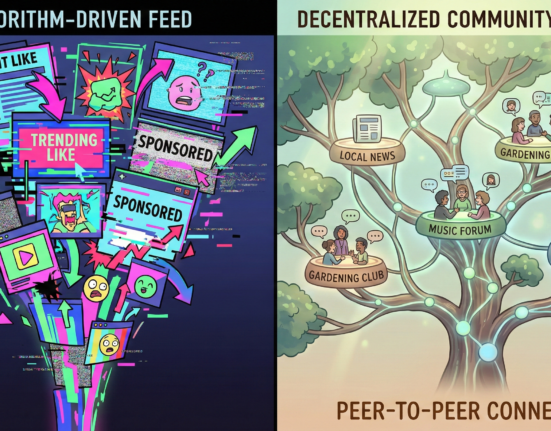
The algorithmic fatigue
Mainstream platforms thrive on engagement, which often means prioritizing outrage, conflict, and low-effort, high-dopamine content. This degrades the quality of discourse. Users seeking genuine advice, technical support, or deep hobbyist discussion find their conversations drowned out by repost bots and engagement bait. The return to forums is a rejection of the algorithm in favor of the chronological feed and the human moderator.
The quest for a “Third Place”
Sociologist Ray Oldenburg defined the “third place” as a social surrounding separate from the two usual social environments of home (first place) and the workplace (second place). In the physical world, these are cafes, libraries, and parks. In the digital world, forums used to serve this function. Social media turned these third places into performance stages. The new wave of forums seeks to reclaim the “cozy web,” where interaction is about connection, not performance.
1. The Federated Web (The Fediverse)
The most significant technological development in the return of forums is the “Fediverse”—a portmanteau of “federation” and “universe.”
Definition and mechanism
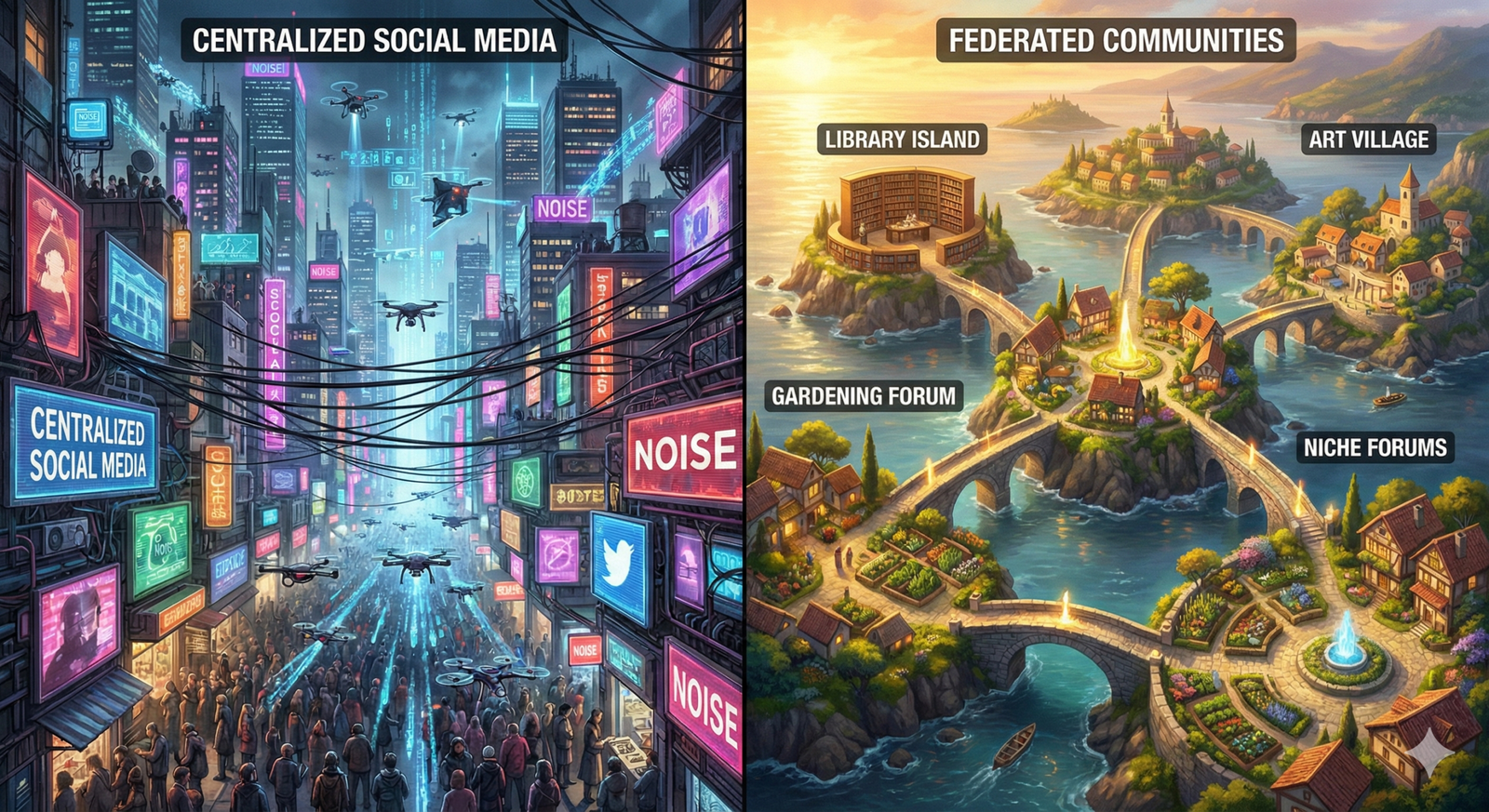
In a centralized model (like Reddit), one company owns the servers, the user data, and the rules. If you are banned from Reddit, you are banned from every community on Reddit.
In a federated model, the network is composed of thousands of independently owned servers (instances) that can talk to each other. It works exactly like email.
- Centralized: If you have a Gmail account, you can only email other Gmail users (this is how Facebook works).
- Federated: If you have a Gmail account, you can email someone with an Outlook, Yahoo, or corporate email address. They are different providers, but they speak the same language.
In the Fediverse, the shared language is a protocol called ActivityPub. This allows a user on “Server A” to subscribe to a community on “Server B” and upvote a post by a user on “Server C,” all without leaving their home server.
Key advantages of federation
- Censorship resistance: There is no central authority to shut down the entire network. If one server goes rogue or shuts down, the rest of the network survives.
- Local moderation: Each server sets its own rules. One server might be strictly “Safe for Work,” while another allows looser speech. Users choose the server that matches their values.
- No lock-in: If you don’t like how your server administrator is running things, you can move your account to a different server (often bringing your followers/data with you) while staying connected to the same wider network.
2. Top federated Reddit alternatives
If you are looking for a Reddit-like experience—threaded conversations, upvoting/downvoting, and community-driven content aggregation—the Fediverse offers several robust options.
Lemmy
Best for: General audiences, open-source advocates, and those seeking a direct Reddit clone.
Lemmy is currently the most popular federated link aggregator. It looks and feels very similar to old-school Reddit.
- Structure: It is organized into “communities” (similar to Subreddits).
- Technology: Written in Rust, it is fast and efficient.
- The Experience: You sign up on a specific “instance” (e.g., lemmy.world or sh.itjust.works). Once registered, you can browse communities hosted on your instance or search for communities hosted on other instances.
- Pros: Large user base (relative to alternatives), familiar UI, good mobile app support (apps like Voyager, Thunder).
- Cons: The learning curve of choosing an instance can be confusing for newcomers. Early political friction between instance admins caused some “defederation” (servers blocking each other), fragmentation of the network.
Kbin (and Mbin)
Best for: Users who want a hybrid of Reddit and Twitter.
Kbin takes a different approach. It aggregates not just links and threads, but also “microblogging” posts (short, tweet-like updates) from the wider Fediverse (like Mastodon).
- Structure: Content is organized into “Magazines.”
- The Experience: It feels more magazine-like and visually polished than the utilitarian Lemmy. It handles cross-platform content better, allowing for a more seamless integration of different types of media.
- Pros: Elegant design, versatile content types, strong privacy focus.
- Cons: Smaller user base than Lemmy; development pace has varied.
Beehaw
Best for: High-quality, strictly moderated, civil discourse.
Beehaw is actually a specific instance of Lemmy, but it deserves special mention because of its philosophy. It grew rapidly as a “safe haven” during the Reddit exodus.
- Philosophy: Radical civility. It is not a place for aggressive debate or “free speech absolutism.” It is a curated garden.
- The Catch: To maintain quality, they often restrict sign-ups or require an application. They also aggressively “defederate” (block) instances they deem toxic.
- Pros: Incredible signal-to-noise ratio; very friendly environment.
- Cons: You are cut off from large parts of the wider Fediverse; getting in can be difficult.
3. The resurgence of standalone forums
While the Fediverse tries to link everyone together, another trend is the revival of the completely independent, standalone forum. These are islands by design, and that is their strength.
The Discourse revolution
If you have visited a modern forum recently, it was likely running on Discourse. This open-source software modernized the forum experience with infinite scrolling, dynamic notifications, and a mobile-friendly design, replacing the clunky “pagination” of 1990s bulletin boards (like phpBB or vBulletin).
Why they are winning:
- Vertical depth: Specialized hobbies (mechanical keyboards, espresso, coding languages) benefit from deep archives and persistent knowledge, not the “vanishing” nature of social feeds.
- SEO value: Unlike Discord or Facebook Groups, standalone forums are indexable by Google. This means the knowledge created there helps the wider internet, rather than being locked in a black box.
- Examples: The intense, high-value discussions found on forums like BladeForums (knives), Head-Fi (audio), or various automotive forums prove that for expertise, nothing beats a dedicated forum.
Tildes
Best for: People who miss the “old internet” and hate engagement algorithms.
Tildes is a non-profit, open-source community with a unique philosophy: no images in the feed, no low-effort memes, and strictly high-quality discussion.
- The Mechanic: There is no “downvote” button for disagreement, only “exemplary” or “off-topic” tags. The goal is to encourage thoughtful reading.
- Exclusivity: It is invite-only (though invites are periodically available), which keeps the growth rate manageable and the culture assimilative.
- Pros: Exceptionally high-quality text-based discussion.
- Cons: Small user base; no instant gratification.
Hacker News (HN)
Best for: Tech, startup, and intellectual curiosity.
While hosted by Y Combinator, HN remains the gold standard for a standalone link aggregator. It is centralized, archaic in design, and brutally moderated, yet it remains the most influential forum in the technology sector. It proves that fancy UI is secondary to community quality.
4. Walled gardens: The shift to Discord and Slack
A massive portion of the “forum” energy has shifted not to open websites, but to semi-private chat servers.
Discord: The new default forum
Originally for gamers, Discord has morphed into the default community hub for almost everything—YouTubers, open-source projects, crypto communities, and local clubs.
- The “Forum Channel”: Discord recently introduced “Forum Channels” which allow for threaded conversations that don’t disappear as quickly as chat logs.
- The appeal: It is real-time. It feels alive. It offers voice and video streaming natively.
- The downside: It is a “black hole” for information. Answers given in a Discord server cannot be Googled. This leads to the same questions being asked daily. It is also not interoperable; if Discord bans you, you lose access to all your communities.
Slack and Mattermost
For professional communities, Slack (and its open-source alternatives like Mattermost) serves as the modern professional forum. Many industries have “shadow” Slacks where the real networking and knowledge sharing happens, away from the public eye of LinkedIn.
5. How to choose your new base
With the fragmentation of the social web, there is no longer a “one size fits all” default. You must actively choose where to invest your digital time. Here is a framework for choosing:
Criteria 1: The “Bus Factor” (Ownership)
- Centralized (Reddit/Discord): High risk. The company can change rules, add ads, or sell data.
- Federated (Lemmy/Mastodon): Medium risk. Your instance admin could quit, but you can move your account.
- Self-Hosted: Low risk. You own the data, but you bear the technical burden and cost.
Criteria 2: Visibility vs. Intimacy
- Public Forums: Good if you want your questions to help others in the future (searchable).
- Private Chats (Discord): Good if you want immediate camaraderie and “hanging out” vibes, but bad for archiving knowledge.
Criteria 3: Moderation Style
- Algorithmic: You see what makes you angry or engaged (Mainstream Social).
- Community-Led: You see what the community votes up (Lemmy/Reddit).
- Curated: You see what the admins think is high quality (Tildes/Beehaw).
6. Challenges of the new era
The transition back to a decentralized web is not without friction. Moving from a convenient monopoly to a diverse ecosystem requires effort.
The “Empty Room” problem
When you join a new Lemmy instance or a niche forum, it may feel quiet compared to Reddit. This is natural. A feed that moves slower often contains higher quality interaction, but it lacks the dopamine hit of an endless scroll.
Discovery friction
There is no central algorithm to feed you content. You must actively search for communities, subscribe to them, and curate your own feed. This requires “active” usage rather than “passive” consumption.
Fragmentation
If the mechanical keyboard community splits into three different Lemmy instances, two Discords, and an old-school forum, the collective knowledge is fractured. This is the price of freedom: lack of consensus.
7. Technical primer: How to join the Fediverse
For those ready to make the leap to a federated Reddit alternative like Lemmy, here is a practical, step-by-step guide.
Step 1: Choose an Instance (Server) Think of this like choosing an email provider. It determines your local rules and your username address (e.g., @user@lemmy.world).
- Lemmy.world: The largest, generic server. Good for beginners.
- Sh.itjust.works: A large, general-purpose tech-focused server.
- Specific Instances: Look for servers dedicated to your region or specific political/social interests for a tighter-knit community.
- Tip: Check the server’s “About” page for their moderation policy and “blocked instances” list.
Step 2: Create an Account Sign up. This usually requires an email and a password. Some instances require approval to prevent spam.
Step 3: Subscribe to Communities This is the tricky part. You can browse communities on your own server easily. But if you want to subscribe to a community on a different server, you need to use the search bar.
- Format: !community_name@instance_domain
- Example: Searching for !technology@lemmy.world from a different server will locate that community and let you hit “Subscribe.”
Step 4: Get an App The web interface is functional, but mobile apps offer a smoother experience.
- iOS: Mlem, Memmy, Thunder.
- Android: Jerboa, Connect, Thunder.
8. Looking ahead: The future of online communities
As we move toward 2030, the “Return of Forums” suggests a bifurcation of the internet.
The “Commercial Web” will remain dominated by AI-generated content, influencers, and massive ad-driven algorithms. It will be loud, fast, and largely superficial.
The “Community Web” (the Fediverse, private Discords, niche forums) will become the repository of human experience. It will be smaller, slower, and human-moderated.
We are seeing the emergence of “The Cozy Web”—a retreat from the public square into the digital living room. The success of a community in 2026 is no longer defined by how many millions of users it has, but by the density of trust between the users it retains.
The tools are maturing. The protocols (ActivityPub) are becoming standards (even Threads by Meta is experimenting with integration). The return of forums is not just a trend; it is a correction. It is the internet healing itself, creating spaces where people can once again be people, rather than data points.
Conclusion
The era of the monolithic social media giant is cracking. While Reddit and Twitter remain massive, their monopoly on discourse has shattered. The return of forums—whether through the federated innovation of Lemmy and Kbin, the polished focus of Discourse forums, or the real-time energy of Discord—offers a diversity of choice we haven’t seen in fifteen years.
Navigating this new landscape requires more effort than simply downloading an app. You must choose your server, curate your feed, and perhaps even donate to keep the lights on. But the reward is a digital life that belongs to you and your community, not to an advertiser. The best time to plant a tree was twenty years ago; the second best time is now. The same applies to building the community you wish to see online.
Next steps
- Browse the Fediverse: Visit a site like lemmy.world or kbin.social just to browse the “All” feed and see the culture.
- Audit your usage: Ask yourself which Reddit communities bring you value. Search for their alternatives on the Fediverse or look for dedicated standalone forums.
- Join a niche: Find one specialized forum using Discourse or a specific Discord server for your hobby. Introduce yourself. Start building social capital in a place where you aren’t just a metric.
FAQs
Q: Is the Fediverse safe for casual users? A: Generally, yes, but it depends on the “instance” (server) you choose. Major instances like lemmy.world have strict moderation policies against hate speech and illegal content, similar to Reddit. However, because it is decentralized, there are unmoderated corners of the Fediverse. Stick to reputable, moderated instances for a safe experience.
Q: Can I use my Reddit account to log into Lemmy or Kbin? A: No. These are completely separate ecosystems. You will need to create a new account. However, there are no “verified email” requirements for many servers, making anonymity easy to maintain if desired.
Q: What happens if the server I join shuts down? A: If a server shuts down, you lose the account and data hosted on that specific server. This is the risk of federation. However, the protocol usually allows for data exports. Many users maintain accounts on a couple of different servers or donate to their admins to ensure stability.
Q: Why are people using Discord as a forum alternative? A: Discord offers immediate, real-time gratification and very strong moderation tools for admins. It feels like a private club rather than a public billboard. However, the trade-off is discoverability; information in Discord is hard to find later.
Q: Is “federated” the same as “blockchain” or “crypto”? A: No. Federation (like ActivityPub) has nothing to do with blockchain, cryptocurrency, or NFTs. It is standard server technology, similar to how email or websites work, just connected in a specific way. It does not require a wallet or tokens.
Q: How do these free forums make money without ads? A: Most federated instances and niche forums rely on community donations (Patreon, Ko-fi, OpenCollective) or are funded out-of-pocket by enthusiasts. Some larger ones may have non-intrusive sponsorships, but the primary model is user-supported sustainability, not profit maximization.
Q: Can I view Fediverse content without an account? A: Yes. Most Lemmy and Kbin instances are public web pages. You can browse threads, read comments, and view images just like you would on a public website. You only need an account to post, vote, or comment.
Q: What is the difference between Mastodon and Lemmy? A: Both are part of the Fediverse. Mastodon is a microblogging platform (like Twitter/X) focused on short posts and following people. Lemmy is a link aggregator (like Reddit) focused on threaded discussions, communities, and voting on content.
References
- World Wide Web Consortium (W3C). (2018). ActivityPub Recommendation. https://www.w3.org/TR/activitypub/
- Doctorow, C. (2023). The Enshittification of TikTok (and other platforms). Wired. https://www.wired.com/story/tiktok-platforms-cory-doctorow/
- Lemmy Project. (n.d.). Join Lemmy: A decentralized link aggregator. https://join-lemmy.org/
- Discourse. (n.d.). Civilized Discussion: The Discourse Blog. https://blog.discourse.org/
- Oldenburg, R. (1989). The Great Good Place. Da Capo Press. (Foundational text on “Third Places”).
- Kbin Project. (n.d.). Kbin: Content Aggregator and Microblogging. https://kbin.pub/
- FediDB. (2025). Fediverse Network Statistics. https://fedidb.org/ (For current stats on active instances and user counts as of early 2026).
- Tildes. (n.d.). Tildes Docs and Philosophy. https://docs.tildes.net/
- Reddit. (2023). API Changes and Updates. Official Reddit Blog. (Context for the migration). https://www.redditinc.com/blog