
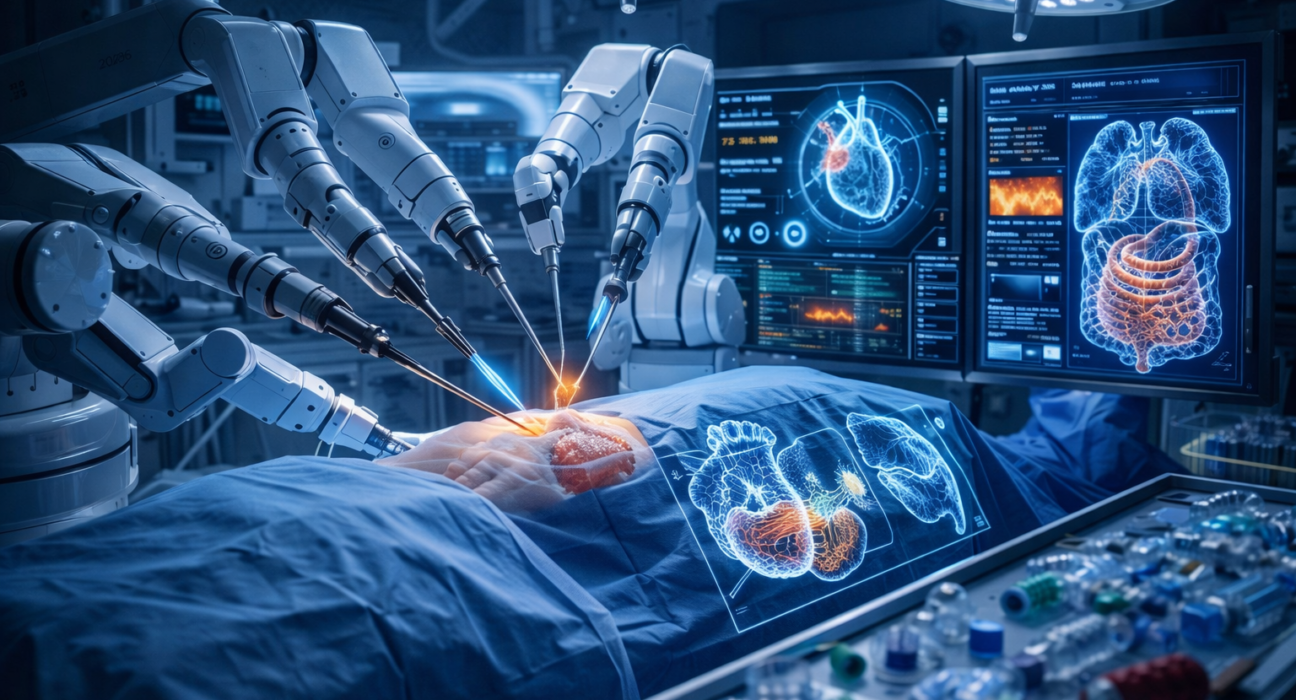
The integration of Artificial Intelligence (AI) into the operating room (OR) is no longer a futuristic concept; as of March 2026, it is a clinical standard. Surgical AI represents the ultimate convergence of data science and mechanical precision, shifting the paradigm from a “one-size-fits-all” surgical approach to the era of precision medicine. By leveraging machine learning, computer vision, and real-time predictive analytics, surgeons can now navigate complex anatomical landscapes with a level of accuracy that was physically impossible just a decade ago.
Key Takeaways
- Precision and Safety: AI-driven systems reduce intraoperative complications by up to 30% through real-time tissue identification and hazard alerts.
- Efficiency: Automated surgical workflows and predictive scheduling have increased OR throughput by 15% in major metropolitan hospitals.
- Human-Centric Design: Surgical AI acts as a “clinical co-pilot,” enhancing the surgeon’s skills rather than replacing their judgment.
- Patient Outcomes: Data-driven recovery models enable personalized post-operative care, significantly reducing readmission rates.
Who This Is For
This guide is designed for surgical professionals, hospital administrators, medical technology developers, and healthcare policy-makers. It serves as a comprehensive deep dive into the technical, clinical, and ethical landscape of AI-enhanced surgery, providing a roadmap for those looking to implement or understand the next generation of precision medicine.
1. The Foundations of Surgical AI: From Tools to Intelligence
To understand the impact of surgical AI, we must first distinguish it from traditional surgical technology. For decades, “advanced” surgery meant better optics or more ergonomic manual tools. Digital surgery, however, introduces a “brain” into the loop. As of March 2026, the global market for AI in the operating room has surpassed $1.3 billion, driven by a shift from simple hardware to software-as-a-service (SaaS) models that learn from every procedure.
The Evolution of the Digital Surgeon
The journey began with basic robotic assistance, where the machine simply mirrored the surgeon’s hand movements. Today, we have moved into the era of shared autonomy. In this framework, the AI “perceives” the environment through computer vision, “reasons” by comparing the live feed to millions of hours of training data, and “acts” by providing haptic feedback or visual overlays to the surgeon.
Precision Medicine Defined in the OR
In a surgical context, precision medicine means tailoring the operation to the specific unique anatomy and physiology of the individual patient. No two gallbladders are in the exact same spot; no two vascular networks are identical. Surgical AI uses pre-operative data (CT, MRI) and intraoperative reality to create a customized “surgical GPS” for every case.
2. Pre-operative Planning and the Rise of the Digital Twin
The “impact” of the OR starts long before the first incision. One of the most significant breakthroughs in 2025 and early 2026 is the mainstreaming of Digital Twin Surgery.
Modeling the Individual
A Digital Twin is a virtual, high-fidelity replica of the patient’s specific organ or system. Using AI algorithms, surgeons can now aggregate genetic markers, historical health records, and 3D imaging to simulate an entire procedure in a virtual environment.
- Scenario Testing: A surgeon can “operate” on the digital twin multiple times to find the optimal trajectory for a tumor resection.
- Risk Prediction: AI models like the POTTER (Predictive Optimal Trees in Emergency Surgery Risk) calculator now outperform traditional scoring systems by identifying patients at high risk for sepsis or cardiac events before they even enter the building.
Patient Counseling and Consent
Precision medicine also transforms the patient experience. Instead of looking at a generic diagram, patients in 2026 are often shown a 3D VR rendering of their own anatomy. This “human-first” transparency builds trust and ensures that informed consent is truly informed.
3. Computer Vision: The “Eyes” of the Modern OR
Computer vision (CV) is perhaps the most transformative sub-field of surgical AI. By analyzing the video feed from an endoscope or overhead camera in real-time, CV systems provide insights that the human eye might miss due to fatigue or cognitive overload.
Real-Time Tissue Identification
One of the “Common Mistakes” in traditional surgery is the accidental injury of critical structures, such as the bile duct during a cholecystectomy. Modern CV models, trained on millions of frames of surgical video, now provide a “Safety Map” overlay.
- Green Zones: Safe areas for dissection.
- Red Zones: Proximity to nerves, major vessels, or sensitive ducts.
The Milestone of March 2026: Perimeter Medical’s “Claire”
A landmark event occurred on March 3, 2026, when the FDA approved “Claire,” the first AI-enabled imaging device specifically for breast cancer surgery. This system uses optical coherence tomography (OCT) and AI to evaluate tumor margins in real-time. Previously, 20% of breast cancer patients required a second surgery because margins were found to be “positive” (containing cancer) days after the initial procedure. With Claire, surgeons can identify and remove residual cancer before the patient ever leaves the table.
Automated Blood Loss Estimation
Quantifying blood loss has historically been a guessing game. AI-driven vision systems now scan surgical sponges and suction canisters to provide a precise, milliliter-by-milliliter count of blood loss, allowing anesthesiologists to manage fluids and transfusions with surgical precision.
4. Robotic-Assisted Surgery (RAS) and Supervised Autonomy
As of late 2025, the release of the da Vinci 5 changed the landscape of robotic-assisted surgery. While earlier models focused on dexterity, the latest generation focuses on “intelligence” and “sensing.”
Force Feedback and Haptics
One of the long-standing criticisms of robotic surgery was the lack of “feel.” Surgeons couldn’t tell how hard they were pulling on a suture or how much pressure they were applying to delicate tissue. The latest AI-driven robots use force-sensing technology to provide artificial haptic feedback. If a surgeon applies too much pressure, the system provides resistance or an audible alert, preventing “iatrogenic” (doctor-induced) trauma.
Supervised Autonomy: The “Auto-Suture” Assistant
We are not yet at the stage of fully autonomous “robot surgeons,” but we have reached supervised autonomy. Tasks that are tedious and prone to human error—such as suturing a long incision or stabilizing a camera—can now be offloaded to the AI.
- The Surgeon’s Role: The surgeon sets the parameters and watches as the robot performs the task with sub-millimeter consistency.
- Safety Interlocks: The AI is programmed with “No-Fly Zones,” ensuring that even an autonomous arm cannot enter a restricted anatomical area.
5. Intraoperative Decision Support: The AI Co-Pilot
The OR is a high-stress environment where decisions must be made in seconds. AI acts as a cognitive buffer, filtering vast amounts of data into actionable insights.
Predictive Risk Scoring
During a procedure, the AI monitors the patient’s vitals, the surgeon’s movements, and the progress of the operation. If it detects a pattern that historically leads to an intraoperative complication—such as a specific drop in oxygen saturation combined with a certain heart rate variability—it flags the anesthesiology and surgical teams before the crisis occurs.
Surgical Phase Recognition
AI models can now “understand” which phase of the surgery is occurring. If a surgeon skips a critical safety step (like the “Time Out” or a specific check for hemostasis), the system can pause the workflow or display a checklist on the primary monitor. This reduces “never events”—serious, preventable medical errors that should never happen.
6. Post-operative Impact: Beyond the Incision
The impact of surgical AI does not end when the patient is moved to the PACU (Post-Anesthesia Care Unit). Precision medicine continues into the recovery phase through predictive modeling and continuous monitoring.
Early Detection of Complications
AI-driven predictive models can analyze post-operative data (vitals, wound drainage, inflammatory markers) to predict surgical site infections (SSIs) or internal leaks up to 24 hours before clinical symptoms appear.
- Case Study: In a 2025 study of 1,200 colorectal surgeries, AI models identified anastomotic leaks with 85% accuracy, allowing for early intervention and a 40% reduction in ICU stay duration.
Personalized Rehabilitation
Because the AI has “seen” the entire surgery, it knows exactly how much tissue was manipulated and how much stress the body underwent. It can then generate a personalized “smart recovery” plan, including tailored physiotherapy schedules and automated remote monitoring alerts for the patient’s smartphone.
7. Challenges, Ethics, and the “Black Box” Problem
Despite the undeniable benefits, the integration of AI in the OR faces significant hurdles. As of 2026, the medical community is grappling with the ethical “Black Box”—the reality that we don’t always know how a deep-learning model reached its conclusion.
The 2026 ISE Consensus Framework
In early 2026, the Institute for Surgical Excellence (ISE) convened a conference to establish the first global standards for human-AI collaboration. The resulting framework focuses on three pillars:
- Accountability: Establishing that the lead surgeon remains the ultimate decision-maker, even when following AI guidance.
- Transparency (XAI): Pushing for “Explainable AI” where the system must be able to justify its alerts (e.g., “Warning: 88% probability of nerve proximity based on vascular pattern”).
- Algorithmic Bias: Ensuring that training data includes diverse patient populations. An AI trained only on one demographic may not be as accurate when operating on patients of different ethnicities or body types.
Common Mistakes in AI Implementation
Hospitals often fall into “The Tool Trap”—buying the latest robot without investing in the “human-in-the-loop” training.
- Over-reliance: Surgeons may become “cognitively lazy,” trusting the AI’s “Green Zones” without manually verifying anatomy.
- Data Silos: Implementing AI in the OR without integrating it into the Electronic Health Record (EHR) limits the system’s ability to learn from long-term patient outcomes.
8. Specialized Use Cases: AI in Action (March 2026)
Cardiac Surgery: The Intercontinental Reach
In 2025, the first intercontinental robotic cardiac surgery was performed, with a surgeon in France operating on a patient in India. AI was the “glue” that made this possible, compensating for “latency” (signal lag) by predicting the surgeon’s movements and smoothing out the robotic response in real-time.
Orthopedics: The Perfect Fit
In joint replacements, AI-driven navigation now ensures that implants are aligned within 0.5 degrees of the patient’s mechanical axis. This precision has led to a 10% increase in the “lifespan” of prosthetic knees and hips.
Oncology: Real-time Margin Assessment
As mentioned with the “Claire” system, the ability to see cancer at the cellular level during surgery is the holy grail of oncology. AI-driven fluorescence imaging (using dyes that stick only to cancer cells) allows surgeons to perform “targeted resections,” saving as much healthy tissue as possible while ensuring the cancer is gone.
Conclusion: The Path Forward for Surgical AI
The impact of surgical AI on precision medicine is profound and permanent. As we have seen throughout early 2026, we are moving away from a world where surgical success depends solely on the steady hand and memory of a single individual. We are moving toward a collaborative ecosystem where the surgeon, the robot, and the AI algorithm work in a closed-loop system of continuous improvement.
For hospital leaders, the next step is not just “buying a robot.” It is about building a digital infrastructure that can support these intelligent systems. This means investing in high-speed data networks, fostering a culture of “human-AI partnership,” and staying abreast of the rapidly evolving regulatory landscape.
For surgeons, the transition requires a shift in education. The “Great Surgeons” of the next decade will be those who can master both the scalpel and the data stream. Precision medicine in the OR is ultimately about using technology to be more human—more attentive, more accurate, and more empathetic to the unique biological needs of every patient.
Would you like me to develop a specific implementation checklist for a hospital looking to integrate these AI tools?
FAQs (Schema-Style)
Q1: Is the AI actually performing the surgery?
A: No. As of March 2026, AI acts as a “clinical co-pilot” or “supervised assistant.” It provides real-time data, identifies anatomy, and assists with repetitive tasks (like suturing), but the human surgeon remains in control of all critical decision-making and maneuvers.
Q2: How does surgical AI improve patient safety?
A: AI improves safety by providing “safety maps” that identify nerves and blood vessels, predicting complications before they occur through vitals monitoring, and ensuring that “never events” (like leaving a sponge inside a patient) are virtually eliminated through computer vision tracking.
Q3: What is a “Digital Twin” in surgery?
A: A Digital Twin is a virtual 3D model of a specific patient’s anatomy, created from their MRI, CT scans, and medical history. Surgeons use it to practice the procedure and identify the safest surgical path before the patient enters the OR.
Q4: Does AI integration make surgery more expensive?
A: While the initial investment in hardware and software is high, studies in 2025 showed that AI reduces overall costs by decreasing surgery time by 25%, lowering complication rates by 30%, and shortening hospital stays, which saves thousands of dollars per patient.
Q5: What happens if the AI makes a mistake?
A: This is a major area of legal and ethical focus. Currently, the “Human-in-the-Loop” model is the standard, meaning the surgeon is responsible for verifying the AI’s suggestions. The 2026 ISE Consensus Conference has established that liability frameworks must currently remain centered on human agency.
References
- National Center for Biotechnology Information (PMC): Status and Trends of the Digital Healthcare Industry (2024-2026). [Online].
- NVIDIA Healthcare: State of AI in Healthcare and Life Sciences: 2026 Trends Survey Report. [Online].
- American College of Surgeons (ACS): AI Avalanche Is Forcing Healthcare to Reimagine Future of Surgery (Jan 2026). [Online].
- Intuitive Surgical: The da Vinci 5 and the Integration of Real-Time Surgical Insights (2025/2026). [Company Document].
- Research and Markets: Global Forecast: Artificial Intelligence in the Operating Room Market 2026-2032. [Market Report].
- AdvaMed (Advanced Medical Technology Association): FDA Approval of Perimeter Medical Imaging AI’s “Claire” (March 3, 2026). [Official Press Release].
- JAMA Surgery: Clinical Outcomes of AI-Assisted Robotic Interventions in Oncology (2025). [Academic Journal].
- Institute for Surgical Excellence (ISE): 2026 Consensus Conference on Human-AI Collaboration Standards. [Conference Proceedings].
- Taylor & Francis: Artificial Intelligence and Robotic Surgery in Clinical Medicine: Progress and Challenges (2025). [Peer-Reviewed Review].
- MDPI Journal of Clinical Medicine: Balancing Ethics and Innovation: AI in Emergency Surgery (2026). [Open Access Study].