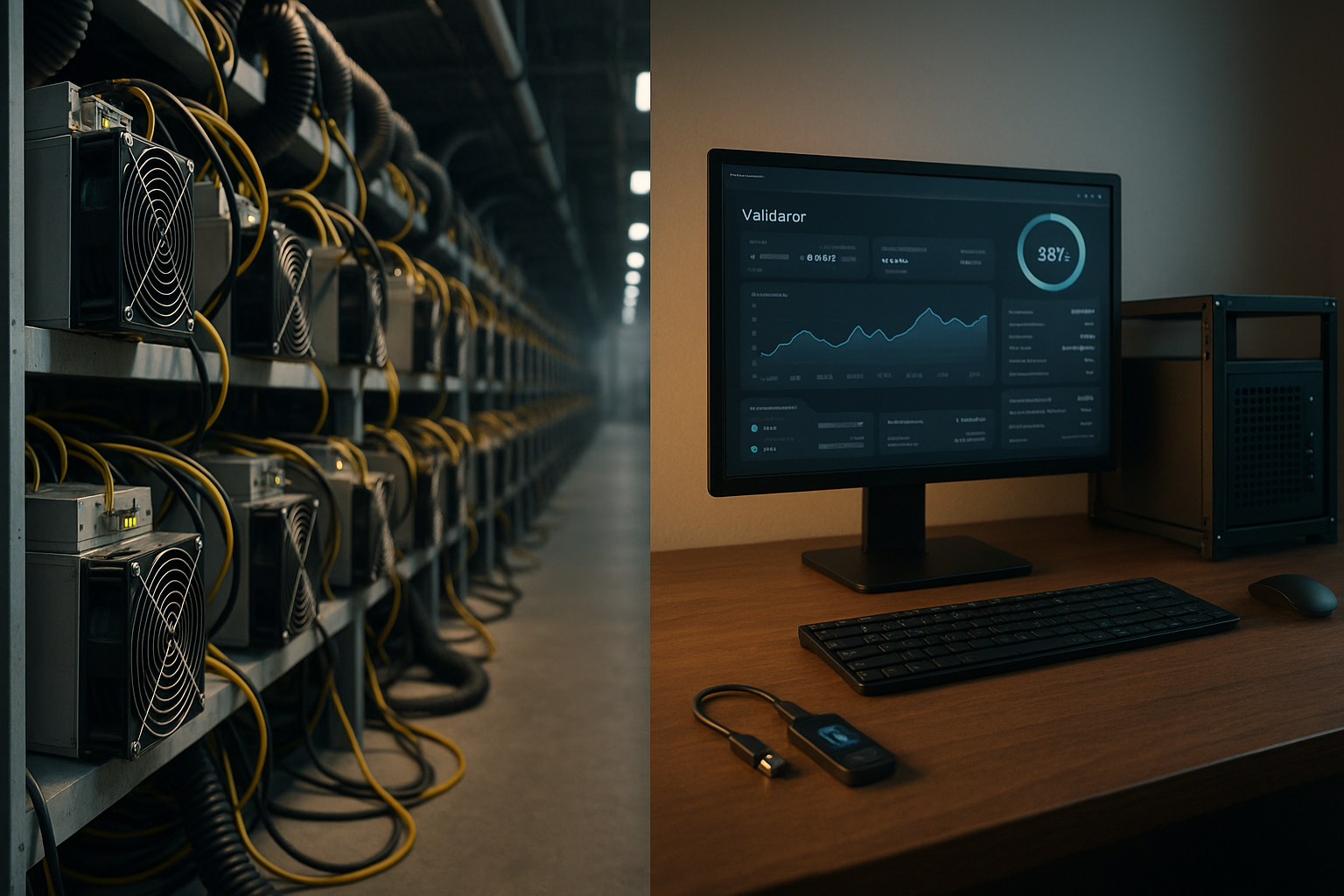
If you’ve wondered how blockchains create new coins, you’ve met the same fork everyone does: mining vs staking. Here’s the crisp answer: mining (proof-of-work) mints new coins by rewarding nodes that spend electricity to solve cryptographic puzzles, while staking (proof-of-stake) mints new coins by rewarding nodes that lock native tokens to validate blocks honestly. Both secure the chain and distribute issuance, but they do it with different incentives, costs, and risks. Below is a practical, human-first guide to help you evaluate the trade-offs and pick a path that fits your goals and constraints.
Disclaimer: This is educational information about crypto networks and economics, not financial, tax, or legal advice.
Quick steps preview: (1) decide your risk/energy budget, (2) map your capital and technical skills, (3) choose PoW or PoS networks aligned with those limits, (4) run a small simulation of rewards vs costs, (5) start conservatively with robust security hygiene, (6) monitor rewards, penalties, and fees, (7) adjust or exit if assumptions break.
1. What Actually Creates New Coins in Each Model
New coins are created by block rewards—work in mining and stake in staking decide who earns them. In proof-of-work (PoW), miners compete to find a hash below a target; the first to do so proposes a block and receives the block subsidy plus transaction fees. In proof-of-stake (PoS), validators are pseudo-randomly chosen to propose/attest to blocks proportional to their stake; honest performance earns rewards, while provable misbehavior can be penalized or slashed. Both models align incentives: do the costly thing (spend electricity or lock capital) to secure the chain and you’re paid in native tokens. That’s the essence of coin creation at the protocol level, though each network tunes issuance, fees, and penalties differently.
How it works (plain language)
- PoW: Expend real-world energy to perform hashes; a valid block header proves you burned resources fairly.
- PoS: Lock coins as collateral; the protocol selects you to validate based on stake, and bad behavior risks losing part of that stake.
- Rewards: Usually a base subsidy that trends down over time (varies by chain) plus transaction fees.
- Eligibility: PoW needs appropriate hardware and cheap power; PoS needs stake and reliable validator uptime.
- Security lever: PoW’s cost is energy; PoS’s cost is capital at risk via slashing/penalties.
Numbers & guardrails
- In PoW, a winning block is probabilistic; your share of rewards ≈ your share of network hash rate.
- In PoS, expected rewards ≈ your share of total stake, adjusted by uptime, penalties, and protocol curves.
- Mini case: if you control ~1% of either resource (hash or stake) and operate correctly, long-run rewards gravitate toward ~1% of issuance + fees, minus costs.
Synthesis: The “engine” is the same—block rewards—but PoW pays for burned electricity while PoS pays for locked, well-behaved capital. Your decision starts with which cost you prefer to carry.
2. Hardware and Capital: What You Need to Start
You can’t mint new coins without committing resources. With mining, that means hardware + electricity + cooling. With staking, that means native tokens + a validator setup (or a trusted pool if you won’t self-host). The barrier to entry looks very different: miners must buy specialized rigs (ASICs for many PoW chains) and live with noise, heat, and maintenance; stakers must acquire enough tokens to make running a validator practical, or use a pool to aggregate smaller stakes. Both paths benefit from planning for durability—hardware lifecycles in mining, and reliable uptime and key management in staking.
Practical breakdown
- PoW hardware: ASICs or high-end GPUs (chain-dependent), PDUs, racks, dedicated circuits, ventilation.
- PoS stack: A modest server or cloud VM, consensus/execution clients, a hardware wallet, monitoring/alerting.
- Upfront spend: Mining skews to capex (hardware); staking skews to stake acquisition (tokens).
- Opex: Mining pays ongoing power and replacement parts; staking pays bandwidth, modest compute, and occasional client maintenance.
- Resale/exit: ASICs depreciate but can be resold; staked tokens remain liquid (subject to unbonding or exit queues).
Numeric mini case
- Mining: A ~3 kW rig running 24/7 consumes ~72 kWh/day. At $0.10/kWh, that’s ~$7.20/day in power. Ten rigs? ~$72/day before cooling and pool fees.
- Staking: A validator on a quiet 50 W server uses ~1.2 kWh/day (~$0.12/day at the same rate). Capital at risk is the big lever (e.g., 32 tokens if the chain requires that per validator).
Synthesis: Mining demands heavier physical investment and operating discipline; staking demands financial capital and key/custody discipline. Choose the resource you can manage best.
3. Energy Use and Environmental Profile
Energy is the visible cost of PoW and the hidden advantage of PoS. Mining ties security to energy expenditure, which can be large at scale and sensitive to electricity pricing and cooling. Staking ties security to economic stake, which is orders of magnitude less energy-intensive because validation is lightweight computation. The environmental profile matters for public perception, regulatory scrutiny, and your own operating costs.
Why it matters
- Cost sensitivity: Power price swings can flip mining from profitable to loss-making quickly.
- Siting: Miners often colocate at cheap or stranded energy sources; grid relationships matter.
- Narrative risk: Some stakeholders prefer low-energy systems; others value energy-backed security.
Numbers & guardrails
- Independent estimates consistently show PoS validation reduces energy use by ~99%+ compared with PoW for similar throughput.
- PoW power draw is dominated by the network’s installed hardware; your kWh per coin varies with difficulty and your rig efficiency.
- Mini case: If your region’s all-in electricity is $0.08/kWh vs $0.16/kWh, doubling power cost can erase thin mining margins; PoS margins are far less power-sensitive.
Synthesis: If electricity price or environmental optics are binding constraints, staking generally wins. If you can secure very low-cost power and manage heat/noise, mining stays viable.
4. Security Models and Attack Economics
Both systems discourage attacks by making them prohibitively expensive—but they do so differently. In PoW, an attacker must control a majority of hash rate to reliably reorganize the chain; sustaining this is costly in hardware and electricity. In PoS, an attacker must control a large share of stake and risks getting slashed (forfeit part of their stake) and ejected. Finality mechanisms and social consensus add further defense. The upshot: PoW burns money continuously; PoS risks losing locked money instantly.
How to reason about it
- PoW: 51% attacks require massive, ongoing power and specialized hardware; detectability is high.
- PoS: Large-stake attacks are punished via slashing and can be socially reversible; capital must be reacquired to retry.
- Nothing-at-stake vs slashing: Modern PoS designs pair economic penalties with finality to neutralize free-attack vectors.
Numeric mini case
- Suppose a PoS network has 14,000,000 tokens staked and market price $1,000 per token. Gaining >33% requires >4,620,000 tokens, i.e., >$4.6 billion in stake at risk. Multiple slashing and exit-queue constraints make repeated attacks slower and costlier.
- In PoW, renting or amassing majority hash rate for a top chain is infeasible for most actors; for smaller chains it can be cheaper, which is why chain size matters.
Synthesis: Both designs can be secure; PoW leans on physical resource cost, PoS leans on economic finality and slashing. Evaluate the chain’s actual scale and design, not just the label.
5. Rewards, Fees, Inflation, and Issuance Curves
Your real returns come from issuance + fees − costs − penalties. PoW issuance is often programmatic and may decrease over time; fees vary with demand. PoS issuance typically targets a participation rate and gets distributed to online validators, with fee-burns or tips depending on design. Inflation perception differs: PoW mints coins to miners; PoS mints to stakers while sometimes burning part of fees, making net supply growth path-dependent.
What to track
- Base reward rate: Protocol emission per block/epoch.
- Fee dynamics: Congestion drives fees; some chains burn a portion.
- Your cut: In pools, subtract pool fee (e.g., 1%–5% typical ranges).
- Penalties/slashing: PoS can dock rewards for downtime; severe misbehavior risks principal.
- Compounding: Re-staking rewards increases your share of stake over time.
Numeric mini case
- Mining: If your rigs earn 0.01 coin/day and power/hardware amortization costs you 0.007 coin/day (valued at market), your margin is ~0.003 coin/day before taxes.
- Staking: If gross reward rate is 5% annualized, pool fee is 10% of rewards, and fee-burn reduces net supply by 1% on average, your real yield ≈ 5% × (1 − 0.10) − 1% = 3.5% (simplified), before volatility.
Synthesis: Returns in both systems are moving targets. Model them explicitly and revisit assumptions when network usage, fees, or participation shift.
6. Decentralization, Pooling, and Who Really Controls Production
Decentralization isn’t just node counts—it’s distribution of production power. In PoW, mining pools aggregate hash rate and smooth rewards, but large pools can become coordination hubs. In PoS, staking pools and liquid staking protocols aggregate stake and operational responsibility, which concentrates governance and MEV (maximal extractable value) decisions. Healthy ecosystems encourage many small operators and transparent pool policies.
What good looks like
- Diverse operators across geographies and providers.
- Transparent payout rules and non-custodial options where possible.
- Client diversity (multiple implementations reduce correlated failures).
- Exit mobility—low switching costs between pools/providers.
Mini checklist
- Check top pool shares; avoid ecosystems where 2–3 parties control a majority.
- Prefer pools with open-source tooling, public performance metrics, and risk disclosures.
- For liquid staking, understand redemption mechanics, caps, and governance rights.
Synthesis: Pooling improves access but can erode decentralization. Favor ecosystems that make it easy for many competent small operators to participate.
7. Liquidity, Lockups, and Access to Your Funds
Mining capital is tied up in hardware, while staking capital is tied up in native tokens—and each has different liquidity quirks. Miners can sell rigs, but secondary prices swing with difficulty and demand. Stakers can often exit or unbond with a delay; some networks and providers offer liquid staking tokens (LSTs) that trade freely and track staked positions with varying tracking error and redemption paths.
Key considerations
- Unbonding/exit: Some PoS chains have multi-day delays and/or validator exit queues.
- Liquidity via LSTs: Offers flexibility but adds smart-contract and depeg risks.
- Hardware liquidity: ASIC resale markets can freeze when profitability drops.
- Custody: Staked funds may sit in your wallet (self-custody) or with a provider (custody risk).
Numeric mini case
- If an LST trades at a 0.5% discount to the underlying (due to redemption frictions), exiting a 10,000-token position costs ~50 tokens in implicit fees versus waiting out the unbonding.
- If a rig bought for $2,500 later sells for $1,200 during a bear market, the realized hardware loss is $1,300, offset only by prior mining revenue.
Synthesis: Staking tends to offer cleaner liquidity through protocol exits or LSTs; mining liquidity is hardware-dependent. Price in these frictions upfront.
8. Operational Complexity, Uptime, and Day-to-Day Work
Mining is a facilities game; staking is a systems game. Miners manage airflow, dust, fans, breakers, and noise, plus firmware and pool connections. Stakers manage client software, key ceremonies, updates, monitoring, and MEV-related settings (where applicable). Both require high uptime to keep rewards steady and risks low. Your tolerance for hands-on operations should heavily influence your choice.
Operations at a glance
- Mining ops: Power audits, rack layout, intake/exhaust planning, firmware tuning, and rapid replacement of failing units.
- Staking ops: Key generation and storage, consensus/execution client diversity, monitoring (Prometheus/Grafana), and safe upgrades.
- Automation: Use alerting for temperature, hashrate, or validator duties missed.
- Redundancy: Spare parts (mining) vs backup nodes/sentries and failover (staking).
Mini checklist
- Document runbooks for outages and upgrades.
- Test restores from keys and backups before going live.
- Track KPIs: PoW: uptime, hashrate stability, power efficiency (J/TH). PoS: attestation rate, inclusion distance, missed proposals.
Synthesis: Neither path is “set and forget.” Mining demands physical resilience; staking demands software discipline and key hygiene.
9. Risk Landscape: From Slashing to Theft to Regulation
Mining risk concentrates in market, mechanical, and energy exposure; staking risk concentrates in key/custody, slashing, and smart-contract exposure. Both face regulatory and tax uncertainty that differs by jurisdiction. Good controls mitigate most operator errors: redundant cooling/power for miners; segregated keys, hardware wallets, and testnets for stakers.
Common pitfalls
- Mining: Overpaying for rigs at cycle tops; ignoring power quality; poor dust control leading to failures.
- Staking: Hot-key leakage; double-sign slashing; running identical clients/assets (correlated failures).
- Pooled products: Smart-contract bugs; governance capture; rehypothecation risk.
- General: Phishing, malware, weak change management.
Numbers & guardrails
- Downtime penalties in PoS are typically minor but compound; slashing can seize a noticeable slice of stake for provable misbehavior (percent varies by chain and severity).
- Insurance/coverage exists for some staking providers, but read exclusions; mining insurance focuses on facility and equipment.
Synthesis: Map risks to controls, not headlines. Most losses trace to operational lapses—build muscle memory with small positions first.
10. Taxes and Accounting: Property, Income, and Records
Tax rules vary, but two themes recur: coin rewards are often income when received, and disposals trigger capital gains/losses. Mining/validation rewards may be taxed as income at fair market value on receipt; later sales can incur capital gains. Fees and operating costs may be deductible depending on whether your activity qualifies as a trade or business. Jurisdictions differ, especially around staking rewards, airdrops, and pooled products.
Practical guardrails (not advice)
- Keep meticulous records: timestamps, amounts, fiat values at receipt, fees, and sales.
- Separate wallets for operations vs treasury to simplify tracking.
- Understand when a disposal occurs (swaps, spending, or potentially wrapping).
- If running as a business, consult a qualified professional on depreciation (mining) or expense treatment (staking).
- For staking, clarify whether rewards are taxed on receipt or on disposal in your jurisdiction.
Region notes
- Some authorities treat crypto as property and staking/mining rewards as income, with later sales creating capital gains/losses.
- Others publish manuals that describe miscellaneous income treatment for rewards and outline business vs non-trade distinctions.
Synthesis: Taxes can dominate net returns if you ignore them. Track everything from day one and get bespoke advice for your jurisdiction.
11. A Decision Framework to Pick Your Path
You don’t need ideology; you need a fit-for-purpose choice. Start by ranking constraints—capital, electricity price, technical skill, and risk tolerance—then pick the model that optimizes for those constraints. If you have cheap power and enjoy facilities engineering, mining may suit you. If you prefer capital efficiency and cleaner operations, staking may align better. Diversification—some mining exposure, some staking—can smooth idiosyncratic risks.
One-page table (keep it simple)
| Criterion | Weight (1–5) | PoW score (1–5) | PoS score (1–5) |
|---|---|---|---|
| Upfront cash fit | 5 | 3 | 4 |
| Ongoing complexity fit | 4 | 2 | 4 |
| Energy price sensitivity | 5 | 1 | 5 |
| Hardware appetite | 3 | 5 | 2 |
| Key/custody comfort | 4 | 3 | 4 |
(Example only; replace with your own weights and honest scores.)
Mini checklist
- If power ≥ $0.12/kWh, lean away from PoW unless specialty access offsets it.
- If capital volatility scares you, start with delegated or pooled staking before self-hosting.
- If you want max control, self-host either path and accept the ops overhead.
Synthesis: Choose the path that matches your constraints today; you can always rebalance as your skills, capital, or energy access changes.
12. Getting Started Safely: Two Short Playbooks
The safest way to start is with small, reversible steps. Pilot on testnets or with modest positions, prove your operations, then scale. Below are two concise playbooks that cover the basics without vendor lock-in. Adapt them to your chain and risk tolerance.
PoW playbook (first 30–60 days)
- Estimate all-in power cost; walk the site with an electrician.
- Acquire a single efficient rig first; validate noise/heat plans.
- Join a reputable pool; benchmark hashrate, uptime, and payouts.
- Set alerts for temp, hashrate dips, and breaker trips.
- Track revenue vs kWh and adjust firmware conservatively.
PoS playbook (first 30–60 days)
- Decide on self-hosted vs pooled vs liquid staking; understand slashing terms.
- Generate keys offline; store in a hardware wallet; document recovery.
- Run client diversity where possible; enable monitoring and alerts.
- Start with one validator; verify attestation performance before scaling.
- Reinvest rewards prudently; keep an emergency buffer for penalties or downtime.
Synthesis: Small starts, clear metrics, and security-first habits turn both mining and staking from intimidating to manageable—and they keep your downside capped while you learn.
Conclusion
New coins come from block rewards, and mining vs staking are two credible ways to earn them while helping secure a network. PoW pays you to turn electricity into probabilistic block wins; it excels where power is cheap and facilities skills are strong. PoS pays you to lock capital and behave; it shines where capital is accessible, operations are disciplined, and energy or noise constraints make mining impractical. You don’t need to pick a side forever; you need to pick a fit for your constraints and beliefs about where a chain’s demand, fees, and participation are headed. Start conservatively, measure everything, and upgrade your controls before you scale.
CTA: Choose one tiny next step—model costs, spin up a test validator, or survey power rates—and commit to executing it this week.
FAQs
1) Is staking “risk-free” compared with mining?
No. Staking removes power and hardware risk but introduces key, slashing, and smart-contract risks, especially if you use pooled or liquid staking. A lost key or a double-sign event can be far costlier than a few days of high electricity prices. Treat staking with the same operational seriousness you’d bring to a data center.
2) Can I mine or stake profitably with a small budget?
Possibly, but the constraints differ. A single efficient PoW rig can be viable on very cheap power and with good airflow. For PoS, some networks allow small stakes via pooled or liquid staking so you earn pro-rata rewards with minimal hardware. In both cases, start small, track results, and scale only when the data supports it.
3) What happens if my validator goes offline?
Short outages usually mean missed rewards and minor penalties; prolonged or repeated failures compound losses. Severe misbehavior (like double-signing) can trigger slashing, permanently removing a portion of your stake and ejecting you from the validator set. Good monitoring and safe key practices keep this risk low.
4) Do mining pools or staking pools change decentralization?
They can. Pools aggregate power or stake for smoother payouts but may concentrate decision-making (e.g., MEV strategies, governance proxies). Favor ecosystems where many independent operators exist and where switching providers is easy, lowering the risk of persistent concentration.
5) Why do some networks burn fees and others don’t?
Fee policy is a design choice. Burning a portion of fees can offset issuance and link value to network demand; paying all fees to producers increases direct operator incentives. Either way, your returns depend on issuance + fees − costs − penalties under the specific rules of the chain you’re operating on.
6) What equipment do I need to mine at home?
At minimum: an efficient ASIC or supported GPU (chain-dependent), safe power circuits, adequate cooling/ventilation, and a reliable internet connection. Add a fire-safe environment, dust control, and sound mitigation for comfort. Start with a single machine to validate noise/heat and your power bill before expanding.
7) What equipment do I need to run a validator?
A modest, reliable server (or cloud instance), SSD storage, stable internet, and client software. Use a hardware wallet for keys, enable monitoring, and practice upgrades on a non-production node first. Aim for client diversity if supported to avoid correlated failures across the network.
8) Are rewards fixed in staking?
No. Reward rates float with participation, fees, and protocol parameters. Your realized yield also depends on uptime, penalties, pool fees, and whether the chain burns fees. Expect variability and avoid over-optimistic projections.
9) How long are staking lockups?
It varies. Many networks have unbonding periods ranging from a few days to multiple weeks, and some also have validator exit queues. Liquid staking can offer immediate tradable exposure but adds its own risks, including tracking error and smart-contract dependencies.
10) Does staking give me governance power?
Often yes, but it’s chain-specific. Some networks tie voting to stake or delegate that power to operators or token holders. If governance matters to you, verify whether your staking method (self-hosted, pooled, liquid) preserves or gives up your voting rights.
11) Which is better for the environment?
Staking generally uses far less energy because security derives from stake, not compute. Mining’s environmental footprint depends on energy sources and efficiency. Operators using stranded or renewable energy can mitigate impact, but absolute usage remains higher than PoS validation.
12) How should I track profits for taxes?
Use a dedicated tracker that records reward timestamps, amounts, fiat values at receipt, fees, and subsequent disposals. Separate operational wallets and keep invoices for power, hardware, or cloud costs. Because rules differ across jurisdictions and can change, consult a qualified tax professional before filing.
References
- Bitcoin: A Peer-to-Peer Electronic Cash System, Bitcoin.org (Satoshi Nakamoto), 2008. https://bitcoin.org/bitcoin.pdf
- Proof-of-stake vs proof-of-work, Ethereum.org, January 25, 2024. https://ethereum.org/developers/docs/consensus-mechanisms/pos/pos-vs-pow/
- Ethereum Energy Consumption, Ethereum.org, August 25, 2025. https://ethereum.org/energy-consumption/
- Cambridge Bitcoin Electricity Consumption Index (Methodology & Data), Cambridge Centre for Alternative Finance, n.d. https://ccaf.io/cbeci/
- Blockchain Technology Overview (NISTIR 8202), National Institute of Standards and Technology, 2018. https://nvlpubs.nist.gov/nistpubs/ir/2018/nist.ir.8202.pdf
- Ouroboros: A Provably Secure Proof-of-Stake Blockchain Protocol, IOHK Research Library (Kiayias et al.), 2017. https://iohk.io/en/research/library/papers/ouroboros-a-provably-secure-proof-of-stake-blockchain-protocol/
- Proof-of-stake rewards and penalties, Ethereum.org, August 25, 2025. https://ethereum.org/developers/docs/consensus-mechanisms/pos/rewards-and-penalties/
- Notice 2014-21: Virtual Currency Guidance, Internal Revenue Service (USA), 2014. https://www.irs.gov/pub/irs-drop/n-14-21.pdf
- Cryptoassets Manual: Staking (CRYPTO21200), HM Revenue & Customs (UK), March 30, 2021. https://www.gov.uk/hmrc-internal-manuals/cryptoassets-manual/crypto21200
- Tracking electricity consumption from U.S. cryptocurrency operations, U.S. Energy Information Administration, February 1, 2024. https://www.eia.gov/todayinenergy/detail.php