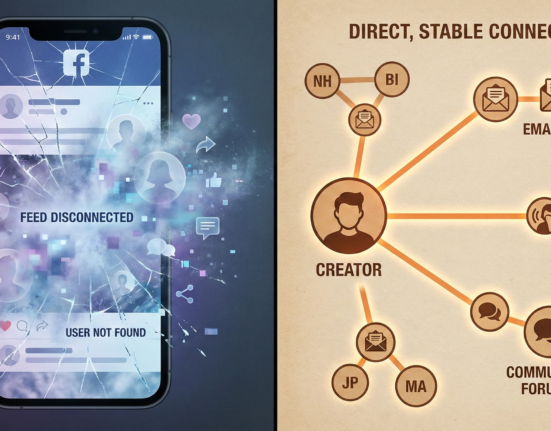
In an era where artificial intelligence can generate a thousand-word blog post in seconds, the digital landscape is facing a paradox of abundance. We have more content than ever before, yet genuinely resonant, human-centric stories are becoming a scarce commodity. As the internet floods with “grey goo”—a term used to describe the endless proliferation of generic, AI-generated text—readers and consumers are increasingly seeking refuge in depth, nuance, and authenticity.
This shift marks a critical turning point for content creators, marketers, and thought leaders. The competitive advantage is no longer speed or volume; it is connection. Long-form storytelling, once thought to be endangered by the shrinking attention spans of the TikTok generation, is experiencing a renaissance. It has become the primary vehicle for demonstrating the one thing AI cannot simulate: the human experience.
This guide explores why long-form storytelling is not just surviving but thriving in the age of AI. We will examine the psychological drivers behind narrative immersion, the SEO benefits of deep content in a world of “helpful content” updates, and practical strategies for crafting stories that cut through the algorithmic noise to build lasting trust.
Key Takeaways
- Scarcity Creates Value: As AI commoditizes information, human perspective and narrative depth become premium assets.
- Trust is the New Currency: Long-form content signals authority and commitment, fostering deeper trust than surface-level AI summaries.
- SEO Favors Experience: Search engines are evolving to prioritize “Experience” (the extra E in E-E-A-T), which is best demonstrated through detailed, personal storytelling.
- Differentiation Strategy: Deep narratives provide a unique brand voice that Large Language Models (LLMs) cannot replicate without hallucinating or sounding generic.
- The “Slow Content” Movement: There is a growing audience segment actively seeking “slow content” that respects their intelligence and offers meaningful insight over quick dopamine hits.
Who This Is For (and Who It Isn’t)
This guide is designed for:
- Content Strategists and Marketers looking to differentiate their brands from competitors relying solely on AI automation.
- Writers and Journalists seeking to understand their value proposition in a changing labor market.
- Business Leaders who want to build authority and thought leadership through substantial communication.
- SEO Professionals navigating the shift from keyword-stuffing to engagement-led ranking factors.
This guide is NOT for:
- Those looking for “hacks” to mass-produce content using AI tools.
- Marketers focused exclusively on short-form, viral clips without an underlying narrative strategy.
- Readers seeking a technical manual on how to prompt engineering for story generation.
The Current Landscape: Navigating the AI Content Deluge
To understand the value of long-form storytelling, we must first understand the environment in which it now exists. The barrier to entry for content creation has effectively collapsed. Tools like ChatGPT, Claude, and various AI writing assistants allow anyone to publish high volumes of text with minimal effort. While this democratizes access to writing tools, it has led to a saturation of “average” content.
The Problem of “Commodity Content”
AI models work by predicting the most probable next word based on training data. By definition, they gravitate toward the mean—the most likely, consensus-based answer. This results in content that is often factually accurate and grammatically correct, but devoid of novelty, wit, or emotional weight. It is “commodity content”: useful for quick answers, but indistinguishable from one brand to the next.
For readers, this creates “content fatigue.” When every search result looks the same—structured with the same generic introductions and the same bullet points—users stop engaging. They begin to skim, or worse, they leave. This behavior signals to search engines that the content is not satisfying user intent, which hurts rankings.
The Return to Human Signals
We are seeing a noticeable behavioral shift where users are appending terms like “reddit” or “forum” to their search queries. They are bypassing the polished, SEO-optimized (and increasingly AI-generated) articles in favor of messy, unpolished, but undeniably human discussions. They are looking for anecdotes, specific scenarios, and “I tried this, and here is what happened” narratives.
Long-form storytelling addresses this hunger directly. It offers a structured, deep dive that combines the polish of professional writing with the raw authenticity of forum discussions. It signals to the reader: “A human sat down, thought about this deeply, and crafted this for you.”
Defining Long-Form Storytelling in a Digital Context
Before we discuss execution, we must clarify what we mean by “long-form storytelling.” In the context of digital content, this is not merely defined by word count (though it typically exceeds 1,500 or 2,000 words). It is defined by its structural approach to information.
More Than Just Length
A 4,000-word instruction manual is “long-form,” but it is not “storytelling.” Long-form storytelling weaves information into a narrative arc. It uses classic elements of story—character, conflict, resolution, setting, and theme—to contextualize facts.
Key Characteristics:
- Narrative Arc: The content takes the reader on a journey from a state of ignorance or problem-awareness to a state of understanding or resolution.
- Emotional Resonance: It aims to evoke a feeling—curiosity, empathy, excitement, or concern—rather than just transferring data.
- Contextual Depth: It explores the “why” and “how,” not just the “what.” It embraces complexity and nuance rather than stripping it away for the sake of brevity.
- Distinct Voice: It carries the specific tone, worldview, and personality of the author or brand.
The “Slow Content” Counter-Culture
Just as fast food led to the “Slow Food” movement, the deluge of “Fast Content” (TikToks, Tweets, AI blurbs) is fueling a “Slow Content” counter-culture. This movement values quality, comprehensiveness, and contemplation.
Platforms like Substack, Medium (in its premium tier), and long-form podcasts are evidence of this. People are willing to read 5,000 words or listen for three hours, provided the storytelling is compelling. The myth that “people don’t read anymore” is false; people don’t read boring things anymore. They will happily binge-read a compelling investigative piece or a deeply researched industry analysis.
The Psychology of Immersion: Why Brains Crave Stories
The effectiveness of long-form storytelling isn’t just a stylistic preference; it is rooted in cognitive science. Human brains are wired for narrative. Before writing was invented, knowledge was preserved and transmitted through oral storytelling. Our cognitive machinery is optimized to process and retain information when it is presented as a story.
Narrative Transport
Psychologists use the term “narrative transport” to describe the state where a reader becomes immersed in a story. When “transported,” readers are less likely to generate counter-arguments or skepticism. They become open to the writer’s perspective. In a marketing context, this is incredibly powerful. A reader immersed in a brand story is less likely to be comparison-shopping in the next tab; they are emotionally invested in the narrative being presented.
The Neurochemistry of Connection
- Dopamine: Released when the brain detects an emotionally charged event or a cliffhanger. It keeps the reader curious and turning the page (or scrolling).
- Oxytocin: Often called the “empathy chemical.” It is released when stories foster a sense of connection or when we identify with a character (or a case study subject). This builds trust.
- Cortisol: Released during moments of tension or conflict in a story. This commands attention and focus.
AI-generated content often fails to trigger these chemical responses because it lacks the peaks and valleys of human narrative. It tends to be flat—a steady stream of information without the emotional modulation that keeps a human brain engaged. Long-form storytelling utilizes pacing, tension, and release to maintain engagement over thousands of words.
SEO and the “Experience” Factor (E-E-A-T)
For years, SEO was dominated by keywords and backlinks. However, Google’s evolution toward semantic search and helpful content has shifted the goalposts. The current gold standard for quality content is E-E-A-T: Experience, Expertise, Authoritativeness, and Trustworthiness.
The “Experience” Gap in AI
Of these four pillars, Experience is the one most difficult for AI to fake. An AI can possess “Expertise” (access to vast databases of facts), but it cannot possess “Experience.” It has never used a product, managed a team, failed at a project, or felt the relief of a solution.
Long-form storytelling is the primary vessel for demonstrating Experience.
- Instead of: “Here are 5 tips for project management.” (Generic/AI-friendly)
- Try: “How we almost lost our biggest client due to scope creep, and the 5 protocols we installed to ensure it never happens again.” (Experience-driven/Storytelling)
The second title implies a narrative. It implies a specific, lived reality. Google’s ranking systems are increasingly tuned to prioritize this kind of content because it is unlikely to be mass-produced spam.
Dwell Time and User Signals
Long-form storytelling naturally increases “dwell time”—the amount of time a user spends on a page. If a user reads a 3,000-word article for 10 minutes, that is a massive signal of quality to search engines. Conversely, if they bounce after 10 seconds because the content looks generic, rankings suffer. By hooking readers with a narrative, you improve the behavioral metrics that underpin modern SEO success.
Why AI Struggles with Genuine Narrative
To effectively leverage long-form storytelling, we must understand why AI tools (as of mid-2024 and beyond) struggle to compete in this arena. While LLMs are impressive, they have specific limitations regarding narrative construction.
The “Prediction” vs. “Intention” Problem
LLMs generate text by predicting the next logical word. They do not have an overarching “intention” or a “point” they are trying to make in the same way a human does. A human writer creates a 4,000-word piece with the ending in mind; they plant seeds in the introduction that bloom in the conclusion. They use callbacks, foreshadowing, and tonal shifts to guide the reader.
AI creates linearly. It often loses the “thread” of a long argument, repeats itself, or circles back to generic summaries. It struggles to maintain a consistent narrative arc over a long duration without significant human intervention.
The Lack of Subtext and Cultural Nuance
Great storytelling often relies on what is not said—the subtext. It relies on shared cultural moments, irony, sarcasm, and emotional ambiguity. AI struggles with these subtleties. It tends to be literal and explicit. In long-form writing, this literalness becomes exhausting. The “texture” of the writing feels smooth but synthetic, lacking the friction and grit of real life.
Hallucination in Narrative Details
When AI tries to “tell a story” or provide examples, it often fabricates details (hallucinations) to fit the pattern. In fiction, this might be acceptable. In brand storytelling, journalism, or technical writing, it is fatal. Human storytelling relies on the specificity of truth—the exact temperature of the room, the specific error code on the screen, the precise quote from the customer. These specificities ground the story in reality, something AI cannot authenticate.
Strategies for Creating Human-First Long-Form Content
Knowing why to write long-form is different from knowing how to do it effectively. Writing 4,000+ words that maintain engagement requires a different toolkit than writing a 500-word blog post. Here is a strategic framework for creating deep, narrative-driven content.
1. The “Subject Matter Expert” (SME) Interview Strategy
The easiest way to infuse “Experience” into your content is to talk to someone who has it. AI summarizes the internet; you should document the undocumented.
- The Approach: Before writing, interview an expert (internal or external). Ask them for specific war stories, unpopular opinions, and recent learnings.
- The Integration: Use their quotes to anchor your sections. Build the narrative around their perspective. “When our Lead Engineer, Sarah, first looked at the data, she realized…” is a hook that AI cannot generate on its own.
2. The “Hero’s Journey” Structure for Case Studies
Avoid the dry “Problem -> Solution -> Result” format. Frame your case studies or tutorials as a Hero’s Journey.
- The Status Quo: What was the world like before the change?
- The Inciting Incident: What broke? What opportunity arose?
- The Refusal of the Call: Why was the change hard? What were the internal doubts?
- The Ordeal: The messy middle. What went wrong during implementation? (This is crucial for authenticity).
- The Reward: The result, but also the emotional payoff/relief.
- The Return: How the “hero” is different now.
3. Visual Storytelling and Multimedia Integration
Long-form text can be intimidating. Break it up with visual storytelling. This doesn’t just mean stock photos.
- Data Visualization: Custom charts that prove your narrative points.
- Screenshots with Annotation: Show, don’t just tell.
- Embedded Video: Short clips of the SME interviews mentioned above.
- Infographics: Summarizing complex sections for scannability.
4. Injecting “Voice” and Opinion
Neutrality is the default mode of AI. Therefore, having a strong opinion is a differentiator.
- Take a Stand: Don’t just list the pros and cons. Tell the reader what you recommend and why.
- Use First-Person: “I,” “We,” “Our team.” Remind the reader there are humans behind the screen.
- Embrace Imperfection: Admit what you don’t know. Acknowledge where your solution might not work. This vulnerability builds massive trust.
Differentiating Your Brand Through Narrative
In a crowded market, your product features are likely similar to your competitors’. Your pricing is likely comparable. Your story is the only thing that cannot be copied.
Case Example: The Outdoor Industry
Imagine two outdoor gear companies.
- Company A (AI-Style Content): Publishes “Top 10 Hiking Boots 2026.” The content lists specifications, weights, and materials. It is informative but dry.
- Company B (Long-Form Storytelling): Publishes a 5,000-word travelogue titled “Surviving the Pacific Crest Trail: What 5 Months on Foot Taught Us About Durability.” They weave in the specs of the boots, but they do so within the context of a blister-inducing rainstorm in Washington.
Company B wins. They aren’t just selling boots; they are selling the adventure and the expertise required to survive it. The reader trusts Company B because the content proves they understand the application of the product, not just the theory of it.
B2B Applications
This applies to boring B2B industries too. A cybersecurity firm shouldn’t just write about “The importance of firewalls.” They should write a long-form “Anatomy of a Breach,” walking the reader through a timeline of a specific hack, the panic in the IT room, the regulatory fallout, and the eventual recovery. This narrative approach turns abstract fears into concrete scenarios that decision-makers can visualize.
The Role of AI as a Tool, Not a Creator
Advocating for long-form storytelling does not mean banning AI. In fact, AI is a powerful assistant for the long-form writer, provided it is kept away from the “publish” button.
How to Use AI to Support Long-Form
- The Research Assistant: Use AI to find historical analogies, statistical data, or counter-arguments to your thesis. “What are the common criticisms of [My Argument]?” is a great prompt to ensure your long-form piece is balanced.
- The Outliner: Use AI to suggest structures. “Give me 10 subheadings for an article about X.” You might throw away 5, but the other 5 might reveal angles you hadn’t considered.
- The Editor: AI is excellent at spotting repetition, passive voice, and confusing sentences. Use it to polish your human-written draft.
- The Transcriber: Use AI tools to transcribe and summarize your SME interviews, accelerating the time-to-draft.
The Golden Rule: AI should be the sous-chef, prepping the ingredients. You are the executive chef, designing the menu and cooking the meal.
Common Mistakes in Long-Form Content
Creating 4,000 words of content is an investment. To ensure ROI, avoid these common traps that turn “long-form” into “long-winded.”
1. The “Wall of Text”
Nothing kills engagement faster than giant blocks of text.
- Solution: Use short paragraphs (2-3 sentences). Use frequent subheadings (H2, H3, H4). Use bullet points. Ensure the content is scannable on mobile devices.
2. Fluff and Padding
Writing long for the sake of length is a mistake. Users can smell “padding”—repetitive sentences, circular logic, and over-explanation—from a mile away.
- Solution: Every section must earn its keep. If a section doesn’t add a new perspective, data point, or narrative beat, cut it. If you are under your word count target, do not stretch the text; dig deeper into the research or add a new angle.
3. Burying the Lede
In long-form, you still need to hook the reader immediately. Do not spend 1,000 words “warming up.”
- Solution: Start in the middle of the action (in media res) or state the core value proposition upfront before diving into the deep explanation.
4. Ignoring Internal Navigation
In a long piece, readers may want to jump to specific sections.
- Solution: Always include a Table of Contents with jump links at the top.
Measuring Success Beyond Clicks
If you invest in long-form storytelling, you must change how you measure success. The standard metric of “pageviews” is insufficient for this type of content.
High-Value Metrics for Long-Form
- Scroll Depth: Are users reaching the 50%, 75%, or 100% mark of the page?
- Time on Page: As mentioned, high dwell time signals engagement.
- Social Shares: People share stories that move them or make them look smart. Long-form content often generates higher share counts than generic news.
- Backlinks: Other websites prefer to link to “The Ultimate Guide” or the “Definitive Story” rather than a thin summary. Long-form content is a link magnet.
- Brand Sentiment: Analysis of comments and feedback. Are people thanking you for the depth?
Future Outlook: The “Slow Content” Movement
As we look toward the future of the internet (Web 3.0 and beyond), the divide between “commodity content” and “premium storytelling” will widen.
We are likely to see a bifurcation of the internet. One side will be utility-driven, AI-mediated, and highly efficient—perfect for checking the weather or finding a syntax error in code. The other side will be human-driven, slow, and narrative—perfect for learning, connecting, and entertainment.
Brands that master long-form storytelling now are positioning themselves on the “premium” side of this divide. They are future-proofing their content strategy against the commoditization of information. They are building a moat made of human connection, which is the one fortification AI cannot yet breach.
Conclusion
The rise of AI-generated content is not the end of human writing; it is the catalyst for its evolution. By flooding the world with average, efficient text, AI has inadvertently increased the value of the extraordinary, the inefficient, and the beautiful.
Long-form storytelling is your opportunity to slow the reader down. It is your chance to say, “I see you, I understand your complexity, and I have something meaningful to share.” In a digital world screaming for attention, the quiet confidence of a well-told story is the loudest sound of all.
Ready to elevate your content strategy? Start by auditing your top-performing posts and identifying one topic that deserves the “deep dive” treatment—then schedule that SME interview today.
FAQs
1. How long should a “long-form” article actually be? While definitions vary, long-form content typically starts at 1,500 to 2,000 words. However, “epic” or “pillar” content often ranges from 3,000 to 6,000+ words. The key is not to hit a specific number, but to cover the topic so comprehensively and narratively that no questions are left unanswered.
2. Doesn’t AI content rank better because it is optimized perfectly? Not necessarily. While AI can place keywords perfectly, Google’s algorithms are increasingly sophisticated at detecting “unhelpful” content that lacks unique value. Content that demonstrates E-E-A-T (Experience, Expertise, Authoritativeness, Trustworthiness) generally outranks generic AI content over the long term, even if the AI content is technically “optimized.”
3. Is long-form content bad for mobile users? It is a myth that mobile users won’t read long-form. They will, provided the user experience (UX) is good. This means fast loading times, legible font sizes, ample white space, and frequent subheadings to allow for mental breaks. Visuals are also critical to keep mobile users scrolling.
4. Can I use AI to write long-form stories if I edit it heavily? You can use AI to assist, but using it to write the story often results in failure. AI struggles with narrative arc, callback, and emotional pacing over long distances. It creates a “Frankenstein” effect where the parts don’t quite fit together emotionally. Use AI for research and outlining, but write the prose yourself.
5. How frequently should I publish long-form storytelling? Quality over quantity is the rule here. One incredible 4,000-word piece per month is often more valuable for SEO and brand authority than four mediocre 1,000-word pieces. Long-form takes time to research, write, and design—treat it as a major campaign asset, not a daily chore.
6. How do I find stories to tell for a boring B2B industry? Look for the “stakes.” Every business solves a problem. Where there is a problem, there is conflict. Where there is conflict, there is a story. Interview your customer support team or sales team—they hear the “horror stories” and the “relief stories” every day. Those are your narrative seeds.
7. Does long-form storytelling work for ecommerce? Absolutely. Instead of just product descriptions, use long-form buying guides, “history of” articles, or “behind the design” stories. For example, a coffee seller could write a long-form narrative about a specific trip to a farm in Ethiopia, detailing the farmers’ lives and the harvest process. This builds immense value and justification for the product price.
8. What is the biggest mistake brands make with storytelling? The biggest mistake is making the brand the hero. In effective brand storytelling, the customer (or the reader) is the hero. The brand is the “guide” or the “helper” (like Yoda to Luke Skywalker). The story should be about the customer’s transformation, not just how great the company is.
References
- Google Search Central. (2024). Creating helpful, reliable, people-first content. Google. https://developers.google.com/search/docs/fundamentals/creating-helpful-content
- Content Marketing Institute. (2023). B2B Content Marketing Benchmarks, Budgets, and Trends. https://contentmarketinginstitute.com/
- Nielsen Norman Group. (2023). Long-Form Content vs. Short-Form Content: UX Considerations. https://www.nngroup.com/
- Substack. (2024). The Rise of Long-Form Writing on Substack: Internal Data Analysis. https://on.substack.com/
- Search Engine Journal. (2024). State of SEO: The Impact of AI on Search Rankings. https://www.searchenginejournal.com/
- Edelman. (2024). Edelman Trust Barometer: The Role of Authenticity in Brand Trust. https://www.edelman.com/trust/trust-barometer
- Harvard Business Review. (2022). The Science of Storytelling. https://hbr.org/
- Pew Research Center. (2023). AI in Public Life: Public perception of AI generated content. https://www.pewresearch.org/