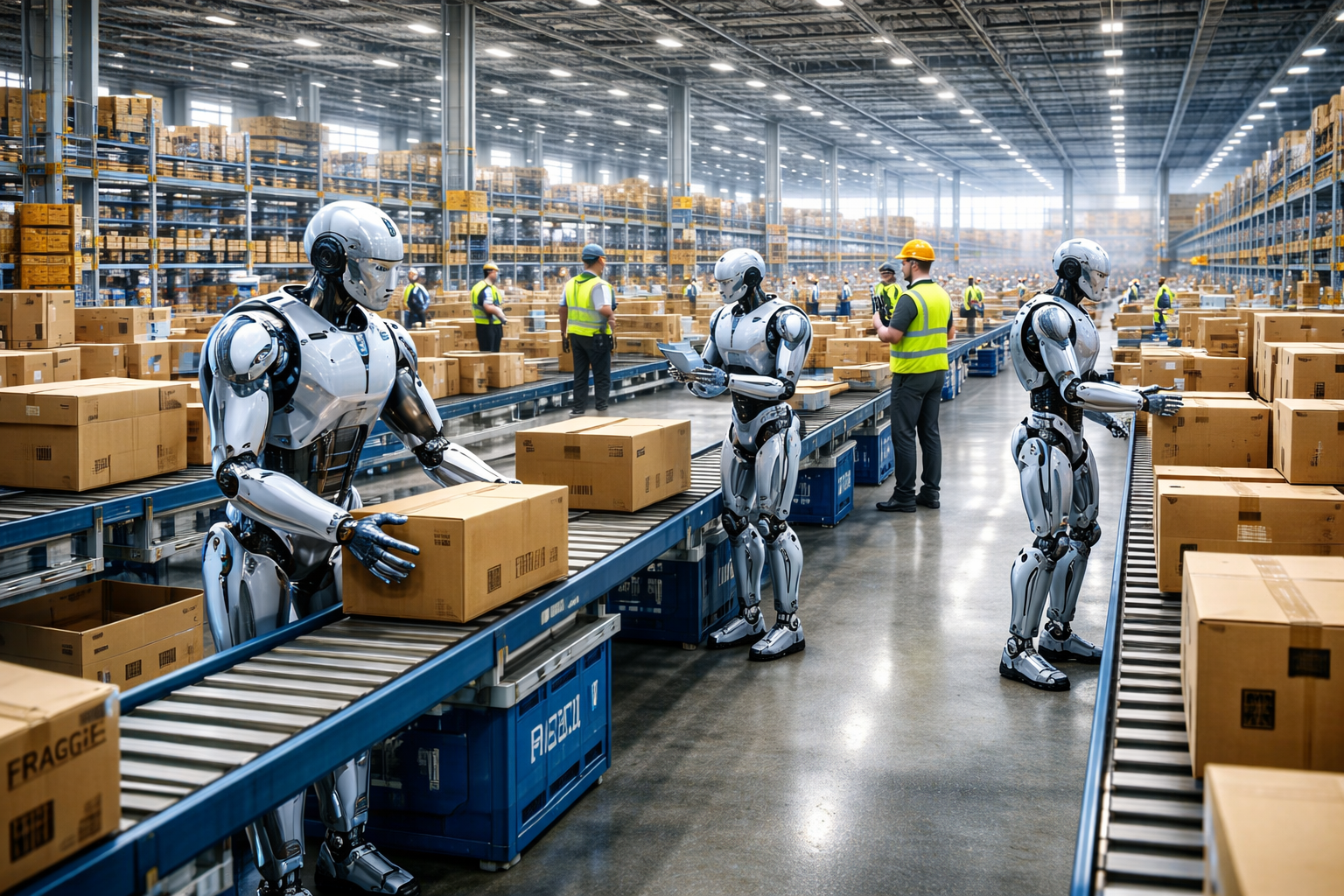
The transition from science fiction to factory floors is no longer a slow crawl; it has become a sprint. As of March 2026, we are witnessing the pivotal moment where “Embodied AI”—artificial intelligence with a physical, human-like form—moves out of the laboratory and into the global economy. By 2035, leading financial institutions like Goldman Sachs and Barclays project that approximately 2 million humanoid robots will be integrated into the global workforce.
This article serves as a comprehensive guide to understanding this shift. We will explore the technological breakthroughs making this possible, the specific industries that will lead the charge, and the complex socioeconomic questions that arise when machines begin to walk, grasp, and reason among us.
Key Takeaways
- Scale of Adoption: 2 million units is the “base case” projection for 2035, representing a market value of nearly $38 billion to $200 billion depending on the depth of service integration.
- Primary Drivers: Severe global labor shortages (affecting 75% of employers in 2026) and the rapid decline in hardware costs (down 40% year-over-year).
- Core Technology: The convergence of “Generative AI” with high-torque actuators and 22-degree-of-freedom (DoF) dexterous hands.
- Impacted Sectors: Logistics and manufacturing will scale first, followed by healthcare assistance and specialized retail roles.
Who This Is For
This deep dive is designed for business leaders planning their 10-year automation roadmap, policy makers grappling with labor laws, and workers looking to understand how their roles will evolve alongside “cobots” (collaborative robots).
The Dawn of the Physical AI Era (2025–2026)
To understand where we will be in 2035, we must look at the foundation being laid today. In the first quarter of 2026, the robotics industry underwent a “GPT-3 moment.” For years, robots were “coded” to perform specific, rigid tasks. If a box moved two inches to the left, the robot failed.
Today, the shift to end-to-end neural networks allows humanoid robots to learn by watching human demonstrations. They no longer require thousands of lines of code for every movement; they require data.
Defining the Humanoid Robot
Unlike industrial “arms” bolted to a floor, a humanoid robot is a general-purpose machine. It is designed with a torso, two legs, two arms, and a head. Why this form? Because our world is built for us. Doors, stairs, tools, and workstations are all designed for the human geometry. By mimicking our form, robots can integrate into existing infrastructure without requiring companies to spend billions on “robot-friendly” factory redesigns.
The “Big Three” Driving the 2 Million Goal
As of March 2026, three major players are dictating the pace of the humanoid robots workforce.
1. Tesla Optimus (The Mass-Production Bet)
Elon Musk’s Optimus project is the most watched experiment in the industry. Tesla’s advantage isn’t just robotics; it’s the supply chain. By leveraging the same batteries, sensors, and AI inference chips used in their electric vehicles, Tesla aims to drive the cost of a humanoid robot down to approximately $20,000 to $30,000 by 2030.
- Current Status (March 2026): Optimus Gen 3 is currently undergoing “dogfooding” in Tesla’s Fremont and Texas Gigafactories, performing light tasks like battery cell sorting and moving plastic crates.
2. Boston Dynamics Atlas (The Industrial Gold Standard)
After retiring their hydraulic model in 2024, Boston Dynamics launched an all-electric Atlas. This machine is designed for heavy-duty industrial work. While Optimus focuses on being “cheap and plentiful,” Atlas focuses on being “capable and rugged.”
- Differentiator: Atlas features a staggering 56 degrees of freedom and a payload capacity of 50kg (110 lbs), nearly double its competitors.
3. Figure AI (The AI Integration Leader)
Backed by OpenAI, NVIDIA, and Microsoft, Figure AI is focusing on the “brain.” Their Figure 02 and 03 models are the first to demonstrate natural language reasoning while performing physical tasks.
- Real-World Application: Figure has already signed a commercial agreement with BMW to deploy humanoids at the Spartanburg, South Carolina plant for sheet metal manipulation.
Sector Breakdown: Where the 2 Million Will Work
By 2035, the humanoid robots workforce will be concentrated in four primary pillars.
I. Logistics and Warehousing (The “Pick-and-Place” Champions)
This will be the first sector to reach “critical mass.” E-commerce growth has outpaced the available labor pool.
- Tasks: Unloading trailers, palletizing mixed-SKU boxes, and “each-picking” for individual orders.
- Key Player: Agility Robotics, with its “Digit” robot, is already testing with Amazon to move empty “totes” (yellow bins).
II. Smart Manufacturing (The Assembly Line Evolution)
In automotive and electronics assembly, robots will handle the “dirty, dull, and dangerous” tasks that current stationary robots cannot reach.
- Example: Threading wire harnesses through car doors or performing quality inspections using high-resolution “visual AI” that catches defects invisible to the human eye.
III. Healthcare and Elder Care (The Long-Term Pivot)
As populations in the US, Europe, and Japan age, the caregiver shortage will reach crisis levels by 2035.
- Tasks: Humanoids will serve as “force multipliers” for nurses—carrying heavy equipment, assisting with patient transfers from beds to wheelchairs, and delivering meals.
- Note: This sector requires the highest level of safety certification and “soft-touch” robotics.
IV. Hazardous Environments (Risk Mitigation)
Nuclear decommissioning, chemical spill cleanup, and disaster search-and-rescue will be handled by humanoids operated via “telepresence” or autonomous reasoning.
The Technology Stack: Brains, Brawn, and Batteries
The path to 2 million robots relies on three technological “breakthroughs” that are maturing as of early 2026.
1. The Brain: Embodied AI and Foundation Models
The “brain” of a 2035 humanoid is not a simple processor. It uses Large Behavior Models (LBMs). Just as ChatGPT predicts the next word in a sentence, an LBM predicts the next physical movement in a sequence. If a robot is told to “clean up the spill,” it understands that it must find a cloth, stoop down, apply pressure, and dispose of the cloth—all without being told each individual step.
2. The Brawn: High-Torque Density Actuators
An actuator is the “muscle” of the robot. Historically, these were bulky and inefficient. Modern actuators (like those in the Tesla Optimus) use planetary roller screws and custom electromagnetic motors that provide high torque in a package the size of a human thigh.
3. The Hands: Dexterous Manipulation
The hardest part of the human body to replicate is the hand.
- The 22-DoF Standard: To be useful, a robot needs more than just a “claw.” By 2035, the standard for the humanoid robots workforce will be hands with tactile sensors at every fingertip, capable of picking up a strawberry without bruising it or using a standard screwdriver.
Addressing the Global Labor Crisis
The “Why” behind the 2 million robot figure is often misunderstood. It is not about replacing humans to save money; it is about labor survival.
As of March 2026, the “Great Retirement” of the Baby Boomer generation has left a massive hole in the industrial workforce. In the United States alone, there are over 600,000 unfilled manufacturing jobs. Humanoids represent a “structural solution” to a demographic problem.
The “D” Tasks
Humanoids are being deployed for the Three Ds:
- Dull: Highly repetitive tasks that lead to human mental fatigue.
- Dirty: Tasks in environments that are unhygienic or unpleasant.
- Dangerous: Tasks involving heavy lifting, toxic fumes, or extreme temperatures.
Common Implementation Mistakes for Businesses
As companies rush to join the humanoid revolution, many are falling into predictable traps. Avoid these common errors:
1. Treating Humanoids Like Fixed Automation
Companies often try to program a humanoid robot as if it were a stationary arm.
- The Mistake: Hard-coding every movement.
- The Fix: Leveraging AI training. Allow the robot to “learn” the environment through simulations (NVIDIA Isaac Gym) before it ever touches the factory floor.
2. Ignoring Human-Robot Interaction (HRI)
Placing a 300-pound metal machine next to a human worker without proper psychological and safety onboarding.
- The Mistake: Creating an “us vs. them” culture.
- The Fix: Training human staff to be “Robot Supervisors” or “Fleet Managers,” shifting their role from manual labor to technical oversight.
3. Underestimating Maintenance and “Up-Time”
A robot is only as good as its battery and joints.
- The Mistake: Failing to account for the “Technical Tax.”
- The Fix: Adopting the Robot-as-a-Service (RaaS) model, where the manufacturer handles maintenance and software updates for a monthly fee.
Economic Disruption and Job Evolution
Will robots take our jobs? The answer is nuanced. By 2035, the humanoid robots workforce will indeed displace certain roles, particularly in low-skill logistics. However, history shows that automation creates new categories of work.
New Job Categories in 2035
- Robot Fleet Manager: Overseeing 20–50 robots, troubleshooting errors, and optimizing paths.
- Humanoid Behavior Trainer: Workers who wear VR suits to “show” robots how to perform complex tasks (teleoperation).
- Hardware Maintenance Specialist: A new “blue-collar” trade focused on repairing robotic actuators and sensors.
Financial Safety Disclaimer
Note: The projections for market growth and ROI mentioned here are based on current industrial trends and are subject to macroeconomic volatility. Businesses should conduct thorough pilot programs before committing to large-scale capital expenditures in robotics.
Ethical and Regulatory Landscapes in 2035
As we integrate 2 million bipedal machines into society, the legal framework must catch up.
The “Robot Tax” Debate
Governments may implement a “Robot Tax” to fund Universal Basic Income (UBI) or retraining programs for displaced workers. This remains a highly debated topic in 2026.
Safety and Liability
If a humanoid robot trips and injures a human worker, who is liable?
- The software developer?
- The hardware manufacturer?
- The site owner? New insurance products and OSHA standards specifically for humanoid-human collaborative environments are currently being drafted.
Conclusion: The Path Forward
The “Humanoid Revolution” is not a distant 2035 dream—it is an active transition that requires immediate attention. By the time we reach the 2-million-robot milestone, the very definition of “work” will have changed. We are moving toward a world where human effort is reserved for high-value reasoning, creativity, and empathy, while the mechanical “grind” is handled by our bipedal counterparts.
Next Steps for Your Organization:
- Audit Your Workflows: Identify the “Three Ds” (Dull, Dirty, Dangerous) in your current operations. These are your primary candidates for humanoid integration.
- Invest in Data: Start collecting high-fidelity video and telemetry data of your manual processes. This data will be the “fuel” used to train your future robotic workforce.
- Monitor Pilot Results: Follow the 2026 pilot results from companies like BMW, Mercedes-Benz, and Amazon. Their successes—and failures—will provide the blueprint for your adoption.
The revolution has legs. It’s time to start walking with it.
FAQs
1. How much will a humanoid robot cost in 2035?
While early enterprise models in 2026 cost between $50,000 and $150,000, mass production is expected to drive the price of a general-purpose humanoid down to the $20,000 to $30,000 range by 2035—roughly the price of a mid-sized sedan.
2. Can humanoid robots work in any environment?
Not yet. Most robots in 2026 are “climate-controlled” machines. However, by 2035, we expect to see IP67-rated humanoids capable of working in rain, dust, and extreme heat, specifically for construction and agriculture.
3. How long can a humanoid robot work on a single charge?
Current 2026 models like the Boston Dynamics Atlas offer roughly 4 hours of high-intensity work. By 2035, advancements in solid-state batteries are projected to extend this to a full 8-to-12 hour shift, with autonomous “hot-swapping” or rapid-charging capabilities.
4. Do I need to be a programmer to use these robots?
No. The goal of the humanoid robots workforce is “natural interaction.” In 2035, you will likely “train” a robot by either showing it what to do (demonstration) or simply telling it what to do using natural language, much like you would a human trainee.
5. Are humanoid robots safe to work around?
Yes, modern humanoids use “force-limited” actuators and vision-based “fencing.” If a robot detects a human in its immediate path or feels unexpected resistance, it is designed to freeze or soften its movements instantly to prevent injury.
References
- Goldman Sachs Research: “Humanoid Robot: The AI Accelerant” (Jan 2024/Update 2026).
- Barclays Impact Series: “The Future of Work: AI Gets Physical” (Jan 2026).
- Tesla Investor Relations: 2025 Q4 Earnings Call – AI & Robotics Update.
- Boston Dynamics Technical Blog: “The Electric Atlas: Design and Capability Whitepaper.”
- McKinsey Global Institute: “Automation, Productivity, and the Future of Work” (2030-2035 Forecast).
- IEEE Spectrum: “State of the Art: Dexterous Manipulation in Humanoid Hands” (Feb 2026).
- International Federation of Robotics (IFR): World Robotics Report 2025.
- Figure AI Newsroom: “Scaling Deployment: The BMW Partnership Progress Report.”
- Nature Machine Intelligence: “Foundational Models for Embodied AI” (Academic Review).
- MIT Technology Review: “Why the Humanoid Form Factor Wins.”