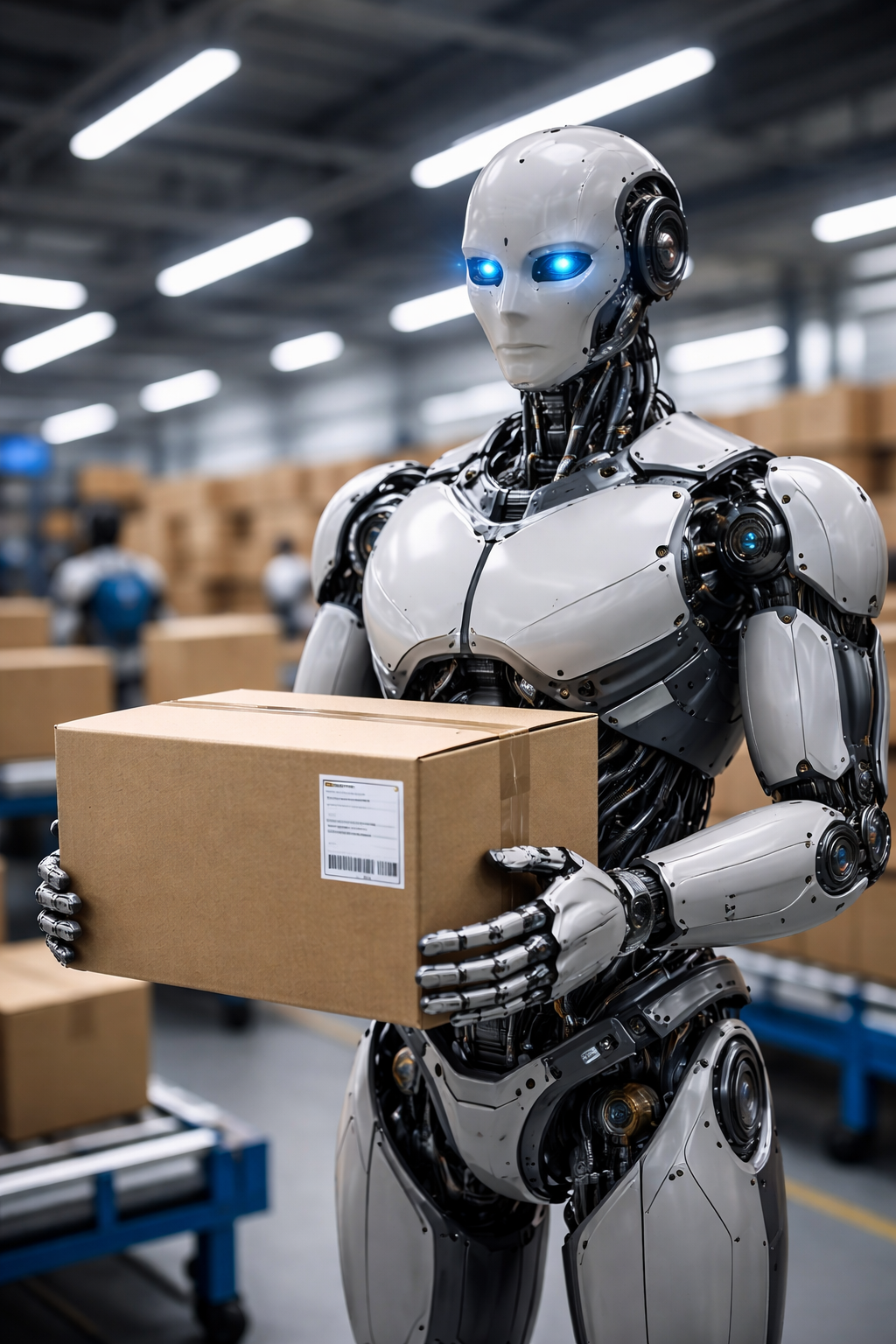
The landscape of robotics has undergone a seismic shift. As of March 2026, the debate over whether robots should have wheels, tracks, or four legs has largely been settled in favor of the bipedal, humanoid form. While specialized robots still exist for niche tasks, the “humanoid” has emerged as the gold standard for general-purpose automation. This transition isn’t just about aesthetics; it is a calculated response to the world we have already built.
Definition and Current Context
A humanoid robot is a professional-grade machine designed with a body structure resembling the human anatomy—typically featuring a torso, a head, two arms, and two legs. In 2026, these machines are powered by “General Purpose AI” (GPAI), allowing them to learn tasks through observation rather than rigid coding. The “Preferred Form Factor” refers to the industry-wide consensus that the bipedal design offers the highest Return on Investment (ROI) across manufacturing, logistics, and increasingly, domestic service.
Key Takeaways for 2026
- Infrastructure Compatibility: We live in a world designed by humans, for humans. Humanoids require zero retrofitting of existing workspaces.
- The Power of Generalization: Unlike a robotic arm fixed to a floor, a humanoid can move between tasks—unloading a truck, then sorting a shelf, then sweeping the floor.
- Hardware-Software Convergence: Breakthroughs in high-torque actuators and Vision-Language-Action (VLA) models have finally made bipedal balance as stable as human gait.
Who This Is For
This deep dive is designed for Chief Operations Officers (COOs) looking to future-proof their supply chains, venture capitalists tracking the next wave of “Physical AI,” and tech-forward consumers interested in the practical arrival of the “robot butler” era. Whether you are managing a fulfillment center or simply curious about the silver machines appearing in your local hospital, this guide explains the “why” behind the form.
Safety & Regulatory Disclaimer: As of March 2026, humanoid robots are classified under “Collaborative Robotics” (Cobots) in most jurisdictions. Users must adhere to ISO 10218-1 and ISO 10218-2 safety standards. Operating humanoid hardware in proximity to humans requires active collision-avoidance sensors and emergency stop protocols. This article does not constitute financial advice regarding robotics stocks or labor replacement strategies.
The Infrastructure Logic: Why We Don’t Want to Rebuild the World
The primary reason the humanoid form factor has won the 2026 market is simple: we have already spent trillions of dollars building a world for bipeds.
For decades, the robotics industry tried to force the world to accommodate the robot. We built massive warehouses with perfectly flat floors for wheeled AMRs (Autonomous Mobile Robots). We installed expensive safety cages for robotic arms. We replaced stairs with ramps. But the “Humanoid Pivot” of 2024–2025 proved that it is cheaper to build a robot that fits the world than to rebuild the world to fit the robot.
The Problem with Specialization
In a traditional 2020-era warehouse, you might have five different types of robots:
- Wheeled sorters that only work on flat concrete.
- Conveyor belts that are expensive to move once bolted down.
- Palletizers that take up 200 square feet of space.
- Drones for inventory (which struggle with battery life and payload).
- Human workers to do everything the robots can’t.
In 2026, a single humanoid unit—like the Tesla Optimus Gen 3 or the Figure 02—can navigate the stairs to a mezzanine, use a standard hand truck, open a regular door, and operate a manual keypad. The humanoid form factor is essentially a “universal interface” for the existing physical world.
Navigating the “Human Gap”
Humanoids excel in the “in-between” spaces. Most industrial accidents and bottlenecks occur at the hand-off points between two specialized machines. A humanoid robot eliminates these gaps by performing the end-to-end task. If a box falls off a conveyor, a wheeled robot is stuck. A humanoid simply bends down, picks it up with five-fingered hands, and places it back. This flexibility is the core driver of the 2026 preference.
Technological Breakthroughs: The “iPhone Moment” for Physical AI
To understand why 2026 is the year of the humanoid, we must look at the convergence of three specific technologies that matured simultaneously over the last 24 months.
1. High-Torque, High-Density Actuators
In 2022, humanoid robots were either “clunky” (using heavy industrial motors) or “fragile” (using lab-grade hydraulics). By early 2026, companies like Fourier Intelligence and Apptronik have perfected proprietary electric actuators that mimic the elasticity of human muscle.
These “quasi-direct drive” motors allow for proprioception—the robot knows how much force it is applying. If you shake hands with a 2026 humanoid, it doesn’t crush your fingers; it feels the resistance and adjusts in real-time. This “soft touch” is what allows them to handle everything from heavy car batteries to fragile glass vials.
2. The Rise of VLA (Vision-Language-Action) Models
The software has finally caught up to the hardware. In the past, you had to program every joint movement. Today, thanks to models like NVIDIA’s GR00T and OpenAI’s Physical-1, we use “End-to-End Learning.”
You can show a robot a video of a human folding a shirt. The VLA model translates those pixels into motor commands. By March 2026, these models have been trained on billions of hours of human movement data. The result? A robot that doesn’t just “move”—it “behaves.” It understands that a “cup” should be held upright and that “fragile” means moving slower.
3. Edge Compute and 6G Connectivity
A humanoid robot generates terabytes of sensor data every hour (Lidar, depth cameras, tactile skin). Processing this in the cloud was too slow (latency killed the balance). As of 2026, onboard NPU (Neural Processing Unit) chips—specifically the NVIDIA Jetson Thor series—allow the robot to process its “balance loop” at 1,000Hz. This means it can recover from a trip or a shove faster than a human can blink.
Leading the Charge: The Titans of 2026
The market is no longer a collection of “cool lab experiments.” It is a multi-billion dollar industry with clear leaders.
Tesla Optimus (Gen 3)
Tesla’s advantage is manufacturing at scale. Using the same battery cells and FSD (Full Self-Driving) computer found in their vehicles, Tesla has driven the cost of a humanoid down to roughly $30,000–$40,000 USD. In 2026, Optimus is the primary labor force in Tesla’s Gigafactories, handling “dull, dirty, and dangerous” tasks like moving cell manifolds.
Figure AI (Figure 02 & 03)
Figure has focused heavily on the BMW manufacturing partnership. Their robots are specialized for high-precision assembly. Unlike the generalist approach of Tesla, Figure’s robots use advanced tactile sensors on the fingertips, allowing them to feel the “click” of a connector or the tension of a wire.
Boston Dynamics (The Electric Atlas)
After retiring the hydraulic Atlas, Boston Dynamics released their fully electric version in late 2024. By 2026, this model is the “athlete” of the group. It is used in environments where extreme range of motion is required—think search and rescue or construction sites with uneven debris. Its “swivel” joints allow it to move in ways humans can’t, like rotating its torso 360 degrees to look behind itself without moving its feet.
Agility Robotics (Digit)
Digit is the “pragmatic” humanoid. With its backward-facing legs (inspired by birds), it is optimized for “tote handling.” While it looks less “human” than Optimus, its form factor is perfectly tuned for the narrow aisles of 2026 e-commerce fulfillment centers.
Economic Drivers: Solving the Global Labor Crisis
Why now? Why wasn’t 2020 the year of the humanoid? The answer is the 2026 Labor Gap.
As of March 2026, the global manufacturing sector is facing a shortage of over 10 million workers. Aging populations in Japan, South Korea, Germany, and the United States have created a “silver tsunami.” There simply aren’t enough young people willing to work in 3PL (Third-Party Logistics) or assembly lines.
The “Robot-as-a-Service” (RaaS) Model
In 2026, most companies don’t buy a robot for $50,000. They rent one for $12–$15 per hour through RaaS contracts. This is cheaper than the minimum wage in most developed nations ($18–$25/hr when including benefits and insurance).
- No Sick Days: Humanoids work 20 hours a day (4 hours for charging/maintenance).
- Predictability: A robot’s performance doesn’t degrade at the end of a shift.
- Scalability: If a warehouse gets busy for the holidays, the manager simply “downloads” more instances or rents ten more units for a month.
The Multi-Task ROI
A specialized machine (like a robotic welder) has a long ROI because it can only do one thing. If your product changes, that machine is scrap. A humanoid is a depreciable asset that gains value via software updates. One month it’s a welder; the next, you update its “Skills Library,” and it’s a quality-control inspector. This “liquidity of labor” is why CFOs are choosing the humanoid form factor over traditional automation.
Technical Deep Dive: The Anatomy of a 2026 Humanoid
To appreciate why these machines are “preferred,” we need to look under the hood (or the chassis).
End-Effectors (The Hands)
The “Hand” is the most complex part of the humanoid. In 2026, we have moved beyond the “pincer” claw. Modern humanoids use 5-fingered hands with 16 to 22 degrees of freedom (DoF).
- Tactile Skin: Using MEMS (Micro-Electro-Mechanical Systems) sensors, the fingers can detect texture, temperature, and slip. If a box starts to slide, the robot’s “reflex” tightens the grip in milliseconds.
- Haptic Feedback: Remote operators (using VR teleoperation) can “feel” what the robot feels, allowing for complex repairs in hazardous environments from the safety of an office.
The “Brain” (The World Model)
In 2026, robots don’t use maps in the traditional sense. They use Spatial Intelligence. * Object Permanence: If a robot sees you put a wrench in a drawer and close it, the robot “knows” the wrench is still there.
- Reasoning: If you tell a 2026 humanoid, “I spilled my coffee,” it doesn’t need a “Spilled Coffee” command. Its LLM (Large Language Model) layer reasons: Spill = Mess -> Mess needs cleaning -> Find paper towels -> Wipe surface.
Battery and Power Management
We haven’t had a “battery miracle,” but we have had a “density evolution.” As of March 2026, Semi-Solid State batteries have become the industry standard for high-end humanoids. This allows for:
- 8-hour runtimes on a single charge.
- 15-minute fast-charging to 80%.
- Weight reduction: The battery now serves as a structural part of the torso, lowering the center of gravity for better balance.
Beyond the Warehouse: The Expansion into Service and Home Care
While the 2026 “Humanoid Summer” started in factories, it is rapidly moving into the “Grey Space”—areas where robots and humans must interact closely.
1. Healthcare and Elder Care
With the global nursing shortage, humanoids are being deployed as “Patient Assistants.” They don’t perform surgery, but they handle the “physical load”:
- Transferring patients from beds to wheelchairs.
- Delivering meals and medication.
- Monitoring vitals via non-invasive optical sensors. The humanoid form is preferred here because it provides a psychological comfort that a “box on wheels” does not. It can make eye contact and use gestures, which is vital for patients with dementia.
2. Retail and Hospitality
Walk into a high-end grocery store in 2026, and you’ll likely see a humanoid restocking shelves. Why? Because the store was built for humans. A robot needs to reach the top shelf (height) and the bottom shelf (kneeling), and it needs to move through narrow aisles without hitting shoppers. The humanoid form factor is the only one that can navigate a crowded Trader Joe’s or Whole Foods without requiring a total store redesign.
Common Mistakes in Humanoid Implementation
Despite the hype, many firms fail during their first humanoid rollout. Here are the “lessons learned” from the 2024–2025 pilot phase:
1. The “Human Replacement” Fallacy
The Mistake: Trying to replace a human worker 1-for-1. The Reality: Humanoids are best used for “Task Augmentation.” A humanoid is great at carrying heavy things, but humans are still better at “exception handling”—deciding what to do when something goes wrong. Successful companies use a 1:5 ratio (one human managing five humanoid “associates”).
2. Ignoring the “Floor Health”
The Mistake: Assuming a humanoid can walk anywhere a human can. The Reality: While they can handle uneven terrain, 2026 humanoids are still heavy (typically 140–180 lbs). Floors with loose rugs, deep cracks, or slippery oil spills can still cause “balance-loop failures.” Facilities must be “Robot-Aware” even if they aren’t “Robot-Optimized.”
3. Underestimating Data Privacy
The Mistake: Not realizing a humanoid is a “mobile surveillance station.” The Reality: These robots have 360-degree cameras and microphones. In 2026, a major “Common Mistake” is failing to implement Edge-Privacy. Companies must ensure that the robot processes facial data locally and deletes it instantly to comply with 2026 privacy laws (like the updated GDPR-R).
The Future: 2027 and Beyond
As we move toward the end of 2026, the “Preferred Form Factor” is evolving from “Novelty” to “Utility.” We are seeing the rise of Humanoid Swarms—groups of robots that communicate via local 6G mesh networks to coordinate a complex task, like lifting a heavy beam or organizing a disaster relief site.
The next frontier is Personalization. By 2027, expect to see the first “Consumer Grade” humanoids hitting the market for under $20,000. These won’t be industrial powerhouses, but they will be capable of loading the dishwasher, folding laundry, and providing basic home security.
Conclusion: Embracing the Bipedal Era
The dominance of the humanoid form factor in 2026 is the result of a “perfect storm”: the exhaustion of the human labor pool, the maturation of “Physical AI,” and the simple economic reality that it is easier to change the machine than the environment. We have moved past the era of specialized, clunky automation into an era of General Purpose Robotics.
For businesses, the choice is no longer if they should automate, but how they will integrate humanoid labor into their existing workflows. The companies that succeed will be those that view these robots not as “replacements,” but as “versatile tools” that free human workers from the mechanical drudgery of the physical world.
As we look at the sleek, bipedal forms moving through our factories and hospitals, it’s clear that we haven’t just built a better robot—we’ve built a mirror for our own ingenuity. The humanoid isn’t just a machine; it’s the ultimate interface for a world built by us, for us.
Next Steps:
- Audit your “Human Gaps”: Identify areas in your workflow where specialized robots fail due to infrastructure (stairs, tight corners, manual controls).
- Evaluate RaaS Providers: Look into 2026 leaders like Tesla, Figure, or Agility to compare “Cost per Task” against your current labor spend.
- Safety First: Review your facility’s compliance with the latest 2026 collaborative robotics standards.
FAQs (Schema-Style)
1. Why is a humanoid better than a wheeled robot for a warehouse?
Wheeled robots (AMRs) are highly efficient on flat, unobstructed floors but cannot climb stairs, navigate narrow mezzanines, or interact with tools designed for humans (like manual pallet jacks). Humanoids offer infrastructure compatibility, meaning they can work in any environment a human can, without the need for expensive warehouse retrofitting.
2. How much does a humanoid robot cost in 2026?
While high-end specialized units can exceed $150,000, the “General Purpose” market (led by Tesla) has driven prices down to $30,000–$50,000 per unit. Most enterprises opt for “Robot-as-a-Service” (RaaS) models, paying a monthly subscription or an hourly rate of $12–$18 per hour.
3. Are humanoid robots safe to work alongside humans?
Yes. By 2026, humanoids are equipped with “Sensitive Skin” (tactile sensors) and high-frequency collision-avoidance systems. They are classified as Collaborative Robots (Cobots), meaning they are designed to stop movement instantly if they detect unexpected contact with a human.
4. Can a humanoid robot learn new tasks on its own?
Modern 2026 humanoids use Foundation Models (similar to ChatGPT but for movement). They can learn through “Imitation Learning”—where they watch a human perform a task via video or VR—and “Reinforcement Learning,” where they practice a task in a digital twin (simulation) millions of times before attempting it in the real world.
5. What is the battery life of a 2026 humanoid?
Most professional models offer 6 to 10 hours of active work time. Because of “Hot-Swapping” technology and autonomous charging docks, robots can swap their own batteries in under 2 minutes, allowing for near 24/7 operation.
6. Do these robots require a constant internet connection?
While they use the cloud for “Heavy Learning” and fleet updates, 2026 humanoids perform their core “Balance and Safety” loops on Edge AI hardware (onboard chips). This ensures they remain stable and safe even if the Wi-Fi or 6G connection is interrupted.
References (Authoritative Sources)
- IEEE Spectrum: “The State of Bipedal Robotics 2025: From Hydraulics to Electrification.” (Official Engineering Journal).
- Tesla Investor Relations: “Optimus Gen 3 Deployment Metrics in Gigafactory Texas.” (March 2026 Update).
- International Federation of Robotics (IFR): “World Robotics Report 2025: The Surge of Humanoid Form Factors.” (Official Industry Stats).
- Nature Machine Intelligence: “Foundational Models for Bipedal Locomotion: A 2026 Review.” (Academic Peer-Reviewed).
- ISO (International Organization for Standardization): “ISO/TC 299 Robotics – Safety requirements for humanoid service robots.” (Standards Doc).
- Figure AI Newsroom: “BMW Manufacturing and Figure: A Case Study in Automotive Assembly.” (Case Study).
- MIT Technology Review: “Why 2026 is the Year the Humanoid Robot Became Real.” (Tech Analysis).
- NVIDIA Blog: “Project GR00T: Scaling General Purpose Robotics with Thor NPUs.” (Technical Documentation).
- Boston Dynamics: “Electric Atlas Technical Specifications and Payload Capacity.” (Product Manual).
- Journal of Labor Economics: “The Impact of General-Purpose Humanoids on 3PL Labor Shortages.” (2026 Economic Study).