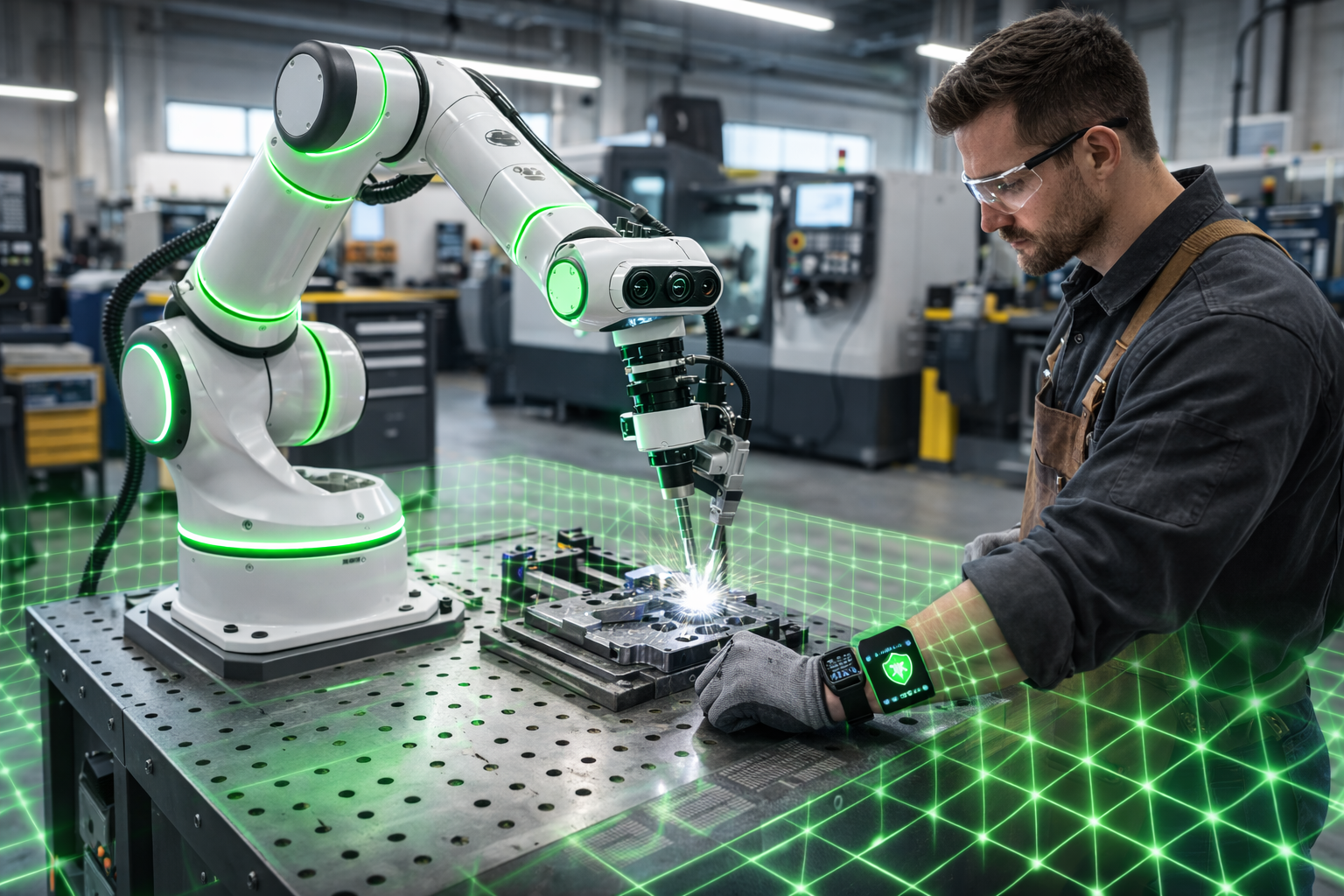
As of March 2026, the industrial landscape has shifted from “automation behind cages” to a fluid, integrated environment where humans and machines share the same workspace. Human-Machine Collaboration (HMC)—specifically the use of collaborative robots or “cobots”—is no longer a niche technology; it is the backbone of modern manufacturing, logistics, and healthcare. However, with this proximity comes a complex web of safety requirements designed to prevent physical injury and psychological strain.
What is Human-Machine Collaboration (HMC) Safety?
At its core, HMC safety is the practice of ensuring that any interaction between a human and an autonomous or semi-autonomous system is governed by protocols that prioritize human well-being. This involves a mix of functional safety (the hardware and software that stops a machine when a person is near) and operational safety (the training and environment that dictates how work is done). In 2026, these standards have evolved to include not just physical force limiting, but also the integration of Artificial Intelligence (AI) and real-time spatial data.
Key Takeaways for 2026
- Dynamic Risk Assessment: The shift from static safety zones to AI-driven, real-time risk mitigation.
- Updated ISO Frameworks: The widespread adoption of the revised ISO 10218-1 and ISO 10218-2 (2026 editions) which now account for mobile collaborative platforms.
- Sensor Fusion: The use of LiDAR, 3D vision, and wearable tech to create a 360-degree “safety bubble” around workers.
- Cyber-Physical Security: Safety standards now explicitly include cybersecurity requirements to prevent malicious overrides of safety-rated systems.
Who This Guide Is For
This comprehensive deep dive is designed for Safety Officers, Industrial Engineers, Plant Managers, and CTOs who are responsible for deploying or maintaining collaborative systems. Whether you are scaling a fleet of AMRs (Autonomous Mobile Robots) in a warehouse or integrating a single cobot into a CNC machining cell, these 2026 standards are your roadmap to compliance and workforce protection.
Safety Disclaimer: The information provided in this article is for educational purposes and reflects the industry landscape as of March 2026. Industrial safety is site-specific. Always consult with a certified safety professional and perform a formal Risk Assessment (according to ISO 12100) before deploying any robotic system.
The Regulatory Landscape: ISO, OSHA, and the EU AI Act
In 2026, the regulatory environment is more harmonized than in previous decades, yet the complexity of the technology requires a multi-layered approach to compliance.
ISO 10218-1 & 10218-2: The 2026 Revisions
The International Organization for Standardization (ISO) released updated versions of the primary robotics safety standards earlier this year. The biggest change in the ISO 10218-1:2026 is the inclusion of “Adaptive Safety Behavior.”
Unlike previous versions that relied on binary “on/off” states, the 2026 standard allows for machines to modify their speed and torque based on the specific identity and authorization level of the human collaborator. For instance, a trainee might trigger a full stop at a 2-meter distance, while a certified maintenance technician can work within 0.5 meters while the machine operates at 10% speed.
OSHA’s Modernized Enforcement (Instruction STD 01-12-002)
In the United States, OSHA has moved away from treating cobots under general “machine guarding” rules. As of early 2026, OSHA inspectors utilize a specific directive for HMC environments. This directive emphasizes “Safety-Rated Monitored Stops” and “Hand Guiding” as legitimate alternatives to physical fencing, provided the employer can demonstrate a validated functional safety circuit (Performance Level d or e).
The EU AI Act: Safety Through Transparency
For those operating in Europe, the EU AI Act is now fully in force. This impacts HMC safety by classifying “Safety Components of Regulated Machinery” as High-Risk AI Systems. This means any machine using AI to identify humans or predict their movements must have a “human-in-the-loop” override and undergo rigorous third-party conformity assessments.
The Four Pillars of Collaborative Safety
To understand the standards, we must look at the four technical methods of collaboration defined by ISO/TS 15066, which remain the gold standard in 2026.
1. Safety-Rated Monitored Stop (SRMS)
This is the most common form of HMC. The robot operates at full speed when the human is outside a designated zone. If the human enters the shared workspace, the robot stops completely, though power remains on.
- 2026 Standard: The stop must now be “intelligent.” Systems must prove they can distinguish between a human entering the zone and an inanimate object (like a pallet) to avoid unnecessary downtime.
2. Hand Guiding (HG)
Here, the operator leads the robot through its motion by hand.
- Safety Requirement: The robot must be equipped with a pressure-sensitive interface and an enabling device (like a 3-position dead-man switch). In 2026, many of these are now “wireless enabling devices” integrated into the worker’s haptic gloves.
3. Speed and Separation Monitoring (SSM)
This is the “Holy Grail” of HMC. The robot and human move simultaneously in the same space. The robot’s speed is inversely proportional to the distance of the human.
- 2026 Implementation: 3D Time-of-Flight (ToF) cameras and LiDAR are now standard. The “Protective Separation Distance” is calculated in real-time, accounting for the robot’s braking distance and the human’s approach speed.
4. Power and Force Limiting (PFL)
In this mode, the robot can physically contact the human, but the impact force is limited to levels that will not cause injury.
- The Biomechanical Threshold: Standards like ISO/TS 15066 provide specific Newton (N) limits for different parts of the human body. In 2026, these tables have been expanded to include more granular data on skin abrasion and pressure sensitivity for a wider demographic of workers.
AI and Machine Learning in Safety Protocols
The most significant advancement in 2026 is the role of Machine Learning (ML) in proactive safety. We have moved from “Reactive Safety” to “Predictive Safety.”
Predictive Path Planning
Modern safety systems use ML models to predict a worker’s next move. By analyzing subtle cues—body orientation, head position, and gait—the system can anticipate if a worker is about to reach into a hazard zone.
- Standard Compliance: To meet IEC 61508 standards in 2026, these AI models must be “explainable.” You cannot simply use a “black box” AI for safety; the logic behind a safety-stop decision must be auditable.
Sensor Fusion and Redundancy
Single-sensor safety is a thing of the past. 2026 standards require Sensor Fusion, where data from cameras, floor pressure mats, and wearables are cross-referenced. If the camera is blinded by a glare, the LiDAR or the worker’s ultra-wideband (UWB) wearable tag provides the necessary redundancy to maintain the Safety Integrity Level (SIL).
Risk Assessment: The Step-by-Step 2026 Process
A compliant risk assessment is no longer a static document; it is a living digital twin. Follow these steps to meet current standards:
- Identify Limits of the Machinery: Define the space, the duration of use, and the intended tasks.
- Identify Hazards: Don’t just look at “crushing.” Consider “entrapment,” “high-temperature contact,” and “psychological stress.”
- Risk Estimation: In 2026, we use the Probability of Occurrence of Harm (P) which now includes the reliability of the software, not just the hardware.
- Risk Evaluation: Is the current risk acceptable? If not, apply the “Hierarchy of Controls.”
- Validation: This is where many fail. You must physically test the safety stops and force-limiting features using bio-fidelic pressure sensors to ensure they meet ISO/TS 15066 thresholds.
Common Mistake: The “Out of the Box” Fallacy
Many managers assume that because a robot is sold as a “cobot,” it is inherently safe. This is false. A cobot holding a sharp knife or a heavy welding torch is a lethal machine. The “system”—including the end-effector and the workpiece—must be the subject of the risk assessment.
The Human Factor: Ergonomics and Mental Well-being
2026 is the year that ISO 10075 (Ergonomic principles related to mental workload) became a central part of HMC safety discussions.
Cognitive Overload and Trust
When humans work closely with machines, two risks emerge:
- Hyper-Vigilance: The worker is terrified of the machine, leading to stress and exhaustion.
- Over-Trust (Complacency): The worker trusts the machine too much and ignores basic safety, such as wearing PPE.
Safety standards now mandate that machine behavior must be “predictable” and “transparent.” This means using visual and auditory cues (like a robot “blinking” its lights before a turn) to communicate intent to the human partner.
Wearable Integration
In 2026, “Safety Wearables” are often part of the PPE requirements. These devices monitor the worker’s heart rate and sweat levels. If a worker shows signs of extreme fatigue, the collaborative system may automatically slow down or trigger a mandatory break, as per the updated NIOSH (National Institute for Occupational Safety and Health) guidelines.
Cybersecurity: The New Safety Frontier
You cannot have safety without security. In 2026, ISA/IEC 62443 (Industrial Communication Networks – Network and System Security) is inseparable from robotic safety.
The “Safety-Security” Link
If a hacker can access your industrial network and change the “Force Limiting” parameters of a cobot from 100N to 1000N, the machine becomes a weapon.
- 2026 Requirements: All safety-rated controllers must have “Immutable Root of Trust” hardware.
- Air-Gapping Safety: The safety logic (Logic) must be physically or cryptographically separated from the general motion control and cloud-connectivity layers.
Practical Examples of 2026 Safety Compliance
Case Study 1: Automotive Trim Line
- The Setup: Humans install interior panels while a cobot applies adhesive.
- Safety Standard: Speed and Separation Monitoring.
- Solution: Ceiling-mounted 3D sensors create a “virtual curtain.” If the worker’s hand moves toward the adhesive nozzle, the robot’s torque drops to zero instantly.
Case Study 2: Pharmacy Fulfillment Center
- The Setup: Mobile robots (AMRs) navigate through a crowd of pharmacists.
- Safety Standard: ISO 3691-4 (Safety requirements for driverless industrial trucks).
- Solution: The robots use “Dynamic Path Planning.” They don’t just stop; they proactively re-route to maintain a 1.5-meter buffer from any human, as detected by their on-board AI vision.
Common Mistakes in Human-Machine Safety
- Ignoring the End-Effector: Buying a safe robot but attaching a dangerous “gripper” without adding additional shielding.
- Bypassing Safeties for Productivity: Programmers often “tweak” the speed to hit KPIs, unknowingly moving the robot out of its “Force Limiting” safety envelope.
- Lack of Re-Validation: A risk assessment is done at installation, but the floor layout changes six months later. Any change in the “shared space” requires a new validation.
- Inadequate Training: Treating cobots like “appliances.” Workers need to understand the limitations of the sensors. They should know where the “blind spots” are.
Conclusion: The Path Forward in 2026
Safety in human-machine collaboration has evolved from a series of physical barriers to a sophisticated, data-driven ecosystem. In 2026, being “safe” means being “smart.” It requires a holistic view that integrates the mechanical precision of the robot, the analytical power of AI, and the biological reality of the human worker.
Compliance is no longer just about avoiding fines from OSHA or the EU; it’s about building a resilient workforce. As labor markets remain tight, the companies that thrive will be those that create a “culture of safety” where technology empowers humans rather than endangering them.
Your Next Steps:
- Audit: Review your current robotic installations against the ISO 10218:2026 standards.
- Consult: Engage a functional safety expert to perform “Stop-Time Measurements” on your collaborative cells.
- Train: Update your operator training modules to include “Predictive AI Awareness” and “Cyber-Safety Basics.”
FAQs
1. Does a cobot always need a fence?
No. Under ISO/TS 15066, a cobot can operate without physical fencing if it utilizes one of the four collaborative modes (SRMS, HG, SSM, or PFL) and passes a rigorous risk assessment. However, if the task involves sharp objects or high-speed projectiles, a fence or light curtain may still be required.
2. What is the maximum force a cobot can apply to a human in 2026?
The force limits are body-part specific. For example, a “transient” (accidental) contact to the arm may be allowed up to 140N, while contact to the face or neck is strictly prohibited and must be prevented by design or sensors. Always refer to the latest ISO/TS 15066 Annex A tables.
3. How has the EU AI Act changed robotic safety?
The Act requires that AI-driven safety systems are transparent, traceable, and subject to human oversight. Manufacturers must provide detailed documentation on how the AI identifies humans and what the “error rate” of the safety-vision system is.
4. Can legacy robots be “retrofitted” to 2026 safety standards?
Yes, but it is often costly. Retrofitting requires adding safety-rated controllers, updated sensors (LiDAR/3D Vision), and often a complete rewrite of the safety logic to meet current Performance Level (PL) requirements.
5. Is mental health covered under 2026 safety standards?
While not a “violation” in the traditional sense, ISO 10075 and ISO 45003 are increasingly used by OSHA and European regulators as best-practice frameworks. High levels of “machine-induced stress” are recognized as a leading cause of workplace accidents and are now part of comprehensive risk assessments.
References
- ISO 10218-1:2026: Robots and robotic devices — Safety requirements for industrial robots — Part 1: Robots.
- ISO 10218-2:2026: Robots and robotic devices — Safety requirements for industrial robots — Part 2: Robot systems and integration.
- ISO/TS 15066:2016 (Updated 2024/2026 Guidance): Robots and robotic devices — Collaborative robots.
- OSHA Publication 3107: Guarding of Farm, Industrial, and Construction Equipment (2026 Update).
- ANSI/RIA R15.06-2026: American National Standard for Industrial Robots and Robot Systems – Safety Requirements.
- EU Regulation 2024/1689 (EU AI Act): Official Journal of the European Union.
- IEC 61508: Functional Safety of Electrical/Electronic/Programmable Electronic Safety-related Systems.
- ISO 12100:2010: Safety of machinery — General principles for design — Risk assessment and risk reduction.
- NIOSH Strategic Plan for 2024-2027: Focus on Robotics and Advanced Manufacturing Safety.
- ISO 3691-4:2023/2026: Industrial trucks — Safety requirements and verification — Part 4: Driverless industrial trucks and their systems.