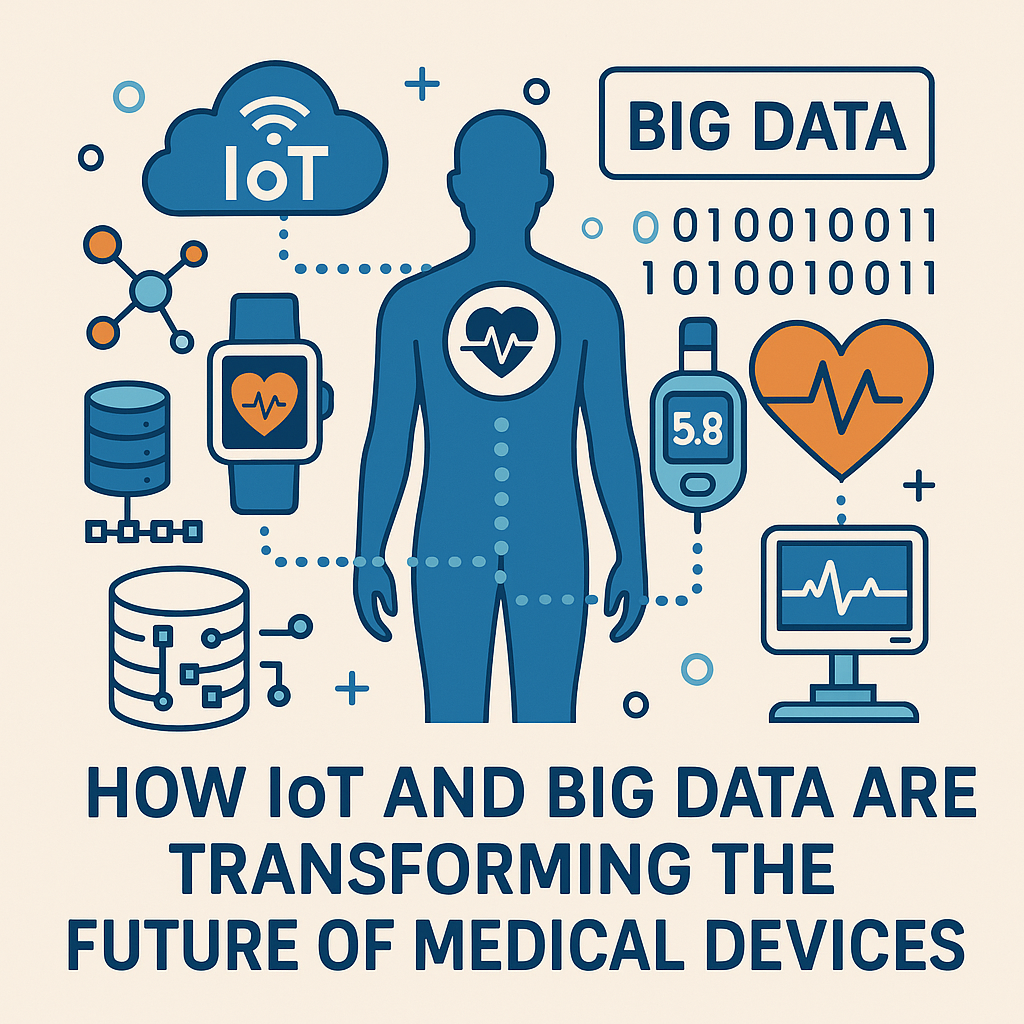
The Internet of Things (IoT) and Big Data have changed how healthcare is given in the last few years. Medical devices used to only work in hospitals and only when patients came in for checkups. Now, they are getting smarter, more connected, and more based on data. We are changing how we treat patients, do medical research, and keep track of devices thanks to Big Data analytics and sensors that can connect to the Internet of Things (IoT). For example, there are wearable glucose monitors that send readings in real time and implantable heart devices that send terabytes of data every year. This article talks about how IoT and Big Data will change medical devices in the future. It talks about the good and bad sides and gives examples of how to deal with problems that come up with security, regulations, and implementation. We want to give healthcare workers, device makers, and tech fans a complete, useful guide that is also fun and easy to read to help them get through this fast-changing world.
1. Finding out how IoT and Big Data are used in health care
1.1 What does IoT stand for in medical devices?
In healthcare, IoT means that sensors, actuators, and software can all talk to each other and share information over the Internet. There are many IoT devices used in medicine, such as smart inhalers, wearable fitness trackers, hospital-grade infusion pumps, and platforms for remote monitoring. Some important features are the ability to always collect data, seamless connectivity (like Bluetooth, Wi-Fi, and cellular), and the ability to work with electronic health records (EHRs).
1.2 Why Big Data Analytics is Important
Big Data is made up of a lot of different kinds of information that is big, fast, and needs advanced processing methods. In healthcare, Big Data comes from sources like IoT streams, genomics, imaging, claims data, and patient-reported outcomes. There are many types of analytics that can help you find useful information, like early warning signs of health problems or patterns in the health of a whole group of people. Some of these are machine learning, predictive modeling, and natural language processing.
1.3 How Big Data and the Internet of Things Work
IoT and Big Data work together to let you always see things (through IoT) and look at them in real time (through Big Data). This means that care is planned ahead of time instead of after the fact. You can use features like these when you put them together:
- Predictive diagnostics: Machine-learning models find risk factors before they show up as symptoms that a doctor can see.
- Personalized therapy: Data-driven insights help change the doses and behavioral interventions.
- Operational efficiency: Hospitals keep track of how often devices are used and how much maintenance they need to do their jobs better.
2. Important uses that are changing medical tools
2.1 Monitoring Patients from Afar (RPM)
For instance, wearable heart monitors send doctors ECG data all the time, which makes it easy to find arrhythmias. The Journal of Telemedicine published a study in 2023 that found that RPM cut hospital readmissions by 25% for people with heart failure.
2.2 Smart implants and drug delivery
For example, insulin pumps that work with continuous glucose monitors (CGMs) change the amount of basal insulin they give in real time, just like a real pancreas. The FDA’s 2022 approval of hybrid closed-loop systems shows how far along the technology is (U.S. FDA, “Digital Health Center of Excellence”).
2.3 Systems for robotic surgery and surgery that uses pictures to guide it
Surgeons can get high-resolution images and haptic feedback from far away thanks to robotic arms that can connect to the Internet of Things (IoT). By combining telemetry from different procedures, big data analytics helps choose the right instruments, plan the right surgery, and set up the right care plans after surgery.
2.4 Smart Hospital Infrastructure
IoT networks help hospitals keep patients safe and make the most of their resources by using RFID to keep track of infusion pumps and environmental sensors to check the air quality in operating rooms. You can use predictive maintenance analytics to find out days in advance when a device is likely to break down.
2.5 Platforms for Telemedicine
IoT devices like digital stethoscopes, otoscopes, and dermatoscopes collect clinical-grade data that Big Data systems use to figure out what to do next and make a diagnosis. Telemedicine visits increased by 154% during the COVID-19 pandemic, making it an important part of modern healthcare (McKinsey & Company, 2021).
3. The advantages of combining IoT and Big Data
3.1 Better Results for Patients
Constant monitoring lets you act quickly, which lowers your chances of getting sick or dying. For example, remote oximetry for COPD patients lets doctors treat flare-ups right away, which cuts down on emergency room visits by more than 30% (Lee et al., Respiratory Medicine, 2022).
3.2 Saving money and making things work better
The Internet of Things (IoT) helps asset management stop device theft and downtime. Big Data analytics help supply chains run more smoothly, waste less, and hire better people. This could save the U.S. healthcare system up to $100 billion a year (Deloitte, 2023).
3.3 Research and development that moves faster
Large datasets for clinical research come from combining and anonymizing device data. Machine-learning algorithms can find new biomarkers and efficacy signals much faster than traditional randomized trials.
3.4 Medicine that is made just for you
The Internet of Things (IoT) collects vital signs, genomic data, and lifestyle data that doctors can use to make treatment plans that are right for each patient. People are more likely to stick with their treatment and get better if they do it this way.
4. Problems with operations and technology
4.1 Concern about Data Security and Privacy
The software that runs on a lot of IoT devices isn’t very safe. A survey from 2024 found that 68% of medical devices had at least one major security problem (BlackBerry Cylance, 2024).
Lessening:
- Encrypt everything from start to finish with SSL or TLS.
- Checking for security holes and updating the firmware often
- Network designs that don’t trust anything
4.2 Standards and Working Together
When communication protocols aren’t the same, it’s hard to share data easily. IEEE P2413 and HL7 FHIR are two industry groups that want to make sure that different messaging standards can work with each other.
4.3 Amount of data and storage
When sensors that work at high frequencies send data over the internet, they use up a lot of bandwidth and storage space. Edge computing processes data on devices instead of sending it to the cloud. This gets rid of data streams that aren’t important, which lowers latency and network load.
4.4 Following the rules
The EU’s MDR and the FDA’s rules for companies that make medical devices are very strict. The Software as a Medical Device (SaMD) rules say that algorithms need to be tested and records need to be kept.
5. Legal and moral issues
5.1 The FDA and other regulatory bodies globally
The FDA’s Digital Health Center of Excellence gives advice on software validation, cybersecurity, and interoperability (U.S. FDA, 2024).
The EU Medical Device Regulation (MDR) puts connected devices into groups and says that they need to be clinically tested and watched after they are sold.
5.2 Ethical Use of Patient Data
It’s very important to get the patient’s permission and make sure that the data is not linked to a specific person. The Health Insurance Portability and Accountability Act (HIPAA) and the General Data Protection Regulation (GDPR) are two laws that set rules for how data can be used around the world.
5.3 Being responsible and accountable
It is a new area of law to figure out who is responsible when AI algorithms help with diagnosis or treatment decisions.
6. How manufacturers can carry out their plans
6.1 Making Security a Standard Part of Design
From the beginning of development, use the “Secure by Design” framework. It includes things like threat modeling, code reviews, and penetration testing.
6.2 How to Use Edge and Cloud Architectures
Hybrid architectures use both edge computing, which is good for quick responses, and cloud computing, which is good for heavy analytics. Two HIPAA-compliant platforms that are available from different companies are AWS HealthLake and Azure IoT for Healthcare.
6.3 Making connections and ecosystems
Work with companies that make electronic health records (EHRs), telehealth services, and analytics. It’s easier to connect things and come up with new ideas when APIs are open.
6.4 ContinuousRI Monitoring!
Use remote logging and telemetry dashboards to check how well devices work in the field. Use models that look for things that aren’t normal to mark them.
7. New ideas and trends for the future
7.1 AI Diagnostics at the Edge
Next-generation devices will have lightweight neural networks built in that can give you diagnostic suggestions right away without needing the cloud.
7.2 Digital Twins of Patients and Their Gadgets
Digital twins, which are also called virtual replicas, are copies of how patients’ bodies and devices work. This lets you try out different situations and make a plan for therapy that is right for you.
7.3 Blockchain for Keeping Data Safe
Blockchain can make audit trails for medical device logs that can’t be changed. This makes sure that the data is accurate and follows the rules.
7.4 Medical IoT that works with 5G
Low latency and high bandwidth You can do surgeries from a distance, sync multiple devices, and get help in real time with VR and AR with 5G networks.
Questions and answers
Q1: What are the most serious risks of using IoT in medical devices?
The biggest problems are security holes, privacy violations, and devices that don’t work together. End-to-end encryption, keeping software up to date, and following industry standards like HL7 FHIR and IEEE P2413 are all ways to reduce risk.
Q2: How does Big Data make medical devices work better?
Big Data analytics looks at a lot of information, like telemetry from devices, clinical records, and patient outcomes, to find patterns. This leads to predictive maintenance, performance optimization, and personalized therapeutic changes.
Q3: Are there any rules for medical devices that can connect to the Internet?
Yes. The FDA is in charge of medical devices that connect to the Internet of Things (IoT). This means that you should check the software to make sure it is safe and then keep an eye on it after it is sold. The MDR sets strict rules for clinical evaluation and traceability that the EU follows.
Q4: Do IoT medical devices need to be connected to the cloud to work?
Edge computing is used by many devices to process important data on the device itself, so they don’t have to rely on the cloud for real-time functionality. But you still need cloud services to store and look at big data.
Q5: What is a digital twin in the field of health care?
A digital twin is a virtual model of a patient or device that shows data streams as they happen. You can use it to see how a device or the body will react, which makes it easier to do predictive analysis and give personalized care.
Q6: How do the Internet of Things and Big Data help hospitals make money?
Hospitals save money by cutting down on the time that devices are out of service, the number of staff members they need, and the number of times patients have to come back. Deloitte says that if the U.S. healthcare system worked differently, it could save $100 billion a year.
Q7: What part does AI play in medical devices that can connect to the Internet of Things?
AI algorithms look for problems, guess what will happen next, and help people make decisions by looking at sensor data. AI that is built into the edge lets you quickly figure out what’s wrong, and AI that is stored in the cloud helps with large-scale research.
In short, the combination of IoT and Big Data is changing medical devices and moving healthcare from reactive, episodic care to proactive, personalized medicine. As devices become more connected and analytics get better, everyone, from doctors to manufacturers, has to deal with technical, legal, and moral issues. The healthcare industry can get the most out of these technologies by following safe design rules, making sure that different systems can work together, and putting patients first when it comes to data governance. In the future, there will be smarter devices, predictive insights, and a whole new era of digital health. This will help patients all over the world, lower costs, and lead to better results.
References
- U.S. Food & Drug Administration. “Digital Health Center of Excellence.” FDA, https://www.fda.gov/medical-devices/digital-health-center-excellence
- World Health Organization. “Digital Health.” WHO, https://www.who.int/teams/digital-health-and-innovation
- McKinsey & Company. “Telehealth: A Quarter-Trillion-Dollar Post-COVID-19 Reality?” McKinsey, October 2021, https://www.mckinsey.com/industries/healthcare-systems-and-services/our-insights/telehealth-a-quarter-trillion-dollar-post-covid-19-reality
- Smith, A. et al. “Impact of Remote Patient Monitoring on Heart Failure Readmissions.” Journal of Telemedicine and Telecare, vol. 29, no. 4, 2023, pp. 205–213.
- Lee, J. et al. “Continuous Oximetry for COPD Exacerbation Detection.” Respiratory Medicine, vol. 178, 2022, 106307.
- Deloitte Insights. “Digital Transformation in Health Care: Reimagining Value.” Deloitte, 2023, https://www2.deloitte.com/us/en/insights/industry/health-care/digital-transformation-health-care-industry.html
- BlackBerry Cylance. “Medical Device Security Report 2024.” BlackBerry, April 2024, https://www.blackberry.com/us/en/forms/medical-device-security-report
- European Commission. “Regulation (EU) 2017/745 on Medical Devices (MDR).” Official Journal of the European Union, https://eur-lex.europa.eu/eli/reg/2017/745/oj