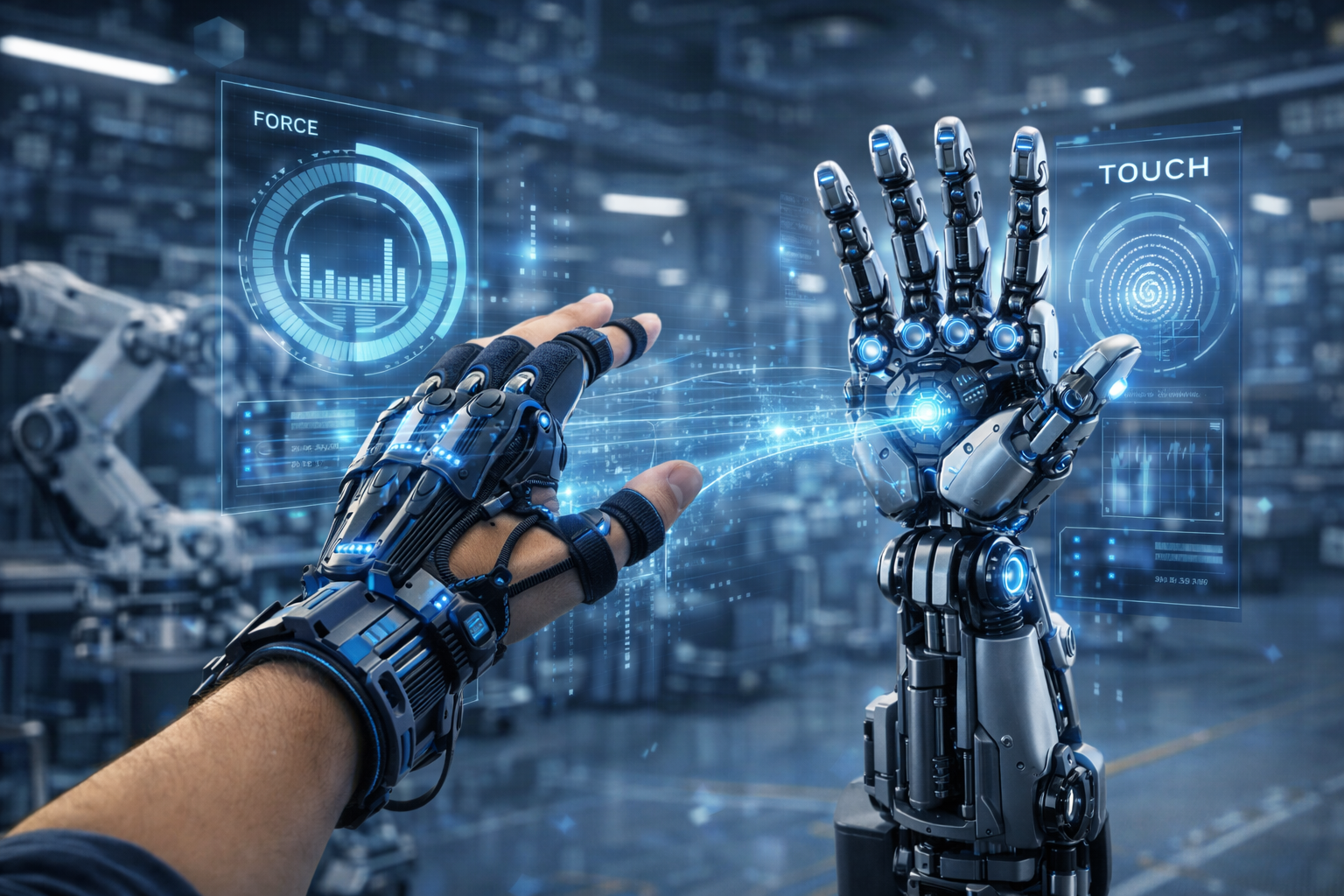
Imagine trying to tie your shoelaces while wearing thick, numb oven mitts—or worse, trying to do it while looking through a grainy camera feed from another room without being able to feel the tension of the strings. This “sensory gap” is the primary hurdle in telerobotics. Haptic feedback is the bridge across that gap. It is the technology that allows a human operator to not just see what a robot is doing, but to feel the resistance of a bolt, the softness of human tissue during surgery, or the weight of a sample collected on the lunar surface.
As of March 2026, the integration of haptic feedback has moved from a “luxury feature” to a mission-critical requirement in fields ranging from telesurgery to deep-sea exploration. This guide explores the mechanics, applications, and challenges of bringing the sense of touch to the digital frontier.
Key Takeaways
- Definition: Haptic feedback encompasses both kinesthetic (force) and tactile (texture/vibration) sensations.
- Bilateral Control: The “gold standard” of remote control where information flows both ways—commands to the robot and sensations back to the user.
- Critical Barrier: Latency (the delay between action and sensation) remains the greatest technical challenge for stability.
- Safety First: In medical and industrial settings, haptics prevent “over-torquing” and accidental damage by providing physical limits to the operator.
Who This Article Is For
This guide is designed for robotics engineers looking to optimize control loops, medical professionals interested in the evolution of robot-assisted surgery, UX/UI designers moving into spatial computing, and tech enthusiasts eager to understand how we will interact with machines in the coming decade.
1. The Fundamentals of “Feeling” at a Distance
To understand haptic feedback in remote robotic control, we must first break down what “touch” actually is. In the world of robotics, touch is not a single data point; it is a complex interplay of forces and surface characteristics.
Kinesthetic vs. Tactile Feedback
When we talk about haptics, we are usually discussing two distinct systems:
- Kinesthetic Feedback: This relates to the forces felt by muscles and joints. If a robotic arm hits a wall, kinesthetic feedback is what pushes back against the operator’s hand, preventing them from moving the controller further. It communicates weight, resistance, and position.
- Tactile Feedback: This relates to the skin’s surface. It communicates texture, temperature, vibration, and friction. If a robot picks up a piece of sandpaper, tactile feedback allows the operator to feel the “grit” through specialized actuators in a glove or joystick.
The Bilateral Teleoperation Loop
In a standard “unilateral” system, the human sends a command, and the robot executes it. In a bilateral system, the loop is closed. The basic physics can be modeled through impedance or admittance control. If we look at the interaction as a mechanical system, the force $F$ felt by the operator can be simplified as a function of the slave robot’s interaction with the environment:
$$F_{human} \approx K(x_{master} – x_{slave}) + B(\dot{x}_{master} – \dot{x}_{slave})$$
Where:
- $K$ is the virtual stiffness of the connection.
- $B$ is the damping coefficient.
- $x$ represents the position.
This equation illustrates that the operator feels a force proportional to the difference in position between their hand and the robot, essentially “coupling” them across space.
2. The Anatomy of a Haptic Teleoperation System
A functional remote haptic system consists of three main components: the Master Station, the Communication Link, and the Slave Manipulator.
The Master Station (The Human Interface)
The master station is where the human resides. It requires an interface that can both track human movement and exert force back onto the human.
- Exoskeletons: Full-arm or hand suits that provide high-fidelity force feedback to multiple joints.
- Joysticks and Styluses: Common in surgery (e.g., the Da Vinci system), these provide localized force feedback at the fingertips.
- Wearable Haptics: Thimbles or rings that use small motors to pull on the skin to simulate the sensation of grasping an object.
The Slave Manipulator (The Remote Robot)
The “slave” is the robot performing the task. To provide haptic feedback, it must be equipped with sensors:
- Force-Torque Sensors: Usually mounted at the “wrist” of the robot to measure the total load.
- Tactile Skins: Flexible membranes embedded with pressure sensors that mimic human skin.
- Current Sensing: A “software-only” approach where the robot’s motor current is monitored. If the current spikes, it implies the robot has encountered resistance.
Sensors and Actuators: The Hardware Layer
As of 2026, the hardware has become significantly more miniaturized.
| Component Type | Technology | Best Use Case |
| Actuator | Linear Resonant Actuator (LRA) | Precise vibrations and “clicks.” |
| Actuator | Piezoelectric Elements | High-frequency texture simulation. |
| Sensor | Fiber Bragg Grating (FBG) | Surgical tools (immune to MRI/Electrical noise). |
| Sensor | Capacitive Pressure Arrays | Robotic “skin” for detecting contact. |
3. Control Architectures and the Quest for “Transparency”
In telerobotics, transparency refers to how “invisible” the system is. Perfect transparency means the operator feels exactly what the robot feels, with no friction from the motors or lag from the computer.
Stability vs. Transparency
This is the “Golden Trade-off” of robotics.
- High Transparency: Makes the system feel real but is prone to instability. If there is even a tiny delay, the force feedback can oscillate wildly (imagine a steering wheel that starts shaking violently on its own).
- High Stability: Often requires “damping” the system, which makes the robot feel like it is moving through molasses or thick oil.
Common Control Schemes
- Position-Position: The slave tries to match the master’s position, and the master tries to match the slave’s. If the slave hits a wall, the position mismatch creates a “virtual spring” force back to the user.
- Force-Position: The master sends position commands, and the slave sends back raw data from its force sensors. This is more accurate but extremely sensitive to network delays.
4. Industry Applications: Where Haptics Save Lives
Haptic feedback isn’t just for gaming. It is a transformative tool for high-stakes environments.
Robotic Surgery (Telesurgery)
In the early days of robotic surgery, surgeons relied entirely on visual cues (e.g., seeing the tissue deform) to know how hard they were pulling. This led to broken sutures or damaged vessels.
Modern systems use haptic feedback to allow surgeons to “feel” the difference between a hard tumor and soft healthy tissue. This is especially critical in remote surgery, where the specialist may be in a different city than the patient.
Safety Disclaimer: Robotic surgery should only be performed by licensed medical professionals using FDA/EMA-approved equipment. Haptic feedback is a support tool and does not replace the clinical judgment of the surgeon.
Hazardous Environments (Nuclear and Deep Sea)
When decommissioning a nuclear plant or repairing a subsea oil pipe at 3,000 meters, a mistake can be catastrophic.
- Nuclear: Haptics allow operators to handle delicate radioactive waste containers with the same finesse as if they were holding them by hand.
- Deep Sea: Water pressure and murky visibility make cameras unreliable. Haptic feedback allows the pilot of a Remotely Operated Vehicle (ROV) to “feel” their way around a structure.
Space Exploration
With the Artemis missions and planned Mars exploration, “tele-presence” is vital. Astronauts in orbit can control rovers on the lunar surface. Because the signal takes roughly 1.3 seconds to reach the Moon, haptic systems use Predictive Rendering. The operator feels a “simulated” version of the moon rock based on a local computer model while the real robot catches up seconds later.
5. Overcoming the Latency Barrier
Latency (lag) is the arch-nemesis of haptic feedback. In a standard video call, a 200ms delay is annoying. In a haptic loop, a 200ms delay can cause the robot to vibrate so hard it breaks itself.
The Speed of Light Problem
Information cannot travel faster than light. For earth-to-orbit or transcontinental control, delays are unavoidable.
- The 10ms Rule: For a human to perceive a haptic sensation as “real-time” and stable, the loop usually needs to run at 1,000Hz (1ms updates) with a total round-trip latency of under 10-20ms.
6G and Edge Computing
As of March 2026, the rollout of 6G networks has begun to address this. Unlike 5G, 6G is designed specifically for “sub-millisecond” latency and “ultra-reliable” communication. By using Edge Computing—placing the processing power physically close to the operator—we can process haptic data locally before sending it across the globe.
6. Common Mistakes in Haptic Implementation
Even with the best hardware, haptic systems can fail if the human element is ignored.
- Over-Saturation: Flooding the operator with too much feedback. If every motor vibration is sent to the hand, the “useful” information (like hitting a wall) gets lost in the noise.
- Ignoring Ergonomics: A haptic glove that provides 10 lbs of force might be “realistic,” but it will fatigue a surgeon or pilot within 20 minutes.
- Visual-Haptic Mismatch: If the operator sees the robot touch an object but doesn’t feel it for another 100ms, the brain gets confused, often leading to motion sickness or “cyber-sickness.”
- Neglecting Friction Compensation: Every motor has its own internal friction. If the software doesn’t “cancel out” the weight of the robotic arm itself, the operator will feel like they are dragging a heavy anchor.
7. The Future: AI, Soft Robotics, and Neural Links
Where is the field headed in the next five years?
AI-Enhanced Haptics
AI models are now being used to “guess” what a surface feels like before the sensors even send the data. This Predictive Haptics allows for smoother control even on slower internet connections. AI can also filter out the “hand tremors” of an aged surgeon, providing a stabilized, haptic-perfect interface.
Soft Robotics
Most robots today are “hard” (metal and plastic). Soft robotics uses flexible materials and fluid-filled chambers. Haptic feedback for soft robots is revolutionary because it allows the robot to “hug” an object, distributing pressure evenly. This is vital for search-and-rescue missions where a robot might need to pull a survivor from rubble without causing further injury.
Neural Haptics
We are seeing the first successful trials of Direct Neural Interfaces (DNI). Instead of wearing a glove, the haptic data is sent directly to the user’s peripheral nervous system or brain. This bypasses the skin entirely, offering a level of immersion that was once strictly science fiction.
Conclusion
The role of haptic feedback in remote robotic control is nothing less than the restoration of a lost sense. We have spent decades giving robots “eyes” through cameras and “ears” through microphones. By giving them “touch,” we are finally closing the loop of human-machine interaction.
The transition from 5G to 6G, combined with advances in soft-actuator technology, has made March 2026 a landmark era for telerobotics. Whether it is a doctor performing surgery across an ocean or a technician repairing a satellite in orbit, the ability to feel is what makes the remote task human.
Next Steps for Implementation:
If you are looking to integrate haptics into your own project, start by defining your transparency requirements. Do you need to feel the texture of the surface (Tactile), or just the resistance of the movement (Kinesthetic)? Selecting the right actuator—whether an LRA for vibration or a DC motor for force—is the first physical step toward building a truly immersive remote control system.
FAQs
1. Can haptic feedback work over standard Wi-Fi?
While it is possible for non-critical applications (like gaming), standard Wi-Fi is generally too “jittery” for precision robotics. The fluctuations in latency (jitter) can cause the haptic loop to become unstable. For professional use, dedicated fiber optics or 5G/6G “network slicing” is preferred.
2. Does haptic feedback make remote control harder to learn?
Initially, there is a learning curve as the brain adapts to “feeling” through a machine. However, studies consistently show that once the user is trained, haptic feedback significantly reduces cognitive load and task completion time because the operator doesn’t have to rely solely on vision.
3. What is “Haptic Ghosting”?
Haptic ghosting occurs when an operator feels a sensation that isn’t there, usually caused by a software glitch or a “echo” in the data transmission. It can be disorienting and is a major focus of safety protocol development.
4. Are there any health risks to using haptic interfaces?
Long-term use of high-vibration tactile haptics can lead to “Vibration White Finger” or temporary numbness, similar to using heavy power tools. Ergonomic design and “vibration damping” software are used to mitigate these risks.
5. How much does a professional haptic interface cost?
As of 2026, entry-level haptic styluses for education start around $2,000, while medical-grade, multi-degree-of-freedom exoskeletons can exceed $100,000.
References
- IEEE Xplore: “Advances in Bilateral Teleoperation and Haptic Feedback” (2025).
- Nature Machine Intelligence: “Tactile Sensing and Haptic Rendering in Soft Robotics” (February 2026).
- International Journal of Medical Robotics: “The Impact of Force Feedback on Surgical Precision in Remote Environments.”
- NASA Technical Reports Server (NTRS): “Telerobotic Control on the Lunar Surface: Overcoming Latency with Predictive Haptics.”
- MIT Press: The Handbook of Haptics for Human-Computer Interaction.
- 6G World News: “Network Slicing and the Future of Sub-millisecond Haptic Loops” (Jan 2026).
- Stanford Robotics Lab: “Impedance Control vs. Admittance Control in Modern Telerobotics.”
- Journal of NeuroEngineering and Rehabilitation: “Direct Neural Interfaces for Haptic Restoration.”