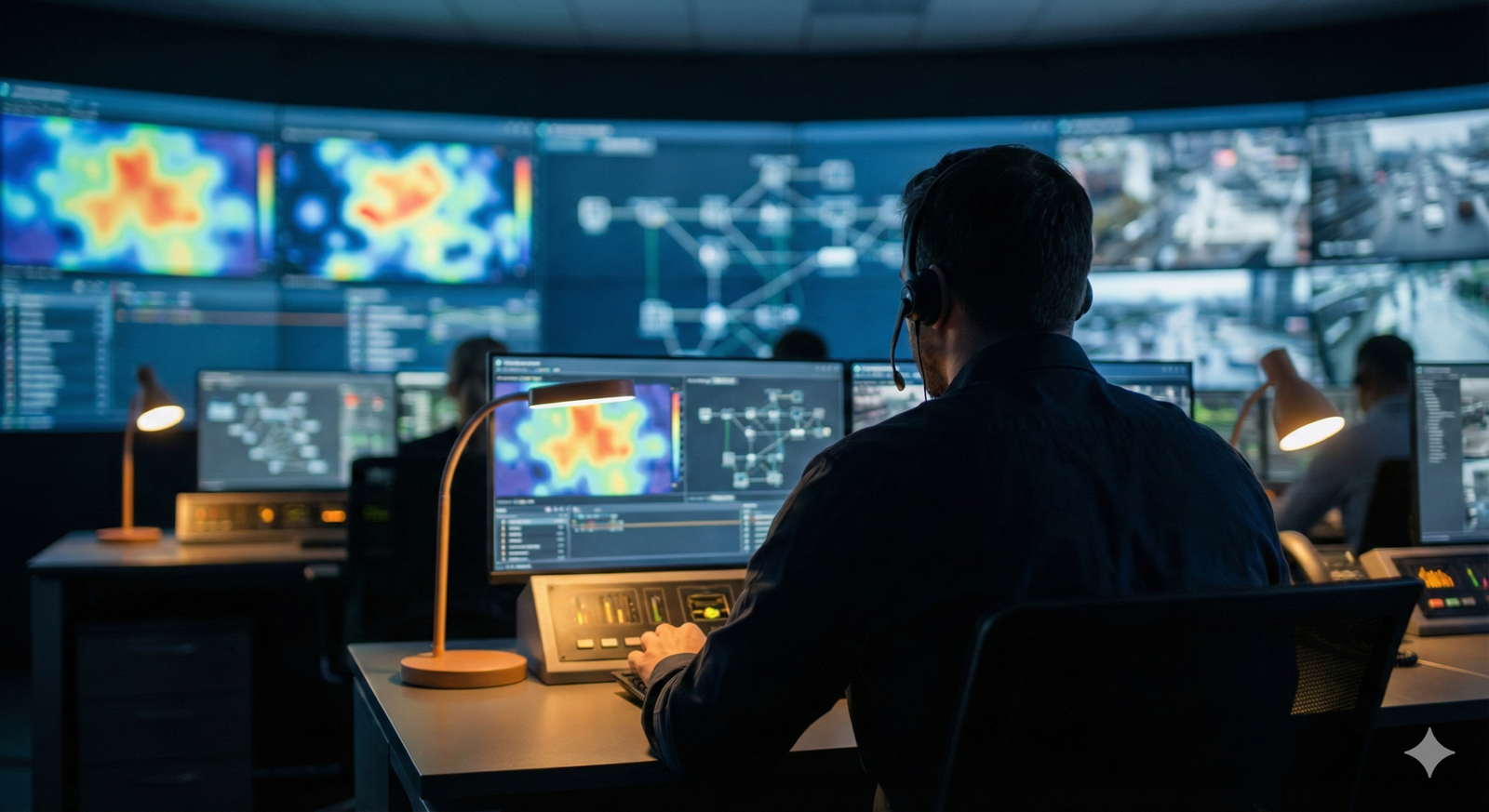
Artificial intelligence has fundamentally transformed the landscape of public and private monitoring. We have moved rapidly from the era of “dumb” closed-circuit television (CCTV)—where humans had to watch tapes to find evidence—to an era of intelligent, real-time analysis. Today, AI-powered surveillance systems can identify faces in a crowd, analyze gait and emotion, predict criminal activity before it happens, and track movements across entire cities. While proponents argue that these tools are essential for modernizing public safety and optimizing urban management, they raise profound questions about the nature of freedom, privacy, and equality.
The ethical dilemmas in AI surveillance are not merely theoretical; they are active conflicts playing out in legislative chambers, police departments, and city councils worldwide. As these technologies become cheaper and more ubiquitous, the friction between collective security and individual rights intensifies. This guide explores the multifaceted ethical landscape of automated monitoring, helping readers understand the trade-offs involved in the deployment of these powerful tools.
Key Takeaways
- The shift from passive to active: AI transforms surveillance from a retrospective investigative tool into a proactive, real-time control mechanism.
- The privacy paradox: Increased safety often comes at the cost of anonymity, creating a tension that is difficult to resolve ethically.
- Algorithmic bias: Surveillance AI often performs unevenly across different demographics, leading to discriminatory outcomes in law enforcement and access to services.
- The chilling effect: The mere presence of intelligent monitoring can alter human behavior, stifling free expression and the right to protest.
- Accountability gaps: When an autonomous system makes an error—such as a wrongful identification—determining liability remains a complex legal and ethical challenge.
Scope of This Guide
In this guide, “AI-powered surveillance” refers to the use of machine learning, computer vision, and predictive analytics to monitor people, objects, and environments. This includes facial recognition, gait analysis, license plate reading, and predictive policing algorithms. While we touch upon workplace monitoring, the primary focus is on mass surveillance in public spaces and the use of these technologies by state actors and large corporations. We will examine these issues through the lens of human rights, privacy ethics, and social justice.
Understanding AI-Powered Surveillance: Beyond the Camera Lens
To navigate the ethical terrain, it is necessary to understand how AI differs from traditional surveillance. Traditional surveillance is passive; it records video footage that is only useful if a human reviews it. It is labor-intensive and limited by human attention spans.
AI-powered surveillance is active and persistent. It involves the automated processing of sensory data to extract meaning.
- Computer Vision: Algorithms can instantly recognize objects (guns, abandoned bags), behaviors (running, fighting), and identities (faces, license plates).
- Data Aggregation: AI systems can fuse data from disparate sources—video feeds, social media, geolocation data, and purchase history—to create a comprehensive profile of an individual’s life.
- Pattern Recognition: Machine learning models identify deviations from “normal” behavior, flagging individuals who act in ways the system deems suspicious.
The ethical implication of this technical shift is scale. AI enables mass surveillance that was previously impossible due to manpower constraints. It allows for the simultaneous monitoring of millions of people, fundamentally changing the relationship between the watcher and the watched.
The Privacy vs. Security Trade-off
The foundational ethical dilemma in AI surveillance is the classic tension between privacy and security. This is often framed as a zero-sum game: to gain more security, one must surrender more privacy.
The Utilitarian Argument
Proponents of AI surveillance—typically law enforcement agencies, security vendors, and some city planners—rely on a utilitarian ethical framework. They argue that the potential benefits to the collective good outweigh the intrusion on individual privacy.
- Crime Deterrence and Resolution: If facial recognition can locate a missing child or a terrorist suspect in minutes rather than days, the argument goes, the technology is morally justified.
- Efficiency: Automated systems can monitor critical infrastructure (like airports and power plants) more reliably than tired human guards, potentially preventing catastrophic events.
The “Nothing to Hide” Fallacy
A common counter-argument to privacy concerns is the phrase: “If you have nothing to hide, you have nothing to fear.” Privacy advocates and ethicists strongly contest this.
- Contextual Privacy: Everyone has things they wish to keep private from the state or corporations, including medical conditions, political associations, religious practices, and personal relationships.
- Power Dynamics: Privacy is not just about hiding secrets; it is about maintaining autonomy. When a central authority has unlimited visibility into the lives of citizens, the power dynamic shifts dramatically, leaving individuals vulnerable to coercion and manipulation.
The ethical failing of the “security at all costs” approach is that it treats privacy as a luxury rather than a fundamental right. In liberal democracies, the presumption is that citizens should be free from monitoring unless there is specific suspicion of wrongdoing. AI surveillance flips this presumption, treating every individual as a potential risk to be assessed.
Facial Recognition and the Death of Anonymity
Of all AI surveillance technologies, facial recognition (FRT) elicits the strongest ethical backlash. Our faces are our most public and yet most personal identifiers. Unlike a password or a credit card number, you cannot change your face if your biometric data is compromised.
The Right to Anonymity
In the past, one could walk through a city crowd and be “anonymous.” While you were visible, you were not identified. AI removes this layer of protection. Live facial recognition scans faces in real-time, comparing them against watchlists. This effectively turns public spaces into identity checkpoints.
- Ethical Concern: The destruction of public anonymity makes it impossible to move through the world without leaving a digital trace. This has profound implications for freedom of movement and association.
- In Practice: If a government can track exactly who attends a political rally or visits a specific healthcare clinic, individuals may be deterred from exercising their legal rights due to fear of retribution or social stigma.
Consent and Opt-Out Mechanisms
A core tenet of data ethics is informed consent. In online environments, we (theoretically) click “agree” to terms of service. In physical spaces, there is no “I Agree” button.
- Lack of Choice: Citizens cannot practically “opt out” of facial recognition in public squares, airports, or shopping malls without withdrawing from society entirely.
- Passive Collection: Most people are unaware they are being scanned, identified, and potentially logged in a database. This violation of autonomy is a major ethical stumbling block for widespread FRT deployment.
Bias and Discrimination in Algorithms
Perhaps the most urgent ethical crisis in AI surveillance is the issue of algorithmic bias. AI systems are not neutral; they reflect the biases of the data they were trained on and the priorities of the engineers who designed them.
Demographic Disparities in Accuracy
Numerous studies, including benchmarks by standards bodies like NIST (National Institute of Standards and Technology), have historically shown that facial recognition algorithms perform less accurately on people of color, women, and younger or older subjects compared to white middle-aged men.
- Training Data Bias: If a model is trained primarily on datasets dominated by white male faces, it learns the features of that group best. When applied to other demographics, error rates rise.
- The Consequence of False Positives: In a surveillance context, a “false positive” means an innocent person is misidentified as a suspect. Because of demographic disparities, these errors disproportionately affect minority communities. This leads to wrongful stops, interrogations, and arrests, exacerbating existing racial inequities in the justice system.
Automation of Prejudice
Beyond facial recognition, AI is used to flag “suspicious behavior.” However, what constitutes “suspicious” is subjective and often coded with cultural bias.
- An AI trained on historical police data may learn that loitering in certain neighborhoods is a predictor of crime.
- This creates a digital form of racial profiling, where automated alerts dispatch police to minority neighborhoods more frequently, leading to more arrests, which feeds more data back into the system—a pernicious feedback loop.
Predictive Policing and the Presumption of Innocence
Predictive policing software uses historical crime data to forecast where crimes are likely to occur (place-based) or who is likely to commit them (person-based). This application of AI challenges the legal and ethical foundation of the presumption of innocence.
Punishment Before the Crime
Ethical systems of justice are reactive: they punish individuals for acts they have committed. Predictive policing is preemptive.
- Risk Scores: Some systems assign “risk scores” to individuals based on their network of associates, past arrests, and socioeconomic factors.
- Guilt by Association: If an individual has a high risk score not because of what they did, but because of where they live or who they know, they are effectively being judged for their circumstances.
The Feedback Loop of Data
As mentioned regarding bias, predictive algorithms rely on dirty data. Historical crime data does not measure crime; it measures policing.
- Over-policing: Wealthy neighborhoods often experience crimes (like drug use) that go under-reported and under-policed. Lower-income neighborhoods are heavily policed.
- Reinforcement: The AI sees more arrests in area X, sends more officers to area X, who make more arrests, confirming the AI’s prediction. The algorithm is not predicting the future; it is codifying the past biases of the police force into a mathematical certainty that is harder to challenge because it is viewed as “objective” science.
The Chilling Effect on Civil Liberties
The psychological impact of surveillance is as significant as the technical capability. The “chilling effect” refers to the inhibition or discouragement of the legitimate exercise of natural and legal rights by the threat of legal sanction.
The Panopticon Effect
The 18th-century philosopher Jeremy Bentham designed the Panopticon, a prison where inmates could be watched at any time but never knew exactly when. The result was that inmates effectively policed themselves.
- Self-Censorship: When citizens believe they are being watched by AI that can analyze their sentiment, expression, and associations, they alter their behavior. They may avoid controversial topics in conversation, dress differently, or avoid attending protests.
- Erosion of Democracy: A healthy democracy requires a space for dissent. If AI surveillance makes dissent feel dangerous or tracked, the democratic process creates a conformity that benefits the status quo and suppresses necessary social change.
Threat to Freedom of Assembly
In recent years, AI surveillance has been deployed specifically against protesters.
- Identification of Dissidents: Authorities can use video footage from protests to identify every participant, cross-referencing them with social media profiles.
- Deterrence: Knowing that mere attendance at a peaceful protest could land one on a government watchlist or affect future employment prospects discourages participation in civil society.
Data Security and Function Creep
Even if an AI surveillance system were perfectly accurate and unbiased, ethical dilemmas regarding data stewardship remain.
The Problem of Function Creep
“Function creep” occurs when data collected for one specific, agreed-upon purpose is later used for a different, often more invasive purpose without new consent.
- Example: A city installs cameras ostensibly for traffic optimization (counting cars). Later, the police request access to the feed to track a fleeing suspect. Eventually, the data is used to issue automated fines or track the movements of political opponents.
- Ethical Breach: This violates the principle of purpose limitation. Citizens might accept cameras for traffic control but would reject them for mass behavioral monitoring. Once the infrastructure is built, the temptation to expand its use is politically and financially overwhelming.
Data Retention and Vulnerability
Surveillance systems generate massive amounts of biometric and behavioral data.
- Honey Pots for Hackers: Centralized databases of facial patterns and movement logs are high-value targets for cybercriminals. If a password database is hacked, you change your password. If a facial recognition database is hacked, the victims are compromised for life.
- Commercialization: There is also the risk of data being sold to third parties (insurance companies, advertisers) who could use it to discriminate (e.g., denying life insurance based on gait analysis suggesting a health issue).
Accountability: Who is Responsible When AI Fails?
Automated decision-making introduces an accountability void. When a human officer makes a mistake, there are disciplinary procedures. When an AI makes a mistake, identifying where the fault lies is difficult.
The “Black Box” Problem
Many deep learning algorithms are “black boxes,” meaning even their creators cannot fully explain why the AI made a specific decision.
- Lack of Redress: If an AI flags you as a security risk at an airport, you may be detained. If you ask why, the answer might be “the computer said so,” with no way to audit the decision logic. This lack of explainability denies individuals due process.
Liability Distribution
- The Vendor: Often claims their software is just a tool and that they are not responsible for how it is used. They may also hide behind trade secret laws to prevent independent auditing of their algorithms.
- The Operator: The agency using the tool (e.g., the police department) often blames the vendor for technical errors (“the system told us it was a match”).
- The Result: A diffusion of responsibility where the victim of the error is left without recourse.
Global Regulatory Landscape
Governments are beginning to recognize these ethical perils and are responding with a patchwork of regulations. Understanding this landscape helps contextualize the current limits of AI surveillance.
The European Union: The AI Act
As of late 2025 and moving into 2026, the EU’s AI Act stands as the most comprehensive attempt to regulate this technology.
- Unacceptable Risk: The Act bans certain applications entirely, such as “real-time” remote biometric identification in public spaces by law enforcement (with narrow exceptions for terrorism or missing children).
- High Risk: Most other surveillance tools are classified as “high risk,” requiring rigorous conformity assessments, high data quality standards, and human oversight.
- Social Scoring: The Act explicitly bans AI systems used by public authorities for social scoring (evaluating trustworthiness based on social behavior).
The United States: A Localized Approach
In the US, there is no single federal law governing AI surveillance as comprehensively as the EU. Instead, regulation happens at the state and city level.
- Bans and Moratoriums: Cities like San Francisco, Boston, and Portland have passed bans on the government use of facial recognition technology.
- State Laws: States like Illinois (BIPA) regulate the collection of biometric data by private companies, allowing citizens to sue for violations.
Authoritarian Models
In contrast, some nations have embraced AI surveillance as a tool for state stability. The “social credit” experiments and pervasive monitoring in parts of Asia demonstrate the full potential of these technologies when privacy is not prioritized. These examples serve as a warning of where unrestricted surveillance can lead.
Path Forward: Ethical Frameworks and Mitigation
Is it possible to have AI surveillance that is ethical? Most experts argue that while the risks cannot be eliminated, they can be mitigated through strict governance.
Human Rights Impact Assessments (HRIA)
Before deploying any surveillance technology, agencies should conduct an HRIA. This goes beyond a technical pilot; it assesses how the system will affect civil liberties, privacy, and marginalized groups in the specific context of its deployment.
Human-in-the-Loop (HITL)
Automation should never be fully autonomous when human rights are at stake.
- Verification: An AI match should be treated as a lead, not evidence. A trained human must independently verify the match before any action is taken.
- The Problem of Automation Bias: Agencies must train staff to avoid “automation bias”—the psychological tendency to trust the machine over one’s own judgment.
Transparency and Public Registries
Secrecy is the enemy of ethical surveillance.
- Public Registers: Cities should maintain public registries of all surveillance technologies in use, detailing what data is collected, how long it is kept, and who has access.
- Auditability: Algorithms used in the public sector should be open to audit by independent third parties to test for bias and accuracy.
Sunset Clauses and Data Minimization
- Data Minimization: Collect only the data strictly necessary for the specific purpose. If the goal is counting crowds, faces should be blurred immediately.
- Retention Limits: Data should be deleted automatically after a short period (e.g., 24 hours) unless it is evidence in an active investigation.
Who This Is For (And Who It Isn’t)
This guide is for:
- Policy Makers and Civic Leaders: Who need to draft ordinances regarding the procurement and use of surveillance tech.
- Tech Professionals: Who want to understand the societal impact of the code they write.
- Privacy Advocates and Journalists: Looking for a structured overview of the arguments and terminology.
- Concerned Citizens: Who want to understand their rights and the technologies watching them.
This guide is not for:
- Technical Implementers: This is not a coding tutorial on how to build computer vision models.
- Military Strategists: We focus on civil and commercial surveillance, not battlefield reconnaissance.
Related Topics to Explore
To further understand the ecosystem of AI ethics and privacy, consider exploring these related concepts:
- Data Sovereignty: The concept that data is subject to the laws of the nation within which it is collected.
- Adversarial Machine Learning: Techniques used to fool surveillance systems (e.g., “fashion” designed to confuse cameras).
- Smart City Infrastructure: The broader integration of IoT sensors in urban planning.
- The Right to Explanation: The legal right to demand an explanation for an automated decision.
- Differential Privacy: A statistical technique to maximize data utility while protecting individual privacy.
Conclusion
The integration of AI into surveillance infrastructure represents a critical juncture for modern society. We are building the architecture of control faster than we are building the ethical and legal frameworks to contain it. The dilemma is not a simple choice between total privacy and total security, but a complex negotiation about what kind of society we wish to inhabit.
If left unregulated, AI-powered surveillance risks creating a world where the presumption of innocence is eroded, where anonymity is a relic of the past, and where algorithmic bias enforces systemic inequality. However, with robust transparency, strict legal boundaries, and a commitment to human rights, it may be possible to harness the analytical power of AI to improve public safety without sacrificing the liberties that define a free society.
The next steps for concerned individuals are clear: demand transparency from local officials regarding what tools are currently in use, advocate for bans on the most invasive technologies (like indiscriminate real-time facial recognition), and support legislation that codifies digital rights. Technology determines what is possible, but ethics determines what is permissible.
FAQs
1. Is facial recognition technology legal in public spaces? The legality varies significantly by jurisdiction. In the European Union, the AI Act places strict bans on real-time remote biometric identification by police in public spaces, with very narrow exceptions. In the United States, there is no federal ban, but several cities (like San Francisco and Boston) have banned government use. In many other parts of the world, it is legal and widely used.
2. Can AI surveillance systems really predict crimes before they happen? Not exactly. Predictive policing algorithms do not predict specific crimes; they predict risk based on historical data. They identify areas or individuals with a statistically higher probability of involvement in crime based on past records. However, because past records reflect past policing patterns, these predictions often reinforce existing biases rather than accurately forecasting new criminal behavior.
3. What is “function creep” in the context of surveillance? Function creep refers to the gradual widening of the use of a technology or system beyond the purpose for which it was originally intended. For example, a camera system installed strictly to monitor traffic flow might later be used by police to identify political protesters or by tax authorities to track business activity, often without public debate or new consent procedures.
4. How does AI surveillance discriminate against minorities? AI systems can discriminate in two main ways. First, technical bias: facial recognition algorithms have been shown to have higher error rates for people with darker skin tones and women, leading to more false identifications. Second, historical bias: predictive policing tools trained on arrest data from over-policed minority neighborhoods will unfairly target those same neighborhoods, creating a feedback loop of surveillance and arrest.
5. What can I do to protect my privacy from AI surveillance? Complete protection is difficult in public spaces. Some individuals use “adversarial fashion” (patterns that confuse algorithms) or strict digital hygiene (disabling location tracking, using encrypted communication). However, systemic protection requires policy change. Engaging with local city councils to demand transparency ordinances and supporting privacy advocacy groups are the most effective ways to push for protection.
6. Who owns the data collected by smart city sensors? This is a complex legal area. Often, the private vendors who provide the hardware and software retain rights to the data or the “insights” generated from it. Cities may own the raw footage, but the vendor might use the data to train their algorithms. This lack of clear public ownership poses risks regarding how that data might be monetized or sold in the future.
7. What is the difference between “verification” and “identification” in biometrics? Verification (1-to-1 matching) asks, “Is this person who they claim to be?” (e.g., unlocking your phone with your face). Identification (1-to-many matching) asks, “Who is this person?” by scanning a face against a database of millions. Identification poses significantly higher risks to privacy and civil liberties than verification.
8. Are there any benefits to AI surveillance? Proponents argue that AI surveillance can process video evidence much faster than humans, potentially solving serious crimes like abductions or terrorist acts more quickly. It can also manage traffic flows to reduce congestion and monitor critical infrastructure for safety hazards, theoretically improving urban living conditions and public safety efficiency.
9. What is the “chilling effect”? The chilling effect is a sociological phenomenon where people modify their behavior because they know—or believe—they are being watched. In the context of AI surveillance, this might mean people are afraid to attend protests, meet with controversial groups, or express dissenting opinions, leading to a conformist and less free society.
10. How accurate are current AI surveillance systems? Accuracy depends heavily on the specific technology and the conditions (lighting, camera angle). While top-tier facial recognition algorithms have achieved accuracy rates above 99% in ideal conditions, performance drops significantly in “wild” environments (grainy video, bad lighting) and across different demographics. Even a 99% accuracy rate can result in thousands of false positives when applied to millions of people daily.
References
- European Commission. (2024). The AI Act: Regulation laying down harmonised rules on artificial intelligence. Official Journal of the European Union. https://eur-lex.europa.eu/
- National Institute of Standards and Technology (NIST). (2019). Face Recognition Vendor Test (FRVT) Part 3: Demographic Effects. U.S. Department of Commerce. https://www.nist.gov/
- AI Now Institute. (2023). AI Now 2023 Landscape: Confronting Tech Power. New York University. https://ainowinstitute.org/
- American Civil Liberties Union (ACLU). (2021). The Dawn of Robot Surveillance: AI, Video Analytics, and Privacy. https://www.aclu.org/
- Office of the High Commissioner for Human Rights (OHCHR). (2021). The Right to Privacy in the Digital Age. United Nations. https://www.ohchr.org/
- Information Commissioner’s Office (ICO). (2022). Opinion on the use of live facial recognition technology in public places. United Kingdom. https://ico.org.uk/
- Richardson, R., Schultz, J., & Crawford, K. (2019). Dirty Data, Bad Predictions: How Civil Rights Violations Impact Police Data, Predictive Policing Systems, and Justice. New York University Law Review. https://www.nyulawreview.org/
- Ada Lovelace Institute. (2022). Countermeasures: The need for new legislation on biometrics and facial recognition technology. https://www.adalovelaceinstitute.org/
- European Union Agency for Fundamental Rights (FRA). (2020). Facial recognition technology: fundamental rights considerations in the context of law enforcement. https://fra.europa.eu/
- Electronic Frontier Foundation (EFF). (2024). Street-Level Surveillance: Facial Recognition. https://www.eff.org/