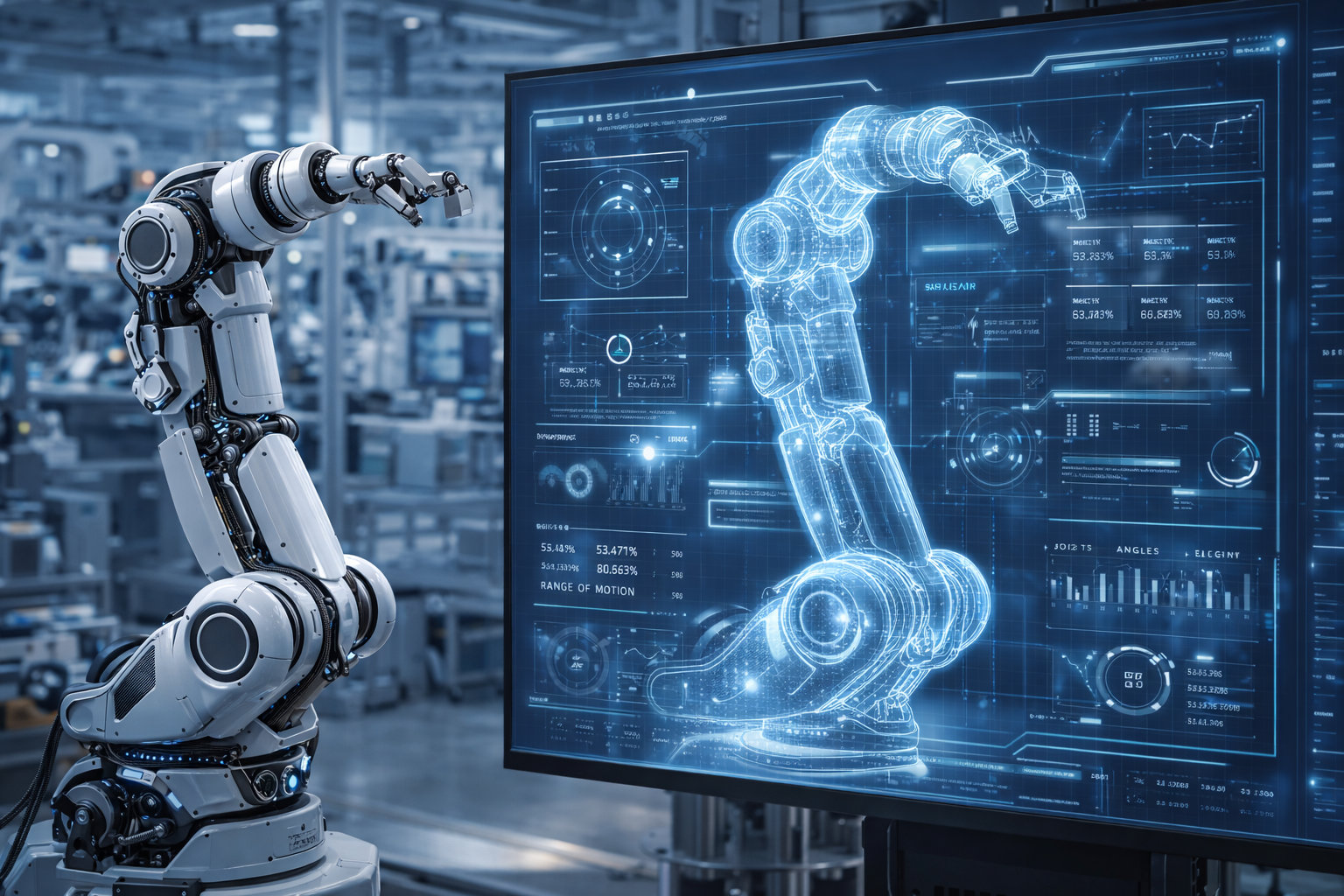
The intersection of robotics and virtual modeling has birthed a paradigm shift in how we build, test, and maintain automated systems. In the past, deploying a robot was a “cross-your-fingers” moment. Today, through the power of digital twins for robotics, we can see the future before it happens.
A Digital Twin is not just a 3D model; it is a dynamic, virtual representation of a physical robotic system that is continuously updated with real-time data from its physical counterpart. This bidirectional flow of information allows engineers to monitor, simulate, and optimize performance with unprecedented precision.
Key Takeaways
- De-risking Deployment: Virtual commissioning allows for testing in a “sandbox” environment, preventing costly hardware collisions.
- Operational Excellence: Real-time synchronization enables predictive maintenance, reducing downtime by up to 30%.
- AI Integration: Digital twins provide the perfect environment for training machine learning models using synthetic data.
- The Digital Thread: It creates a continuous record of a robot’s lifecycle, from initial design to eventual decommissioning.
Who This Is For
This guide is designed for robotics engineers, CTOs, automation consultants, and manufacturing plant managers. Whether you are looking to implement a single collaborative robot (cobot) on a small assembly line or managing a fleet of autonomous mobile robots (AMRs) in a massive fulfillment center, understanding the “twin” philosophy is essential for staying competitive in the current Industry 4.0 landscape.
What Exactly is a Digital Twin in Robotics?
To understand a digital twin, we must distinguish it from traditional CAD (Computer-Aided Design) or simple simulation. A CAD model is static. A simulation is a “what if” scenario based on theoretical parameters. A digital twin, however, is alive.
As of March 2026, the industry standard defines a digital twin by its connectivity. It utilizes the Industrial Internet of Things (IIoT) to ingest data from sensors on the physical robot—joint positions, motor temperatures, torque levels, and battery health—and mirrors these in the virtual space.
The Three Pillars of the Twin
- The Physical Entity: The actual hardware (e.g., a 6-axis industrial arm).
- The Virtual Entity: The high-fidelity simulation model.
- The Data Linkage: The “bridge” (often via MQTT or OPC UA protocols) that allows the two to talk.
The Core Architecture of Robotic Digital Twins
Building a functional twin requires a stack of technologies working in harmony. If one layer fails, the twin loses its “fidelity,” becoming a mere animation rather than a tool for engineering.
1. The Physics Engine
The virtual environment must respect the laws of physics. If a robot picks up a 5kg weight, the virtual model must account for the change in the center of gravity and the resulting stress on the actuators. Modern engines like NVIDIA PhysX or MuJoCo (Multi-Joint dynamics with Contact) provide the mathematical backbone for these simulations.
2. Sensor Fusion and Perception
For a robot to navigate or interact, it needs to “see.” Digital twins simulate sensors like LiDAR, RGB-D cameras, and Ultrasonic sensors. This allows developers to test how a robot will react to “noise” or environmental obstacles without needing to build a physical obstacle course.
3. The Communication Layer
This is the nervous system. Using the Robot Operating System (ROS 2), engineers can send commands to both the physical robot and the digital twin simultaneously.
Safety Disclaimer: While digital twins significantly increase safety, they do not replace physical safety protocols. Always perform “dry runs” at low speeds when transitioning from virtual to physical environments. Ensure all E-stops are functional and ISO 10218 standards for robot safety are strictly followed.
Virtual Commissioning: The Ultimate “Undo” Button
One of the most valuable applications of digital twins for robotics is Virtual Commissioning (VC). In traditional manufacturing, the “commissioning” phase happens on the factory floor. If a programmer makes a mistake, a robot might smash into a $200,000 CNC machine.
With VC, you build the entire factory cell virtually. You can run the PLC (Programmable Logic Controller) code against the digital twin.
Benefits of VC:
- Reduced On-site Time: Commissioning time can be cut by 50–70%.
- Code Validation: Test every “edge case” (e.g., what happens if the power goes out mid-swing?).
- Operator Training: Allow human workers to practice interacting with the robot in VR before it arrives.
Deep Dive: Mathematical Foundations of the Twin
To achieve high fidelity, the digital twin must solve complex kinematic equations in real-time. For a standard robotic manipulator, we use the Denavit-Hartenberg (D-H) parameters to define the relationship between links.
The transformation matrix $T$ between two joints is typically represented as:
$$T = \begin{bmatrix} \cos\theta & -\sin\theta\cos\alpha & \sin\theta\sin\alpha & a\cos\theta \\ \sin\theta & \cos\theta\cos\alpha & -\cos\theta\sin\alpha & a\sin\alpha \\ 0 & \sin\alpha & \cos\alpha & d \\ 0 & 0 & 0 & 1 \end{bmatrix}$$
Where:
- $\theta$: Joint angle
- $\alpha$: Link twist
- $a$: Link length
- $d$: Link offset
A digital twin calculates these matrices across all joints (often 6 or 7) dozens of times per second to ensure the virtual image perfectly matches the physical reality.
Industry Standards and Leading Tools (2026 Edition)
As of March 2026, the landscape for digital twin software has consolidated into a few powerhouse platforms. Choosing the right one depends on your specific use case.
| Tool | Primary Use Case | Key Strength |
| NVIDIA Isaac Sim | AI & Machine Learning | Photorealistic rendering & massive parallel simulation. |
| Siemens Tecnomatix | Large-scale Factory Layout | Deep integration with PLCs and industrial hardware. |
| Microsoft Azure Digital Twins | Enterprise Monitoring | Best for managing massive fleets and data visualization. |
| Unity/Unreal Engine | HMI & Training | High-quality visual fidelity for human-in-the-loop testing. |
| Gazebo / Ignition | Open-source R&D | The standard for the ROS 2 community. |
Training AI with Synthetic Data
Artificial Intelligence requires massive amounts of data. If you want a robot to recognize a defective part, you usually need to take 10,000 photos of that part.
Digital twins allow for Synthetic Data Generation (SDG). You can “tell” the twin to generate 10,000 images of the part under different lighting conditions, at different angles, and with varying degrees of “scratches.” The robot learns in the virtual world and then carries that “knowledge” (the weights of the neural network) into the physical world. This is known as Sim-to-Real transfer.
The “Reality Gap” Challenge
A common mistake in robotics is assuming that what works in the simulation will work perfectly in reality. This is the “Reality Gap.” To overcome this, engineers use Domain Randomization. They intentionally “mess up” the simulation—changing the friction of the floor, the brightness of the lights, or the mass of the objects—to make the AI model more robust.
Real-World Applications Across Industries
1. Automotive Manufacturing
Tesla and BMW use digital twins to simulate the entire assembly line. Before a new car model is even built, the digital twin has simulated the welding robots’ movements a million times to find the most energy-efficient path.
2. Healthcare and Surgical Robotics
Digital twins of patients (based on MRI/CT scans) are used to “practice” robotic surgery. The surgeon uses a haptic controller to guide a virtual robot through a virtual patient, identifying potential complications before the first incision is made.
3. Warehousing and Logistics
Companies like Amazon and Ocado use twins of their entire warehouses. This allows them to simulate how AMRs (Autonomous Mobile Robots) will interact with human pickers during peak seasons like Black Friday.
Predictive Maintenance: Solving Problems Before They Exist
The most immediate ROI for many businesses is Predictive Maintenance. A physical robot is prone to wear and tear. Bearings dry out, belts slacken, and motors overheat.
The digital twin monitors the “health markers” of the robot. If the motor in Joint 3 is drawing $5\%$ more current than the digital twin predicts it should for a specific movement, it’s a sign of impending failure.
- Reactive Maintenance: Wait for it to break (Expensive).
- Preventative Maintenance: Change it every 6 months (Wasteful).
- Predictive Maintenance: Change it when the data says it’s about to break (Optimal).
Step-by-Step Implementation Guide
If you are starting from scratch, follow this roadmap to implement a robotic digital twin.
Phase 1: Define the Scope
Don’t try to twin your entire factory at once. Start with a single “cell” or a high-value asset. Identify what you want to achieve: Is it faster cycle times? Lower maintenance costs?
Phase 2: Create the High-Fidelity Model
Import your CAD data into a physics-enabled environment. Ensure that your “kinematic chain” (how the joints move) is accurate.
Phase 3: Instrument the Physical Robot
Add the necessary sensors. Most modern industrial robots (Fanuc, Kuka, ABB) have built-in APIs to export joint data. For older “legacy” robots, you may need to add external vibration or temperature sensors.
Phase 4: Establish the Data Loop
Set up an edge gateway to collect data from the robot and send it to the cloud or a local server running the twin. Ensure your latency is low enough for the twin to be “near real-time.”
Phase 5: Validate and Iterate
Run the robot and the twin side-by-side. If the robot moves and the twin lags behind or shows a different position, calibrate your data streams.
Common Mistakes and How to Avoid Them
1. Underestimating Data Latency
If your twin is 5 seconds behind reality, it’s useless for safety-critical monitoring. Use Edge Computing to process data close to the robot rather than sending everything to a distant cloud server.
2. “The Graphics Trap”
Many teams spend too much time making the twin look pretty (photorealism) and not enough time making the physics accurate. A beautiful twin that doesn’t calculate friction correctly will lead to failure.
3. Ignoring the “Digital Thread”
A twin should not be an isolated project. It needs to be integrated into your PLM (Product Lifecycle Management) and ERP (Enterprise Resource Planning) systems.
4. Over-Modeling
You don’t need to model every single bolt and screw. Focus on the moving parts and the sensors. Over-modeling leads to high computational costs and slow simulation speeds.
The Future: 5G, 6G, and the Metaverse
As we look toward the late 2020s, the evolution of Digital Twins for robotics will be driven by connectivity. 5G (and upcoming 6G) networks provide the ultra-low latency required for “Closed-Loop” control via the twin.
We are also seeing the rise of the Industrial Metaverse. This is a collaborative virtual space where engineers from around the world can “teleport” into a digital twin of a factory to troubleshoot a robot in real-time, using Augmented Reality (AR) headsets.
Conclusion
Digital twins for robotics represent the pinnacle of modern engineering. They bridge the gap between the messy, unpredictable physical world and the clean, optimized virtual world. By implementing a digital twin, you aren’t just buying a piece of software; you are investing in a philosophy of continuous improvement and risk mitigation.
The journey toward a fully “twinned” facility begins with a single step: recognizing that data is just as valuable as the hardware it describes. As the cost of sensors drops and the power of AI grows, the question for businesses is no longer “Should we build a digital twin?” but rather “Can we afford not to?”
Next Steps:
- Audit your current robotic fleet for data-readiness.
- Choose a pilot project—ideally a high-risk or high-value assembly task.
- Consult with a simulation specialist to select the software stack that fits your existing hardware.
FAQs
What is the difference between a simulation and a digital twin?
A simulation is a static model used to test “what-if” scenarios without a live data link. A digital twin is a dynamic model that is continuously updated with real-time data from a physical asset, creating a two-way flow of information.
How much does it cost to implement a digital twin for a robot?
Costs vary wildly based on complexity. A basic twin for a single cobot using open-source tools might cost $10,000–$20,000 in labor. An enterprise-grade twin for a full automotive assembly line can reach millions of dollars but typically pays for itself through reduced downtime and faster commissioning.
Can I create a digital twin for an old (legacy) robot?
Yes. While modern robots have easier data interfaces, legacy robots can be “retrofitted” with IIoT sensors (vibration, heat, current) to provide the data necessary for a functional digital twin.
Do I need a supercomputer to run these simulations?
For basic monitoring, a standard workstation is sufficient. However, for high-fidelity physics or training AI using synthetic data, high-end GPUs (like the NVIDIA RTX or A-series) are required to handle the parallel processing.
Is ROS 2 necessary for digital twins?
While not strictly “necessary,” ROS 2 (Robot Operating System) is the industry-standard middleware. It provides the communication protocols and libraries that make syncing physical and virtual robots much easier.
References
- NVIDIA Corporation. (2025). Isaac Sim Technical Documentation: Robotics Simulation and Synthetic Data. [Official Site]
- Grieves, M., & Vickers, J. (2017). Digital Twin: Mitigating Clouded Visions Sharing Manufacturing Knowledge. Springer.
- IEEE Robotics and Automation Society. (2024). Standards for Robotic Simulation and Digital Representation.
- Siemens Digital Industries Software. (2026). The Role of Virtual Commissioning in Modern Manufacturing. [White Paper]
- National Institute of Standards and Technology (NIST). (2023). Digital Twin for Advanced Manufacturing Framework.
- Amazon Web Services. (2026). AWS IoT TwinMaker: Developer Guide for Industrial Digital Twins.
- Rosen, R., et al. (2015). About the Importance of Autonomy and Digital Twins for the Future of Manufacturing. IFAC-PapersOnLine.
- International Organization for Standardization. (2021). ISO 23247: Digital Twin Manufacturing Framework.