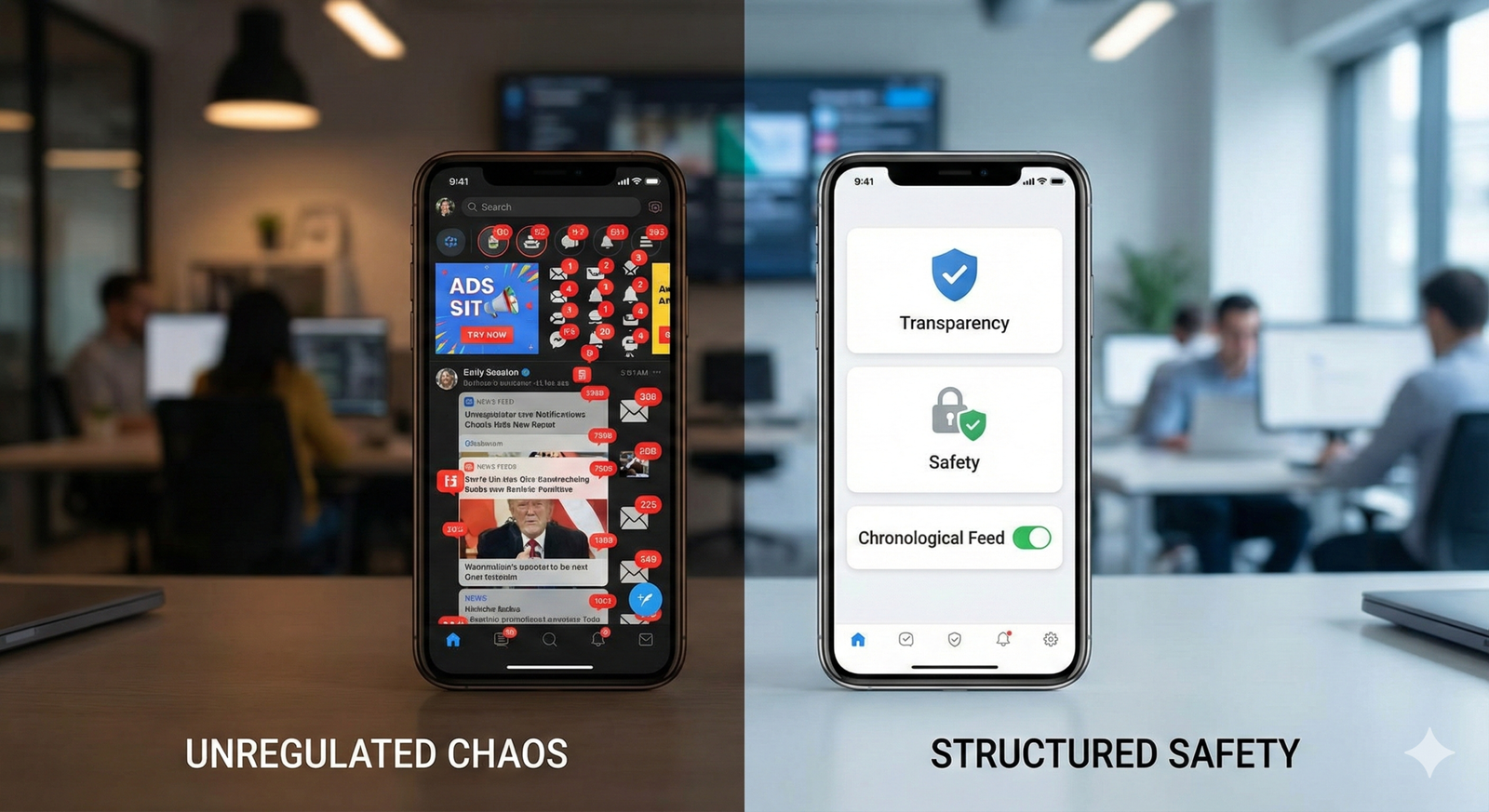
For over a decade, social media operated in a regulatory “Wild West.” Platforms grew at breakneck speeds, prioritizing engagement and scale over safety and transparency. Content moderation was opaque, algorithms were black boxes, and user recourse was often non-existent.
That era effectively ended on February 17, 2024, when the European Union’s Digital Services Act (DSA) became fully applicable to all online intermediaries operating in the EU.
The DSA is not just another piece of red tape; it is the most significant overhaul of internet regulation in history. While technically a European law, its reach is global. By forcing the world’s largest tech companies to open their hoods and take responsibility for the risks they create, the DSA is reshaping how social platforms function fundamentally—from how they serve content to how they handle your data.
In this guide, we explore exactly how the DSA changes the landscape for platforms, marketers, and users, and why this regulatory shift matters far beyond the borders of Europe.
Key Takeaways
- The Era of Self-Regulation is Over: Platforms can no longer grade their own homework; they face independent audits, mandatory risk assessments, and fines of up to 6% of global turnover.
- Algorithmic Transparency is Now Law: Users must be told why they are seeing content and offered non-profiled options (like chronological feeds).
- Targeted Advertising has New Limits: Ads targeting minors or using sensitive data (religion, ethnicity, sexual orientation) are strictly banned.
- The “Brussels Effect” is Real: Because it is technically difficult to maintain separate versions of a platform for different regions, many DSA protections are being rolled out globally.
- Content Moderation Must Be Due Process: You now have a legal right to know why your post was removed and a clear path to appeal that decision.
What is the Digital Services Act (DSA)?
The Digital Services Act is a comprehensive set of rules designed to keep users safe online, protect fundamental rights, and foster fair competition. Unlike previous guidelines which were often voluntary, the DSA is a regulation—meaning it is a binding legislative act.
The Scope: It’s Not One-Size-Fits-All
The DSA applies a tiered approach. The level of regulation depends on the size and impact of the service:
- Intermediary Services: ISPs and domain registrars.
- Hosting Services: Cloud and web hosting services.
- Online Platforms: Social media sites, app stores, and marketplaces bringing sellers and consumers together.
- Very Large Online Platforms (VLOPs) & Search Engines (VLOSEs): The heavy hitters with over 45 million monthly active users in the EU (e.g., Facebook, TikTok, X, YouTube, Instagram).
While all platforms face new transparency and diligence obligations, VLOPs bear the brunt of the regulation. They are viewed as “systemic” actors that pose significant risks to society, democracy, and mental health, and thus face the strictest scrutiny.
Scope Note: The DSA applies to any service offered to users in the EU, regardless of where the company’s headquarters are located. A US-based startup with significant EU users must comply or face penalties.
The Core Pillars of Compliance
The impact of the DSA can be categorized into four major shifts that platforms are currently navigating.
1. Radical Transparency in Content Moderation
Gone are the days of “shadowbanning” or silent removals. Under the DSA, platforms must provide a Statement of Reasons to any user whose content is removed or restricted.
- What this looks like in practice: If Instagram takes down your photo, they must tell you exactly which policy rule was violated and how the decision was made (automated detection vs. human review).
- The Right to Appeal: Platforms must provide an internal complaint-handling system that is easy to access and free. If the internal process fails, users can take their dispute to an out-of-court dispute settlement body.
2. Algorithmic Accountability
This is arguably the most disruptive change for the business models of Big Tech. The DSA attacks the “black box” nature of recommendation engines.
- Opt-out of Profiling: VLOPs must provide at least one recommendation system option that is not based on profiling. Practically, this has led to the return of the chronological feed or “Following” tabs on platforms like TikTok and Facebook, allowing users to see content only from people they follow, ordered by time, rather than by an engagement-farming algorithm.
- “Why am I seeing this?”: Platforms must clearly explain the parameters used to recommend content to you.
3. Advertising Restrictions and Dark Patterns
The DSA introduces strict guardrails on how platforms monetize attention.
- Protection of Minors: Targeted advertising based on profiling is completely prohibited for minors. Platforms can no longer track a teenager’s behavior to serve them ads.
- Sensitive Data Ban: Platforms cannot use “sensitive” personal data (political opinions, health data, sexual orientation, religious beliefs) for targeted ads.
- Ad Repositories: VLOPs must maintain public repositories of all ads they have run, showing who paid for them, the target audience, and the reach. This allows researchers to track disinformation campaigns and dark money in politics.
- Ban on Dark Patterns: Interfaces effectively cannot be designed to trick or manipulate users into making choices they didn’t intend to make (e.g., making the “Reject All Cookies” button invisible or impossible to find).
4. Systemic Risk Management (VLOPs Only)
The largest platforms must now act preventatively. They are required to conduct annual Systemic Risk Assessments to identify how their services could be used to:
- Spread illegal content.
- Disrupt electoral processes.
- Promote gender-based violence.
- Harm public health or the mental well-being of minors.
Once risks are identified, they must implement mitigation measures—such as tweaking the algorithm to downrank disinformation during an election. These measures are then audited by independent external auditors.
Global Ripple Effects: The “Brussels Effect”
A common question is: “If I’m in the US or Asia, why should I care about EU law?”
The answer lies in the Brussels Effect. This is the phenomenon where the European Union acts as a global regulatory trendsetter.
Practical Necessity
For engineering teams at Meta or Google, maintaining two completely separate codebases—one “safe” version for Europe and one “legacy” version for the rest of the world—is expensive and technically complex.
- Example: When Microsoft rolled out GDPR-compliant privacy tools, they eventually extended many of those rights to global users because it streamlined their data governance operations.
Regulatory Contagion
Policymakers in Brazil, Japan, the UK (with its Online Safety Act), and even the US (at the state level) look to the DSA as a blueprint. The DSA has shifted the “Overton window” of what is considered possible in tech regulation. It proved that you can regulate algorithms without “breaking the internet.”
Consequently, changes made to satisfy the DSA often become the default global standard for platform features, Terms of Service, and community guidelines.
Challenges and Pitfalls for Platforms
While the goals of the DSA are noble, the implementation is fraught with challenges for the platforms.
1. The Cost of Compliance
Compliance is expensive. It requires hiring thousands of human moderators (to meet the “human in the loop” requirements for appeals), paying for independent audits, and funding the regulatory fees (VLOPs pay a supervisory fee to the European Commission).
- Impact: This raises the barrier to entry. While the DSA aims to help startups by creating a level playing field, the compliance costs could ironically entrench the incumbents who can afford to pay for it.
2. The “Over-Removal” Risk
Faced with massive fines for failing to remove illegal content, platforms may err on the side of caution. This leads to over-blocking, where legitimate speech is removed because the platform is terrified of liability. The DSA tries to balance this by penalizing wrongful removal, but the financial incentive skews toward taking content down.
3. The “Trusted Flagger” Bottleneck
The DSA mandates that platforms prioritize reports from “Trusted Flaggers”—expert organizations designated by national coordinators.
- The Pitfall: If these organizations are under-resourced or politically biased, it could skew moderation efforts or overwhelm platform queues, slowing down the removal of actual harmful content.
Who This Is For (And Who It Isn’t)
This guide is essential for:
- Trust & Safety Professionals: Understanding the specific compliance workflows for Notice & Action mechanisms.
- Digital Marketers: Adapting to the loss of granular targeting options for minors and sensitive categories.
- Product Managers: Designing user interfaces that avoid dark patterns and integrate transparency disclosures.
- Legal & Policy Teams: Navigating the audit and risk assessment cycles.
This guide is less relevant for:
- Small Personal Blogs: If you run a small hobby site that doesn’t host user-generated content or act as an intermediary, the DSA largely doesn’t apply to you.
- Passive Web Users: While you benefit from the protections, you don’t need to take action other than knowing your new rights.
Conclusion
The Digital Services Act represents a fundamental maturing of the internet. We are moving away from the “move fast and break things” philosophy toward a model of “move responsibly and prove it.”
For social platforms, the impact is operational and cultural. Safety and compliance are no longer afterthoughts to be patched; they are legally mandated features that must be baked into the product design. For users, the internet may not suddenly become a utopia, but it will become more transparent. You will finally have the tools to ask “why” and the right to say “no” to the algorithms that have governed digital life for the last decade.
Next Steps: If you are a platform operator, audit your current content moderation workflow against the DSA’s “Statement of Reasons” requirement immediately. If you are a marketer, begin testing contextual advertising strategies to replace reliance on sensitive data profiling.
FAQs
1. Does the DSA apply to US companies? Yes. The DSA applies to any digital service provider that offers services to users located in the EU, regardless of where the company is headquartered. If you have EU users, you must comply.
2. What happens if a platform ignores the DSA? The penalties are severe. The European Commission can impose fines of up to 6% of the company’s total worldwide annual turnover. In cases of repeated, serious non-compliance, the EU has the power to temporarily ban the service from operating in the EU.
3. How does the DSA differ from the GDPR? The GDPR (General Data Protection Regulation) focuses on privacy and how personal data is collected and processed. The DSA focuses on content, platform liability, and keeping the online environment safe from illegal goods and speech. They work in tandem.
4. What are “Trusted Flaggers”? Trusted Flaggers are independent entities (like NGOs or industry associations) with proven expertise in detecting illegal content. Platforms must treat reports from these entities with priority and process them without delay.
5. Can I turn off the algorithm on TikTok or Instagram now? Under the DSA, VLOPs must offer an alternative recommendation system not based on profiling. In many cases, this manifests as a “Following” feed or a chronological sort option, which allows you to view content without the influence of behavioral tracking.
6. Does the DSA ban targeted ads completely? No. It bans targeted ads for minors and ads based on sensitive data (ethnicity, religion, sexual orientation, etc.). Behavioral targeting based on non-sensitive data for adults is still permitted, provided there is transparency.
7. How does the DSA protect children specifically? Beyond the ad ban, platforms must redesign their interfaces to ensure a high level of privacy, safety, and security for minors by default. This often includes setting profiles to private by default and removing manipulative design features.
8. What counts as a “Very Large Online Platform” (VLOP)? A platform is designated as a VLOP if it reaches more than 45 million monthly active users in the EU (roughly 10% of the EU population). Examples include Facebook, Twitter (X), TikTok, YouTube, and Amazon Store.
References
- European Commission. (2024). The Digital Services Act: Ensuring a safe and accountable online environment. European Commission. https://commission.europa.eu/strategy-and-policy/priorities-2019-2024/europe-fit-digital-age/digital-services-act_en
- European Parliament. (2022). Digital Services Act: deeply changing the digital landscape. European Parliament News. https://www.europarl.europa.eu/news/en/headlines/society/20220705STO34412/digital-services-act-deeply-changing-the-digital-landscape
- Bradford, A. (2020). The Brussels Effect: How the European Union Rules the World. Oxford University Press.
- AlgorithmWatch. (2023). A guide to the Digital Services Act, the EU’s new law to rein in Big Tech. AlgorithmWatch. https://algorithmwatch.org/en/dsa-explained/
- TechPolicy.Press. (2024). The Digital Services Act Is Fully In Effect, But Many Questions Remain. TechPolicy.Press. https://www.techpolicy.press/the-digital-services-act-in-full-effect-questions-remain/
- Pinsent Masons. (2023). Very large online platforms designated for Digital Services Act regulation. Out-Law News. https://www.pinsentmasons.com/out-law/news/very-large-online-platforms-digital-services-act