
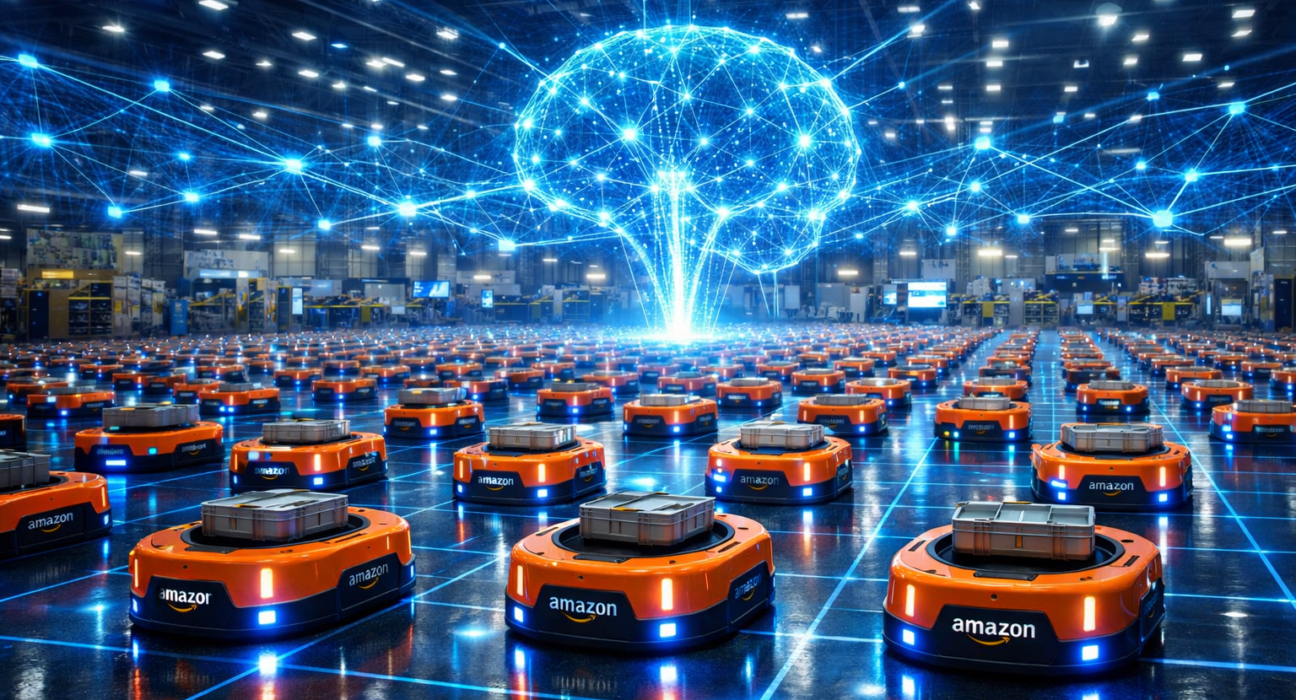
As of March 2026, the global logistics landscape has reached a historic inflection point. For the first time in industrial history, a single enterprise—Amazon—is operating a fleet of more than one million active robots across its global network of fulfillment centers. At the heart of this massive robotic expansion is DeepFleet AI, a generative AI foundation model designed to serve as the “central brain” for a million-strong workforce of autonomous agents.
DeepFleet AI represents a shift from traditional, rigid automation to agentic orchestration. Unlike previous iterations of warehouse management systems that relied on pre-defined paths and static rules, DeepFleet AI utilizes multi-agent trajectory forecasting to predict bottlenecks before they happen, rerouting robots in real-time to optimize throughput. This transition has resulted in a measurable 10% increase in fleet travel efficiency, translating to billions of dollars in saved operational costs and faster delivery windows for consumers worldwide.
Key Takeaways
- The Milestone: In June 2025, Amazon officially crossed the 1,000,000 robot mark, marking a 400% increase in its robotic fleet since 2019.
- DeepFleet AI Defined: A suite of foundation models (including robot-centric and robot-floor architectures) that coordinate massive-scale robot swarms using generative AI.
- Operational Impact: Systems like Sequoia and robots like Sparrow have reduced inventory processing times by 25% and increased storage capacity by 40%.
- Human-Robot Synergy: Automation is increasingly focused on ergonomic safety, moving repetitive heavy-lifting tasks from humans to machines like Cardinal and Titan.
Who This Article Is For
This deep dive is intended for supply chain executives, industrial engineers, AI researchers, and operations managers who are looking to understand the technical and strategic blueprints of the world’s most advanced automated logistics network. Whether you are scaling a fleet of ten robots or ten thousand, the lessons from DeepFleet AI provide a roadmap for the future of “Logistics 4.0.”
The Genesis: How Amazon Scaled to One Million Robots
To understand the current state of DeepFleet AI, we must first look at the decade-long journey that led to the million-robot milestone. The story began in 2012 with the acquisition of Kiva Systems, a move that introduced the first generation of drive units capable of moving mobile shelving units.
By 2020, the fleet had grown to 200,000 units. However, as the number of agents increased, the complexity of managing them grew exponentially rather than linearly. Traditional central controllers struggled with the “curse of dimensionality”—the mathematical difficulty of calculating the optimal path for thousands of agents in a shared space without causing gridlock.
As of early 2026, the fleet is no longer just composed of “shelve-movers.” It is a heterogeneous ecosystem of:
- Autonomous Mobile Robots (AMRs): Like Proteus, which navigate freely alongside humans.
- Robotic Arms: Like Sparrow and Cardinal, which use computer vision and tactile sensing to manipulate millions of unique items.
- Integrated Storage Systems: Like Sequoia, which containerize inventory to maximize vertical space.
The deployment of DeepFleet AI in mid-2025 was the “unlock” needed to harmonize these disparate systems into a single, cohesive unit.
DeepFleet AI: The Generative “Brain” of Global Logistics
The primary challenge of a million-robot fleet is coordination. When thousands of robots operate on a single floor, they risk creating “traffic jams” that can halt an entire fulfillment center. DeepFleet AI solves this through a multi-agent foundation model architecture.
The Architecture of DeepFleet AI
DeepFleet AI is built on a Transformer-based architecture—the same fundamental technology behind Large Language Models (LLMs)—but instead of predicting the next word in a sentence, it predicts the next movement vector of a robot.
- Robot-Centric (RC) Models: These operate like “individual intuition.” Each robot uses an autoregressive decision transformer to evaluate its immediate neighborhood (other robots, humans, and obstacles) and make micro-adjustments to its path.
- Robot-Floor (RF) Models: This is the “global view.” It analyzes the spatiotemporal state of the entire warehouse floor, identifying high-density areas and predicting where congestion is likely to form five to ten minutes in the future.
From Reactive to Predictive
Before DeepFleet AI, a robot would stop if it detected an obstacle (reactive). With DeepFleet, the fleet identifies that a specific aisle will become crowded because a human worker is currently picking items there, and it proactively reroutes the next twenty robots to alternative paths (predictive). This predictive capability has been the primary driver behind the 10% efficiency gain observed in late 2025 and early 2026.
The Hardware Revolution: Proteus, Sparrow, and Sequoia
DeepFleet AI is the “software soul,” but the hardware is what interacts with the physical world. Three specific systems have defined the recent million-robot era.
1. Proteus: The Unfenced AMR
Proteus is Amazon’s first fully autonomous mobile robot. Unlike its predecessors, which required “caged” floors where humans were not allowed to enter, Proteus uses advanced LiDAR and 3D computer vision to operate safely in “green zones” shared with people.
- Impact: By eliminating the need for fences, Amazon can now deploy robots into existing facilities without major structural renovations.
- Speed: Proteus moves heavy GoCart trolleys at a pace that matches human walking speed, ensuring seamless integration into manual workflows.
2. Sparrow: The Master of Manipulation
Picking a single bottle of vitamins out of a bin of mixed items is easy for a human but incredibly difficult for a robot. Sparrow, introduced as a prototype and scaled globally by 2025, uses AI-driven computer vision to identify and handle over 200 million different products.
- Tactile Sensing: Newer iterations of Sparrow (often called “Vulcan” in some pilot programs) include force sensors that allow it to handle fragile items, such as glass or soft-packaged food, with the same delicacy as a human hand.
3. Sequoia: The Containerized Future
Sequoia is not a single robot but an integrated system. It combines gantry cranes, mobile robots, and ergonomic workstations.
- 75% Faster Identification: By containerizing goods into standardized plastic totes, Sequoia allows the AI to track inventory with near-perfect precision.
- Ergonomics: Sequoia delivers totes to workers in the “Power Zone” (between mid-thigh and mid-chest), eliminating the need for employees to reach overhead or squat, which has significantly reduced musculoskeletal injuries in Shreveport-style facilities.
Swarm Intelligence at Scale: Managing 1,000,000 Agents
Managing a million robots is fundamentally different from managing a thousand. As the fleet grows, the “communication overhead”—the amount of data the robots must exchange to avoid each other—can saturate even the most advanced Wi-Fi 7 networks.
Overcoming Communication Latency
DeepFleet AI utilizes Edge Computing (specifically AWS Inferentia-2 chips) located directly on the robots. This allows for local decision-making with latencies as low as 12 milliseconds. Only high-level “intent” data is sent back to the central cloud, preventing network congestion.
The Mathematics of the Swarm
The coordination of the million-robot fleet can be modeled using a variation of the Ant Colony Optimization (ACO) algorithm.
$$E = \sum_{i=1}^{n} (d_i – o_i)$$
Where $E$ is the total efficiency, $d_i$ is the desired path length, and $o_i$ is the actual path taken by robot $i$ considering detours. DeepFleet AI’s goal is to minimize the delta between the ideal and actual paths across a million agents.
The ROI of Automation: Cost Savings and Throughput
For any business looking to follow Amazon’s lead, the primary question is: Does it pay off?
| Metric | Pre-Robotics (Manual) | Post-DeepFleet AI (2026) |
| Inventory Processing Time | ~60-90 Minutes | ~15 Minutes |
| Storage Density | Base | +40% (via Sequoia) |
| Cost per Pick | ~$0.25 | ~$0.03 |
| Safety Incident Rate | Base | -15% in robotic centers |
As of 2026, analysts estimate that Amazon’s robotics division generates approximately $4 billion in annual cost savings. By 2030, this is projected to grow to $10 billion as more facilities are retrofitted with Sequoia and DeepFleet-managed fleets.
Human-Centric Automation: Safety and Upskilling Lessons
A common critique of the “Million-Robot Fleet” is the displacement of human workers. However, the data from March 2026 shows a more nuanced reality. While manual “fetch and carry” tasks are being automated, Amazon’s human headcount has remained relatively stable at 1.6 million employees.
The “Co-bot” Philosophy
Amazon’s strategy has shifted toward Collaborative Robotics (Co-bots). Robots like Proteus are designed to take over the “Dull, Dirty, and Dangerous” tasks, while humans are moved into higher-value roles.
Upskilling the Workforce
To manage a million robots, you need a million robot-literate workers. Amazon has invested heavily in its “Career Choice” program, upskilling over 700,000 employees in:
- Robotics Maintenance: Diagnosing and repairing hardware.
- AI Training: Curating data for Sparrow’s computer vision models.
- System Optimization: Using DeepFleet’s dashboard to manage regional logistics flows.
Safety Disclaimer: While robotics systems significantly reduce physical strain, employees must adhere to all proximity protocols and use required Personal Protective Equipment (PPE) when performing maintenance on energized robotic units.
Common Mistakes in Large-Scale Fleet Deployment
Through the development of DeepFleet AI, several “hard lessons” were learned that other companies should note before beginning their automation journey.
- Over-Automation of Non-Standard Tasks: Trying to automate the “long tail” of irregular tasks (like handling extremely oversized or uniquely shaped items) is often more expensive than keeping a human in the loop. Amazon still relies on humans for complex packaging and quality control.
- Neglecting Data Cleanliness: DeepFleet AI is only as good as the telemetry data it receives. Poor sensor calibration on even a small percentage of the fleet can lead to “phantom” traffic jams.
- Ignoring the “Cold Start” Problem: Introducing a million robots overnight is impossible. Amazon’s success came from an incremental “Flywheel” approach—starting with one facility, refining the code, and then scaling.
- Underestimating Connectivity Needs: Many warehouses have “dead zones” where Wi-Fi signal is blocked by steel shelving. Without a robust mesh network or 5G private core, autonomous fleets will fail.
The Roadmap to 2030: Future of the Autonomous Warehouse
The lessons from Amazon’s million-robot fleet point toward a future where the warehouse is not just a building, but a massive, living computer.
Project Eluna and Agentic AI
The next step, currently in testing as of 2026, is Project Eluna. This is an agentic AI model that allows warehouse operators to speak to the facility in natural language. An operator might say, “Prioritize all Prime Same-Day orders for the Seattle region and clear the outbound dock for a late truck arrival.” DeepFleet AI then autonomously reconfigures the million robots to meet that high-level goal.
Conclusion: The New Standard for Logistics
DeepFleet AI has proven that managing a million-robot fleet is not just a feat of hardware engineering, but a triumph of generative AI orchestration. By moving from reactive movements to predictive trajectory forecasting, Amazon has set a new global benchmark for efficiency, safety, and scalability.
For businesses looking to adopt these technologies, the lesson is clear: Start with the data, prioritize human safety through ergonomics, and invest in an AI orchestration layer that can grow with your fleet. The autonomous warehouse is no longer a sci-fi concept; it is the operational reality of the 2026 global economy.
FAQs
What exactly is DeepFleet AI?
DeepFleet AI is a generative AI foundation model used by Amazon to coordinate the movements and tasks of its one million+ robots. It uses spatiotemporal modeling to predict and prevent congestion in large-scale logistics environments.
How did Amazon reach one million robots?
The milestone was reached in June 2025 through a combination of scaling its existing drive units and deploying new systems like the Sequoia storage framework and Proteus autonomous mobile robots.
Does DeepFleet AI replace human workers?
While DeepFleet automates many manual tasks (like carrying and sorting), Amazon currently uses it to augment its 1.6 million-person workforce. The focus has shifted to moving humans into technical, maintenance, and supervisory roles.
How does DeepFleet AI improve safety?
By managing robots like Proteus (which can work alongside humans without fences) and Sequoia (which delivers items at an ergonomic height), DeepFleet reduces the risk of collisions and musculoskeletal injuries.
What is the “Robot-Floor” model?
It is a specific architecture within DeepFleet AI that looks at the warehouse floor as a whole to identify macro-trends in traffic and congestion, allowing for global fleet optimization rather than just individual robot avoidance.
References
- Amazon Science. (2025). DeepFleet: Multi-Agent Foundation Models for Mobile Robots. [Link to Official Research]
- Visual Capitalist. (2026). Charted: Amazon Is Hiring Robots While Cutting Human Jobs. [Industry Analysis]
- Medium: Prof Galloway. (2025). Big Tech Stock Pick of 2026: The Retail Margin Story. [Financial Overview]
- Roots Analysis. (2026). Global Warehouse Robotics Market Size and Forecast 2026-2040. [Market Research]
- Xpert.Digital. (2025). The Robotics Fulfillment Center System: Sequoia, Titan, and beyond. [Technical Documentation]
- AWS Documentation. (2026). Scaling Industrial AI with Amazon Bedrock and SageMaker. [Developer Guides]