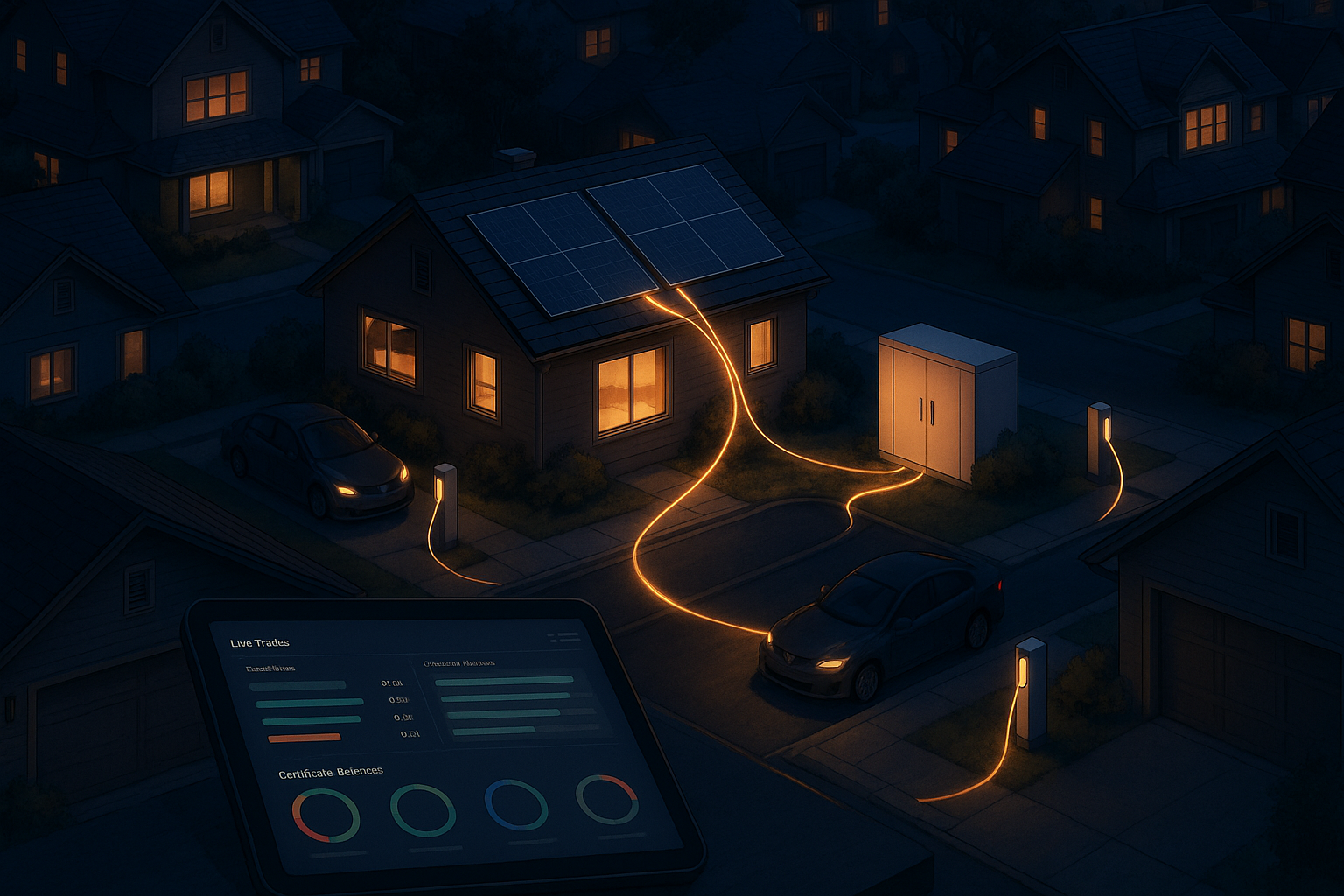
Decentralized energy grids let homes, businesses, and community assets generate, store, and exchange renewable power locally, while coordinating with the wider system for safety and stability. Blockchain adds an auditable transaction layer—settling peer-to-peer trades, tracking renewable certificates, and automating rules—so value can flow with electrons, not just tariffs. In short: decentralized energy grids shift decision-making closer to the edge; blockchain provides shared truth for who produced, consumed, or shifted energy and when.
Disclaimer: Energy market design, metering, and data protection are regulated domains. Treat the following as a practical framework—not legal, engineering, or financial advice. Consult qualified professionals before implementation.
Fast path overview: You’ll build a grid-aware, certificate-compliant marketplace in this order: (1) market model, (2) identity and roles, (3) revenue-grade metering, (4) smart-contract market logic, (5) certificates & Scope 2 alignment, (6) grid-aware dispatch & flexibility, (7) pricing and settlement, (8) cybersecurity & privacy, (9) interoperability standards, (10) measurement & verification, (11) EV & device orchestration, (12) pilot-to-scale operating model.
1. Choose Your Market Model and Scope
Start by defining how participants will interact: peer-to-peer trades among neighbors, a community market mediated by a cooperative, or a transactive energy framework where device-level bids and offers help balance supply and demand. Decide whether you’ll trade kilowatt-hours, flexibility (e.g., curtailment or shifting), or both—and whether trades are purely local or also feed into wholesale markets via an aggregator. Establish clear success criteria: e.g., peak reduction, self-consumption increase, bill savings, or certificate issuance volume. This scoping step anchors all technical and regulatory choices that follow, preventing costly rework later. IEAgridwiseac.org
Why it matters
“Transactive energy” is an established concept: economic and control mechanisms dynamically balance supply and demand within grid constraints. P2P markets are one flavor of this broader idea; local flexibility markets are another, often run to relieve distribution bottlenecks. Aligning to recognized frameworks helps you speak the regulator’s language and pick compatible standards from day one.
Numbers & guardrails
- Trading scope: local feeder or microgrid radius; add an aggregator for regional or wholesale participation (minimum aggregation thresholds often apply). NREL Docs
- Product set: energy (kWh), flexibility (kW curtailed/shifted), and attributes (certificates per MWh).
- Operational KPI examples: peak reduction (kW), local self-consumption (%), avoided curtailment (MWh), settlement timeliness (min).
Synthesis: A crisp, regulator-aligned market model defines what you’ll measure, automate, and certify—so hardware, software, and contracts can snap into a coherent system.
2. Establish Identity, Roles, and Governance
Next, design the identity and role system. At minimum, you need verified participants (prosumers, consumers, aggregators), registered assets (PV, batteries, EVSE), and operator roles (DSO, market operator). On-chain, use a permissioned or public-permissioned chain with decentralized identifiers (DIDs) and attestations linking real-world identities and assets to cryptographic keys. Off-chain, maintain a rulebook: dispute resolution, settlement windows, meter data submission deadlines, and penalties for non-delivery. If your jurisdiction allows, integrate with recognized digital registries that anchor asset records and market roles.
How to do it
- Digital onboarding: Issue wallets to participants; bind them to KYC’d identities and asset certificates.
- Asset registry: For each inverter/meter/charger, store serials, location, standards compliance, and owner.
- Rulebook: Codify market products, baseline methods, and when the operator can curtail or halt trading (e.g., safety events).
Tools & examples
- Energy-sector stacks (e.g., Energy Web’s “Digital Spine”) focus on secure, open-source data and asset management trusted by utilities and regulators—useful patterns even if you deploy elsewhere.
Synthesis: Strong identity and governance turn a clever pilot into a market others can trust—and regulators can approve.
3. Prove Every Electron: Revenue-Grade Metering and Data Integrity
Trades only work when measurements are defensible. Use revenue-grade meters—typically ANSI C12.20 (Classes 0.1, 0.2, 0.5) or IEC 62053-22 (Classes 0.2S, 0.5S)—with tamper resistance and time-stamped interval data. Pair meters with secure gateways that sign readings at the edge and deliver them to a metering oracle; smart contracts should settle only on attested data. Document current transformer (CT) specs and calibration schedule; system accuracy depends on the full measurement chain.
Numbers & guardrails
- Accuracy targets: Class 0.2/0.2S (~±0.2%) for billing-grade trades; confirm CT class and burden so system accuracy holds across loads. dranetz.com
- Interval granularity: 1–5 min for flexibility, 5–15 min for energy balancing (align with DSO/market rules).
- Clock discipline: NTP/PTP with cryptographic sealing; drift kills trust.
- Oracle design: Hash raw readings; store summaries on-chain; keep full data off-chain for audits.
Common mistakes
- Using sub-meter accuracy for settlement.
- Ignoring CT/PT tolerances and phase shift.
- Letting gateways transmit unsigned payloads.
Synthesis: Settlement-grade instrumentation and cryptographically sealed data are the foundation of credible blockchain energy markets. Regulators will look for these first.
4. Encode Market Logic in Smart Contracts (Without Breaking the Grid)
Smart contracts can clear continuous double auctions, run request-for-flexibility tenders, and escrow funds and certificates. Start simple: batch clearing at fixed intervals; then add locational constraints and feeder limits from the DSO. Contracts should reference off-chain rulebooks and composable modules (pricing, baselines, penalties) to avoid brittle monoliths. Use oracles for prices, grid limits, and metered delivery; never trust device-reported data directly without attestation. ScienceDirect
How to do it
- Order types: limit, market, block offers for flexibility.
- Baseline methods: last-week same-hour with weather normalization; specify ex-ante vs. ex-post rules.
- Delivery & penalties: settlement reduces escrowed funds if shortfalls exceed tolerance.
Numbers & guardrails
- Block time vs. market interval: keep contract clearing synced to the metering interval.
- Max feeder utilization: enforce caps (e.g., 80–90% of thermal limit) from DSO signals.
- Slippage control: price bands on orders to prevent manipulation.
Synthesis: Contracts automate trust, but safety constraints must enter the same logic path. That’s the difference between a demo and an operable market.
5. Tie Every Trade to Certificates and Scope 2 Rules
Energy attribute certificates—RECs, Guarantees of Origin, or I-RECs—represent the environmental attributes of 1 MWh. If your goal includes corporate decarbonization claims, align issuance, transfer, and retirement with the GHG Protocol Scope 2 Guidance. Tokenize certificates carefully (one unique token per MWh, with serial and issuance/retirement states) and integrate a recognized registry workflow where available; blockchain is the shared ledger, but registry rules define what’s claimable.
How to do it
- Issuance: Mint a certificate only after meter-verified generation.
- Transfer: Atomic with energy settlement or decoupled as a separate market.
- Retirement: Burn tokens to finalize claims; record beneficiary and vintage.
Tools & examples
- Energy-sector stacks (e.g., EW Origin) document tokenized issuance and ownership for certificate traceability; adapt the pattern to your market and registry.
Numbers & guardrails
- One certificate = 1 MWh; no partial reuse.
- Quality criteria: align with Scope 2’s market-based method and quality criteria (e.g., unique claims, supplier specificity, temporally/geographically relevant).
Synthesis: Certificates convert kilowatt-hours into recognized climate claims. Get this right and your marketplace doubles as a compliance-ready reporting engine.
At-a-glance table — Energy attributes (single view per concept)
| Instrument | What it certifies | Typical use | Notes |
|---|---|---|---|
| REC/GoO/I-REC | 1 MWh renewable attribute | Market-based Scope 2, green tariffs | Registry-defined serials; retire for claims. |
| EAC labels (e.g., P-REC) | REC + social co-benefits | Impact claims | Must still meet Scope 2 quality criteria. 3Degrees |
| PPA contract data | Contracted MWh & emissions factor | Market-based Scope 2 | Pair with certificate delivery terms. |
6. Make It Grid-Aware: DSO/TSO Coordination and Flexibility
Local markets must respect network constraints. Adopt a flexibility market design where the DSO (and sometimes the TSO) can request services—congestion relief, voltage support, or peak reduction—and where aggregators bid portfolios of DERs. Reuse existing role models and message flows so your design interoperates with national pilots and standards. When in doubt: align with a recognized flexibility framework to accelerate approvals and interoperability.
How to do it
- Congestion interface: DSO publishes locational limits; your market only clears within those caps.
- Coordination: Define who has curtailment rights and how compensation works.
- Visibility: Share anonymized telemetry with the DSO/TSO to validate delivery.
Region notes
- Many jurisdictions are formalizing local flexibility procurement and aggregator rules; FERC Order No. 2222 in the U.S. opened wholesale participation for DER aggregations, while European policy emphasizes energy communities and local flexibility access.
Numbers & guardrails
- Activation times: seconds–minutes for voltage support; minutes–hours for congestion.
- Baseline tolerance: typical ±10–20% delivery bands with penalties beyond.
- Stacking: enable simultaneous energy + flexibility value streams if not double-counted. usef.energy
Synthesis: When your market speaks the DSO’s language, flexibility becomes a revenue stream—not a compliance headache.
7. Design Pricing, Settlement, and Cash Flows People Actually Understand
Prices must be transparent and defensible. For energy, consider locational pay-as-bid or clearing-price auctions at fixed intervals. For flexibility, use capacity-style availability fees plus activation payments. Keep money flows simple at launch: fiat rails, local currency, and standard invoicing—crypto assets are optional and often complicate compliance. Settlement should net energy, flexibility, and certificate transfers, with audit trails that an accountant (and regulator) can follow.
Mini case
A 40-home community with 120 kW PV and a 100 kWh battery targets 20% peak reduction. During two critical hours, your market clears 15 kW of load shift and 10 kW discharge at $100/kW-month equivalent for flexibility; average energy trades clear at $0.12/kWh, beating retail $0.18/kWh. Net: ~$900 flexibility revenue plus $48 energy savings across the event—before certificate value.
Guardrails
- Bill alignment: Show participants net effects against the utility bill line items they know.
- Dispute process: Define deadlines and documentation (meter data, baselines, DSO notices).
- Consumer protection: caps on exposure, clear opt-out, and explanations in plain language.
Synthesis: Clear, grid-aware pricing makes participation sticky and compliance smoother.
8. Build Cybersecurity and Privacy into the Architecture
Energy systems are critical infrastructure. Use a defense-in-depth posture aligned to NISTIR 7628 for smart grid cybersecurity: segment networks, harden endpoints, and define security controls by function. Secure IEC 61850 and other grid protocols with IEC 62351 profiles, and ensure smart meter data processing respects privacy law (e.g., GDPR in the EU). On-chain transparency does not mean exposing personal data: store only hashes or pseudonymous IDs; keep personal data off-chain with strict access controls.
How to do it
- Device trust: hardware root-of-trust, signed firmware, mutual TLS.
- Data minimization: share the minimum attributes—kWh, timestamps, and asset IDs—not living patterns.
- Security ops: key rotation, incident response playbooks, continuous monitoring of metering oracles.
Numbers & guardrails
- Latency budgets: don’t break protection schemes; keep control loops local; blockchain is for market state, not sub-second protection.
- PII handling: privacy impact assessment before pilot launch; pseudonymize meter IDs; explicit consent and purpose limitation for analytics.
Synthesis: Regulators will ask “Is it safe?” and “Is it lawful?”—meeting NISTIR 7628, IEC 62351, and privacy guidelines lets you answer “Yes.” NIST Publications
9. Use Open Standards So Devices Can Actually Participate
Interoperability eliminates vendor lock-in and speeds integration. For demand response, use OpenADR to convey event and price signals to building systems. For DER control and telemetry, use IEC 61850 (with DER profiles) across substations and microgrids. For EV charging, use OCPP so chargers can join flexibility programs and local energy markets. These standards map cleanly to blockchain workflows via oracles and adapters; don’t reinvent device protocols on-chain.
Tools/Examples
- OpenADR specifies event payloads (e.g., load shed %, absolute price); your market can auto-generate these from cleared results.
- IEC 61850 DER profile aligns with inverter and microgrid functions, enabling standardized data models and control.
- OCPP ensures chargers from different vendors can be orchestrated as flexibility assets and billed consistently.
Guardrails
- Map standard message IDs to on-chain asset IDs; store the mapping off-chain with strict access.
- Track versions (e.g., OCPP 2.0.1 vs. 1.6) and test conformance in a sandbox before onboarding.
Synthesis: Open standards are your “universal adapter”—they connect edge devices to market logic without custom glue code everywhere.
10. Measure What You Pay For: Baselines, M&V, and Audits
If you pay for energy or flexibility, you must prove delivery. Adopt IPMVP principles and M&V guides to define baselines, non-routine adjustments (e.g., new equipment), and acceptable error bounds. For advanced, near-real-time programs, combine smart meter analytics with curated weather and occupancy data; publish your algorithms and error metrics. Your blockchain can anchor hashes of M&V reports so audits can reproduce results later.
How to do it
- Protocol choice:
- Option C (whole-facility) for building-level effects,
- Option B (retrofit isolation) for specific assets,
- Comparison groups for aggregated programs. EnergyCAP
- Report contents: baseline method, window, error metrics (e.g., CVRMSE, NMBE), event logs.
Numbers & guardrails
- Accuracy targets: publish CVRMSE/NMBE thresholds; reject delivery if errors exceed guardrails.
- Cost ratio: M&V spend should be “small” relative to benefits; automate where possible. evo-world.org
Synthesis: Transparent M&V turns performance into bankable outcomes—and gives regulators confidence to scale programs.
11. Orchestrate EVs, Heat Pumps, and Storage as First-Class Market Actors
EV chargers, heat pumps, and batteries are the most responsive edge assets. Onboard chargers via OCPP, enabling smart charging and potential vehicle-to-grid participation; aggregate water/space heating load with OpenADR signals; expose batteries for both energy arbitrage and flexibility. Price signals should respect comfort and mobility constraints (e.g., departure times). Pair device telemetry with metering to avoid double counting trades versus station loads.
Mini case
A community with 50 EVs and 20 heat pumps offers 60 kW of flexible load nightly. Your market clears 40 kW at $50/kW-month equivalent plus 0.08/kWh charging discount. Participants save roughly $2–4 per session while the DSO gets predictable peak relief; certificates accrue from surplus PV charging.
Guardrails
- Comfort & mobility SLAs: e.g., charge to 80% by stated departure.
- Feeder constraints: throttle aggregations to maintain voltage and thermal margins.
- Auditability: tag each activation with device IDs and event IDs for post-hoc verification.
Synthesis: Treat devices as portfolio assets, not gadgets. Interoperability + clear SLAs unlocks meaningful, dependable flexibility.
12. Pilot, Learn, and Scale with a Repeatable Operating Model
Start small—one feeder, a handful of buildings, a few dozen assets—so you can iterate quickly on pricing, data flows, and customer experience. Define stage-gates: technical readiness (interoperability tests passed), market readiness (rulebook approved), and compliance readiness (privacy and M&V sign-offs). Move to multi-feeder and city-scale only when telemetry quality, settlement accuracy, and participant satisfaction meet targets. Track costs per enrolled kW and minutes to settle; automate onboarding, KYC, M&V, and certificate retirement as you grow.
How to do it
- Runbooks: customer support, incident response, DSO communications.
- Dashboards: settlement health, certificate lifecycles, flexibility fulfillment rate.
- Ecosystem: coordinate with utilities, regulators, device OEMs, and certificate registries.
Numbers & guardrails
- Onboarding: < 1 hour per asset with pre-certified device profiles.
- Settlement: < T + 3 business days for netting and payouts.
- Quality: > 98% telemetry completeness; < 1% disputed trades.
Synthesis: Scaling is an operational discipline. Bake repeatability into tools and processes—not just code.
Conclusion
Decentralized energy grids distribute both decision-making and value. Blockchain doesn’t replace grid engineering; it creates a common, auditable record of who produced, shifted, or consumed energy—and which certificates moved alongside. The 12 building blocks above walk from market design and identity, through metering, smart contracts, certificate compliance, grid-aware flexibility, settlement clarity, security & privacy, interoperability, M&V, device orchestration, and into a pilot-to-scale operating model. The throughline is simple: align with proven standards, encode the rulebook, and measure delivery with revenue-grade instrumentation. Do that, and you’ll unlock local resilience, lower peaks, verifiable carbon claims, and a marketplace people understand. Start with one feeder, one product, and one clear success metric; then scale what works.
Copy-ready CTA: Ready to design your pilot? Pick your market model, choose your metering class, and draft the rulebook—then stand up the minimum viable market in weeks, not months.
FAQs
1) Do I need a private blockchain, or can I use a public chain?
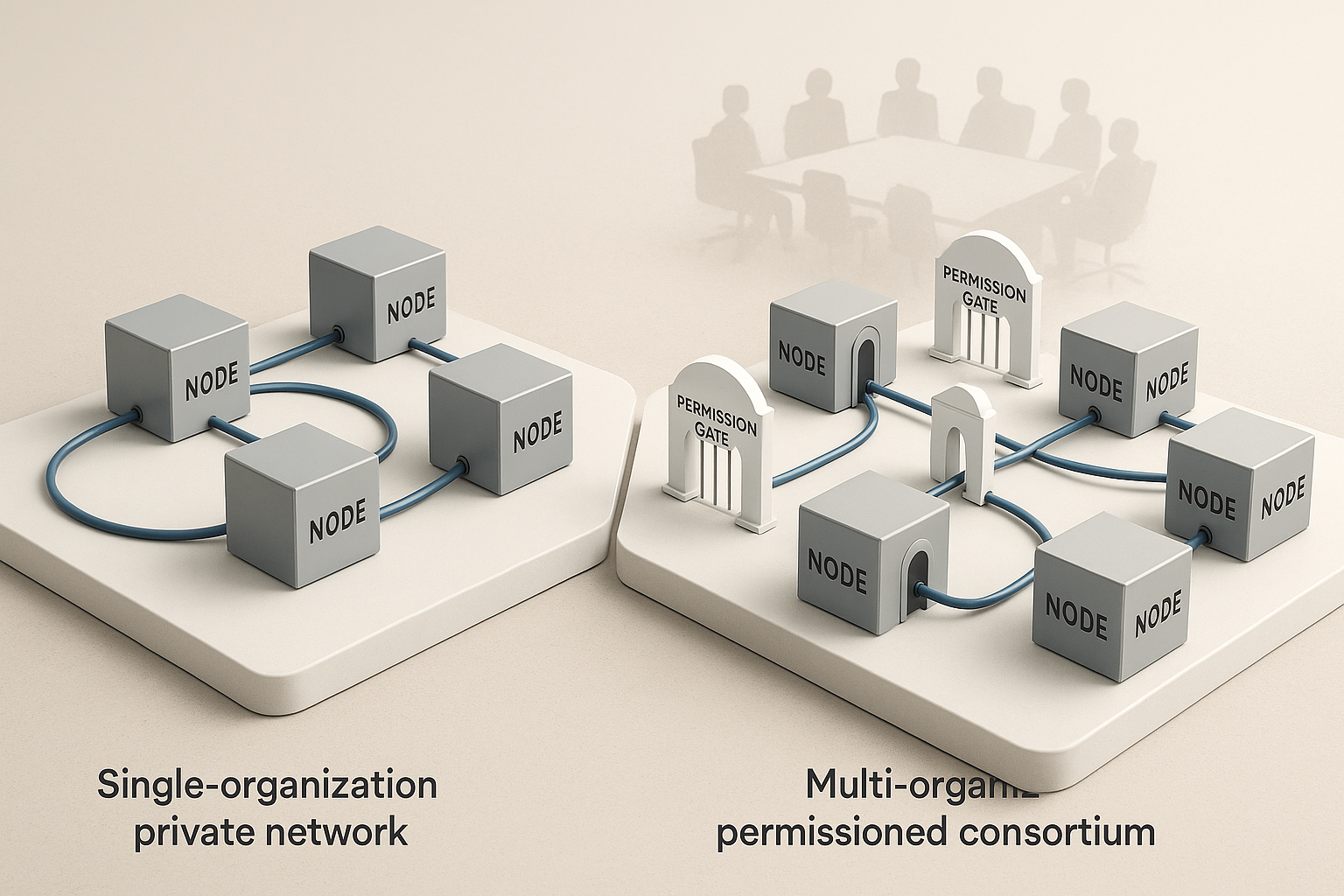
Both can work. Many operators prefer public-permissioned setups for transparency with access control over write operations. What matters is key management, privacy (hashes on-chain, data off-chain), and low-friction integration with metering and registries. If regulators require data residency or specific performance guarantees, a permissioned consortium may be simpler to certify.
2) How do renewable energy certificates relate to P2P energy trades?
Think of trades as moving energy, and certificates as moving attributes. One certificate corresponds to 1 MWh of renewable generation; transfer and retire the certificate to claim the environmental benefit under Scope 2 market-based accounting. Your marketplace can couple or decouple these flows, but you must prevent double claims and adhere to registry rules.
3) Can households really provide reliable flexibility?
Yes—if you aggregate and standardize. Heat pumps, EVs, and batteries respond predictably to price and event signals when integrated via standards (OpenADR, OCPP) and backed by baselines and SLAs. Delivery risk is managed through over-subscription, conservative baselines, and performance penalties.
4) What accuracy do my meters need?
Use revenue-grade meters: ANSI C12.20 or IEC 62053-22 at Class 0.2/0.2S for settlement. Lower classes jeopardize trust and may fail audits. Remember, total system accuracy includes CT/PT tolerances and installation quality.
5) How do we prevent overloading feeders when lots of devices respond to price?
Make markets grid-aware. The DSO publishes constraint envelopes; your clearing engine enforces them. For fast events, let local controllers cap ramp rates and voltages, while the market settles the economics after the fact. This is the essence of flexibility markets. smartEn
6) Is tokenizing certificates necessary?
Not required, but helpful. Tokenization streamlines issuance, transfer, and retirement with auditability. Still, the claim validity comes from registry rules and Scope 2 criteria—not the token itself. energy-web-foundation-origin.readthedocs-hosted.com
7) How does this fit with wholesale market participation?
In some regions, aggregators can bundle DERs to participate in wholesale energy and ancillary services under rules that allow heterogenous aggregations and set minimum sizes. Your local market should expose a clean interface to that aggregator.
8) What cybersecurity controls are non-negotiable?
Device identity and signed telemetry, segmented networks, encrypted protocols, and a program aligned to NISTIR 7628. Secure power-system communications (e.g., IEC 61850) with IEC 62351 profiles; never place PII on-chain.
9) How do we measure and pay for flexibility?
Define baselines under IPMVP principles, specify tolerances and non-routine adjustments, and pay for both availability (capacity) and activation (performance). Anchor M&V reports on-chain for traceability. evo-world.org
10) What about EVs and mobility constraints?
Use OCPP to orchestrate charging while honoring departure times and minimum state-of-charge. Price incentives should respect mobility SLAs, and flexibility bids must be derated when drivers opt out.
11) Are energy communities a good starting point?
Yes. Policy often supports community-level projects with local ownership and flexibility procurement pathways. Start with a cooperative governance model and a handful of shared assets to demonstrate value quickly. Energy
12) Will blockchain fees or latency get in the way?
Not if you design properly. Use batching and off-chain data channels; keep sub-second control off-chain. The chain records market state, certificates, and settlement proofs—not millisecond device controls.
References
- GridWise Architecture Council. “Transactive Energy—An Introduction.” GridWise. (n.d.). gridwiseac.org
- National Institute of Standards and Technology. “Transactive Energy: An Overview.” NIST. 2017. NIST
- International Renewable Energy Agency (IRENA). “Peer-to-Peer Electricity Trading—Innovation Landscape Brief.” IRENA. 2020. IRENA
- Energy Web. “Documentation Overview & Tech Stack.” Energy Web. 2024. and https://www.energyweb.org/ docs.energyweb.org
- U.S. EPA. “Renewable Energy Certificates (RECs).” EPA. 2025. EPA
- I-TRACK Foundation. “Product Code for Electricity (I-REC(E)).” I-TRACK. 2023. I-TRACK
- Greenhouse Gas Protocol. “Scope 2 Guidance & FAQs.” WRI/WBCSD. (n.d.). and https://ghgprotocol.org/scope-2-frequently-asked-questions GHG Protocol
- USEF Foundation. “A Flexibility Market Design.” USEF. (n.d.). usef.energy
- Federal Energy Regulatory Commission. “Order No. 2222—Fact Sheet; Federal Register Notice.” FERC. 2020–2021. and https://www.federalregister.gov/documents/2021/03/30/2021-06089/participation-of-distributed-energy-resource-aggregations-in-markets-operated-by-regional Federal Energy Regulatory Commission
- OpenADR Alliance. “The OpenADR Primer.” OpenADR. (n.d.). openadr.org
- NIST. “NISTIR 7628—Guidelines for Smart Grid Cybersecurity (Rev.1).” NIST. 2014. NIST Computer Security Resource Center
- IEC / IEEE sources. “IEC 62351: Security for Power System Communications (overview).” IEEE 802. 2025. IEEE 802
- NIST. “IEC 61850 Profile for Distributed Energy Resources.” NIST Technical Note 2217. 2022. NIST Publications
- Open Charge Alliance. “Open Charge Point Protocol (OCPP).” OCA. (n.d.). and “What’s New in OCPP 2.0.1.” 2023. https://openchargealliance.org/wp-content/uploads/2024/01/new_in_ocpp_201-v10.pdf Open Charge Alliance
- ANSI / NEMA. “ANSI C12.20—Electricity Meters: 0.1, 0.2, 0.5 Accuracy Classes (summary).” NEMA. 2019. https://www.nema.org/docs/default-source/technical-document-library/c12-summary.pdf NEMA