
Medical Disclaimer: The information provided in this article is for educational and informational purposes only and does not constitute medical advice, diagnosis, or treatment. Always seek the advice of your physician or other qualified health provider with any questions you may have regarding a medical condition or the implementation of new medical technologies.
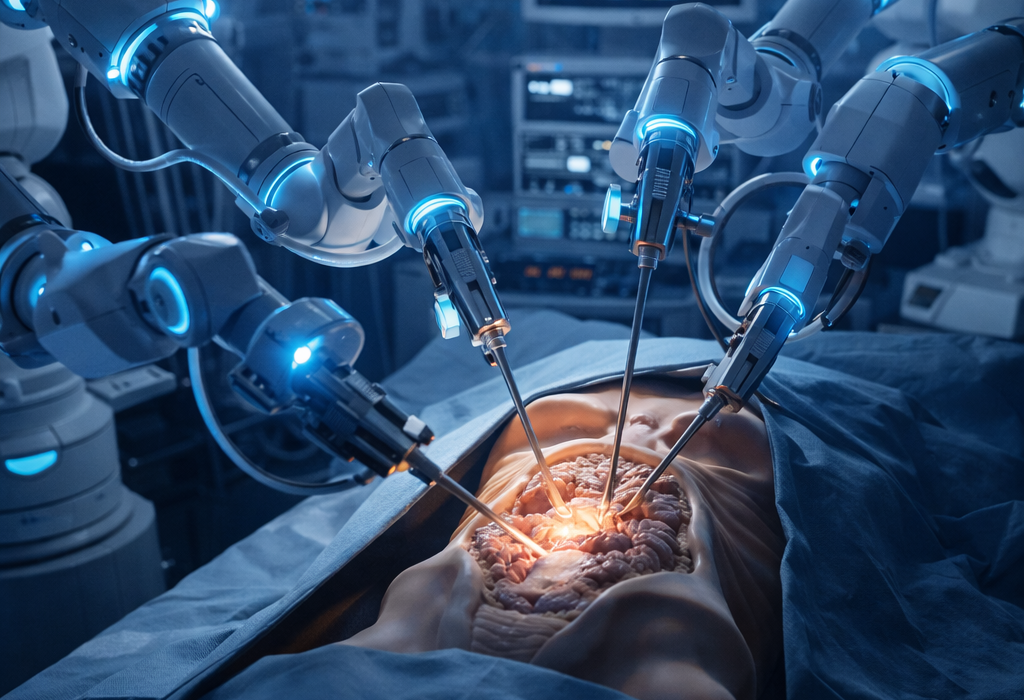
The landscape of modern medicine is shifting from the steady hands of human surgeons to the algorithmic precision of machines. Autonomous surgical robotics represents the pinnacle of this evolution—a leap from systems that merely assist a human (Level 1 autonomy) to machines capable of performing complex surgical tasks entirely on their own (Level 4 and 5 autonomy). While we have spent decades perfecting Robotic-Assisted Surgery (RAS), we are now entering a boundary-pushing era where artificial intelligence (AI) and computer vision allow machines to make real-time intraoperative decisions.
Key Takeaways
- Definition of Autonomy: Transitioning from “master-slave” systems to goal-oriented autonomous agents.
- The STAR Breakthrough: How the Smart Tissue Autonomous Robot (STAR) proved machines could outperform humans in soft-tissue suturing.
- The Safety Paradigm: Autonomous systems aim to eliminate human factors like fatigue, tremor, and cognitive bias.
- Integration Challenges: Ethical, legal, and regulatory hurdles remain the primary barriers to widespread adoption as of March 2026.
Who This Is For
This guide is designed for healthcare administrators looking to understand the ROI of surgical automation, medical professionals concerned about the future of their practice, med-tech investors tracking the next wave of innovation, and patients curious about the safety of “robot-only” procedures.
The Spectrum of Autonomy: Understanding the Levels
To understand where we are going, we must understand the hierarchy of surgical automation. Much like the automotive industry’s levels of self-driving capability, surgical robotics is classified into six distinct tiers.
Level 0: No Autonomy
The surgeon has complete control. Even if a robotic tool is used, it does not interpret data or provide feedback. It is a mechanical extension of the human hand.
Level 1: Robot Assistance
The system provides some mechanical support, such as steadying a tremor or providing enhanced visualization. The Da Vinci Surgical System, in its standard configuration, largely operates here, though it is moving toward Level 2.
Level 2: Task Autonomy
The robot can perform a specific, discrete task—such as suturing a small wound or drilling a specific hole in a bone—under the direct supervision of a surgeon. The human initiates the task and can stop it at any time.
Level 3: Conditional Autonomy
The system can perform a series of tasks and plan its own movements based on sensor data. However, a human must be present to approve the “plan” and intervene if the environment changes unexpectedly.
Level 4: High Autonomy
The robot can perform an entire procedure under the supervision of a surgeon. The machine makes decisions about how to navigate complex anatomical structures without step-by-step human prompts.
Level 5: Full Autonomy
The “holy grail.” A machine capable of performing a surgery from start to finish without a human surgeon in the room. This remains a theoretical and experimental goal for the coming decades.
The Technological Pillars of Autonomous Surgery
A robot cannot be autonomous if it cannot “see,” “feel,” and “think.” The transition to fully autonomous machine procedures relies on three core technological advancements.
1. Computer Vision and Spatial Awareness
In traditional surgery, the surgeon’s eyes interpret the field. In autonomous robotics, this is replaced by 3D light-field imaging and near-infrared (NIR) fluorescent marking.
As of March 2026, systems are utilizing advanced “SLAM” (Simultaneous Localization and Mapping) algorithms. These allow the robot to create a real-time digital twin of the patient’s internal anatomy. Because organs are not static—they move with breathing and blood flow—the robot must constantly recalibrate its map.
2. Machine Learning and Path Planning
The “brain” of the autonomous robot uses reinforcement learning. By analyzing millions of hours of surgical video, AI models learn the “optimal path” for an incision or a suture. Unlike a human, who relies on muscle memory and intuition, the robot calculates the path of least resistance to minimize tissue trauma.
3. Haptic Feedback and Force Sensing
One of the greatest challenges in surgery is the “feel” of the tissue. Is the thread too tight? Is the liver too firm? Autonomous robots use haptic sensors that can detect pressure at a level of sensitivity far exceeding human fingertips. This allows the machine to adjust its grip or tension in milliseconds, preventing accidental tears.
Milestones in Autonomy: The STAR System
The most significant benchmark in this field is the Smart Tissue Autonomous Robot (STAR). Developed by researchers at Johns Hopkins University, the STAR system successfully performed laparoscopic surgery on the soft tissue of a pig—specifically an intestinal anastomosis (connecting two ends of an intestine)—without human guidance.
Why this mattered: Soft tissue surgery is notoriously difficult for robots because it is unpredictable. Bones stay in place; intestines move, stretch, and slide. The STAR system’s ability to perform this task more accurately and consistently than seasoned surgeons was the “Sputnik moment” for autonomous medical robotics.
Benefits of Moving to Fully Autonomous Procedures
The push toward autonomy isn’t just about the “cool factor” of technology; it addresses systemic failures in global healthcare.
Elimination of Human Error
Human surgeons are subject to fatigue, stress, and physical limitations. A robot does not experience a hand tremor after a 12-hour shift. It does not get distracted by a conversation in the OR. By automating the mechanical aspects of surgery, we remove the “human variable” that leads to complications.
Democratization of High-End Surgery
Currently, the quality of a surgery depends heavily on the individual skill of the surgeon. A patient in a rural clinic may not have access to the same “star surgeon” as a patient in a major metropolitan hospital. Autonomous systems can “package” the skills of the world’s best surgeons into an algorithm, making elite-level surgical outcomes available anywhere the hardware can be shipped.
Enhanced Precision in Micro-Surgery
There are procedures—particularly in ophthalmology and neurosurgery—where the margin of error is measured in microns. Autonomous robots can operate at scales where human biology simply cannot compete.
The Ethical and Legal “Black Box”
As we move toward Level 4 and 5 autonomy, we face a crisis of accountability. This is often referred to as the “Black Box” problem.
- Liability: If an autonomous robot makes a mistake that leads to patient harm, who is responsible? Is it the surgeon who supervised? The software engineer who wrote the code? The manufacturer of the hardware?
- The Loss of Intuition: Critics argue that surgery is an art as much as a science. There are moments in an OR where a surgeon makes a “gut call” based on decades of experience. Can an algorithm ever truly replicate the “sixth sense” of a master clinician?
- Cybersecurity: A fully autonomous machine is a networked device. The risk of “med-jacking” (medical device hijacking) becomes a matter of life and death. Ensuring these systems are air-gapped or protected by quantum-resistant encryption is a mandatory step for adoption.
Common Mistakes in Implementing Surgical Robotics
Hospitals and surgical centers often stumble when transitioning to autonomous or semi-autonomous workflows. Avoiding these pitfalls is essential for patient safety and financial viability.
1. Over-Reliance on the “Cool Factor”
Many institutions purchase high-end robotic systems without a clear clinical need. A robot should only be used if it improves outcomes or reduces recovery time. Using an autonomous system for a procedure that a human can do faster and cheaper is a “technology-first” mistake.
2. Neglecting the “Human-in-the-Loop” Training
Even an autonomous robot needs a “pilot.” A common mistake is failing to train surgeons on how to intervene when the robot fails. If a surgeon loses their manual skills because they always rely on the robot, they may be unable to take over during a critical system error.
3. Ignoring Soft-Tissue Deformation
In the early stages of autonomous planning, developers often treat the human body like a rigid object. The “mistake” is failing to account for how tissue shifts during the procedure. Modern systems must include real-time elastic deformation modeling.
4. Underestimating Maintenance and Downtime
Autonomous robots are complex. A single sensor failure can mothball an entire OR. Hospitals often fail to budget for the specialized engineering staff required to keep these machines calibrated.
The Regulatory Landscape (As of March 2026)
Regulatory bodies like the FDA (U.S.) and EMA (Europe) have had to rewrite the playbook for autonomous medical devices.
In 2024, the FDA introduced the “Predetermined Change Control Plan” (PCCP) for AI-based devices. This allows a robot’s software to “learn” and update itself after it has been cleared for market, provided the manufacturer follows a strict, pre-approved framework. This was a massive win for autonomy, as it allows machines to get smarter with every surgery they perform.
However, as of March 2026, the FDA still requires a “Human-in-the-Loop” for Level 3 and Level 4 procedures. We are not yet at the point where a robot can operate without a licensed surgeon present in the room, or at least connected via a high-speed (6G/Fiber) link.
Future Outlook: The Next 20 Years
What does the “Era of Fully Autonomous Machine Procedures” look like by 2045?
Nano-Robotics and Micro-Autonomy
We will likely see a shift from large, multi-armed gantries to swarms of autonomous micro-bots. These bots could be injected into the bloodstream, navigate autonomously to a tumor site using chemical sensors, and perform “surgery” at a cellular level.
The “Surgical Autopilot”
Just as modern commercial pilots spend most of their time monitoring systems rather than “flying” the plane, surgeons will become “mission commanders.” Their role will shift from manual labor to high-level decision-making and crisis management.
Space and Remote Medicine
Full autonomy is the only way to perform surgery in deep space. With the latency of communication between Earth and Mars, a remote-controlled robot is impossible. A Level 5 autonomous robot will be a mandatory component of any long-term lunar or Martian colony.
Conclusion: Preparing for the Autonomous Shift
The transition to autonomous surgical robotics is not a matter of “if,” but “when.” We have already proven that machines can suture more accurately than humans and that AI can detect tumors that the human eye misses. The “Era of Fully Autonomous Machine Procedures” promises a world where surgical complications are rare, and life-saving care is no longer a geographical lottery.
However, this future requires a balanced approach. We must embrace the precision of the machine while maintaining the ethical oversight of the human. For healthcare providers, the next step is not just buying the latest robot, but investing in the digital infrastructure—the data pipelines and cybersecurity—that makes autonomy possible.
For patients, the “robotic future” is one of greater safety. While the idea of a machine holding the scalpel may be daunting, the data consistently shows that when machines and humans work in a high-autonomy partnership, the patient wins.
Next Steps for Stakeholders:
- For Surgeons: Focus on mastering “supervised autonomy” and AI data interpretation. Your value will shift from manual dexterity to clinical judgment.
- For Hospital Admins: Conduct a “robotics audit” to see where Level 2 and Level 3 autonomy can currently reduce bed-occupancy times.
- For Developers: Prioritize “explainable AI” (XAI). Regulators and surgeons need to know why a robot chose a specific path.
FAQs
1. Can an autonomous robot be hacked during surgery?
While theoretically possible, surgical robots operate on highly secure, often localized networks. Modern systems use end-to-end encryption and “fail-safe” mechanical locks that freeze the robot in a safe position if a security breach or connection loss is detected.
2. Will robots eventually replace human surgeons?
It is unlikely that human surgeons will be replaced entirely. Instead, their roles will evolve. Humans will focus on diagnosis, pre-operative planning, and complex decision-making, while robots handle the repetitive and high-precision physical tasks.
3. How does the robot know if something goes wrong?
Autonomous robots use “anomaly detection” algorithms. If the sensor data (e.g., blood pressure, tissue resistance, or visual cues) deviates even slightly from the expected surgical plan, the robot is programmed to pause and alert the human supervisor.
4. Is autonomous surgery more expensive for the patient?
Initially, the capital cost of the equipment is high. However, autonomous surgery aims to reduce costs in the long run by shortening surgery times, reducing complications, and minimizing the length of hospital stays.
5. Has a fully autonomous surgery been performed on a human?
As of March 2026, parts of procedures (like suturing or bone cutting) are performed autonomously, but a full “start-to-finish” autonomous surgery on a human has not yet replaced the standard supervised model in clinical practice.
References
- Johns Hopkins University (The STAR Project): “Autonomous Antimesenteric Superior Mesenteric Artery Surgery in Soft Tissue.” Science Robotics.
- Intuitive Surgical: “The Evolution of the Da Vinci Ecosystem: Toward Digital Surgery.” Annual Corporate Report 2025.
- FDA (Food and Drug Administration): “Marketing Submission Recommendations for A.I./M.L.-Enabled Medical Devices.” (Updated Jan 2026).
- The Lancet Digital Health: “A Comparative Study of Human vs. Autonomous Robotic Accuracy in Laparoscopic Tasks.”
- IEEE Xplore: “Haptic Feedback and Sensor Fusion in Autonomous Medical Systems.”
- Mayo Clinic Proceedings: “The Role of Artificial Intelligence in the Future of the Operating Room.”
- Nature Biomedical Engineering: “Closed-loop control in robotic surgery: Challenges and opportunities.”
- Harvard Medical School: “Ethics of AI in Healthcare: Who takes the blame when the machine fails?”
- MIT Technology Review: “Why the future of surgery is autonomous.”
- Journal of Medical Robotics Research: “Levels of Autonomy in Medical Robotics: A New Standard.”